
Donald Trump recently boasted that he would be “taking Cuba”. Describing it as a beautiful island with great weather, he said: “They’re not in a hurricane zone, which is nice, for a change they won’t be asking us for money for hurricanes every week.” That comment was not only factually incorrect - Cuba does suffer from hurricanes – it was also a dig at Cuba’s smaller twin, Puerto Rico, which he claimed during his first term had wanted “everything to be done for them” after Hurricane Maria had killed 2,975 people and destroyed the island’s infrastructure.
Trump’s attitude is like a parody of Rudyard Kipling’s most famous poem, “The White Man’s Burden,” which is apt because the poem was written to celebrate the US annexation of the Philippines, Guam, Cuba and Puerto Rico from Spain in 1898. In portraying Empire as a thankless task, Kipling wrote that America would not find its “new-caught sullen peoples” very grateful and would have to accept the “old reward” of “the blame of those ye better, the hate of those ye guard, the cry of hosts ye humour.”
The US did not, at the time, risk Cuban wrath and gave them nominal independence. Filipinos mounted fierce resistance to US rule but did not gain independence until 1946. Both Guam and Puerto Rico are still US possessions for reasons that are obvious from a glance at an atlas: they are priceless military outposts guarding the world’s two great oceans.
My father, Brandon Howell, lived in Puerto Rico in the 1940s. He had gone there to work for Rexford Tugwell, the close ally President Roosevelt appointed to introduce New Deal reforms after previous governors had used deadly force to crush nationalist protests in the 1930s. In the freer climate of Tugwell’s liberalism and with the US and Soviet Union being allies against Hitler, my father evidently thought nothing of combining his official duties as a planning official with extra-curricular activities for Puerto Rico’s communist-led unions. The FBI had been spying on Puerto Rican activists since the 1936, but the only precaution Brandon took was to use the pen names Pepe and Diego Munoz for cartoons he produced for union and communist publications (see the example below with the FBI laboratory’s label on it).
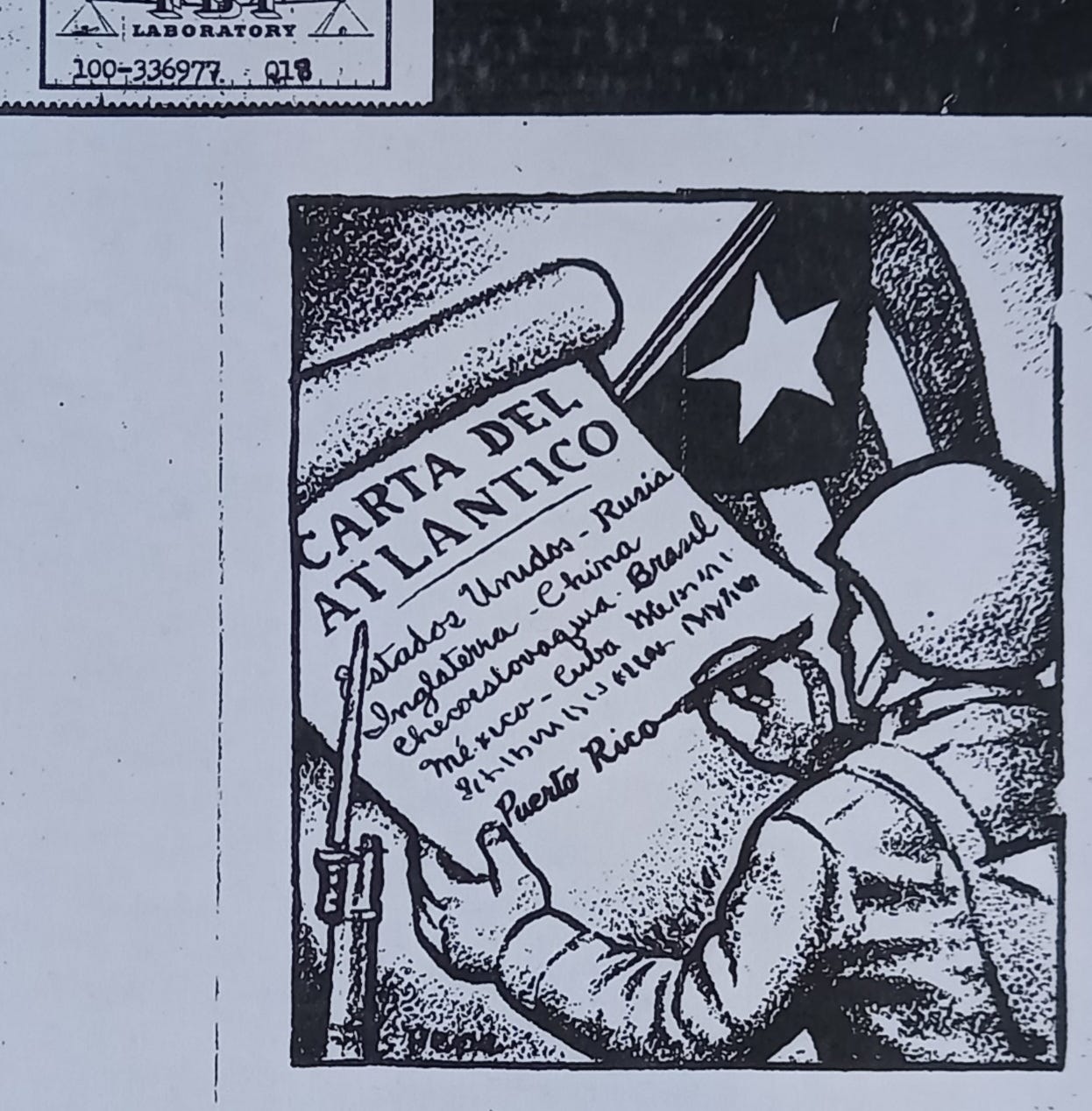
Despite the repression of the 1930s, hopes for independence were rising. Roosevelt and Winston Churchill had signed the Atlantic Charter in 1941 committing themselves to “respect the right of all peoples to choose the form of government under which they will live.” But it would soon become clear that what Washington had in mind was independence for – and access to – Britain’s colonies, not freeing its own. Tugwell made this explicit in 1945 by claiming that the island “could not exist alone” and saying that, in any plebiscite on its future status, “fairness to everyone requires that the Congress offer the choices it is willing to accept rather than to require that Puerto Ricans should petition for status with the risk of rejection.”
At the heart of the issue was Puerto Rico’s value to Washington as a fortress from which to enforce its domination of the Western Hemisphere. The US military presence on the island had expanded dramatically during the 1940s with the construction of the Roosevelt Roads naval base and the expropriation of most of the nearby islands of Vieques and Culebra to serve as bombing ranges. They would be vital assets in the wars and interventions that were to come – including, most recently, for the attack on Venezuela to kidnap its President Maduro.
Somehow the US had to appear to decolonise Puerto Rico while actually retaining control of it. But this required a credible indigenous advocate with the means to suppress those who dissented. By 1948, those ingredients were in place: Puerto Rico’s pre-eminent politician, Luis Muñoz Marín, was already advocating a solution that fell short of independence and had in his back pocket what became known as the Gag Law to deal with troublesome opponents. Washington seized its chance to allow Puerto Ricans to elect their own governor confident Muñoz Marín would win and open negotiations for what he called a ‘free association’ that devolved some powers without changing the island’s status as an unincorporated US territory. It would allow Washington to have the final say on everything, but Puerto Ricans were not to be given a vote in US elections because that would negate the pretense of de-colonisation.
In 1950, with negotiations on Puerto Rico’s status reaching a critical stage, a pre-emptive revolt by nationalists was crushed by US National Guards and followed by Muñoz Marín using the Gag Law to round up supporters of independence, regardless of whether or not they had participated in the uprising. Two years later, even as a ‘free association’ deal with Washington was being sealed in a take-it-or-leave-it referendum, dozens of its opponents were still incarcerated.
Meanwhile, the island’s communists presented Hoover and Muñoz Marín with a different difficulty because they supported independence but opposed the insurrectionary tactics of the nationalists. In March 1954, after four nationalists had fired guns in the US Capitol Building in Washington - injuring five members of Congress - Muñoz Marín had ten communist leaders arrested. But he soon had to release them because there was no evidence whatsoever connecting them to what had happened.
This was a turning point that led to the repressive tools commonly associated with “McCarthyism” being openly and directly used in Puerto Rico. Later the same year, Hoover sent his agents out to round up eleven Puerto Rican communists, including eight of those arrested the previous March, in order to indict them under the Smith Act, the US legislation on which the Gag Law was based.
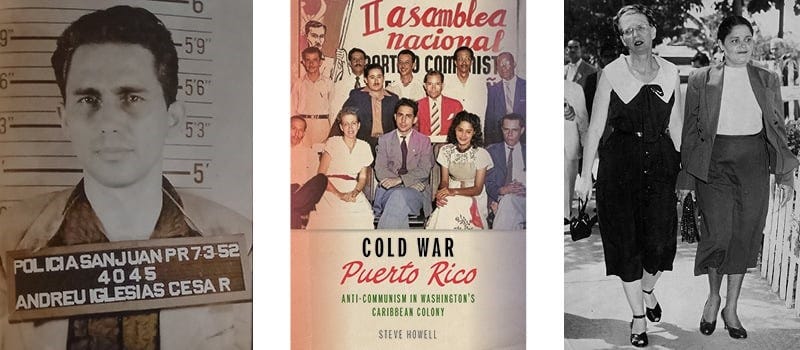
Above: Left - César Andreu Iglesias on one of the four occasions he was arrested and imprisoned; Right - Jane Speed de Andreu and Consuelo Burgos de Saez Corales handcuffed together on their way to the Federal courthouse in San Juan for a Smith Act hearing.
This use of a US statute only served to underline just how lacking in autonomy the island really was. Over the following three years, the defense lawyers - who were not themselves communists - would repeatedly challenge the indictments on this politically sensitive point until eventually, as if to amplify the irony, the charges were dropped because the US Supreme Court had issued an interpretation of the Smith Act that rendered successful prosecution unlikely.
Hoover was not ready, however, to give up his mission to crush Puerto Rico’s Communist Party along with any remaining organized support for independence. As the Smith Act prosecutions were collapsing, and with Muñoz Marín sidelined, he set his agents to work investigating who should be subpoenaed to appear at hearings of the House Committee on Un-American Activities (HUAC) on “Communist Activities among Puerto Ricans,” which his conservative allies in Congress dutifully scheduled for November 1959.
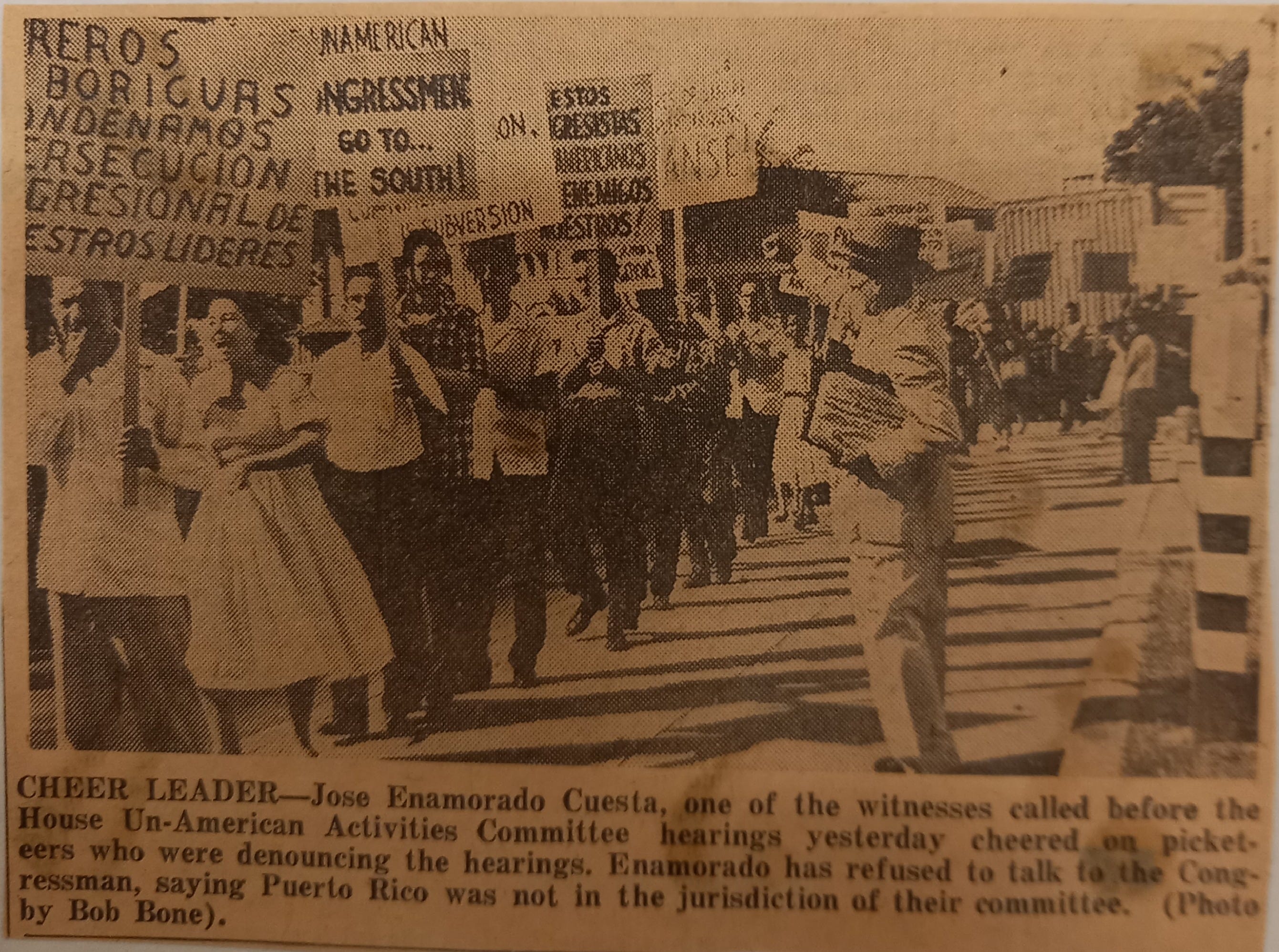
HUAC’s decision to sit for three days in San Juan caused an outcry, with prominent figures across the political spectrum arguing that it did not have jurisdiction in Puerto Rico. Once underway, HUAC met with what Clark Foreman, a civil rights advocate and director of the Emergency Civil Liberties Committee, called “the most unified and absolute resistance” in the committee’s history. Having cut short its proceedings on the final day, HUAC left the island to face headlines in the US saying they had been humiliated. Nevertheless, instead of heeding the sensitivities about Puerto Rico’s status, they ploughed on with securing a congressional decision to cite the thirteen witnesses for contempt the following year. But that tactic also failed when, nearly three years after the hearings, a federal court ruled that Congress had not explicitly included Puerto Rico in HUAC’s remit, while conveniently leaving intact the principle that it could have done so.
Finally, having found legal channels unproductive, Hoover turned to covert action. In 1960, he decided that Puerto Rico would be a test bed for extending COINTELPRO, a program developed four years earlier to disrupt and divide what remained of the US Communist Party. The fact that the island was chronologically the second target of COINTELPRO reflected the concern in Washington about what one FBI memo called the “increasing boldness” of the independence movement and the “courage given to their cause by Castro’s Cuba.” From this point on, he would not be content with “mere harassment” but wanted the FBI to “disrupt the activities of these organizations” by sowing division and conflict.
My father left Puerto Rico in 1948 and opted to leave the US altogether in 1949 to take a job at the University of Liverpool, but he stayed in touch with Puerto Rican friends such as César Andreu Iglesias and Jane Speed, who were both imprisoned multiple times in the 1950s and were among the eleven communists indicted under the Smith Act. When I was growing up in London, he often talked about his life there in the 1940s and old friends from that time, including César, would visit us. But it was only after he died in 1987 that I discovered how heavily involved politically he had been from papers he left behind.
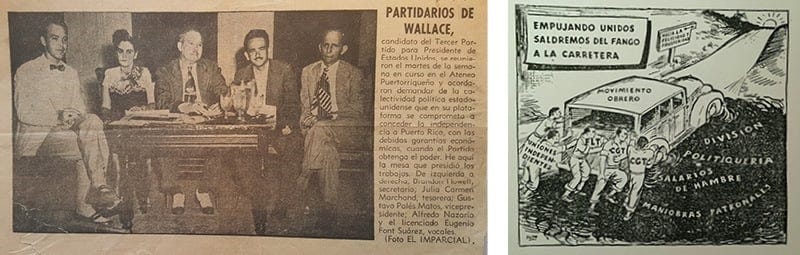
After visiting San Juan myself in 2007, I started researching this in earnest. I made contact with Leila and Nico Andreu, I obtained - after a battle and on appeal - FBI files revealing he’d been under surveillance for 30 years, and I visited archives at UC Berkeley (where he’d studied), in San Juan (on a second visit), in New York (at Columbia and the Center for Puerto Rican Studies) and at Liverpool University.
Much to my surprise, I discovered that histories of Cold War repression and COINTELPRO either do not mention Puerto Rico at all or relegate it to a footnote or passing reference. This neglect helps feed the idea that Puerto Rico’s status – which has not changed since 1952 – is a product of ‘consent’. In writing Cold War Puerto Rico, I hope to have made a small contribution to correcting that perception.
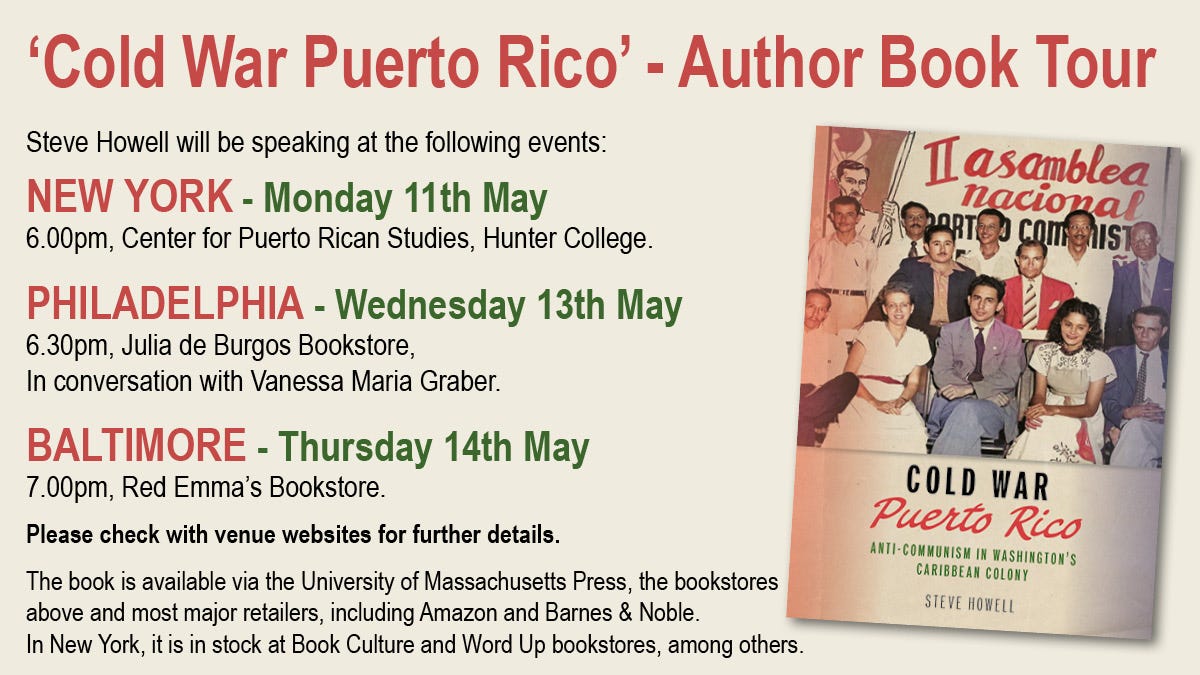
Cold War Puerto Rico is now available in paperback via the publisher - the University of Massachusetts Press - and all major retailers at the RRP of $34.95. I have limited stock available at the special offer price of £20 including postage (but this applies to orders from Britain and Ireland only due to US tariffs and other costs). - see below.
Britain and Ireland only: Cold War Puerto Rico in paperback at the author’s special offer price of £20.00 including postage ORDER
From any country: Cold War Puerto Rico in paperback at $34.95 plus postage via the publisher ORDER
From any country: Cold War Puerto Rico in paperback or Kindle via Amazon ORDER
“An engaging and important historical contribution.” - Sandy Plácido, Associate Professor, Rutgers-Newark
“Most histories of McCarthyism ignore Puerto Rico. Most histories of the Puerto Rico independence movement focus on the Nationalist current. Steve Howell’s book makes a major contribution to filling these gaps.” - Rafael Bernabe, author of Obstinate Star: a History of the Puerto Rico Independence Movement.
“What Steve’s done here is shine a light on a story that’s far too often brushed aside. Puerto Rico’s struggle isn’t just some footnote to Cold War history; it’s about real people whose lives were torn apart for daring to stand up against colonial rule…Anyone who cares about justice and democracy should read this book.”- Maryam Eslamdoust, General Secretary, TSSA Union.
“This deeply researched and expertly written account of red scare politics in Puerto Rico offers an impressively panoramic yet surprisingly intimate portrayal of mid-twentieth-century U.S. colonialism and anti-communism.” - Dr Hugh Wilford, author of The CIA: An Imperial History, Professor of U.S. History, California State University, Long Beach
No posts
Comments
Nothing yet. Say the first thing.
Sign in to join the conversation.