
Some of you will be familiar with the 1982 novel, A Very British Coup, by Chris Mullin, who became an MP five years later. The book’s protagonist prime minister, Harry Perkins, was a left-winger who wanted to withdraw from NATO and close the US bases in Britain. It isn’t a spoiler to tell you that his plan met strong opposition from within the parliamentary Labour party, the intelligence services and the military. The plot is, pardon the pun, spookily like what happened thirty years later to Jeremy Corbyn - without him even getting the keys to Downing Street.
The Keir Starmer version of the story departs from Mullin’s original in that he had no intention of challenging the status quo. Those we colloquially call ‘the powers that be’ had every reason to think they had in Sir Keir a man who would obligingly deliver whatever was expected of him. The trouble was that on one big issue – arms spending - he wouldn’t bow fully to their demands and on another – the Mandelson affair – he had become a liability who even picked a fight with one of their own, Olly Robbins.
Starmer’s unpopularity was a product of many factors, from policies that punished pensioners, the disabled and children to his penchant for freebies and nice suits. He angered Left MPs by suspending dissident backbenchers and lost support from MPs hand-picked for loyalty by putting their seats at risk. They probably were going to oust him this summer without any external assistance.
But was there more going on than met the eye? The powers-that-be appear, at some point, to have decided that Starmer had to go, but they could not leave the choice of a successor to chance. The possibility of a leadership election in which hundreds of thousands of individual and affiliated Labour members would have a vote was unthinkable. Even though a rule change had raised the percentage of Labour MPs needed for someone to be nominated, there was still a possibility of a politician who would not completely toe the line becoming a candidate, winning the election and inheriting a massive parliamentary majority.
To those who think this is the stuff of fiction, I would acknowledge that the evidence of a plot by ‘the national security state’ – as they themselves call it - is circumstantial. But I think the pattern of events is too convenient for co-ordination between senior national security figures and their close political allies to be ruled out as a decisive factor in easing Starmer out and ensuring a smooth, vote-less transition to a successor who would accept their objectives.
Their main bone of contention with Starmer was arms spending. The announcement by Rachel Reeves in the Budget that annual defence spending would increase from £53.9 billion under the Conservatives in 2024-25 to £75.1 billion in 2029-30 did not go far enough for them. The first shot across Starmer’s bows came in January when an anonymous Ministry of Defence ‘source’ told The Times and The Sun that Britain’s armed forces would not be “war ready” by 2030 unless more was spent. They claimed that an extra £28 billion over four years was needed in a new Defence Investment Plan to meet their goals (see my previous Substack pieces for more detail).
Soon afterwards, Starmer’s position was severely weakened, first, by the arrest on February 4 of the man he had appointed British ambassador to Washington, Peter Mandelson, and then on February 26 by the Green Party grabbing a seat from Labour in the Gorton & Denton by-election. Labour had not been above 20% in the polls since October, and Starmer had become the least popular prime minister since the advent of ‘voter satisfaction’ polling in the 1970s. Just as the tea rooms of Westminster were buzzing through March and into April with discussion of a possible leadership contest, the issue was bound to have been exercising the minds of top officials in the security state.
Assuming Starmer was desperate to save himself, the sacking of Olly Robbins, the top official at the Foreign Office, as a scapegoat for his own decision to appoint Mandelson was hardly likely to have helped his cause in those circles. Robbins was one of their own. Having been the Cabinet Office director of intelligence under Tony Blair and Gordon Brown, David Cameron appointed him deputy national security adviser, a role in which he helped create a US-style national security council and bullied the Guardian into curtailing its reporting of material leaked by Edward Snowden on US and British intelligence agencies.
Meanwhile, the military lobby’s scaremongering continued apace. On April 9, the media reported a claim by the Defence Secretary, John Healey, that three Russian submarines had been trying to spy on the UK pipelines and underwater cables “while the world was distracted by Iran.” The submarines, it turned out, were in the North Atlantic and the threat to cables around Britain’s coast was hypothetical.
Only four days later, a ghost from wars past entered the fray. George Robertson, who was NATO secretary general at the time of the invasions of Iraq and Afghanistan and who Starmer had brought back as a defence adviser, leaked to the Financial Times the text of a lecture he was due to give in which he accused Starmer and Rachel Reeves of “corrosive complacency” on defence, claimed “national security and safety is in peril” and said “we cannot defend Britain with an ever-expanding welfare budget.” The following week, three Tory former defence secretaries – Ben Wallace, Malcolm Rifkind and Penny Mordaunt – weighed in behind him.
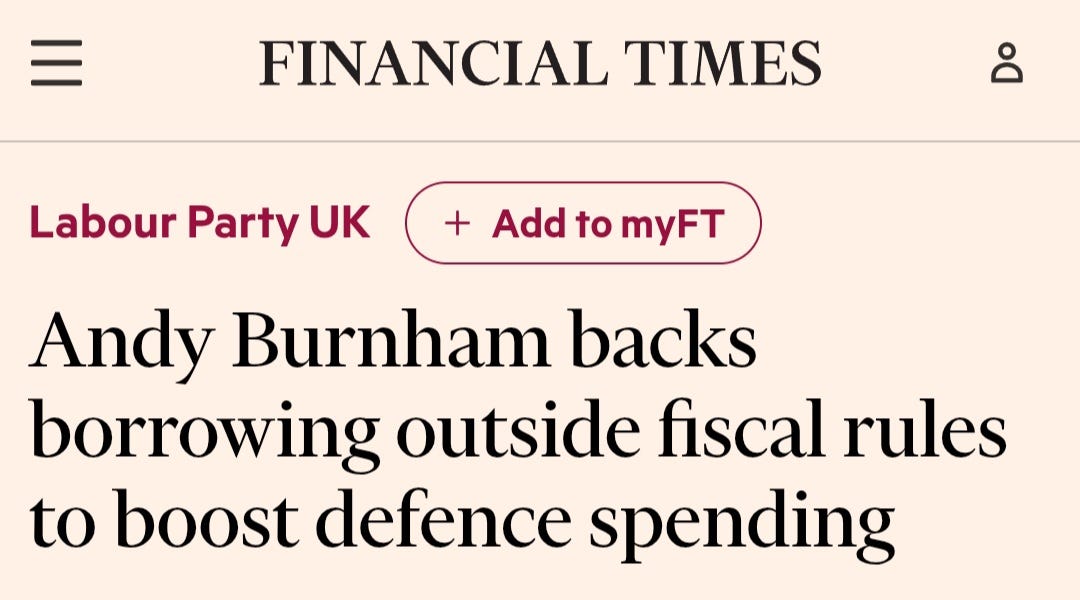
Through all this, Andy Burnham was positioning himself as Starmer’s natural successor. Some on the left saw the Greater Manchester mayor as a potential saviour, convinced that he had left his Blairite past behind. While playing to that gallery, with rhetoric about Britain being on “the wrong path for forty years,” Burnham also signalled that - unlike Starmer - he would be amenable to giving military chiefs the money they wanted. In an interview with the financial news agency Bloomberg on April 29, which was covered by most of the media, he floated the idea of treating defence spending “exceptionally outside of the (fiscal) rules.”
Labour’s disastrous local elections results on May 7 increased the chances of Starmer being forced out. However, Burnham still appeared to be no nearer to solving his problem of not being an MP. The party had blocked him from standing in Gorton & Denton and no other by-elections were in the pipeline. Or so we thought, until something seemingly unthinkable happened: on May 14, one of the operatives behind Starmer’s rise – Josh Simons - facilitated his demise by announcing that he would be resigning as MP for Makerfield.
Simons was the director of pro-Starmer factional vehicle, Labour Together, from 2022 to 2024, earning him the reward of a safe Labour seat and a junior ministerial role. Revelations that in 2023 he had hired a public affairs agency to investigate Paul Holden and other journalists who were exposing Labour Together’s funding irregularities had forced him to stand down from the government, but only a week before the local elections Starmer’s ethics adviser had cleared him of any breach of the Ministerial Code after a cursory inquiry. That had left him well placed to return to government. So why would Simons suddenly forego his promising political career to help the person trying to bring Starmer down? The answer would later become clear.
In the meantime, as the manoeuvres in Makerfield were unfolding, senior government figures continued to intensify the pressure on Starmer over the arms budget.
· On May 16, Jonathan Powell, who was Blair’s cabinet secretary for ten years and had been appointed by Starmer as national security adviser, turned on his nominal boss by letting it be known to The Times that Britain “would struggle to maintain its position on the world stage without a significant increase in (defence) spending.”
· On May 24, Healey claimed to The Times that the RAF jet carrying him back from visiting British troops in Estonia had been “hit by an electronic warfare attack after flying near the Russian border.” The BBC recycled the story saying the plane’s GPS was jammed, which is probably what the UK would do if a Russian military plane was sighted off the white cliffs of Dover.
· On May 31, Healey was at it again with scaremongering reminiscent of the pretext for the Iraq war. Under the headline “Fears Russia could threaten the Artic and put London within range of hypersonic missiles,” the iNewspaper quoted him saying that Russia poses the “greatest threat to Arctic and High North security since the Cold War.” The Express carried the same story saying “sources say nukes could reach London in just 8 minutes.” Of course, a large part of Russia is actually in the Arctic, and Russian nuclear armed missiles have been able to reach London for decades (it’s called Mutually Assured Destruction), but Healey was happy to exploit people’s fears for his own warmongering and personal ends.
Much to the incredulity of most Labour members, the media also began touting Healey as a potential successor to Starmer. For Powell, Robertson and co, the Defence Secretary would undoubtedly have been the safest pair of hands. But, unlike Burnham, he would not command the broad support of Labour MPs needed to avert a leadership election. The next best thing was for him to be kingmaker to whom Burnham would be indebted.
Healey’s resignation on June 11, only a week before the Makerfield by-election, in which Burnham was now the Labour candidate, made certain that Starmer’s premiership was doomed. Sure enough, after Burnham won Makerfield – aided by tactical voting – it took only four days for Starmer to reach that conclusion and then only three more weeks for Burnham to garner the MP nominations he needed to ensure no one else could gain enough to force a contest.
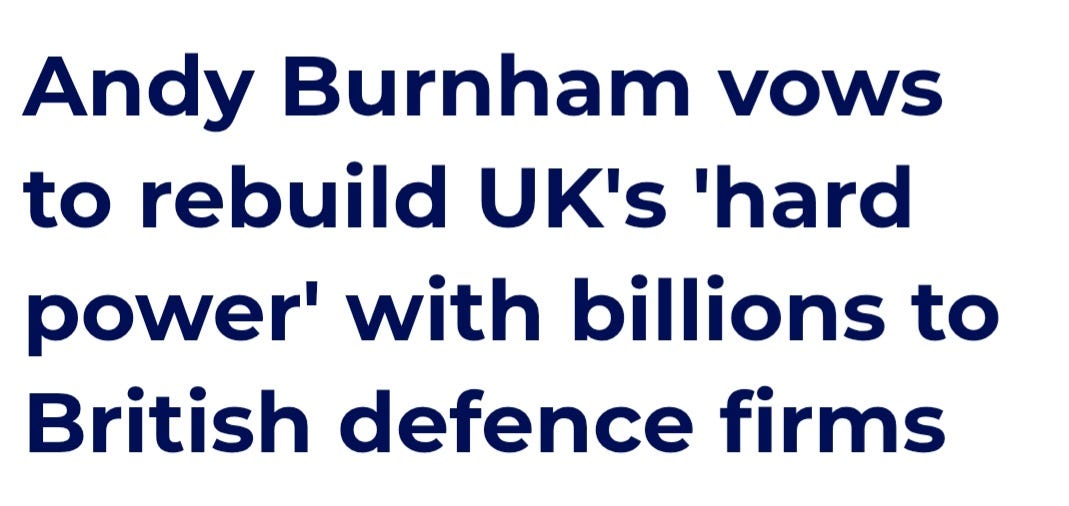
During that interregnum, the former chief foreign policy adviser to four prime ministers, John Bew, warned Burnham to resist pressure from Labour MPs to focus domestic issues. In a revealing sentence, he added that there would be no need to worry if Burnham did take his eye off the ball because “the good news is that the British national security state – the agencies, senior officials, the military – is actually extremely professional comparatively.” Reassuringly for Bew, Burnham confirmed that he understood his brief. On July 8, he told The Times that he was on a mission to “rebuild Britain’s hard power to face a darker world.”
The top officials and officers of the national security state must have been delighted with the outcome. The lottery of a leadership contest had been avoided. Burnham was saying what they wanted to hear. Their man Healey had gained leverage by playing Judas. The two of them had been “talking regularly” (though only “since Makerfield”, Healey claims). And, once in Downing Street, Burnham handed him the Chancellor’s job, complete with a military adviser based in the Treasury for the first time.
Within forty-eight hours of taking office, Burnham was describing Healey’s appointment as a “signal of intent” on arms spending and was heading off the Farnborough Airshow to tell assembled arms companies – including several from Israel – that he would raise military spending to levels not seen since the end of the Cold War, even at “an opportunity cost” for other services.
So, was this all the product of a coup or just of a set of circumstances that were fortuitous for the national security state? The answer is probably a combination of the two. Coups – like revolutions - require favourable conditions. There is no doubt that Starmer had dug his own grave. His days as prime minister were numbered anyway, but his stubborn refusal to bow to all the demands of the Ministry of Defence made an enemy of people with far more media and Whitehall muscle than the Labour backbenchers he had been trying to pacify. It is inconceivable that national security big hitters like Robertson and Powell would move publicly against a sitting prime minister without clearing their lines. And, in Healey, they had a front man who could rally the support of Labour MPs on the Right who might otherwise be nervous about Burnham’s gambit of tacking left. His resignation ensured Starmer’s departure while smoothing the passage to a successor who would be even more malleable.
An intriguing question is the part played by Simons. I find it inconceivable that he acted alone and without an agenda in deciding to resign. Though the talk of him becoming Burnham’s policy adviser came to nothing, Burnham has appointed Alison Phillips, Simons’s successor as director of Labour Together, as the Downing Street deputy chief of staff. Clearly, the change of leadership has not eliminated the influence of that faction – indeed, they also funded Healey’s role as Shadow Defence Secretary to the tune of £39,216. Two perfectly-timed resignations is too much of a coincidence.
Was Burnham in the loop? Possibly not to begin with. It may be that he was simply the grateful recipient of any support coming his way, rather than in the thick of the conspiracy itself. He had craved being prime minister for years and must have relished the constant undermining of Starmer and the surprisingly favourable media coverage given to him. After winning Makerfield, he clearly knew who he had to keep onside and made a bee line for Healey.
In a sense, it doesn’t matter whether or not there was “a concert party”, as such things are called in financial circles. What matters is the substance: we now have a prime minister who has made clear that he will do the bidding of the national security state to a greater degree even than Starmer - who seems to have been surprisingly naïve about prime ministers serving at their pleasure. The Burnham administration is not therefore a shift to the Left but a boost for the arms lobby with very costly consequences for services, benefits and pensions and deadly risks for those in the firing line of yet more wars. Recognition of that is the first step towards resisting it. Andy is not our friend.
My new book, ‘Cold War Puerto Rico: Anti-Communism in Washington’s Caribbean Colony’, published by the University of Massachusetts Press, is now available.
For orders in Britain and Ireland only, Cold War Puerto Rico in paperback is available at the special offer price of £20.00 including postage via my website (which has a PayPal/credit card facility) ORDER
From any other country, Cold War Puerto Rico in paperback or Kindle can be ordered through most bookstores, via the publisher or on Amazon ORDER
“What [Howell] uncovered, and presents capably in this rich and informative work, is the story of Puerto Rico’s struggle for autonomy and the American repression that repeatedly smothered it, all while claiming to uphold the principles of international self-determination. . . . Howell’s story of state surveillance and suppression—and of the costs Washington is willing to incur to hold a Caribbean stronghold—is more instructive now than ever.” - Jacobin

No posts
Comments
Nothing yet. Say the first thing.
Sign in to join the conversation.