
John Healey has been ramping up the rhetoric on military spending for months. Now he has resigned as Defence Secretary because Keir Starmer and Rachel Reeves won’t spend as many extra billions as he would like.
To be clear, a huge hike in spending was already planned. Reeves’s Budget last November made provision for defence spending to rise in 2026-27 by 8.43% to £90 billion, compared to a 6.14% increase for health and the allocation for education shrinking by 0.68%. Alongside this, the government’s six-year capital spending programme allocates £166.4 billion to military hardware, nearly quadruple the amount for education (£43.8 billion) and double the spending on the NHS and social care (£82.9 billion).
However, this was not enough for Healey, the military top brass and assorted arms lobbyists. Soon after the Budget, they started planting claims in the media of a £28 billion ‘black hole’ in military spending accompanied by scare stories about Russian submarines lurking in the Atlantic and missiles being able to hit London (both of which have been the case for decades, just as Britain has submarines in the Black Sea and missiles that can hit Moscow).
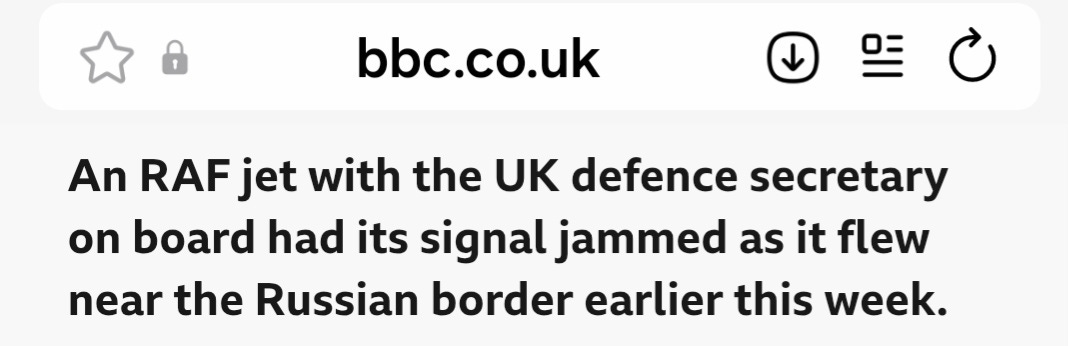
To add spice to this propaganda-dressed-up-as-news, Healey made a personal appearance in the drama when a story was leaked to The Times claiming that an RAF plane carrying him back from visiting troops in Estonia three weeks ago had its signals jammed as it flew ‘near’ the Russian border. The Times blamed Russia, while the BBC recycled the story with the caveat that Russia was only “believed to be behind the attack.” Neither explained why Healey’s plane needed to fly so close to Russia’s border or acknowledged that Britain would undoubtedly react in a similar way if a Russian military jet carrying its defence minister flew near the white cliffs of Dover.
So, does the lobbying for more arms spending really have anything to do with a Russian threat? Both Keir Starmer and Healey claim that “there could be an attack by Russia on NATO as early as 2030.” But are we seriously supposed to believe that Russia wants to take on NATO when it is stuck in a virtual stalemate in Ukraine, its cities and infrastructure are being struck daily by Ukrainian drones, and its relatively small economy is already under severe strain from sanctions?
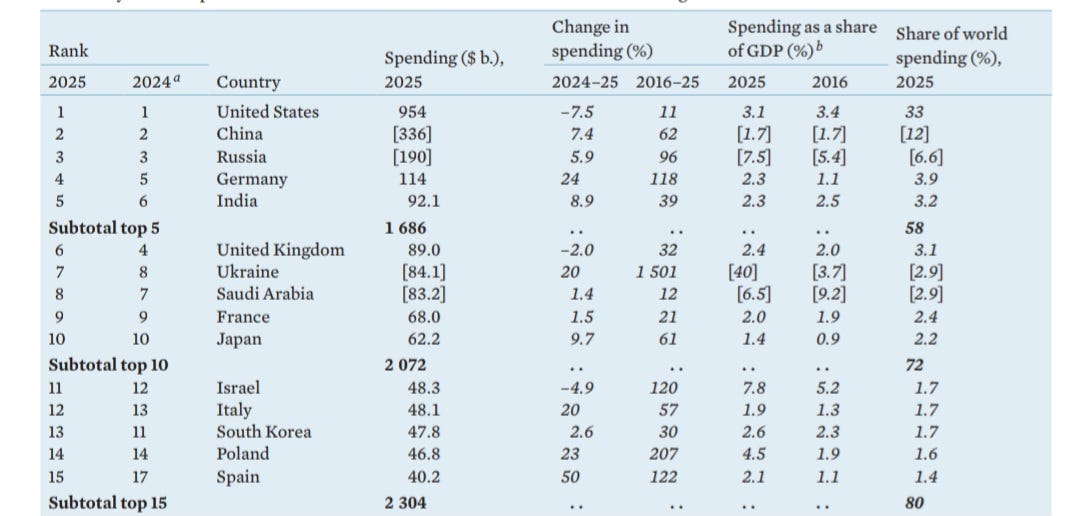
In April, the Stockholm International Peace Research Institute (SIPRI), which was established in 1966 and is widely respected as an independent source, released its annual review of global military spending. The SIPRI data for 2025 shows that the six leading European countries in NATO already spend more than twice as much as Russia on defence. Even though Russia has increased its spending to $190bn because of the Ukraine war, it is still being heavily outspent by the UK, Germany, France, Italy, Poland and Spain ($406bn). And this is before allowing for the fact that the US, despite Trump’s rhetoric, is only planning to withdraw 5,000 of the 58,000 troops it has stationed in Germany, Italy and the UK. Whatever one thinks of Russia, it is stretching credulity to suggest that its leaders – whoever they are by 2030 – would want a war with the West on these terms. There have to be other reasons for the pressure for higher military spending.
One of them is undoubtedly the fact that supplying the hardware for war is a lucrative business. Britain’s major arms companies have seen their share prices go sky high in recent years as they profit from supplying Ukraine at our expense. Why wouldn’t they want this to continue? They have their sights on making more missiles, drones, combat aircraft, naval vessels and armoured vehicles. However, as capitalists in a capital-intensive industry, they won’t invest in extra capacity without the certainty of a long-term order book. It is therefore no coincidence that Healey is resigning over the scale of a ten-year investment plan (a time-period that, incidentally, bears no relation to the claim that Russia could attack in four years).
The interests of the arms companies are unlikely, however, to be the only factor driving arms spending higher. Strategists who tend to call the shots within our elite also appear to be beavering away, anxious to ensure that Britain continues to be able to mount foreign military interventions, with or even without US involvement. Jonathan Powell, who was Tony Blair’s chief of staff from 1997 to 2007 and is now Starmer’s national security adviser, let it be known recently that he thinks Britain “would struggle to maintain its position on the world stage without a big increase in spending.” Similarly, the former foreign secretary William Hague has bemoaned as “shocking” how the Iran war had exposed that we have “little help to give” the US.
Hague was, of course, ignoring the fact that the US would have had great difficulty blitzing Iran as it has without being able to use its bases in Britain and Britain’s bases in Cyprus and Diego Garcia (Mauritius). Nevertheless, his comment does go to the heart of the problem from the elite’s point of view. The rhetoric may be about the imminence of a Russian threat, but the government’s Strategic Defence Review published last year talks about “shaping the global security environment” and specifies the Middle East and the Indo-Pacific as “priority regions.” Even its sub-title – ‘secure at home, strong abroad’ – gives the game away.
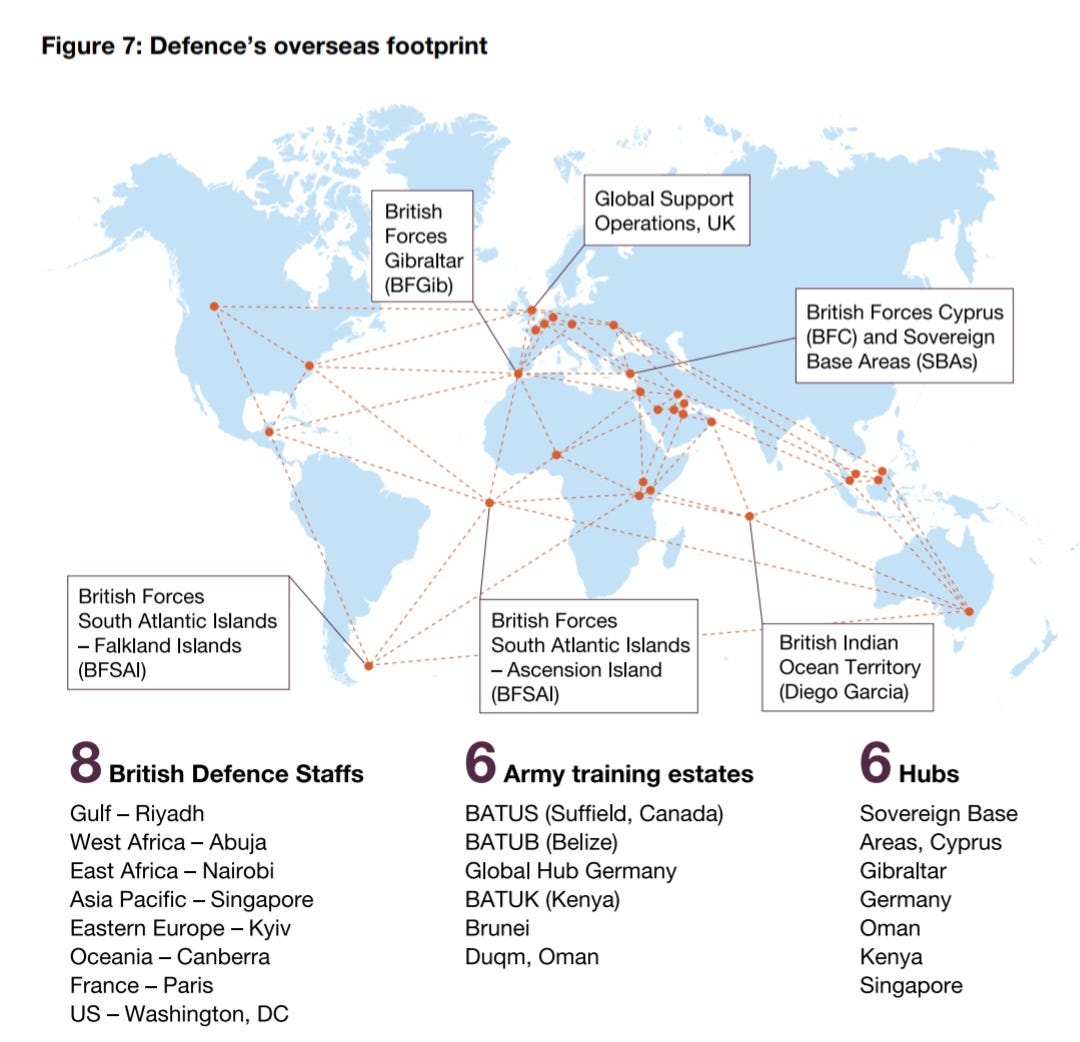
According to the review, from which the map above is taken, Britain still has 8,500 Ministry of Defence personnel stationed in bases across the world, notably in its ‘hubs’ in Cyprus, Gibraltar, Germany, Oman, Kenya and Singapore. In May, a British soldier was killed in a training accident in Iraq, a country whose Parliament told us to leave more than six years ago. On June 1, it was reported that we are supplying “hundreds” of anti-drone missiles to “specialist forces” in the Middle East to “counter Iran”, with whom we supposedly aren’t even at war.
The hard cash these weapons and worldwide bases cost is desperately needed to repair our schools, build more houses and bring down NHS waiting lists. It could also be used, as Ian Byrne MP put it this week, to help the two million children “growing up in food poverty in one of the richest countries on earth.” Byrne said that he looks forward to the day a minister resigns over this national disgrace, but I suspect we will be waiting a long time. Meantime, we should expect the media to continue to portray Healey as a hero, and we will have to rely on our own resources to counter the chorus fear-mongering from the merchants of war.
Steve Howell
“Howell’s book retrieves Puerto Rico from historical obscurity and foregrounds the struggle of its people for independence. Fast-paced and well-constructed, it skilfully blends the political and personal, using the latter to illuminate the former.” - Andrew Murray, Morning Star
“Howell’s story of state surveillance and suppression - and of the costs Washington is willing to incur to hold a Caribbean stronghold - is more instructive now than ever.” – Alex Macarthur, Jacobin.
Published on May 1, 2026 by the University of Massachusetts Press. More details here.
For orders in Britain and Ireland only, Cold War Puerto Rico in paperback is available at the special offer price of £20.00 including postage via my website (which has a PayPal/credit card facility) ORDER
From any other country, Cold War Puerto Rico in paperback or Kindle can be ordered through most bookstores, via the publisher or on Amazon ORDER
No posts
Comments
Nothing yet. Say the first thing.
Sign in to join the conversation.