
The journey started before I even landed in Florida.
I had just fastened my seatbelt as the plane prepared to leave Warsaw.
Twelve hours lay ahead of me.
Hours before my second in-person Rule Symposium in Florida—one of the world’s premier gatherings for natural resource investors.
I was excited.
As the plane took off, I put on my headphones and started listening, once again, to Jack D. Schwager’s Market Wizards series.
It is one of those series I keep coming back to.
Many investors spend their time searching for stock picks.
Market Wizards teaches us that there is no single path to success in investing.
And stock picks themselves are often merely the by-product of a much deeper investment process.
As the plane entered an area of turbulence, I happened to be listening to the stories of some of the greatest traders in history—their struggles, failures and remarkable comebacks.
The analogy was almost too perfect.
Every meaningful investment journey will eventually encounter turbulence.
The question is not whether volatility will appear.
The question is whether you are prepared for it.
Unlike aviation, where procedures are standardised, investing offers no universal protocol.
What preparation means depends entirely on the person.
Before we dive in, one note.
This article is intentionally a little more philosophical than my usual posts because I believe the lessons discussed here are timeless.
In my next article, I’ll share a practical checklist.
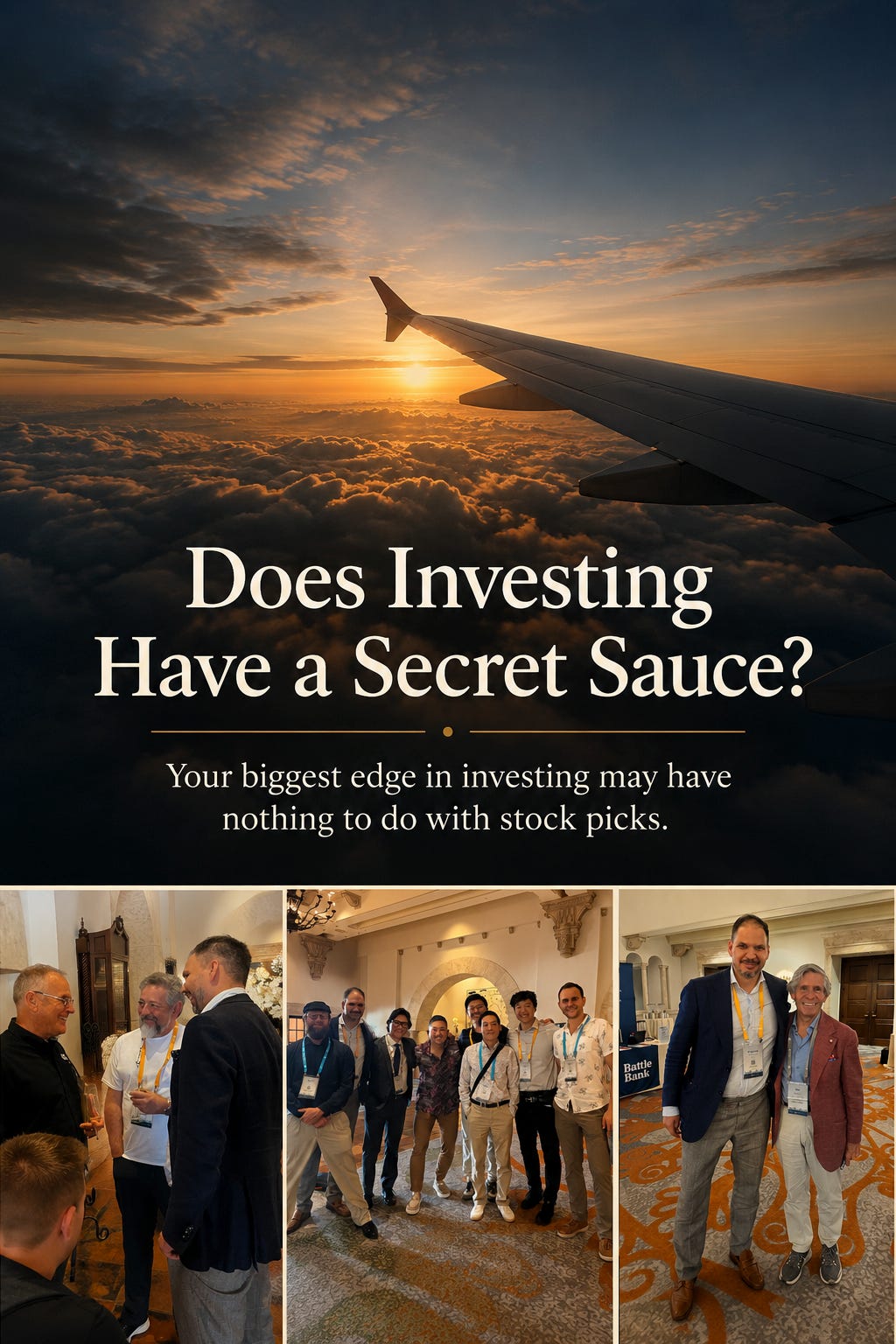
By the time I landed at Miami International Airport, I was already feeling tired.
Spending twelve hours immersed in conversations with legendary traders can be inspiring...
...but it can also be mentally exhausting—even the second or third time around.
Every day, the market bombards us with headlines.
Economic data.
Interest rate decisions.
Political events.
Commodity prices.
Company announcements.
It is incredibly tempting to react to every new piece of information and immediately ask ourselves what it means for our portfolio.
But perhaps we are asking the wrong question.
Millions of investors spend countless hours debating whether the stock market will rise or fall.
Whether AI is a bubble.
Whether passive investing is superior to active investing.
Whether a recession is around the corner.
Whether one famous investor is right and another is wrong.
But what if many completely different investors can all be right?
That is why, after a long journey—or after absorbing a huge amount of information—it is often better to pause.
Get some sleep.
Have breakfast.
Take a walk.
Give yourself time to think before trying to apply everything you have just learned.
Fortunately, Boca Raton is a wonderful place to do exactly that.
So there I was.
One day before the conference.
I had already met a few fellow investors and exchanged some initial thoughts.
Even those early conversations confirmed something I had suspected for years.
Experienced investors often share similar principles.
They manage risk.
They understand positioning.
They specialise in sectors they know well.
Yet their strategies—and especially their tactics—can be completely different.
The same becomes obvious when you read the best investing books.
There are many ways to succeed.
One of the conversations I had been looking forward to most was with Rick Rule.
We spoke about several aspects of investing, but one question had been on my mind long before I arrived in Florida:
Should investor’s psychology play a bigger role at future Rule Symposiums?
Rick replied that psychology was certainly important, although he wasn’t sure he was the right person to speak about it.
I found that answer particularly interesting.
Rick Rule may never have delivered a lecture dedicated solely to investor psychology.
Yet many of his most memorable lessons are, at their core, lessons in investor psychology.
“The greatest enemy is at the right of your left ear and the left of your right ear.”
“The number of companies you should own should equal the number of hours you can realistically spend learning about them.”
“Either you are a contrarian or you will become a victim.”
Notice something interesting.
None of these principles tells you which stock to buy.
All of them help you avoid becoming your own worst enemy.
What struck me even more, however, was Rick’s humility.
After decades of investing and teaching thousands of investors around the world, he still approaches investing as someone who continues to learn.
That alone may be one of the most valuable lessons of all.
We also briefly discussed artificial intelligence.
Rick believes AI will transform investing and that investors should absolutely learn how to use it.
But he also believes that human judgement still provides an edge that technology alone cannot replicate.
During the conference, I had several conversations with Rob McEwen about how he evaluates mining companies.
One of the first things he mentioned was management alignment.
He wants management teams to buy shares in the open market with their own money.
Rob himself sets exactly that example.
He is a major shareholder in several companies, while his salary as CEO of McEwen Mining remains just one dollar per year.
That tells you everything about how strongly he believes in aligning management with shareholders.
Rob also highlighted factors that investors rarely discuss.
The availability of skilled mining workers.
Access to mining equipment.
The ability to actually build and operate a mine—not merely discover one.
These topics rarely dominate company presentations.
Yet they can ultimately determine whether a project succeeds or fails.
As mining has become less attractive to workers than technology and other fast-growing industries, attracting experienced professionals has become increasingly difficult.
Having access to that workforce is becoming a competitive advantage in itself.
Rob mentioned many other factors as well.
But the biggest takeaway wasn’t any individual criterion.
It was the investment process behind those criteria.
The edge doesn’t come from memorising a checklist.
It comes from building a process that fits the way you think.
I also had the opportunity to speak with another investing legend—Jonathan Goodman.
He emphasised something that is easy to underestimate.
The people around us matter.
Business partners.
Management teams.
The people we choose to trust.
Too often, we waste enormous amounts of time trying to change people who simply don’t share our values or way of thinking.
Finding the right people is often far more valuable than trying to change the wrong ones.
I also liked the way Jonathan presented his company during the conference.
He needed just a single slide.
One slide showing what he believed the company’s assets were worth compared with its current market value.
Then he stopped presenting.
Instead, he invited the audience to ask as many questions as they wanted.
It was simple.
Transparent.
Interactive.
To me, it demonstrated something many companies still overlook.
Great communication isn’t about saying more.
It is about answering the questions investors actually care about.
I also spoke with Craig Parry, who has built several billion-dollar mining companies throughout his career.
Like the other successful investors and entrepreneurs I met, Craig combined ambition with remarkable humility.
He shared his views on where he believes the copper market—and his company—are heading.
But what impressed me most wasn’t the forecast itself.
It was how clearly he communicated his vision.
In several previous articles, I have written about the importance of CEOs telling a compelling story.
Craig is undoubtedly one of the best communicators in the mining industry.
Our conversation also turned to one of the darkest moments his company had experienced in Mexico, where several employees lost their lives.
He spoke first about the people.
Only then did he speak about the business.
It was a powerful reminder that behind every mining project are real people whose contributions—and sacrifices—should never be forgotten.
It was also a reminder that challenges are inevitable in business.
The key is to remain resilient and keep moving forward.
On the final day of the conference, I had the opportunity to speak with Michelle Makori—one of the most experienced and respected financial interviewers in the industry.
I asked her a simple question.
How has interviewing so many successful investors and entrepreneurs influenced your own investing?
She smiled and admitted that it certainly had.
Some of those conversations helped her recognise major investment opportunities long before they became obvious to the broader market.
But they also taught her something equally important.
The world’s best investors often disagree.
Some have been predicting a market crash for years.
Others remain fully invested.
Some trade actively.
Others rarely sell.
Some specialise in early-stage exploration companies.
Others avoid them completely.
Many of them have extraordinary long-term track records.
How can all of them be successful at the same time?
Often, they are all right—within their own time horizons and investment strategies.
So which path should you follow?
I am not sure there is a simple answer.
Perhaps the real secret sauce isn’t choosing the “right” strategy.
Perhaps it is finding the strategy that is right for you.
One of the people who helped me think more deeply about my own direction was Albert Rule, the founder of Rule Classroom.
Rather than telling me what I should do, he asked the right questions.
How is your investment style different from that of other investors?
Why should someone listen to you?
What is your real advantage?
Where do you want to be several years from now?
They are not only business questions but also investment ones.
They force you to understand what makes your approach genuinely yours—and whether it is a strategy you can consistently follow.
The same was true of many other conversations I had with fellow attendees.
One investor told me that the greatest value of the Rule Symposium wasn’t discovering new companies.
It was meeting people.
Building friendships.
Building a community.
Exchanging ideas.
Learning from investors he respected.
Another investor admitted that investing wasn’t his full-time profession.
He had no intention of spending hundreds of hours analysing mining companies.
Instead, he preferred following investors with exceptional long-term track records and learning from the way they think.
Another investor told me that the conference reinforced just how important gold could be in a long-term portfolio.
Many keynote speakers argued that today’s monetary system is approaching a period of profound change.
Whether that change happens sooner or later is impossible to know.
But preparing for different scenarios—and protecting yourself and your family—may prove to be one of the most valuable lessons of all.
After dozens of conversations, one conclusion kept coming back.
There is no one-size-fits-all approach to investing.
Every investor has different objectives.
Different constraints.
Different personalities.
Different amounts of available time.
Different emotional tolerances.
Different definitions of success.
Naturally, their strategies should differ as well.
None of them is universally better.
They are simply designed to solve different problems.
On my flight home, I returned once again to Market Wizards.
This time, I noticed something I had somehow overlooked before.
I kept hearing the same words over and over again.
Persistence.
Optimism.
Independent thinking.
Alignment.
People.
Discipline.
Relationships.
Contrarian thinking.
At first, they seemed unrelated.
But they weren’t.
None of them was really about finding the next winning stock.
Every one of them was about building a process you can trust for decades.
For years, I believed that one of the greatest advantages an investor can have is developing deep expertise in a single sector.
Perhaps even focusing on just a handful of companies.
Not because those companies are guaranteed to outperform.
But because genuine understanding makes it much easier to remain rational when emotions take over.
The goal isn’t to know everything.
The goal is to know enough to stick to your own process.
The same principle applies to passive investing.
Many people argue that buying an index ETF and holding it for decades is the optimal strategy.
Perhaps they are right.
History certainly suggests that it can be highly rewarding.
But even passive investing requires discipline.
Buying an ETF is easy.
Holding it through a 40–50% market decline is much harder.
Continuing to invest while everyone around you predicts financial disaster is harder still.
The strategy may be passive.
Executing it certainly isn’t.
Looking back, I don’t think the greatest investors succeed because they all think alike.
Quite the opposite.
They often disagree.
They invest in different sectors.
They use different time horizons.
They manage different amounts of capital.
They have different personalities.
Different objectives.
Different lives.
Yet many of them achieve extraordinary results.
Not because they discovered the same strategy.
But because they discovered a strategy they could consistently follow.
I also realised something else.
We spend an enormous amount of time trying to convince others that our market view is correct.
Gold will go higher.
Copper will fall.
The market will crash.
The market will recover.
But perhaps we are often talking past one another.
A trader and a long-term investor can both be right.
Someone building wealth over thirty years and someone measured on quarterly performance are solving entirely different optimisation problems.
So instead of asking:
“Who is right?”
Perhaps we should ask:
“Right... for whom?”
I flew to Florida expecting to return home with better investment ideas.
Instead, I came back with something far more valuable.
A stronger conviction that successful investing is far less about finding the perfect stock...
...and far more about building a process that fits who you are.
The goal of listening to great investors isn’t to copy their conclusions.
It is to understand the principles behind them.
Then decide which of those principles fit your own personality, objectives, available time and investment horizon.
Perhaps that is the closest thing investing has to a secret sauce.
In my next article, I’ll share a practical checklist I use to evaluate whether an investment strategy truly fits the person using it.
Because I believe that one of the biggest investing mistakes isn’t necessarily buying the wrong stock.
It is following a strategy...
...that doesn’t fit who you are.
Perhaps the greatest investment you will ever make isn’t in a company.
Perhaps it is in building a process you can follow for decades.
This article reflects my personal views and is intended for educational purposes only. It is not investment advice.
No posts
Comments
Nothing yet. Say the first thing.
Sign in to join the conversation.