
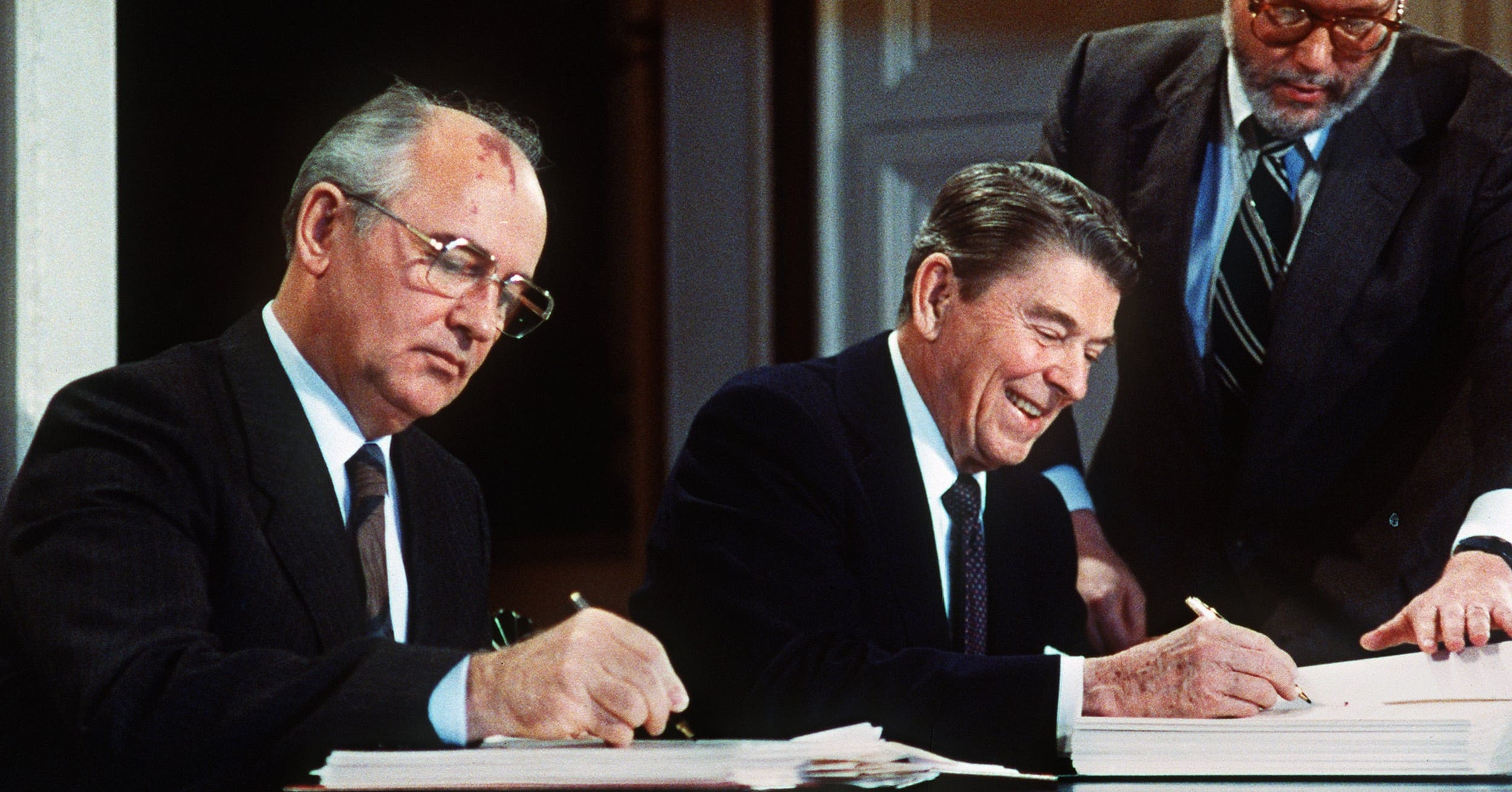
President Ronald Reagan did not come up with the term trust but verify all on his own. Rather, it was a quip directed at the old Russian phrase доверяй, но проверяй (doveryai, no proveryai) provided by Suzanne Massie — her book The Land of the Firebird remains essential reading to understand the Russian character, which Reagan read vociferously and consulted with Massie on multiple occasions while negotiating with the Soviets.
What Reagan effected through these talks with Soviet General Secretary Mikhail Gorbachev was the Intermediate-Range Nuclear Forces (INF) Treaty, predicated on an earlier MOU which earned a great deal of scorn from conservative commentators and Kremlinologists, conceding everything while gaining nothing.
Yet the final draft of the INF Treaty itself succeeded temporarily in eliminating the threat of intermediary nuclear weapons in Europe while allowing Reagan to pour money into the Strategic Defense Initiative, one of many programs which ultimately bankrupted the Soviet Union in their efforts to keep up with American advancements and economic globalization.
Unfortunately, the Russian Federation would eventually turn their backs on the INF treaty by resuming the development of intermediary-range missiles. President Donald Trump would repudiate the treaty in 2019 due to a combined problem of Russia’s resumption of weapons development and the fact that the INF treaty only confined the United States and the Russian Federation — but not the People’s Republic of China as they continued to cast their eyes across the Straits of Taiwan.
Yet the MOUs for the INF treaty were instrumental as a steppingstone to a final agreement between the United States and the Soviet Union, precisely because the MOUs did not exist in a bubble — globalization and free trade were lifting billions out of poverty, American defense spending was putting tremendous pressure on Soviet satellites to choose their allegiances wisely, Charlie Wilson’s War was bleeding the Soviets in Afghanistan, Solidarity continued to capture the imaginations of Poland, Vaclav Havel continued to grumble in Prague, and the East Germans were discovering that socialism with a human face was still socialism — and still required the Berlin Wall and Iron Curtain to keep people within its tender mercies.
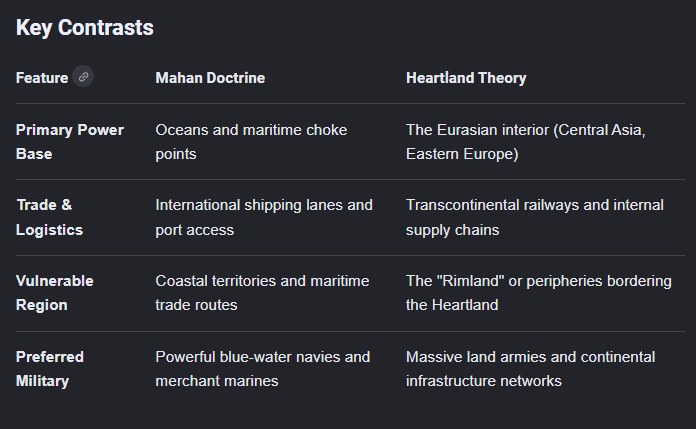
One of the key planks of the post-Second World War peace — the Pax Americana — is that the United States alone guarantees the freedom of the seas.
What is more commonly known as the Mahan Doctrine, it states that those who keep the trade routes also keep the world peace. Freedom of the seas is its the principle foundation, and the chokepoints of world trade — Panama, Suez, Malacca, Hormuz — are the keys to maintaining the freedom of the seas.
Contrary to this is the Heartland Theory which argues that whichever power controls Central Europe controls the outer rim (Western Europe, the Bosphorus, the Middle East, India, China). Which is partially why the European Union continues to push the Russian sphere of influence away from Central Europe at any and all cost.
Now you know why we expanded NATO eastward and are supporting Ukraine in Russia’s near abroad — at least in very broad strokes. The West are the Athenians; the Germans were and Russians are the Spartans.
Here’s what concerns me most about the details of the Trump-Iran MOU at present:
5. Upon the signing of this MOU, the Islamic Republic of Iran will make arrangements using its best efforts for the safe passage of commercial vessels with no charge for 60 days only from the Persian Gulf to the Sea of Oman and vice versa. The traffic of commercial vessels will immediately start and, considering the needs for removing the technical and military obstacles and demining by the Islamic Republic of Iran, will be instated within 30 days. The Islamic Republic of Iran will conduct dialogue with the Sultanate of Oman to define the future administration and maritime services in the Strait of Hormuz in discussion with other Persian Gulf littoral states in line with the applicable international law and the sovereign rights of coastal states of the Strait of Hormuz.
That is a non-starter, ladies and gentlemen.
Central to this MOU going into effect in good faith are the implementations of paragraphs 1, 4, 5, 10, and 11. Paragraph 1 is an immediate ceasefire, including in southern Lebanon where Iran has taken the step of recognizing Hezbollah as a state proxy of terrorism — a short-term win with a long-term consequence.
Paragraph 4 should be read concurrently with Paragraph 5:
4. Immediately upon the signing of this MOU, the United States of America will begin the removal of its naval blockade and any disturbances or impediments against the Islamic Republic of Iran and will fully end the naval blockade within 30 days. During this period, the traffic of vessels will be in proportion to the numbers of prewar traffic being restored by the Islamic Republic of Iran. The United States of America further undertakes to remove its forces from the proximity of the Islamic Republic of Iran within 30 days after the final deal.
In short, whatever administration (sic) the Iranians and Omanis intend to establish over the Straits of Hormuz is predicated on the restoration of a former degree of traffic resuming its normal functions through the straits themselves — and with the full co-operation of Oman.
Now one might imagine a scenario where the Saudis and the United Arab Emirates build their pipelines so as to circumvent the Straits of Hormuz, thus negating their reliance on tankers navigating our present-day version of the Barbary Pirates.
If Paragraph 4 does not come into force, Paragraph 5 is in jeopardy. It’s a semantic reading of the MOU, but it is most certainly an interpretation.
Paragraph 10 allows the Iranians to sell their oil, ostensibly to the Europeans and Chinese. Paragraph 11 is the unfreezing of Iranian funds, to be negotiated by both parties pursuant to a final agreement. Which, for those keeping score, state sponsors of terrorism (see Paragraph 1) don’t get their funds unfrozen easily. Well played, U.S. State Department — well played indeed.
Which then brings us back to Paragraph 5. There are instances in world diplomacy where agreements based on the mutual consent of all parties are designed to keep a thing in stasis. The Anglo-Irish Treaty of 1921 did precisely that with their boundary commission to the shock of the Irish and the pleasure of Ulster — Northern Ireland certainly did not consent to the boundary commission, and the boundaries without a border remained.
One cannot stress hardly enough. The freedom of the seas cannot be negotiated away. In fact, should the Iranians demand “administration” of the Straits of Hormuz, it will send a signal to the Chinese government that they too can “administer” the Straits of Taiwan and the South China Sea. Can Egypt return to “administering” the Suez Canal as they attempted to do in the 1950s under Nasser?
Interesting to me is Paragraph 6 which is an odious $300 billion (with a B) cash giveaway to the Iranian government should they comply with the aforementioned paragraphs in the MOU.
Some people see a carrot. If so, there isn’t much stick behind it. Conversely, much like Reagan with the INF treaty, there are other things moving that do not require the United States to keep its promises if the Iranian government does not in turn keep theirs. Case in point? The paragraphs relating to the dismantling of the Iranian nuclear weapons program. If the Iranian are crowing about the entirety of the provisions in the MOU, then they are either willfully missing the if/then nature of the document, or they are obfuscating the disarmament portions of the MOU with the intention of obfuscating the rest.
If one is reaching for a boxing metaphor, this is the equivalent of allowing the opposition who has taken multiple body shots to catch their breath, which the Iranians will undoubtedly do. Simultaneously, the United States is buying time to develop its own alternative strategies — and time is not on the side of the mullahs of Iran at present. Consider:
The entire Iranian Navy has been destroyed.
The entire Iranian Air Force has been destroyed.
The Iranians have effectively run out of drones and missiles.
Iranian mines are only showing limited effect.
Iran has suffered over a trillion dollars in damages over the last 40 days.
Two layers of its leadership cadre have been killed.
Hezbollah has suffered a tremendous loss in both force projection and prestige over the last 40 days, specifically in Lebanon.
Concerns that the United States has depleted its military stockpiles are a shiver looking for a spine. Only 10% of U.S. naval power has been deployed in theater, and the overwhelming force Trump promised to use has yet to truly be felt. In short, the United States has plenty of cards left to play.
Much like Reagan in 1987, one doubts that many would have predicted the collapse of the Soviet Union five years later (Paul Kennedy did, but that’s another matter) as forces were working assiduously to make that happen in Eastern Europe and elsewhere. What the American public sees are the face cards. What we don’t know will be read in the history books 20 years from now.
One does have concerns that the MOUs tip our hand too much in favor of keeping the ayatollahs in power, which at present seems to be the objective of this new and third leadership cadre in Iran — survival. That’s information enough. One wonders what pro-democracy efforts would achieve with $300 billion in support — by contrast, the United States has given Ukraine about $134 billion since the beginning of the conflict with Russia.
Yet in the abstract, the pieces on the chessboard are still moving in Islamabad just as they were at Reykjavik under Reagan. Breaking faith with the Mahan Doctrine would be the beginning of the end of the Pax Americana, just as surely as Russia losing Ukraine would — for them — be the breaking of any hopes to revive the Heartland Doctrine.
The Trump-Iran MOU signed in Versailles needs a great deal of work over the next two months, but one cannot stress this point enough — the freedom of the seas is essential to the Pax Americana and no degree of appeasement — no matter how well disguised — will provide future generations with the long-term security of a free world.
The difference between realpolitik and appeasement seems to be about $300 billion and the so-called “administration” of the Straits of Hormuz.
SHAUN KENNEY is the senior editor for The Republican Standard.
No posts
Comments
Nothing yet. Say the first thing.
Sign in to join the conversation.