
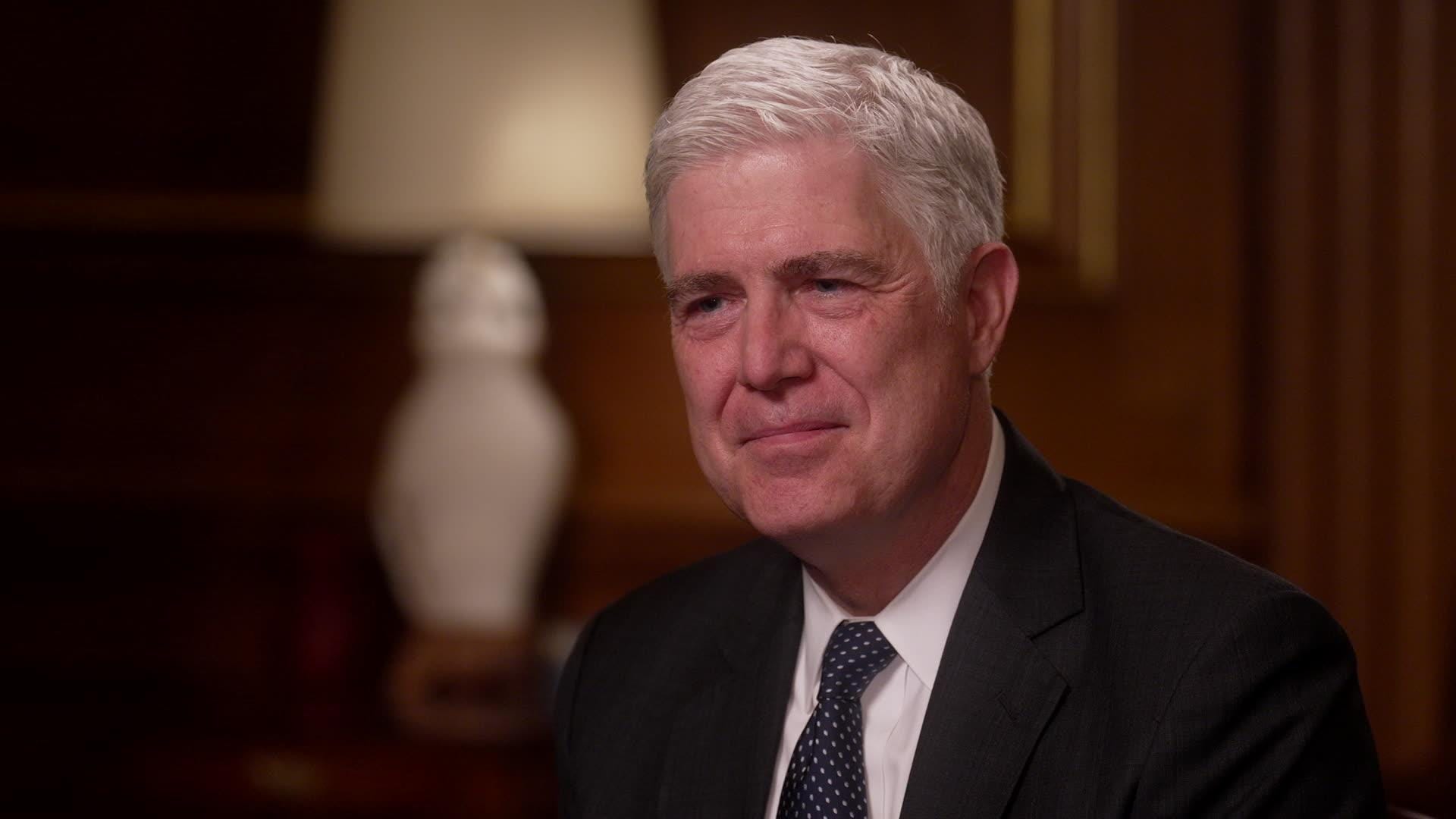
The conversation between Margaret Hoover — heiress to William F. Buckley Jr.’s Firing Line — and U.S. Supreme Court Justice Neil Gorsuch is an interesting one, not just for the interview or the interviewer, but for the real thrust of what Gorsuch was saying and how the political left is desperately attempting to contrast it with the views of Vice President J.D. Vance.
Hoover: Look, you make the point also, as you discuss this book, and even in the book, that there is no common religion or cultural heritage of Americans.
. . .
Gorsuch: We were founded in a lot of our colonies for religious pluralism, right, and the opportunity to practice your own faith in your own way, and we were never supposed to be a nation that was about one race or one religion. It was about those ideas.
Hoover: But you refute the idea that we came from the same heritage and the same religion.
Gorsuch: Well, I mean, it’s demonstrably not true that we came from the same religion.
I mean, think about the Amish who came here in the 1600s on a handful of rickety boats, a third of them dying along the way for their freedom and populating much of, you know, into Pennsylvania and down into the Shenandoah Valley in Virginia and now throughout the rest of the country.
What, they weren’t part of the American experiment? Of course they were. The Quakers, same story. Of course they were, and so America was not found-- I mean, we have a First Amendment for crying out loud. No established religion. Everybody has the freedom of religion. Everybody has the freedom of speech. We are all equal under law.
Now, you cannot believe in those ideas. Fair enough. Then we have a problem, but those three ideas are something all of us can unite behind.
Gorsuch goes so far as to argue as evidence that America’s founding was not a Christian founding because it included Catholics — as if Catholics were not Christian (so goes the old saw).
I’ll take a stab at it — the idea of America ultimately rests on Christian principles, filtered through a Protestant lens and rests on ideas rooted in the both the Anglo-Saxon experience and Enlightenment values.
Stephen Saunders Webb has an excellent four-volume series entitled Governors General on how England during the Stuart dynasty rose from backwater to British Empire. During this time, we get the 1689 English Bill of Rights, we get the proper role of Parliament, and more than this we get the Duke of Marlborough — whose lieutenants eventually are sent to govern the colonies in America and whose leadership style is eventually emulated by the American Founding Fathers. The history is excellent. In like turn, John Locke’s Two Treatise of Government is a more powerful influence over the minds of the early Virginians — specifically Jefferson — than most would care to consider. Finally, there is the influence of such men as the Reverend John Witherspoon over the Founding Fathers who much like George Wythe taught many of them on the precepts of a Lockean respublica Christiana.
What Gorsuch misses is that these values which are claimed as American values — freedom of religion, freedom of speech, equal justice under law — are all ideas predicated upon something and not easily superimposed. Politics is downstream from culture, and if cult is the operative word, then the cultivation of these ideas is rooted in something much deeper than a proscriptive creed defined by Thomas Jefferson and refined in the Federalist Papers.
In fact, the concept of religious freedom and religious toleration is unique to the Christian West, and more specifically to the Protestant tradition where it was never imaginable under the Sun King of France much less the wider Catholic world. In its own way, America enjoyed such diversity of religious thought ranging from Anglicans both low and high, Baptists, Methodists, Presbyterians, Quakers, Puritans, and even Unitarians — imperfectly at first, but more broadly as Americans reached the latter half of the 18th century.
Freedom of speech is still a tricky thing, yet for the English it was defined first as a prerogative of Parliament, next as a bulwark against royal interference, and finally enshrined in the 1689 English Bill of Rights.
The rule of law is a trickier thing to pin down, for while the American Republic would have defined the term in contrast with King George III and Parliament, the antecedents are as old as Montesquieu, Gratian, Bonaventure, Bellarmine, Aquinas, Magna Carta, Cicero, Aristotle, and Plato.
What strikes me as demonstrably true is that all of this is predicated on a certain idea of the human person. No — personalism had not been described in the same manner as we have it today, but the idea of the individual and citizen (in contrast to a subject) had most certainly arrived. What the Protestant reformers were pointing towards were the rights of conscience and the ability to participate in public life despite differences in religious opinion — again, imperfectly, but altogether welded to classical ideas and rooted in the Anglo-Saxon tradition among deeply committed and religious men.
What should be remarkable to skeptics is that the Founding Fathers were indeed deeply religious and Christian men — with pastors and theologians in their midst — and yet they gave us a republic and not a theocracy.
What particularly galls me about the present-day framing is the gotcha. Gorsuch says we didn’t come from one religion, ergo “white Christian nationalist supremacy” (TM) is not only rejected, but that Christianity had nothing to do with the American founding.
The kicker is that America’s founding could not have happened — and in fact, did not happen — in other political cultures. What was that culture? A deeply Christian, deeply Protestant, deeply Anglo-Saxon tradition with antecedents broadly defined as Western Civilization.
Ivan Illich famously defined atheism as a uniquely Christian heresy and modernism as a uniquely Western concept, mimicking the role of the Church in society and offering a sort of quasi-religious perversion of the real thing. Democracy as sacred? What precisely makes it sacred?
The Declaration of Independence as a creed? What precise authority does it have over the minds of Americans to demand the word credo — I believe — in order to be a real American? When we describe rights what are we really describing? If they are inherent, are they natural? Given to us by whom? Should the w- in Whom be capitalized? If natural, are those rights ordered? Ordered to Whom? Or ordered to a Parliament — or perhaps a Politburo?
If that sounds like an awful lot to unpack to postmodern Americans in the present day, they were not terribly difficult for Americans on the cusp of the modern era in 1776. They knew (and more deeply knew that they knew) the answer to all of these questions and would be shocked and perhaps even horrified or even marvelously pleased to discover the conclusions we have drawn from their first premises as we strive to build that New Jerusalem — a more perfect Union.
Now this isn’t to say that there are perfectly capable secular governments out there in the world. Or perfectly tolerant ones. Or that Americans got it right and everyone else is wrong, wrong, wrong.
Yet there is a confession to all of this. Catholics had a certain sensibility regarding representative government, but always with the underpinnings of a rejection of liberalism, republics, religious freedom, and the like seeing them all as outcroppings of the French Revolution. Only with the ralliement with the Third Republic and a slow realization that the Protestant Reformation wasn’t exactly a passing fad did it dawn on the Vatican that religious freedom might be a good idea after all.
Only in 1965 did the Vatican concede that the United States of America — and not the Spanish Falange who united Church and State — had the right idea by giving total religious freedom to the Church. This after the 1929 Lateran Treaty with Italy abandoned all temporal and political power to the state.
One would imagine Thomas Jefferson throwing an arm over his chair — touching the grin in the corner of his mouth with an outstretched finger — to hear that the Catholic Church less than 200 years later discover that Jefferson was right all along.
And yet this is the genius of the American Founding. Yes, the Americans were deeply religious and profoundly Christian, and it was precisely because of their religious sentiment that they continued their experiment in self-government. Yes, the Americans enjoyed a renaissance of classical thought, and it was precisely because of this they aspired to a balance of factions rather than the domination of one over the other. Yes, one Catholic was invited to the table. Yes, Quakers were invited to the table.
Even this was a tremendous leap of faith — but one rooted in a deeper faith that defies the caricatures of those who believe any faith in the sacred whatsoever disqualifies a person for consideration by the secular. For this we can also thank the Protestant Reformers as conscience yielded to willpower — but that’s another debate for another day.
What we can appreciate — and where Neil Gorsuch and George Will are mistaken — is that America’s Christian Founding was no small achievement and no small thing to wonder about. Our origins were the product of culture, and it is a culture most certainly under attack and intentionally misunderstood by barbarians who can only mimic but never create and are insistent upon cashing out a public trust without appreciating the advantages carefully and assiduously handed down by generations upon generations of Americans before them.
For this, we do not have to look to men such as Locke or Witherspoon and their influence on the Founders, but rather to their results as noted by men such as Alexis de Tocqueville:
Americans combine the notions of Christianity and of liberty so intimately in their minds that it is impossible to make them conceive the one without the other. Religion in America takes no direct part in the government of society, but it must be regarded as the first of their political institutions; for if it does not impart a taste for freedom, it facilitates the use of it. Indeed, it is in this same point of view that the inhabitants of the United States themselves look upon religious belief. I do not know whether all Americans have a sincere faith in their religion — for who can search the human heart? — but I am certain that they hold it to be indispensable to the maintenance of republican institutions.
Tocqueville seems to be the more reasonable position than either Gorsuch’s assertions or the fantasies of some sort of quasi-Christian theocracy designed to crush one half of society to the benefit of the other.
Yet it is important to understand how the early Americans understood themselves and the American experiment so as to preserve the tradition of self-government and why it flourishes here. As we have seen over the decades, America isn’t a thing easily exported nor are our values universally shared even among other Americans.
Culture commands — or so the saying goes. It’s a tricky thing to cultivate, but an easy thing to lose.
SHAUN KENNEY is senior editor for The Republican Standard.
No posts
Comments
Nothing yet. Say the first thing.
Sign in to join the conversation.