

If the old adage that socialism eventually runs out of other people’s money, then charity just might start at home.
To wit, the Democratic National Committee is presently facing a severe cashflow problem, with $15 million on hand against a staggering $18 million in debt. Trump’s approval ratings? Right about where Obama and Clinton’s approval ratings were during their second term. The generic congressional ballot for 2026 is less than half of what it was this time in 2018. Job approval ratings for Democrats in Congress sits at a paltry 18% whereas Republicans sit tight at a far more modest 35%.
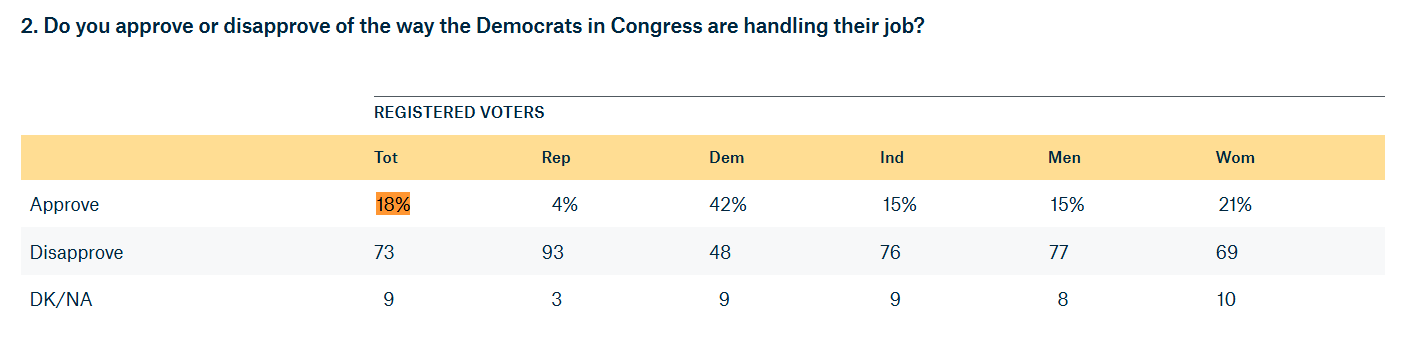
One might think that the Democrats would put up traditional numbers against Republicans in Washington. Yet in their effort to bring Trump down to their level in approval ratings, Democrats are running into two problems reminiscent of the more libertarian leaning Tea Party Revolution in 2010 and the populist MAGA Movement in 2016. First and foremost, the Democratic Party has run out of ideas — the old school neo-liberal corporatism simply isn’t working for the working class. Second and perhaps more dangerous for the Democratic Party is the rise and energy of the Democratic Socialists of America — who are precisely what they say they are, who point at liberals and conservatives and populists as all cogs in the same capitalist machinery, and whose means are justified by the ends. Assassinations of CEOs and politicians all serve a greater good. Rent controls serve a greater good. Eating the rich all serves a greater good.
When Leo Trotsky — who himself was outflanked by Stalin — told the Mensheviks to go into the “dustbin of history” when they walked out of the 1917 Second Congress of Soviets, the feature proved itself not to be a bug. As liberals are outflanked by progressives who are then outflanked by socialists, the Democratic Party as the party of the left is about to have a struggle for its soul and present a real contrast to the wider right, one where the Republican Party’s “big tent” will be tested indeed.
In Europe, democratic socialism was viewed as a response to the rise of the German Empire under Otto von Bismarck in the late 19th century. Historians are keen to remind their students that social security — which Franklin Roosevelt adopted as a Democratic plank during a time where conservatives and progressives were in ideological alliance — was indeed a conservative reform, used primarily by Bismarck as a tool to tamp down revolutionary fervor.
The key to understanding the geist of democratic socialism is that economies across Europe quickly changed during the 19th century, far faster than society’s ability to absorb the changes. Democratic socialism was the halfway house between labor unions and communism before there was a Soviet Union and state sponsorship with which to contend. The economy had changed faster than the culture, the complexity of the economy concentrated wealth in ways unimaginable 100 years or even a decade before. If progress was the new god, its adherents demanded a share.
Of course, in America we learned something a bit different.
Not only did the Industrial Revolution come late to the United States, but the bedrock of industrialization was also the free market — what Jefferson termed the “empire of liberty” in the pursuit of free trade and free goods. Labor unions in America had a far different history than the labor unions of Europe, and though the rise in wages from 1860 to 1960 is commonly sold as the rise of labor, the true marker has been built around three poles: (1) the rise of productivity, (2) the increase in technological advancement and the education required to develop this technology, and (3) the spread of free markets and globalization after the collapse of the Soviet Union.
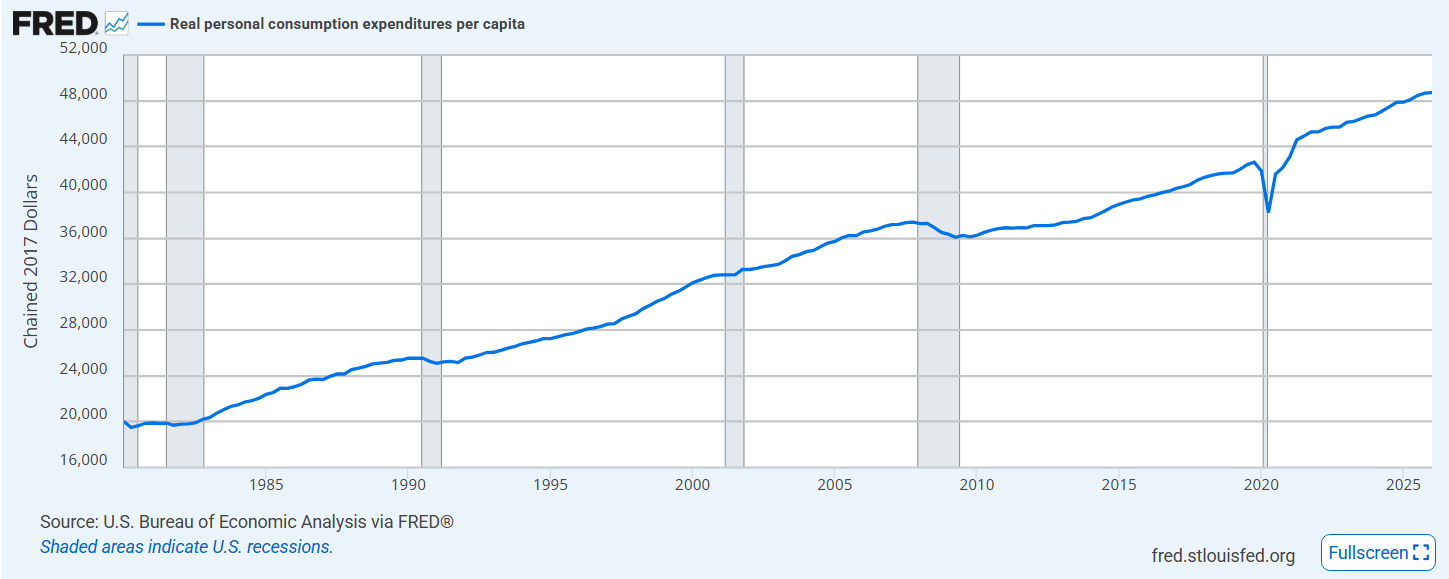
Wage stagnation — the bogeyman of ever democratic socialist — is quite simply a myth. Not only do we live in an era where humans (and particularly Americans) have never had it so good, but other intangibles not measured by the antiquated models. The simple fact of the matter is that real consumption per capita has skyrocketed in the United States:
By grossly lumping together part-time and full-time weekly earnings while leaving out job benefits such as health insurance (among other things), such “data” is often produced and cited to support the stagnation argument frequently made by Krugman and company. The critics of capitalism have been caught in their shortcomings.
Another fantastical trick is to measure the erosion of real income via the Consumer Price Index (CPI for short). Yet the CPI has a tendency to overstate the annual rate of inflation as a function of how it gathers data. By counting the price of a collection of goods and services over time while these very products are themselves changing over time, CPI data often miscounts ordinary price increases as inflationary. This conversely means the CPI understates gains in real income.
Real wages — when you include the intangibles such as health care and 401ks — has actually gone up 18% since the 1980s and consumption has gone up an astounding 74% between 1980 and 2004.
Adjusting for inflation? Real consumption per capita has gone up 110% from 1980 to 2026. Americans are twice as wealthy as we were at the beginning of the Reagan era, and was only interrupted by the Great Recession during the Obama era and one heck of a dip during COVID in 2020 from which the US economy bounced back as if nothing happened despite the inflationary pressures of the Biden era.
So what’s left for the Democratic Party to conquer?
Gone are the days where Lyndon Baines Johnson co-opted the Eisenhower-era Civil Rights legislation with his Great Society project. Obamacare as policy has no true fans, expanding health care access without expanding health care insurance and raising costs across the board.
Meanwhile, the results are in. America spends the most on public education among the G7 and the G20 and routinely turns in mediocre results. University funding is on the cusp of a crisis both in affordability and maintenance. Open immigration policies have backfired. Crime goes up and public safety goes down. The CATO Institute ranks the United States as 15th in economic freedom — not first, but fifteenth — while scoring on par with South Africa in terms of political freedom according to Freedom House.
Whatever is working simply isn’t working for working class anybody. On the right, the revolt take the form of populism and always has — from Andrew Jackson to William Jennings Bryan to Patrick Buchanan to Donald J. Trump.
Yet on the left? Sometimes it looks like Franklin D. Roosevelt in its benign forms, but other times looks a lot more like Eugene Debs.
Rather than going off of what the media pretends democratic socialism to be, Americans should take good hard look at what they say they are for — and believe them the first time:
Capitalism is a system designed by the owning class to exploit the rest of us for their own profit. We must replace it with democratic socialism, a system where ordinary people have a real voice in our workplaces, neighborhoods, and society.
We believe there are many avenues that feed into the democratic road to socialism. Our vision pushes further than historic social democracy and leaves behind authoritarian visions of socialism in the dustbin of history.
When you are invoking the words of Leon Trotsky? Believe them.
We want to win “radical” reforms like single-payer Medicare for All, defunding the police/refunding communities, the Green New Deal, and more as a transition to a freer, more just life.
What does the freer, more just life entail? Socialized medicine which has never worked in any nation that has ever adopted it (see: Britain and the NHS). Disarming communities to the tender mercies of street gangs. The so-called Green New Deal which is making energy more expensive for homeowners.
Don’t worry — there’s room for the weird who want to turn pro. Bodily autonomy — the language of the so-called Virginia amendment on abortion that embeds transgenderism as a basic human right — is right up front on the agenda. In the DSA’s own words:
Like race and class, gender is used to divide and exploit labor under capitalism. It declares that some people, and their labor, are more or less valuable than others. When workers reclaim power over our gender identity, we threaten capitalists’ ability to enforce gendered exploitation and biological hierarchy. In this way, protecting transgender workers and those seeking abortion care also empowers all workers to control our bodies and determine our futures.
At the Chicago DSA Convention in late July, you can sign up for all sorts of conferences, including:
Governing as Socialists
Workers Deserve More: Building to a General Strike
A Free Palestine in our Lifetime
No Walls, No Cages: Organizing to Abolish ICE in the Trump Era
Organizing Fundamentals: Building Blocks for Socialist Victory
Do these guys sound like they are taking hostages when they are using language and tactics such as “mass organizations, united to demand taxing the rich, abolishing ICE, and an arms embargo” (ostensibly against Israel)?
Now if you are a traditional Democrat reading this, you might be wondering what any of the DSA platform has to do with say, the Four Freedoms.
Making matters slightly more complicated, Americans have already experienced the use of direct action for social change. Richmond’s business community has still yet to recover from the SPLC-fueled riots of 2017 and 2020. Degrading law enforcement and offering amnesty to criminals only resulted in more crime. Increasing the minimum wage resulted in more automation, fewer job opportunities, and higher prices for consumers across the board. Data centers have driven the positive growth in the Virginia economy over the last few years — without them, Virginia’s growth would have remained stagnant as increase pressures on local and state governments continue to mount. Once again — socialists should be judged on their results, not their rhetoric.
Yet the leadership class within the Democratic Party is now hooked on the horns of a dilemma, where their own base is finally beginning to believe the rhetoric. Only socialism is strong enough to fight so-called fascism and authoritarianism. Middle ground? Mensheviks go to the wall, comrade. Liberals and conservatives will go to the dustbin of history. After all — so goes the mantra — why elect Democratic majorities if they will not enact socialist policies?
Let’s face it. When even Senator Chuck Schumer (D-NY) isn’t enough for the socialist left? That’s a problem.
When you lose guys like Bill Maher? That’s a real problem.
The old critique that liberals and conservatives are two sides of the same coin isn’t as much of a put-down as one might think anymore. In broad terms, both liberals and conservatives are committed to the constitutional framework, economic freedom, the FDR social safety network and a national defense posture easily recognized by Ronald Reagan. NATO would be the cornerstone; the Five Eyes instrumental; the “special relationship” between the United States and United Kingdom as sacrosanct. Public education, in desperate need of reform, is a positive public good. Free markets, free minds, and a free society should still remain the functional core of who we are, and despite our many differences, much of the problem of scarcity can be solved through economic growth, not social redistribution.
Yet the problem for liberals and conservatives alike is the problem with the prefix far-.
The old saw use to be that the difference between a liberal and a conservative in America was five percentage points in the tax rate. Today, the commonalities should bind the two together against a rising nationalism on the right and a rising socialism on the left — two ideologies alien to the American framework which managed to swallow Weimar Germany whole.
The problem is the far left. The problem is the far right. The problem is that we surrender every disagreement on policy to the words extreme, radical, hateful, bigoted, cruel, or my favorite supremacist. Or even better, if your intellect is informed by the sacred, then your opinion can be instantly discarded whereas secular religions — far more deadly in the 20th century than sacred ones — are nearly always permissible. The problem is that in our effort to be good Nietzscheans and win every argument through coercion and force, we preclude the opportunity to be good Aristotelians in the effort to argue to understand. Our forefathers would have called it compromise.
Yet will Democrats who are soon to be driven out of their own party find any sort of welcome in the present day Grand Old Party? As the extremes continue to stretch the boundaries of acceptable opinion, it might be high time to rediscover our roots in the face of actual socialists and actual nationalists. For instance, in Virginia, we have the RPV Creed which begins with the following:
We believe…
That the free enterprise system is the most productive supplier of human needs and economic justice,
That all individuals are entitled to equal rights, justice, and opportunities and should assume their responsibilities as citizens in a free society,
That fiscal responsibility and budgetary restraints must be exercised at all levels of government,
That the Federal Government must preserve individual liberty by observing Constitutional limitations,
That peace is best preserved through a strong national defense,
That faith in God, as recognized by our Founding Fathers is essential to the moral fiber of the Nation.
One might even argue that the free enterprise system is the entire ballgame. We can argue over the size and scope of equal rights and justice as we have done for 250 years and will continue to do so. We can argue over the definition of fiscal responsibility and budgetary restraint. We can argue over the scope of individual liberty against its enemies, foreign and domestic. We can debate the defense and intelligence budgets. Our faith in God as recognized by the Founding Fathers most certainly includes Jeffersonian ideas of religious freedom.
Yet all of these are predicated on economic growth and free enterprise. One can accomplish a great deal with economic growth, but if one truly cares about all the things the socialists claim to care about, the absolute precondition is and will always be the free enterprise system.
Insofar as Republicans are willing to defend this principle, and insofar as conservatives are ready to reassert themselves as the true leaders of the Republican Party in both sensibility and scope, then the res publica might very well have a chance against its enemies in the 21st century — and believe me, the nationalists and the socialists are indeed enemies to human freedom.
America is about to undergo a profound economic change that is going to reassemble political allegiances as the nature of work undergoes a dramatic transformation. Whatever the challenges, democratic socialism is a 19th century answer to a 21st century problem. Whether or not the Democratic Party in their present state has the ability to push them back remains to be seen, and the pessimists hold the majority. Whether or not Republicans are ready to assert themselves in such a way as to create a majority which puts the first thing first also remains to be seen — yet given the stakes and the danger, conservatives would be wise to rediscover their first principles and build our coalitions accordingly.
The DSA isn’t a left-wing version of the Tea Party by a mile, but rather a dangerous new twist to the game that is alien to our history, rule of law, and constitutional government — and if it is to be vigorously opposed, then it must be done even at the risk of finding likeminded, business-oriented friends in the political center.
SHAUN KENNEY is the senior editor for The Republican Standard.
No posts
Comments
Nothing yet. Say the first thing.
Sign in to join the conversation.