
Every act of transformation begins with an act of imagination.
Long before God spoke light into darkness, creation existed in the limitless imagination of God. Before light broke through the darkness, creation was already held within the boundless imagination of God. Before the waters of the Exodus parted, God imagined a people no longer defined by Pharaoh’s captivity. Before the fire of Pentecost descended, God envisioned a Church in which every language, culture, and people could bear the living Word. And before the stone was rolled away, God had already declared that death would never have the final word.
This is the sacred power of imagination: to perceive, by faith, the future God is already calling into being. The work of generative imagination is and has always been holy work.
For Black people, imagination has never been a luxury. It has been the means by which we have survived worlds that could not imagine our humanity, while simultaneously creating worlds that reflected God’s. Our grandmothers imagined dignity into segregated pews. Our ancestors imagined freedom into brush arbors and hush harbors. Our founders imagined institutions (the Knights of Peter Claver, Black Catholic schools, religious orders, congresses, and caucuses) into a Church that too often could not imagine them. That is not metaphor, but method. That is how Black and Black Catholic people have always done theology: not as abstraction, but as world-making.
I have come to believe that imagination is not a departure from reason or faith. It is how we tap into the mind of God. When we imagine rightly, when we imagine communally, when we imagine in the Spirit, we are not escaping reality. We are remembering the reality that already exists in God and calling it into being here, among us, now. This is the theological conviction beneath everything I want to share with you today: the Black Catholic Flourishing Initiative is, at its heart, an exercise in sacramental imagination.
What We Have Been Building
Two years ago, growing out of FADICA Catholic Philanthropy Network’s commissioned report, And the Walls Came Tumbling Down: A Report on U.S. Black Catholic Dreams Toward a Just Church, a group of us began to ask a different kind of question. Not “how do we fix what is broken,” but “what would it look like for Black Catholic communities to live fully, freely, beautifully, and abundantly?” That distinction matters. Anti-racism work, necessary and noble as it is, is largely oriented toward the center, toward changing systems built by and for whiteness. Flourishing work decenters whiteness altogether and relocates the center to the margin, where joy, memory, healing, and Black brilliance can be celebrated without fear or surveillance.
Out of that conviction, the Black Catholic Flourishing Initiative was born, anchored at The Center for the Human Spirit and Radical Reimagining, the sister non-profit of The REImaginelution, in partnership with FADICA. I want to pause and say plainly: FADICA Catholic Philanthropy Network did something rare. They funded not a program, but a movement. They trusted Black Catholic leadership to imagine, discern, and build without dictating the outcome in advance. That is what it looks like to practice Catholic Social Teaching’s principle of subsidiarity: to trust the wisdom already present in a community rather than imposing solutions from elsewhere. For that courageous, catalytic partnership, we owe them our deepest gratitude.
Alongside my co-leads, Sr. Eva Marie Lumas, SSS, D.Min., former Director of the Institute for Black Catholic Studies at Xavier University of Louisiana, and Fr. Manuel B. Williams, CR, MDiv, ThM, Pastor of Resurrection Catholic Church and Director of Resurrection Catholic Missions of the South, Inc., I have had the privilege of walking with twelve extraordinary conversation partners: women and men who gave us their scholarship, their pastoral wisdom, their institutional memory, and their prophetic imagination over fifteen months of listening, discernment, and communal reflection.
I want you to know their names, because this work belongs to them:
Kayla August, Doctoral Student, Boston College; Dr. Ansel Augustine, Assistant Director of African American Affairs, United States Conference of Catholic Bishops; Dr. Kathleen Dorsey Bellow, Director, Institute for Black Catholic Studies, Xavier University of Louisiana; Most Rev. Robert P. Boxie, III, Auxiliary Bishop of Washington; Rawn Harbor, Catholic Liturgist and Musician; Grant A. Jones, Executive Director, Knights of Peter Claver, Inc.; Rev. Bryan N. Massingale, S.T.D., James and Nancy Buckman Chair in Applied Christian Ethics and Professor of Theological and Social Ethics, Fordham University; Rev. Reginald D. Norman, Vice President of the Board of Directors, National Black Catholic Congress, and Vicar of the Apostolate of Black Catholics, Diocese of Bridgeport; Andrea C. Pannell, OPA, Administrative Director, St. Josephine Bakkita Parish and School & Executive Director, The Spirituality Network; Rev. Kareem Smith, President, National Black Catholic Clergy Caucus, and Pastor, Church of the Blessed Sacrament; Sr. Addie L. Walker, SSND, Ph.D., Director, Sankofa Institute for African American Pastoral Leadership, Oblate School of Theology; and Dr. Will Jemison, Chief Executive Officer, JAHMI Health and Wellness.
Twelve. It is not lost on us that this number carries its own scriptural weight: a fellowship called together not to agree on everything, but to be sent. Their labor across six interrelated domains (Whole Person: Black Life & Brilliance, Black Family & Community, Black Spirituality & Formation, Black Liturgy & Worship, Black Catholic Education & Evangelization, and Black Philanthropy & Stewardship) became the living soil from which our Flourishing Framework grew, and it did not come from a conference room or Zoom meetings alone.
The Twelve engaged Black Catholics across the country, consulted with community leaders in dioceses and parishes far from any national stage, and paired scholarly research with lived, experiential wisdom to build presentations centered on three questions that never left us:
How do you define Black Catholic flourishing?
What does the Spirit reveal when you imagine this flourishing?
And what must be transformed to realize this vision and how will we know we are thriving?
That listening unfolded across six domains, each carried forward by a pair of presenters who brought both expertise and love to the work.
In Whole Person: Black Life & Brilliance, Dr. Ansel Augustine and Dr. Will Jemison called for holistic well-being that breaks down silos, increases Black leadership at every level of Church life, and provides real spaces for healing.
In Black Family & Community, Grant Jones and Most Rev. Robert Boxie lifted up faith formation that goes deeper than sacramental preparation, intergenerational mentorship, and vocational discernment nurtured from childhood.
In Black Spirituality & Formation, Sr. Addie Lorraine Walker, SSND, Ph.D., and Rev. Kareem Smith named the need for evangelization that affirms Blackness as a divine gift and safe spaces for theological reflection through a Black lens.
In Black Liturgy & Worship, Rawn Harbor and Dr. Kathleen Dorsey Bellow called the Church to let worship carry the fullness of Black spirituality, symbol, music, preaching, and movement, connecting Sunday Eucharist to Monday life.
In Black Catholic Education & Evangelization, Kayla August and Rev. Reginald D. Norman envisioned catechesis that finally moves from Eurocentric curricula toward inclusive, liberating models rooted in Black Catholic saints, history, and scholarship.
And in Black Philanthropy & Stewardship, Andrea C. Pannell, OPA, and Rev. Bryan N. Massingale, S.T.D., named the shift we most need: from charity to transformative philanthropy rooted in justice and love stretched out over time.
Out of that thick, rich data, seven themes rose again and again, no matter the city, the diocese, or the generation in the room:
the need for greater leadership representation, especially among younger Black Catholics;
cultural integration and celebration that honors Black saints, history, and spirituality as part of the Church’s shared heritage, not an addition to it;
spirit-filled parishes where worship is genuinely alive;
collaborative networks that end the isolation between our schools, parishes, and ministries;
healing and wellness that takes historical trauma seriously;
economic empowerment built on sustainable, Black-led financial models; and
prophetic witness that speaks truth to injustice with a united voice.
Taken together, these are not separate demands. They are one vision, spoken in seven different registers, of a people who have already imagined their own flourishing and are simply asking the Church, their Church to imagine it with them.
Ubuntu and the Grammar of Flourishing
At the center of that framework sits telos: union with God and the common good, surrounded by Black brilliance, the creative, intellectual, spiritual, imaginative, world-making force generated within Black life. From that center radiate five dimensions of flourishing (spiritual-sacramental, cultural-identity, social-communal, material-structural, and political-liberatory), held together by dignity, justice, memory, embodiment, culture, and Black brilliance itself.
This is Ubuntu theology rendered in Catholic grammar: I am because we are. Flourishing was never meant to be private. It is communal, historical, and structural: a shared inheritance and a shared responsibility.
That conviction is exactly what we carried into Houston this last month.
As the Black Catholic Messenger reported from the National Black Catholic Clergy Caucus convocation, Fr. Manuel Williams and Fr. Bryan Massingale presented the Initiative to nearly fifty priests, deacons, and seminarians gathered under the theme “Dwelling Together as One.” Fr. Massingale put our shared question plainly: “What does it take for Black Catholic life to not merely survive but to flourish? And what would it be if we simply didn’t define ourselves by how others saw us, but by how we defined ourselves?”
Days later, the Messenger also covered our presentation to the Knights of Peter Claver and Ladies Auxiliary at their 110th national convention, where Sr. Eva Marie Lumas offered the image that has stayed with me since: “Can we tear down the pedestals to build platforms where everybody can stand?” Fr. Williams put it just as directly to that same room: the vision cannot be fulfilled without the active participation of the lay faithful, and nobody has done that better than the Knights and Ladies of Peter Claver.
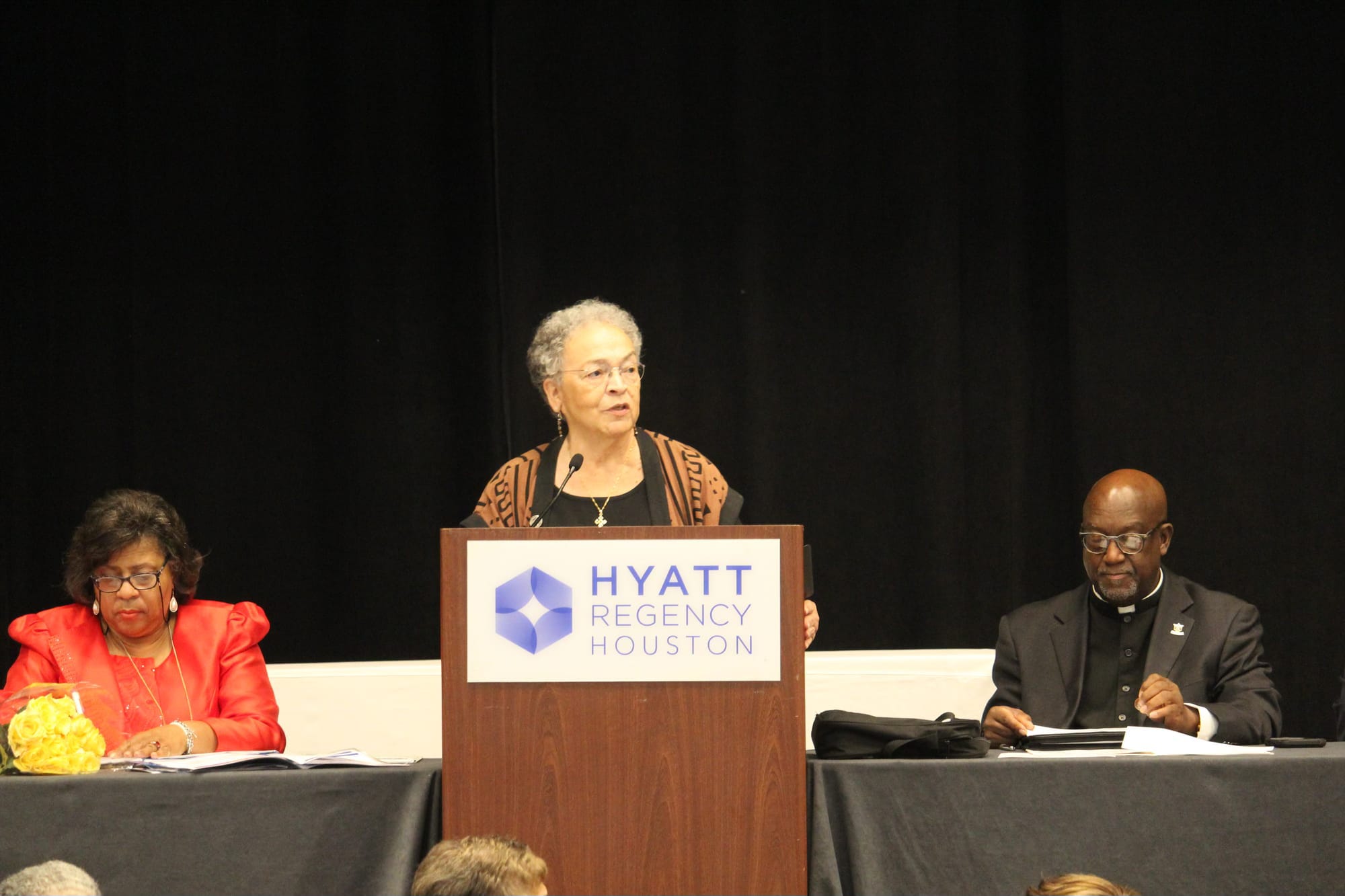
Two rooms, one week, one Spirit.
Clergy discerning mission over maintenance. Laity building platforms instead of pedestals. That is not coincidence. That is what it looks like when a community imagines together in the Spirit, and the response in both rooms was the same: recognition and affirmation. Not surprise, but recognition, the feeling of finally hearing named what had been lived and known all along.
That is what sacramental imagination does. It does not invent something foreign; it makes visible the grace that was already present and moves us together to make the visible tangible.
Where We Go from Here
Discernment was never meant to be the destination. It was meant to be the runway. Over the next three years, and with an at least $2 million investment we are working to raise shared across operations, leadership stipends, convenings, and direct sub-grants, the Initiative moves from imagining to building.
We will widen the circle by bringing in an additional 12 conversation partners each year, deepening and expanding the network of Black Catholic leaders, institutions, and partners engaged in this work.
We will build the leadership formation infrastructure our people have long deserved, with mentorship pathways and intergenerational pipelines that carry this vision past any one generation.
We will launch a research and narrative strategy that tells our own story in our own voice, rather than waiting for others to tell it for us.
We will offer catalytic grants directly to Black Catholic schools, parishes, dioceses, and ministries so that flourishing is not a concept on a page but a resourced reality in a community.
We will pursue economic and philanthropic alignment that moves beyond episodic funding toward sustained, structural investment, and
We will create dedicated spaces for healing and formation, because a people cannot build what they have not first been given room to rest into.
And we will keep showing up, in convention halls and clergy convocations, in dioceses and living rooms, strengthening our civic voice and our institutional presence within the wider Church, so that what we imagine together does not stay imagined. It becomes infrastructure; it becomes Church, and we become not another organization but a catalyst for collaborative transformation working alongside our anchor institutions.
The Invitation
We are not asking the Church to rescue Black Catholics. For if we know anything, we know that no one on this plane is coming to save us. We are inviting Black and Catholic people into the liberating work of creating the conditions of our own flourishing for ourselves and the common good.
We are inviting the whole Church into a movement already in motion, one that insists Black Catholic gifts are not optional additions but essential to Catholic identity in America. Imagination is infrastructure. It is how we build what does not yet exist by first daring to see it by tapping into the mind of God.
If this stirs something in you, I invite you to learn more and join us at The Black Catholic Flourishing Initiative.
Come imagine with us, so we might flourish together.
No posts
Comments
Nothing yet. Say the first thing.
Sign in to join the conversation.