
For months after discovering a noticeable crack in my bathroom rinse cup, I shrugged it off. Probably a superficial wound, I concluded, carrying on the twice-daily ritual of teeth-brushing. Eventually, I noticed a puddle on the counter and saw the crack had deepened to a crystalline fault-line. No big deal, I shrugged, admiring the scar…it’s just water. After every session it became customary to tend to aftermath of the leakage by wiping the counter with a towel and setting it on a rack to dry in time for the next round.
The puddles gradually enlarged and so did the task of sopping up the water. I even attempted rushing the brushing in hopes of not having as big a puddle to clean. Then - at long last - the dawning of an intervening thought brought the needless ritual to a halt.
Why not just get a new bathroom cup?
A simple solution, yet one that had completely evaded me. The long-overdue revelation also brought to light shadows of ancient beliefs I thought I’d long disposed of: Don’t ask for anything; don’t make waves; and above all, remember your role: to shut up and put up.
For those weaned on negative messages and an overall lack of emotional support, it’s not hard to connect the dots. Anyone who grew up with criticism as a primary form of communication, wasn’t protected and supported by parents and caretakers, or who was a target of ridicule, has a subtle-but-powerful soundtrack playing underneath our cerebral cortex. It’s an album full of debilitating hits that informs self-perception. And self-perception affects everything.
A mentor of mine once revealed that, decades after the crimes occurred, she still had to wrestle with her mother’s searing (and oft-repeated) definition of her as “stupid,” a proclamation that was delivered in tandem with a swat to her eight-year-old head. Considerable effort and years of long-term supplanting of the negative label ensued. Eventually, my mentor triumphed over past programming, but admitted every now and then, the shadow belief crept in uninvited.
My parents knew I experienced relentless bullying at school and were quick to remind me I had only myself to blame because I couldn’t stick to a 700-calorie-a-day diet. Not caring to hear another degrading lecture, I stopped expecting support from them, kept the pain to myself, and comforted the emotional ache by sneaking food with stealth precision impressive enough to qualify me for CIA employment. They voiced their disappointment in me often, which only further paralyzed any shot at self-esteem.

“Childhood messages don’t simply influence how we feel about ourselves,” said holistic psychologist Veronica Cole. “They establish what we believe we deserve.”
I became superior at ignoring distress signals of all size and intensities. If the big ones like dread of facing the day and getting out of bed in the morning could be sublimated, innocuous issues like a cracked bathroom cup didn’t even make the radar. Putting up with undesirable situations of all sizes became a survival mechanism when I was younger. But in adulthood, I worked in earnest to turn the ship of embedded beliefs in the opposite direction.
It involved a lot of digging and discarding of beliefs formed by negative experiences, unsupportive people, and a misogynistic culture. Thanks to therapy, support groups, falling asleep to cassette tapes embedded with affirming subliminal messages, and other techniques, I progressed. Which is why the recent cracked-cup scenario stunned me in its revelation of a still-present tendency.
That’s the thing about beliefs: Some are easy to access, while others hide within the indiscernible darkness of the sub-conscious. By nature, they fly under the radar. But viable clues can be behavior, reactions, and aversions. I wasn’t just averse to buying myself a new cup, I was completely blind to it as an option.
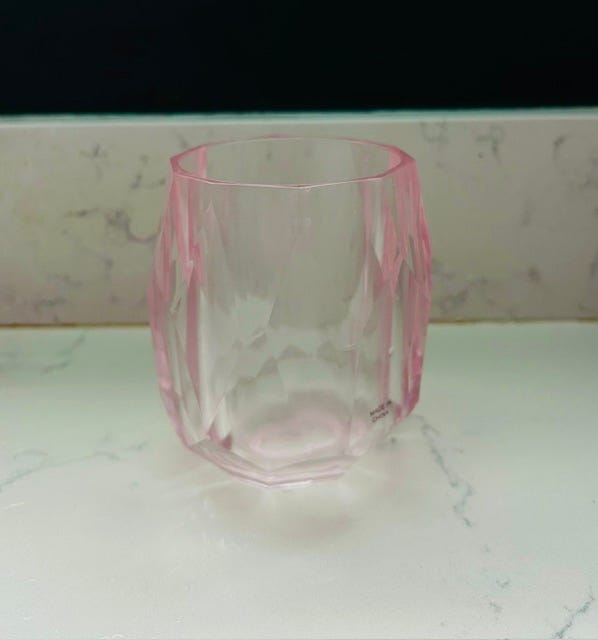
But once my eyes opened to the worn-out pattern, I sprung into action, driving myself to the nearest home décor emporium. I’d make it fun, I decided, marching purposefully down the aisles in search of a pink bathroom cup – the color was the only non-negotiable part of the mission. There were no pink cups in the bathroom department, but I I kept scouring - for nearly half an hour - even retracing my steps back to the bathroom aisle. Finally, I found it in clearance on a bottom shelf obscured by a pile of towels: A diamond-cut pink bathroom cup. Sturdier than the one before and probably crack-proof. But the point is, I replaced a defective model for the simple reason that I would no longer live with the twice-daily aggravation of managing the aftermath of a leaky cup.
Once I realized I had a choice, the rest was easy. Replacement and renewal is always an option, whether it’s a household item, a bad relationship dynamic, or a self-defeating mental habit (still have a few of those).
Freedom really is as basic as a shift in perspective, followed by a revelation, and always cemented with action.

Comments
Nothing yet. Say the first thing.
Sign in to join the conversation.