
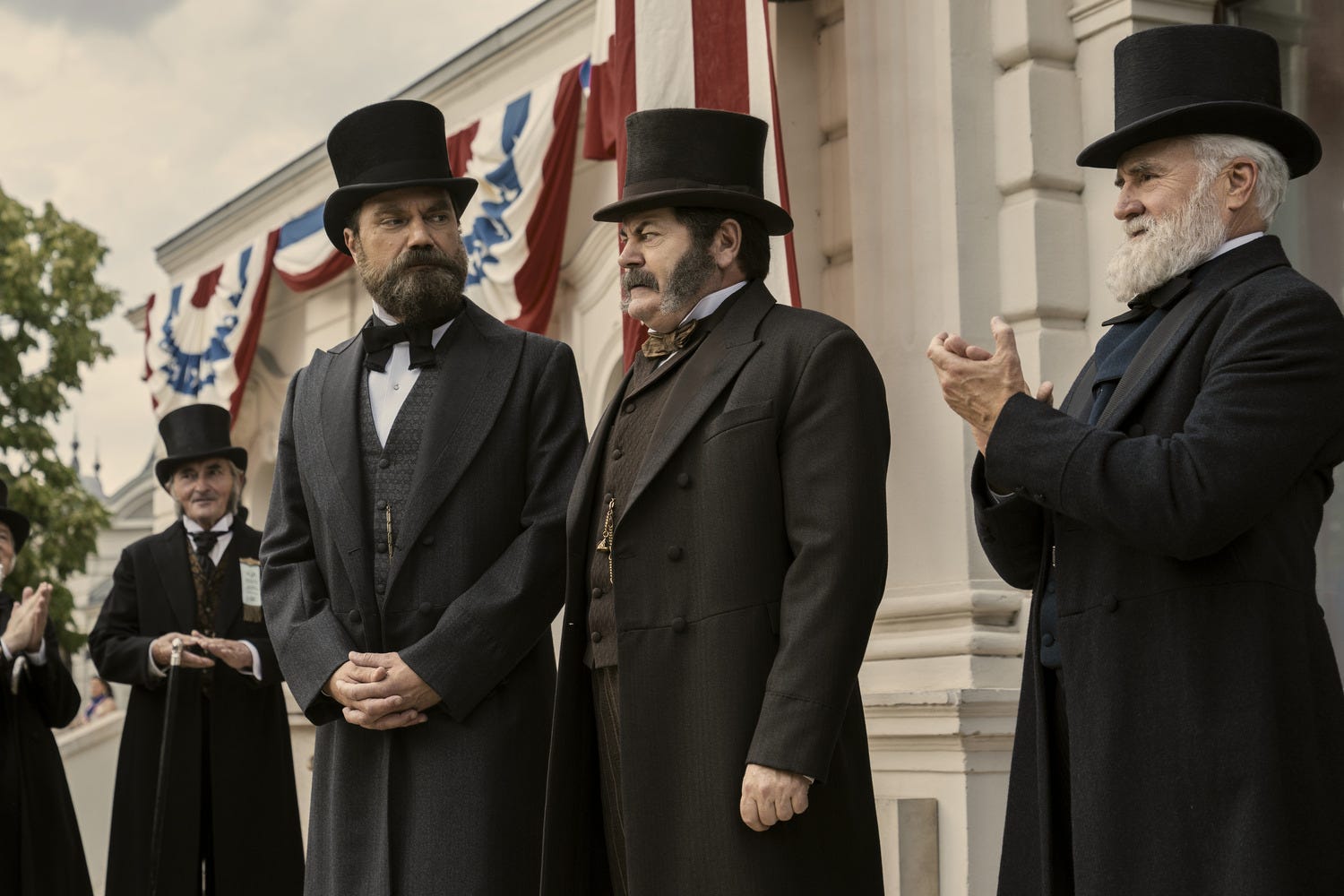
As someone who has a bit of a soft spot for the history of the Gilded Age, the new Netflix miniseries, Death by Lightning, is like manna from heaven.
There it is, in the Top 10! Regular people are sitting down in front of their television and actually watching a show about the assassination of James Garfield. Which means, for the first time in most of their lives, they are forming an opinion about James Garfield.
I could put on my History Major Snob hat and get defensive about the historical inaccuracies or whatnot, but any fictional depiction of real life is bound to have some inaccuracies. Besides, fiction can get at greater truths, even if we have to fudge a few facts. But mainly, I’m excited that, however briefly, it gets people to care about our history.
I’m fond of calling the modern day the New Gilded Age, but I know this is inaccurate. Trump has moved well past the corruption of that era, and besides, the fuel for the elites control was much different 150 years. While they used to keep the rabble in line with some well-placed patronage, today’s elites now manipulate the population via propaganda and he flow of information. As they say, history never repeats, but it does rhyme.
Besides, a lot of what we call historical inaccuracy is really just having a point of view. To use a more modern example, you could make a miniseries about Ronald Reagan and, by simple editorial decisions of which facts to use or highlight, make him either a hero or a monster. What matters is the story we’re trying to tell.
And the story they are trying to tell in Death by Lightning is fascinating. And by diving into those editorial decisions, it says just as much about us today as it did them back in the past. So let’s dive in, and… yeah. Spoilers abound. You should go watch the show first. It’s really good.
The showrunners want us to like James Garfield. That’s not a real problem with me. I like James Garfield, and think he’s a bit of a “What If?” in US history, though maybe not that great of one. Reconstruction was already a dead letter, and no matter how committed he was to civil rights, he wasn’t going to raise Reconstruction from the dead. That die had been cast and the Great Betrayal had already occurred.
The show is invested in a version of Garfield that is most palatable to modern, mildly progressive viewers. It heightens his commitment to civil rights, which was genuine, and invests time and effort to portray him as a good, decent man. And by most accounts I’ve read, he was.
He wasn’t perfect, and the show, to its credit, tries to show that. They depict Garfield failing to support Chinese rights and make the obvious parallel to the rights of freed men. They don’t mention that he was embroiled in the Credit Mobilier Scandal, along with Conkling and Blaine. He was kind of, sort of, not really exonerated by claiming he obtained the money for the shares by a loan rather than a gift, but he was still likely guilty of graft, too. Though not on the staggering scandal of Arthur.
And yeah, he didn’t seek the nomination for president, and he did call on the delegates to change their votes, as they supported him without their consent. But he wasn’t out of politics. He was probably the most powerful Republican in the House, and had only resigned his seat so he could be appointed as a US Senator for the next session. And the whole front porch campaign was sort of thing in the 1800s. Politicians were expected to pretend they weren’t running for president, when they really were.
Still, the broad strokes are true, and the accepted story of James Garfield as a man who rose from almost nothing to the presidency by virtue of his talent and hard work. He is the Horatio Alger story. And yeah, he was a leader of reform, such as it was.
Which gets us to the reason for that story, which goes beyond a TV show. In 1876, the Republicans agreed to end radical Reconstruction in the South, if the Democrats agreed to let Hayes, the GOP nominee, win the disputed 1876 election. The Republicans, and more importantly, the North, turned its back on black Americans so they could go back to business as usual. It was a peace built on turning a blind eye to the egregious acts of the Ku Klux Klan and related white supremacist organization throughout the South, and it is rightly called the Great Betrayal.
And the only way you can justify it, both at the time and to future generations, is by basically portraying the Republicans as reneging on the post-war deal first. Grant tirelessly worked to protect the civil rights of the former slaves and to crush the old slave power, but that’s not the story of his presidency. Instead, it is how corrupt it was. And while Grant remained personally beyond repute, hi administration is known for the Whiskey Ring and yes, Credit Mobilier. Grant, and the Republicans, became synonymous with corruption. So it wasn’t the Great Betrayal of 1876, it was actually the failure of Grant.
Garfield is part of this narrative, as he stood as an honest reformer against the corruption of Grant. Because otherwise, their politics were nearly identical. Both were supporters of civil rights but also of conservative hard money policies and a belief in American business. The only difference was on patronage, and if the sainted Garfield is the good guy, that means Grant is the bad guy. And thus ending Reconstruction was okay, or at least Grant’s fault.
And that ain’t true. That’s a lie we tell ourselves to make ourselves feel better about the Great Betrayal. Or worse, to forget the betrayal occurred at all.
If Garfield is the personification of the American dream, Guiteau is its curdled nightmare. Both come up from nothing, but while Guiteau certainly puts in the work, he lacked the thing Garfield had, whether it is talent or simple moral fiber. Whatever i is, he doesn’t have it.
When I was first taught about Garfield’s assassination, Guiteau was dismissed as a mere office seeker. And while that’s true, it sort of misses the point. He wanted to be the ambassador to France, which, well, is no a reasonable request.
So when I got to college and took more in depth curses on the Gilded Age, Guiteau’s character changed. He wasn’t an office seeker… he was a crazy person. And I’ve long held on to that belief, but it was shook by two recent books on Garfield, Destiny of the Republic (the basis of the miniseries) and President Garfield.
The series truly brings it into focus. Guiteau is a con man and a grifter. And one of the things about con men is that the old saw about not being able to bullshit a bullshitter is completely untrue. They start to fall for their own lies. We see it every day in the universe of grifters feeding off of the wake of the Trump admistration.
Basically, Guiteau missed his window. 150 years later, he could have been the My Pillow guy.
Instead, he’s a cancerous cell clinging to the body politic. You can smell the desperation on him in every scene, and even when he’s being earnest, his body is bowed and he’s covered in flop sweat. I hate to call him an incel, but… I mean the guy couldn’t get laid at a sex colony. Yes, the Charlie Get-Out bit is totally true, and yes, it is hysterical.
But seriously, what a desperate loser. The series could have gone into more detail of the aftermath of the shooting. Garfield hung on for months and was subjected to horrific medical care, but also Guiteau’s trial is its own comedy of errors that is too tragic to actually be funny.
Though cutting straight to his execution and him finally understanding that the world will take no note of him is a delicious ending. But one he likely never internalized. His delusions of grandeur were far too strong.
It’s not quite accurate to say that I admire Arthur, but I do find him endlessly fascinating. Here is a man who was, like Guiteau, little more than a cancer on the body politic for his whole like. He never held elected office, and the political offices he did hold, he would be forced to resign due to corruption.
His whole career was a monument to graft. He stood for nothing other than party politics. He got the right people elected, bribed the right people and took his fair share, and then helped dole out patronage to friends and hangers on. He was, in short, a cartoon of Gilded Age corruption.
To my delight, this is exactly how Nick Offerman plays him. Not just corrupt, but entertainingly corrupt. This is a guy who gets drunk, beats up whoever annoys him, and then goes looking for the sausage man. If he weren’t a real person, it would eb an explicitly comic role.
The thing is, the assassination changed him. He wasn’t worthy of the office and he knew it. And in a way, that self-awareness was his greatest asset. He wouldn’t allow himself to demean the office and instead viewed himself as serving out Garfield’s term. He may have been a thorn in Garfield’s side in life, but he would do his best to complete Garfield’s work in death.
I find that genuinely inspiring.
Instead of looting the White House like he had the Port of New York, he realized the importance of the office but also, that no one had elected him to it. So he viewed it more as his duty to defend the integrity of that office. Also, it didn’t help that Guiteau claimed he killed Garfield on behalf of Arthur, and he rightfully wanted to put some distance between himself and that.
Still, his change was genuine. Conkling almost certainly thought he had a stooge in the Oval Office and instead, Arthur asserted himself as his own man. The Pendleton Act on civil service reforms are still in effect today. Not a bad legacy. It also destroyed any political prospects he may have held.
Signing reform was a betrayal to the Stalwarts, Conkling’s branch of the party, so there’s no chance they would nominate him in 1884. And the reformers didn’t trust him, as he wasn’t one of them. They threw their support behind Blaine. But I’ve always loved this quote about Arthur by Alexander McClure:
“No man ever entered the Presidency so profoundly and widely distrusted as Chester Alan Arthur, and no one ever retired ... more generally respected, alike by political friend and foe.”
There are worse legacies.
Death By Lightning is deeply invested in Garfield’s inherent goodness, yet at the same time it tries to diminish any claims to greatness.
Sure, you can say it is greatness denied. That Garfield had all of the tools to be great, and we robbed of it by an assassin’s bullet. But there is a fundamental cynicism underneath its veneer of righteousness. Greatness is reserved for a select few, and it ain’t you.
The thing is, Garfield was a pretty damn distinguished man and one of the leaders of the Republican Party at the time. OK, maybe he did fall short of greatness, but know who was the giant of the era? James Blaine. More than any other person, James Blaine is the dominant political figure of the Gilded Age.
And yeah, you’ve likely never even heard of him.
If we’re talking about how greatness or fame is ephemeral, Blaine is an even better example than Garfield. A show ostensibly about Garfield is really about Blaine. The 1880 Convention is a political fight between Blaine and Conkling, fought through proxies. Even Blaine’s failure is due to his fame: too many people had a hardened opinion of the man.
He ascends to the Secretary of State, the highest position in Garfield’s cabinet because of course he does. Though not explicit, Arthur might meet Blaine’s approval (“He’s come a long way”), it’s not so much that Blaine is not going to run against him in 1884. Blaine would be a major candidate for the GOP presidential nomination every election from 1876 to 1892. That’s five conventions of being the big man of the party, even when he didn’t win.
Blaine was the most powerful man in America. He would serve as the Speaker of the House, and then as the Secretary of State to two different presidents. He was the primary legislative ally of a third. He was a kingmaker, though never the king. And less than two decades after his death, he was already a footnote.
The Gilded Age passed into memory so quickly, we all forgot to remember it.
There’s no getting around it, Conkling is the villain of the piece.
I don’t think that’s unfair. There’s simply no way you can make a TV series about James Garfield and not make Conkling the villain. He’s the guy who opposes his nomination, fails to campaign for his election, tries to thwart his presidency, and ultimately has the major political showdown. That’s before we get to the fact that Garfield’s killer claimed to be a Stalwart, Conkling’s political faction.
But let’s make the case for Conkling. Because we all contain multitudes.
Let’s start with the obvious: political patronage was not illegal. Hell, the movie about Lincoln attempts to humanize the icon by showing how he got his hands dirty in he political patronage game in order to pass the 13th Amendment.
Yes, Grant’s administration crashed on the rocks of corruption, but as we already discussed, a lot of that is propaganda to have a excuse to end Reconstruction and give up on civil rights. But even moreso, Conkling might have implicated, but he was neve convicted of graft. And he had the political enemies willing to expend the time and money to investigate. They couldn’t find anything on him in the Credit Mobilier scandal and he actually opposed to scandalous pay raise for Congress.
He might have been knee deep in graft and patronage, but it was honest graft. He wasn’t stealing money like Boss Tweed, he was helping friends get elected. Hey, you can call it bribery, but how is it worse than today’s political action committees and web of dark money?
You can also tell a lot about a man by his enemies. And sure, he had a career long feud with Blaine, and he was certainly no friend to Garfield. But he also was the New York opposition to Boss Tweed and Tammany Hall. You think Conkling was bad? Boss Tweed blatantly ripped off the state treasury to line his own pockets. Conkling was showing up to a gunfight, properly armed.
Also, let’s be fair, he agreed with Garfield on everything except political patronage. Garfield might have been a reformer, but Conkling wanted t put people in power who would do advance the same policies as Garfield, mostly. Both were hard money men, opposed the greenback, supported industry and Wall Street, and were deeply committed to civil rights.
I mean, we see Garfield meeting with former slaves so we, as modern viewers, will like him more. He’s one of the good guys. And yes, he did those things. But know what Conkling did? He wrote the goddamn Fourteenth Amendment.
Who has better bona fides on racial justice than Conkling? He was a Radical Republican. He supported Reconstruction in the most expansive sense. He worked to impeach Andrew Johnson. He was the right hand to President Grant, who had an aggressive civil rights presidential platform.
It wasn’t graft for graft’s sake. He was trying to do good things. And again, those were the rules. He wasn’t going to willingly lay down his arms against Tammany Hall, the most famous political machine in US history. You have to win elections first, before you can govern.
The final blow is the final title card, that he slipped into obscurity. Conkling was nominated and confirmed as a Supreme Court Justice. He turned it down, the last man to do so, after confirmation. He was still a big deal, even if he did die in the Great Blizzard of 1888.
Maybe, just maybe, he deserved better from the showrunners. But you need a villain.
Conkling’s concubine probably could merit her own miniseries. She was at the center of most of the political machinations of the Gilded Age, and was no slouch herself. She practically ran her father’s campaign for president in 1868 (Salmon Chase).
She has her moment here, as she torpedoes Conkling’s plan to resign and get re-appointed to the Senate by revealing her affair. The wives revolt, and the chastened husbands vote against Conkling. Man, its a cool moment and shows how luck can intervene… it’s also not true.
The Conkling-Garfield showdown was in 1881. Two years earlier, Kate Sprague’s husband, the senator for Rhode Island, confronted her and Conkling while wielding a shotgun. It made the papers, is what I’m saying. The cat was well out of the bag on their affair.
Still, I like when another story crosses over, so just for shits and giggles, let’s go over Sprague’s story. I get why it was cut from the miniseries, as it goes far and wide, but it also goes to show that there is more stories to tell.
Let’s back up. Salmon Chase was the Treasury Secretary under Lincoln, part of the famed Team of Rivals. Like almost everyone else in the Cabinet, Chase thought he should be the president instead, but unlike the rest of the Cabinet, he kept maneuvering for the position.
A large part of this campaign was his daughter, Kate. Chase was a widower, so it fell upon Kate to be the family’s representative in the Washington social scene. And, well, she killed it. Kate hosted one of the most popular salons in DC, and was a social rival to no less than the First Lady herself.
Not short on prospects, Kate eventually settled on William Sprague, a rich textile magnate and Rhode Island’s governor. Their wedding in 1863 was a massive extravagance, and the center of that year’s social scene. Mary Todd Lincoln did not attend.
Chase’s maneuverings were for naught when he was removed the Cabinet, but ended up with consolation prize of Chief Justice. This thwarted their ambitions in 1864, but renewed them in 1868, after Chase served as the presiding judge of the impeachment of Andrew Johnson.
Chase needed an acquittal for Johnson so he could snag the Democratic nomination out from under him. Sprague, now a Senator, voted for conviction. It did not go over well with the wife, nor did his drinking. Things bottomed out when, after thinking they had the nomination sewn up, Tammany swooped in and secured the nomination for New York governor Horatio Seymour, with the backing of Samuel Tilden.
Ley it be known that Kate remembered her enemies. She essentially stopped living with her husband, openly having affairs with multiple men, so much so that it was widely rumored that her second child was fathered by someone else. Maybe even Conkling.
She had her revenge on Tilden in 1876. when the election was disputed, Congress appointed a commission to sort the matter out. In charge of the commission was one Roscoe Conkling, who was Kate’s lover by this point. It’s not known how much influence she wielded, but it certainly wasn’t zero. The election was thrown to Hayes.
We get the shotgun incident in 1879, and finally the Conkling resignation in 1881. She would finally divorce her now penniless husband in 1882 and go back to her maiden name. She became a recluse and died in poverty in 1889. No one outside of her immediate family attended the funeral. Read the notice:
“No Queen has ever reigned under the Stars and Stripes, but this remarkable woman came closer to being Queen than any American woman has.”
I demand a sequel.
We close with the women because the women are often the people in history left holding the bag. The men go off and do their Great Things, leaving their wives and daughters behind to quietly clean up the mess.
Casting Betty Giplin in the role was a statement that this wasn’t meant to be the quiet, supportive wife role. And she is depicted as an active, even equal partner in Garfield’s political life.
Maybe she was, maybe she wasn’t. It’s hard to know what goes on behind the closed doors of anyone else’s marriage. Yes, it is again an attempt to modernize Garfield and make him a more likeable character for modern audiences, but I think its well-earned.
After Garfield’s death, she would scrupulously collect and organize his papers. She created, essentially, the first presidential library. So when she tell Guiteau that she would erase him from history, she wasn’t kidding. The real Crete actually did that.
Yes, that final scene with Guiteau is almost certainly a fantasy, existing only in the writers’ head. But it serves s a perfect signpost to close the series, and relates it to another popular historical biopic of recent vintage, Hamilton.
Eliza also collects the papers of her husband and tried to complete his work. She reinserts herself as the active participant and, as the song asks, “Who lives, who dies, who tells your story?”
That’s what it comes down to. You need someone to tell your story, and James Garfield was lucky enough to have Lucretia. She continued to be a public figure, campaigning for Teddy Roosevelt and Woodrow Wilson, as a supporter of Progressivism. So maybe the series wasn’t so far off making the conservative Garfield a modern liberal. His wife made that journey.
She lived long enough to serve as a volunteer for the Red Cross during World War I and also to attend the first Rose Bowl Parade. His story ended, but hers didn’t. He was trapped in historical ember, but time kept moving on, rapidly so.
The world she left did not remotely look like the one her husband did. But stories survive, even if we don’t control who tells them. More than anything, I hope they managed to honor her by telling a story the way I think she would want it told.
No posts
Comments
Nothing yet. Say the first thing.
Sign in to join the conversation.