
Signal Forward is a series inside The Ready Set, same publication, different altitude. The Ready Set is for leaders. Signal Forward is for everyone else: the individual contributors, specialists, and practitioners whose behavioral patterns determine whether their contribution gets seen, valued, and rewarded, regardless of title or tenure.
New here? Start with the first article. In People or HR? Pass this along to your team.
Most career advice is organized around moments. The big presentation. The critical conversation. The high-visibility project. The stretch assignment that finally gets you noticed.
The implicit logic is that career advancement is a series of discrete events you either win or lose. Get enough wins and the trajectory takes care of itself.
That’s wrong. And it’s wrong in a way that keeps genuinely capable people stuck for years while they wait for the next big moment to arrive.
And this has been frustrating to watch over the years. We see clients all the time doing great work for their organization’s and yet start to feel resentful after years of doing it and not getting where they envisioned, and not truly understanding why. They did the work, they had great success, so they start to feel as if the organization or their leader is just taking advantage of their willingness to produce wins.
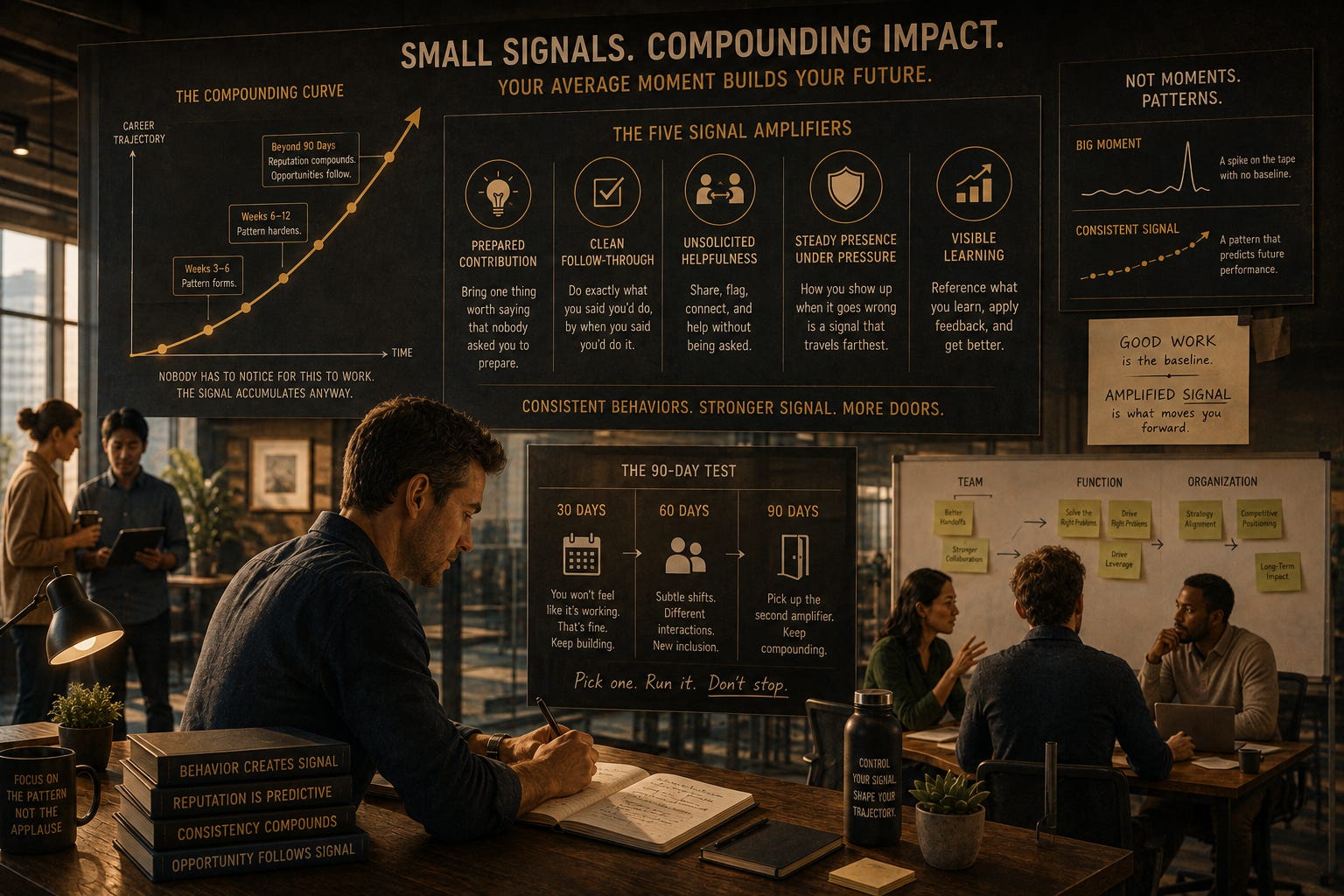
Your career trajectory is not determined by your best moment. It’s determined by your average moment. And your average moment is shaped by behaviors you practice so consistently they stop feeling like choices.
That’s the Signal Amplifier. Not a single action. A compounding pattern.
Think about how financial compounding works. Small, consistent contributions produce returns that grow disproportionately over time. The early deposits don’t feel significant. The account balance barely moves in the first year. But the mechanism is running regardless of whether it feels like it’s working. And ten years in, the person who started early and stayed consistent has built something the person who waited for a windfall cannot catch up to quickly.
Professional signals work the same way. Almost nobody applies this thinking to their career.
I watched a friend spend months preparing for one big moment. It was a board-level update that he was convinced would change everything for him. It went well. In fact, it went really well. But then…nothing happened. And he couldn’t explain it at time, but it was because nobody had a pattern of evidence to attach it to. It was a single data point with no context. A spike on the tape with no baseline to gauge it from. The organization noticed it and then went back to whatever impression they already had of him, which was mostly neutral. One moment just can't carry a signal that hasn't been built yet.
Here’s what consistent signal compounding actually looks like over ninety days.
In the first two weeks, nothing visible happens. You show up prepared. You contribute without being asked. You follow through without being reminded. The room doesn’t respond differently. Nobody pulls you aside to say they’ve noticed. You’re one voice among several and nothing feels like it’s changing.
Weeks three through six, a pattern starts forming in the minds of the people around you. Not consciously. Nobody is sitting in a meeting thinking “I’m updating my assessment of this person.” But the data is accumulating. This person adds value. This person can be counted on. The pattern isn’t a reputation yet. It’s the raw material reputation gets built from.
Weeks six through twelve, the pattern hardens. People start expecting your contribution. They notice when you’re not in the room. Your name comes up in conversations you’re not part of. Not because of any single thing you did. Because of the accumulated weight of consistent behavioral evidence pointing in the same direction.
That’s compounding. One small behavior, practiced without interruption, producing career returns that are disproportionate to any individual instance of it.
And honestly, this is probably the toughest part. It almost feels counterintuitive a bit when your grinding in the middle of it because there won’t be any feedback at the beginning to tell you it’s working. You just have to trust in yourself that what you’re doing and how you’re doing it is making a difference and that the difference is slowly build a perception of you that will pay gains later.
And here’s the part that most people miss entirely: nobody has to notice for this to work. No leader has to formally acknowledge it. No program has to recognize it. The compound interest accumulates in the minds of everyone who experiences you, whether anyone says a word about it or not.
Five specific behaviors produce this compounding effect. None of them are dramatic. None require permission or a sponsor or a special opportunity. Each one, practiced consistently, produces career returns that are invisible at thirty days, noticeable at sixty, and genuinely trajectory-shifting at ninety.
Prepared Contribution. Arriving at every meeting with one thing worth saying that nobody asked you to prepare. Not a speech. Not a lengthy analysis. One observation, one question, one connection between this conversation and something the room hasn’t considered yet. The person who does this consistently across fifty meetings in a quarter becomes the person people want in the room. Not because any single contribution was brilliant. Because the pattern is reliable.
And this holds across every environment I've worked or coached in. Corporate offices, plant floors, healthcare systems, government agencies, it doesn’t matter. The percentage of people who consistently bring an unsolicited contribution to meetings sits somewhere around maybe ten percent. Fifteen on a good day. Which means if you do it every time, you're already in rare company before you've said a word.
Clean Follow-Through. Doing exactly what you said you’d do, by when you said you’d do it, without anyone having to follow up. This sounds basic. It is basic. It is also rarer than it should be, which means the person who does it consistently stands out immediately. Every dropped ball, every “I’ll get that to you by Friday” that arrives Tuesday, is a small withdrawal from the signal account. Clean follow-through is a deposit every single time.
Unsolicited Helpfulness. Sharing information, flagging risks, connecting people, or offering perspective without being asked and without any direct benefit to yourself. Dani sending her logistics partner a five-minute weekly update she wasn’t required to send. Marcus D. texting the next shift about the access panel behind the water heater so they don’t waste twenty minutes. Small. Consistent. Compounding.
Steady Presence Under Pressure. How you show up when something goes wrong is the behavioral data point that travels furthest and fastest through an organization. One calm, clear-headed response to a crisis is worth fifty routine meetings in terms of the signal it creates. But it only reads as signal if it’s consistent with how you show up when things are fine. If you’re solid on routine days and unpredictable under pressure, people remember the unpredictability.
In fact, I've seen this derail people I genuinely believed were ready for more. Smart, capable, hardworking people who had built a solid signal over time and then let pressure expose something that couldn't be unseen. The frustrating part is that it's almost always fixable. Remember, the R-R-R sequence we covered earlier in this series? It exists specifically for this, but you have to build the discipline before the pressure arrives. Not during.
Visible Learning. Referencing what you took from a past experience, applying feedback openly, changing your approach based on what didn’t work before. This behavior signals something specific to everyone watching: this person gets better. And people who get better are worth investing in, because the return on that investment compounds too.
The most common career complaint I hear is some version of this: I’m doing good work and nothing is happening.
That complaint always tells me one thing immediately. That the person saying it has confused doing their job well with building a signal. Those aren't the same thing and nobody should pretend they are. Good work is what keeps you employed and that’s important. But it’s only part of the story. Signal is what actually moves you forward. If you've been doing good work for two years and nothing has changed, let me queue you in on something…the work isn't the problem.
Good work is the baseline. It’s the price of entry. The organization expects good work from everyone it decided to keep. Good work at a 3.5 average is invisible. It meets the bar. It doesn’t build anything.
Good work amplified through consistent signal behaviors, operating at a 4.8 or above, is the force that makes careers move. The difference between those two people isn’t talent. It isn’t effort. It isn’t even output quality, most of the time. It’s whether the behavioral evidence they’re generating every day is compounding into something that changes how people predict their future performance.
One of my all-time favorite coaching moments is when this finally click with the individual I was working with and it changed everything for her trajectory in the organization. She had been doing phenomenal work for years but was kept in the same role. Once she realized that her signal being sent out wasn’t the one she was wanting, she made a few changes, had a few conversations, and bam, all the sudden she was being talked about different in the leader circles. 6 months later and that promotion came.
The amplifiers don’t change the work. They change what the work is building toward.
Pick one amplifier. Just one and run it for ninety days without stopping.
Not two. Not all five because they sound good. Just one. The one where the gap between where you are and where you could be is biggest. Run it until it stops feeling deliberate and starts feeling automatic.
At thirty days you won’t feel like it’s working. That’s fine. The compounding is running whether you can feel it or not.
At sixty days, something will shift in how people interact with you. The shift will be subtle. Someone will ask your opinion on something they wouldn’t have asked about before. You’ll get included in a conversation that would have happened without you six weeks ago. A colleague will reference something you said in a previous meeting. Small things. Real things.
At ninety days, pick up the second amplifier.
Fair warning. Around day twenty-five, you're going to want to add something and it'll feel like discipline. It isn't. It's the same instinct that makes people abandon a strategy the week before it starts working. Stay with one thing until it stops requiring effort. That's when you’ll know it’s time to add the second.
That’s the whole system. It’s not complicated, but it is genuinely hard to sustain. And it’s worth it in a way that the big-moment strategy almost never is.
Question for this week: Which of the five amplifiers would create the most visible shift in your signal if you ran it consistently for the next ninety days? And more honestly, which one are you most likely to talk yourself out of because it feels too small to matter?
That second question is usually the more useful one. I’d love to hear your answer in the comments.
One more thing before you go.
Everything in this series is being built into something larger. Later this year, we’re releasing a significant update to The Ready Set experience, an extension of the AI Ready Set Coach that will meet you exactly where you are, whether you’re two years into your first real role or two levels from the executive suite, and grow with you as you move. For individual contributors, that means the full Signal Forward framework: the behaviors, the disciplines, the trait development, and guided content built specifically for people doing excellent work who want to make sure it doesn’t stay invisible. More details coming soon. If you’re already a paid member, you’ll be among the first to know.
More Signal Forward coming soon. Stay with us.
By Ryan Carnes | A data-backed development experience
Providing executive caliber leadership and talent content and resources to everyone. Subscribe free and get new behavioral-based leader and talent insights every week.
Plus two Ready Set resources to put to work immediately.
Comments
Nothing yet. Say the first thing.
Sign in to join the conversation.