
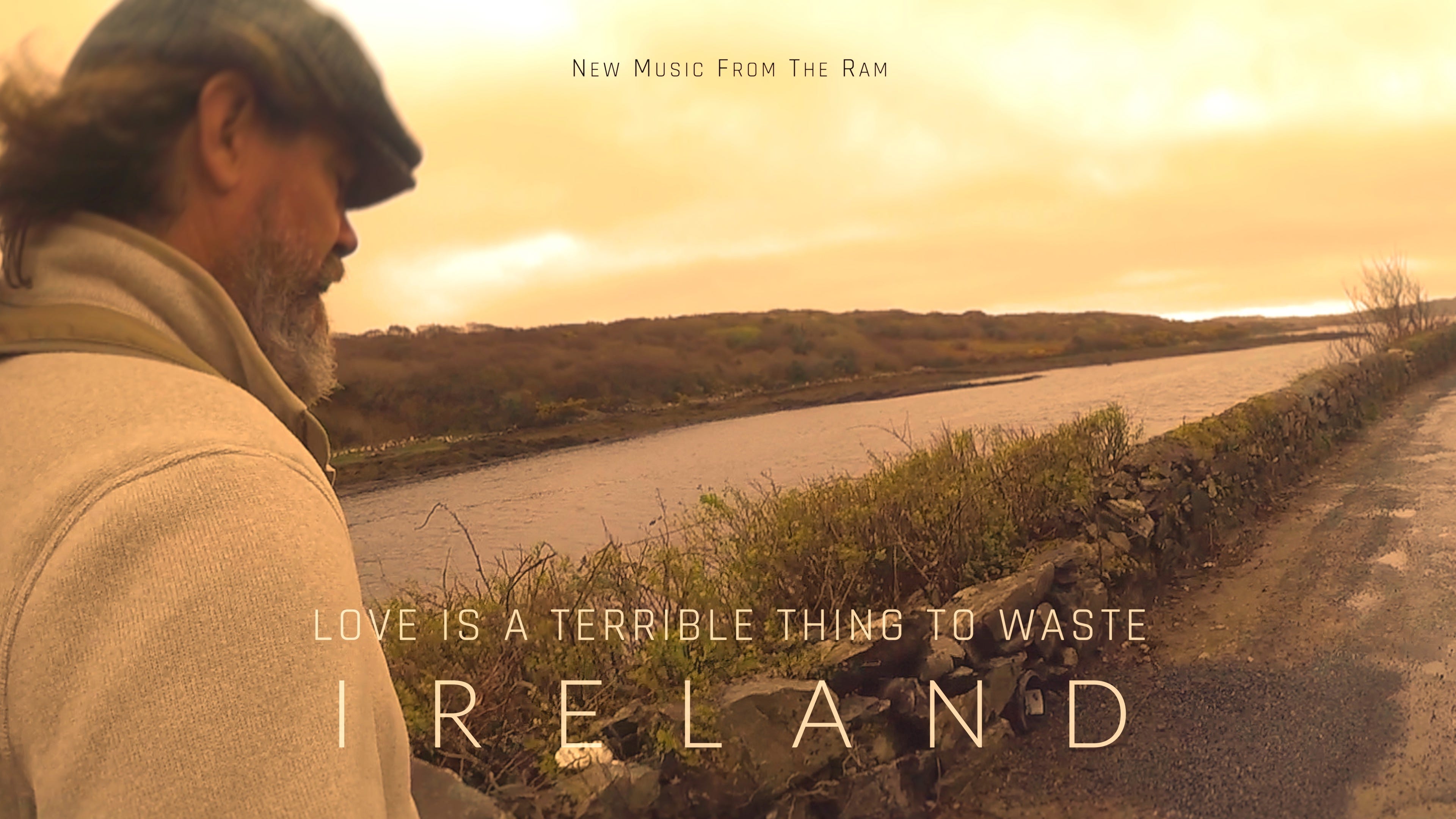
A still from the official video, walking with my brother to a cafe in Clifden, Ireland. The birthplace of my grandmother.
I just wrote the studio notes for the song Join Along, my approach to this song in the studio was virtually the same. Both songs were part of a “studio live” recording session we did for all the new material, as a session warm up. Why release something that’s already been released? Great question. Firstly, songs, music, are not static, they are living things. They evolve as the band breathes life into it, the meaning changes as the listener embraces the song. Secondly, I can honestly say about my early releases that I did not know what I was doing in the studio. My understanding of mixing and mastering was in its infancy.
In the end, each song changed substantially when the band translated it back to me. Over the course of a few years, both songs were key parts of our road tested set list. The resulting sound was far better than what I recorded during the initial demo for each song. In the past, my process was to release the demo as the single. Since then (2020), I’ve settled into the process of cutting a fully formed demo by myself in the studio, then presenting new material to my band and let the magic happen. The magic my friend, is in the rhythm section. No tethered click track, just a loose groove that feels like walking down the street with the crew. Nothing feels better.
As mentioned in a few of the other Studio Notes entries, we track everything here at the house with a fully mic-ed drum set, with guitar, keys, bass, and scratch vocals running silently into the computer interface. Overdubs are minimal, I have the band do 2 takes per song per session. Once that is done, the bass and drums are locked in and set as the foundation of the song. I will sometimes overlay a digital drum model over top to enhance the kick or snare, but I did not need to on these songs. The bass and drums were perfect, thus is the benefit of taking a live band into the studio. Having finished drums and bass makes life easy for me, it’s a clean process that works for us. We use our gigs to work out the kinks of any new material, or any changes, completing the hard work outside the recording studio sessions.
Here are the overdubs I usually do:
We have a Nord Stage 4 set up, along with a Moog Model D. Some sessions, when our keyboard player is absent, we track everything separately. Most times, he’s there and we recall the keyboard model he used, and do a few more takes of his solo on each song. I believe on one song I took two separate Rhodes solos and hard panned them left and right to amazing results. I’ve talked with Mike about this and his feedback is that I need to give him more time to work on the recordings. I’m cool with that, and will take that into consideration on future releases.
For guitars, I over dub a clean guitar tone later based on what keyboard model was used as well as the sounds of the drums, and bass. This brings me to a very important point. For my next album, I am going to record all of the songs on a single project in Logic Pro X. Another option is to simply record a live set either on my QSC Touchmix or my friend’s Midas console. No click, controlled sound separation, simplified production. I did that for about 80% of the I Am Nowhere, I Am Everywhere album, and was able to overdub every song in a few long takes, once I mixed one song, for the most part the entire set was mixed. Mixing and mastering are a huge part of recording and releasing material. Anything you can do as an artist to streamline these processes is worth its weight in gold.
The guitars themselves are pretty straightforward. Either my white Gibson ‘61 custom Les Paul SG, Sister Rosetta Sharpe’s classic axe, of my custom shop Fender Telecaster, tobacco burst. Those two are the standards and I run them through a Fender Chris Stapleton signature Princeton. On top of the Princeton is a Universal Audio OX.
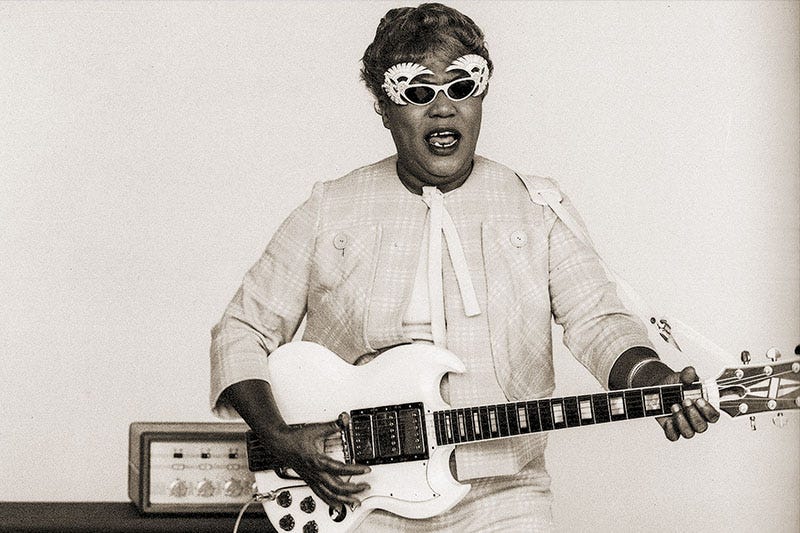
I love everything about this SG, as seen here being played by one of the most bad assed blues singers of all time, Sister Rosetta Sharpe.
Its funny to talk about guitars and amps as I have so many of both, over the years I experimented with so many combinations, rigs, fx, and setups. Problem is, when playing live you need to keep it simple, and minimize the points of failure. In every situation the Princeton stood out both with tone and ease of use. Recording with the OX provides exceptional delay and reverb fx, and the tremolo on the Princeton is truly second to none. With the amp decided upon, guitars were a bit more difficult to narrow down. Both guitars have necks that are pure butter to play, both stay in tune nicely for shows and in the studio. Ha, this is funny. I should mention that on the Gibson ‘61 reissue, the Maestro Vibrola is a nightmare for tuning. Just do yourself a favor and buy the Mojo Axe VibroStop aftermarket kit and lock the entire bridge down. My bad for getting into the weeds, but this is studio notes, a place where I document my failures in the studio. To fail, is to learn. Moving on to the vocals.
Vocals are another animal entirely. That being said, running through all the songs on an album, at once, two takes a piece, just like it was a couple sets of a 2.5 hour show is a great way to take care of business. Rarely are my scratch tracks reusable at any audible volume because I will be whispering the lyrics in front of the drum set during our initial session. I’ll set up a vocal track stack in Logic, run through 2 to 3 times over both of the bands takes, do background singings, harmonize and double where needed, all through a Townsend Sphere 22 stereo mic.
My vocal takes used to suck, even if the performance was good. I used to have a few different mics in front of me during my takes, but a local mastering engineer, just told me the Townsend was so much better, that there was no need for any other additional mic tracks. The mic is that good, so good that Universal Audio bought the company I met years ago at NAMM in Anaheim, CA. Here it is here. Pretty cool tech that saves me and my engineering efforts hours in studio post production.
Given that I’m following these same procedures now, as I work on songs for my upcoming album, smells like progress. I am applying everything that I’ve learned, though at times, in the thick of it I may not realize it. A few things I am going to do differently with these new songs when it comes to vocals. Im going to work with a female backup singer and build out more of a traditional gospel approach to my singing. I look forward to sharing the results in a few months.
For now, I have one last song to write about from last years album, “The Moon’s Loving Light“. Talk soon.
LYRICS:
Take to the street to play music
Got my amplifier, open guitar case
All of the hookers and hustlers
Gonna make em move, where they congregate
Let me tell you
Prostitution’s illegal but ya’d never know by the look of this place
Mind you I’ve got no problem ‘cause I tell you LOVE, is a terrible thing to waste
Ask me where Im going, I’m going way down town
Ask me what I’ll be up to, said I’m a gonna spread a little love around
A little love around
Little love around
Little love around
Little love around
Playing myself some guitar, got a big old smile, right across my face
I’ve been out here for 3 hours, I think its about time, to smoke a jay
Inspiration she finds me, on a crowded sidewalk or just about any place
When I’m with her I hold her so closely ‘ cause I tell you love is a terrible thing to waste
Ask me where Im going, I’m going way down town
Ask me what I’ll be up to, said I’m a gonna spread a little love around
A little love around
Little love around
Little love around
Little love around
METADATA:
Love Is a Terrible Thing to Waste
The Ram
UPC: 199080246245
ISRC: QZHN52570341
Release date: April 18, 2025
ASCAP Work ID: T9275161847
ASCAP Singer Songwriter IPI Number: 375350750
ASCAP Publisher IPI Number: 375351159
ABOUT THE SONG:
There’s a few events that comes to mind when I think of this song, all the stories beckon back to some of my fondest memories while living as a broke artist in East Coast cities. I once knew NYC and Philadelphia like the back of my hand, but cities change. I’ve not lived there since the 1990s, which was a lifetime ago. When I lived in either city, I worked, but never had two pennies to rub together.
That was not a complaint, merely a statement about my income at the time, looking back, those were good times. It may be true that I’ve been robbed, ridiculed, beaten, and cheated, but never broken. These experiences made me who I am today: especially when I stood up for myself, and learned to recognize who my people were. My family, the creatives, the restaurant workers, the artists, the queers, the outcasts. With them I shared time with some of the most beautiful moments of my life. Many are gone, with respect to them, their memories, I wouldn’t change a thing. I know that each experience was a stepping stone to where ai am today.
I don’t know how I came out unscathed. I don’t wish on anyone the experience being chased down the street by an unsavory character in Camden, NJ, or doing the same in a Brooklyn subway, or on Fordham Ave in the Bronx on foot while buying weed. Nothing bad ever happened, I’ve gotten my ass kicked, but I never got stabbed or shot, and for that I consider myself lucky. Travel and life in our cities has taught me to love all people, be aware of your present surroundings, because tomorrow is not guaranteed. Nothing at all is guaranteed in life.
Check out all the other videos from the new album, “I Am Nowhere, I Am Everywhere” by the Ram out April 18, 2025.
ABOUT THE RAM:
Mark “The Ram” O’Donnell is an independent American composer and visual artist based out of Carlsbad, California. He performs original, surf-inspired, West Coast rock-and-roll.
For more information about the Ram and his music, go to www.TheRamMusic.com
MORE INFO:
I currently use DistroKid to get everything out to the streaming platforms, Disco for all sync requests, Bands In Town to list live shows, and Substack for just about everything else.
Share The Ram: Art, Music, Saltwater, & Snow
The Ram: Art, Music, Saltwater, & Snow, consider becoming a free or paid subscriber.
Comments
Nothing yet. Say the first thing.
Sign in to join the conversation.