

If someone told you a couple of months ago that a satirical political page would lead to massive on-the-ground protests in Delhi and result in the resignation of a sitting minister, you would probably think it was a script for a dystopian comedy.
But here we are.
While the whole movement and the resignation were unexpected, what we knew was that the protests would face an onslaught of online disinformation. That’s exactly where Team WebQoof came in. While our reporters were busy covering the protests from the ground, WebQoof was working overtime tracking the relentless mis/disinformation around the Cockroach Janta Party (CJP), the protests and the aftermath.
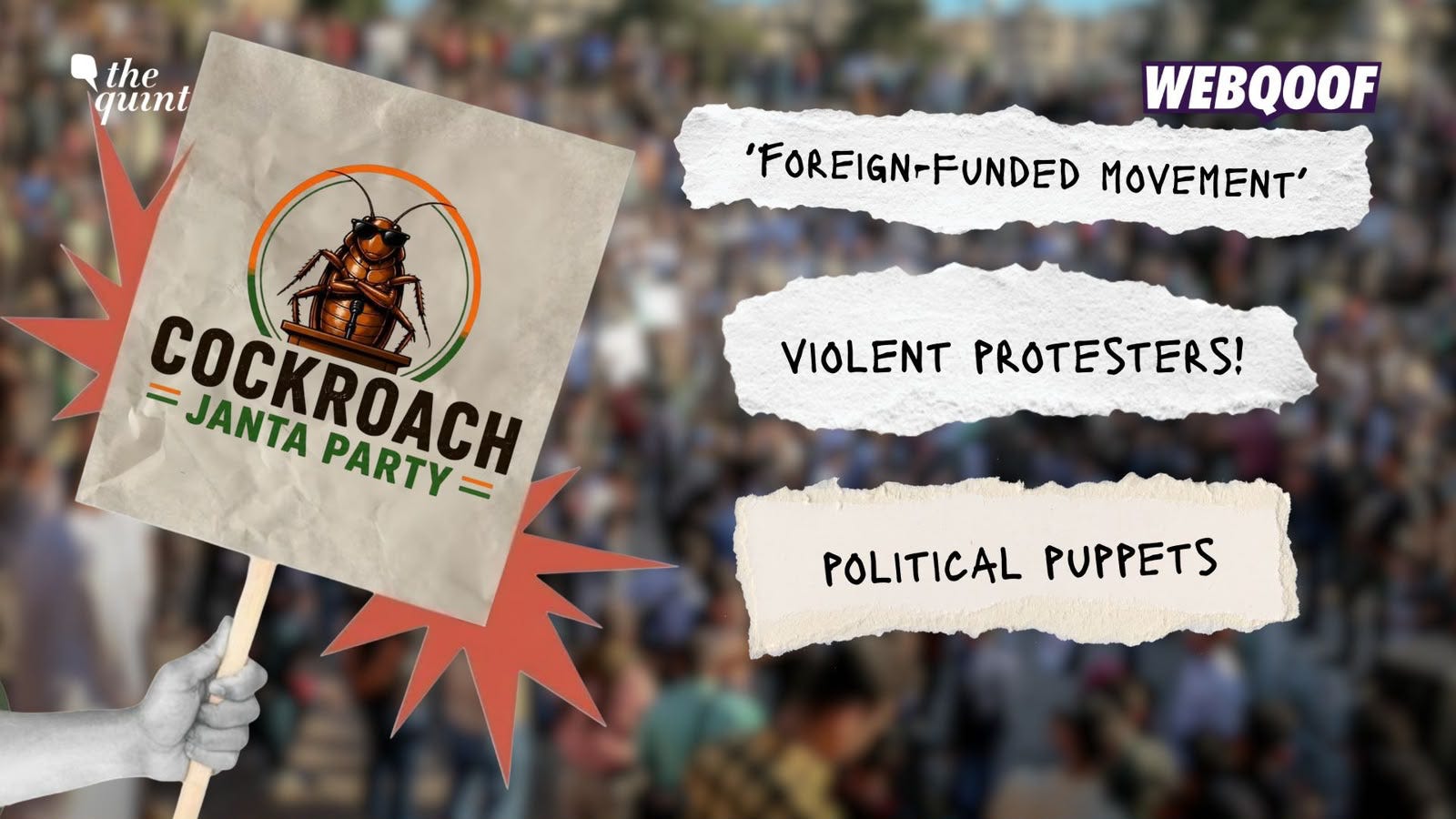
Let us dive into how the internet tried to squash the CJP with ‘fake news’, and how we debunked it.
We don’t just break stories. We stay with them. Stay informed on the stories no one else is willing to tell with The Quint— Become a Quint Member today*!
Politicians In The Crosshairs of Misinformation
The first phase of the misinformation campaign involved bringing top Union Ministers into the fray using both false statements and deepfakes.
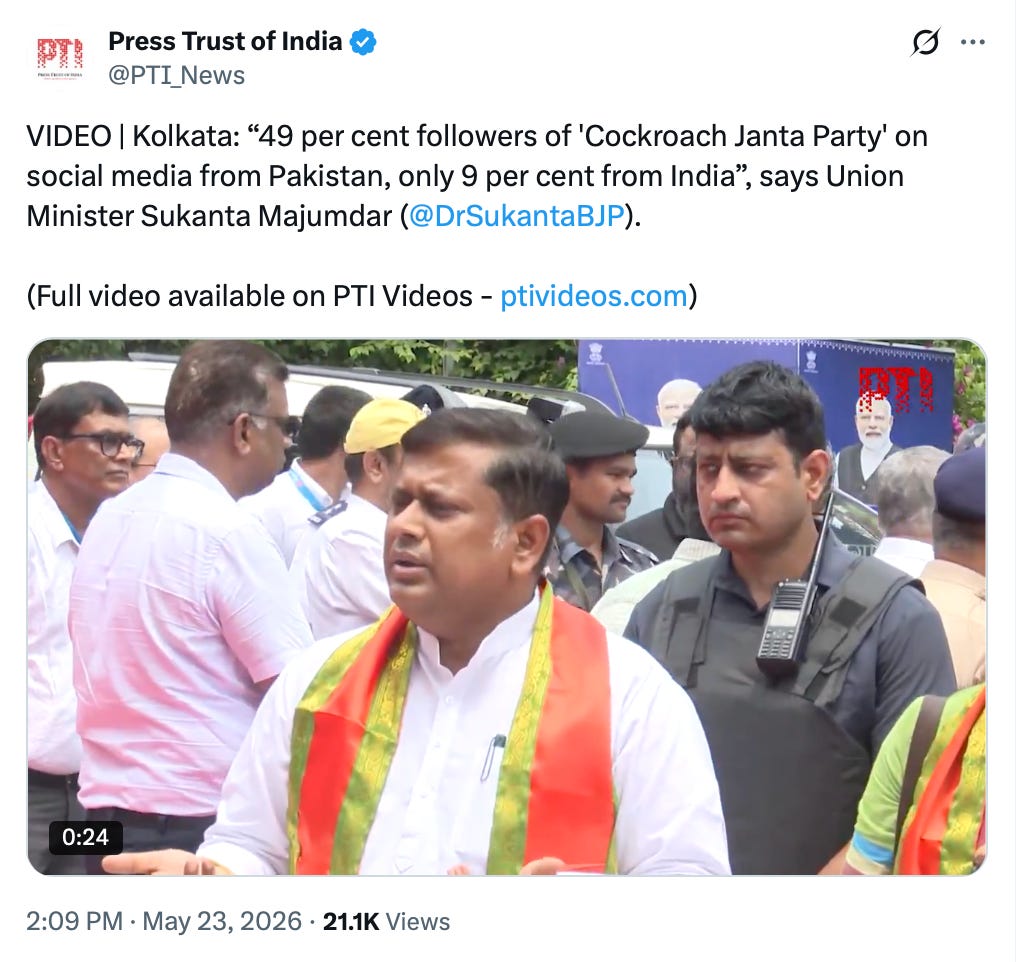
When the CJP first gained traction on Instagram, Union Ministers like Kiren Rijiju and Sukanta Majumdar took to X to claim that the movement was a cross-border influence operation. They alleged that 49 percent of the CJP’s followers were from Pakistan.
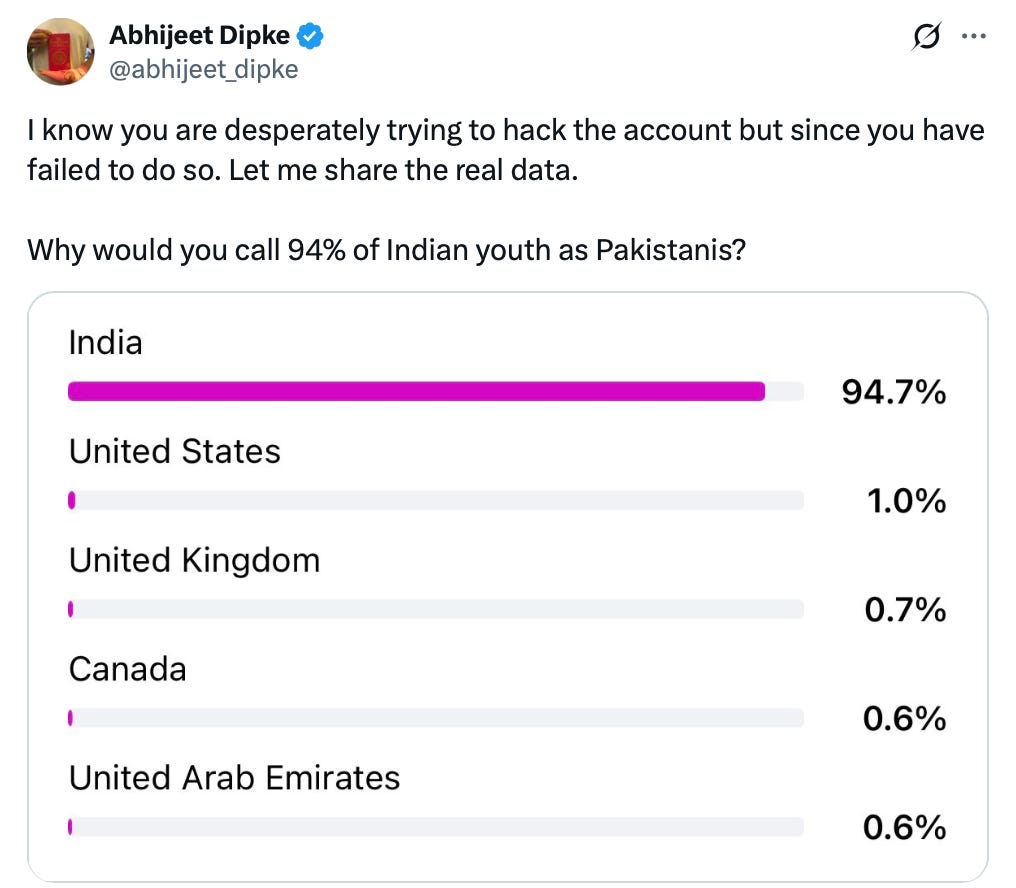
We ran an independent analysis of the CJP’s founder, Abhijeet Dipke, who shared the Instagram account’s stats, showing that a whopping 94 percent of the followers were from India, with only a minuscule fraction being bots.
But it did not stop there. The internet soon flooded with deepfakes. A manipulated video of External Affairs Minister S Jaishankar went viral, falsely claiming he had asked the US to deport CJP founder Abhijeet Dipke to India. Another alarming deepfake claimed to show Delhi Police PRO Rajeev Ranjan stating he had received “clear orders” from Union Home Minister Amit Shah to end the CJP protests “at any cost”. We fact-checked both videos and found them to be completely fabricated.
Targeting Activist Sonam Wangchuk
When climate activist and educator Sonam Wangchuk joined the CJP protests and began a 26-day hunger strike at Jantar Mantar, he immediately became a target for bad actors.
Our team debunked an AI-generated image of a purported Delhi Police Inspector named Shivani Chaudhary. The fake image was shared alongside a fabricated quote claiming Wangchuk had willingly asked the police for medical attention because he felt “betrayed” by CJP leaders who were allegedly living in a “5-star apartment”.
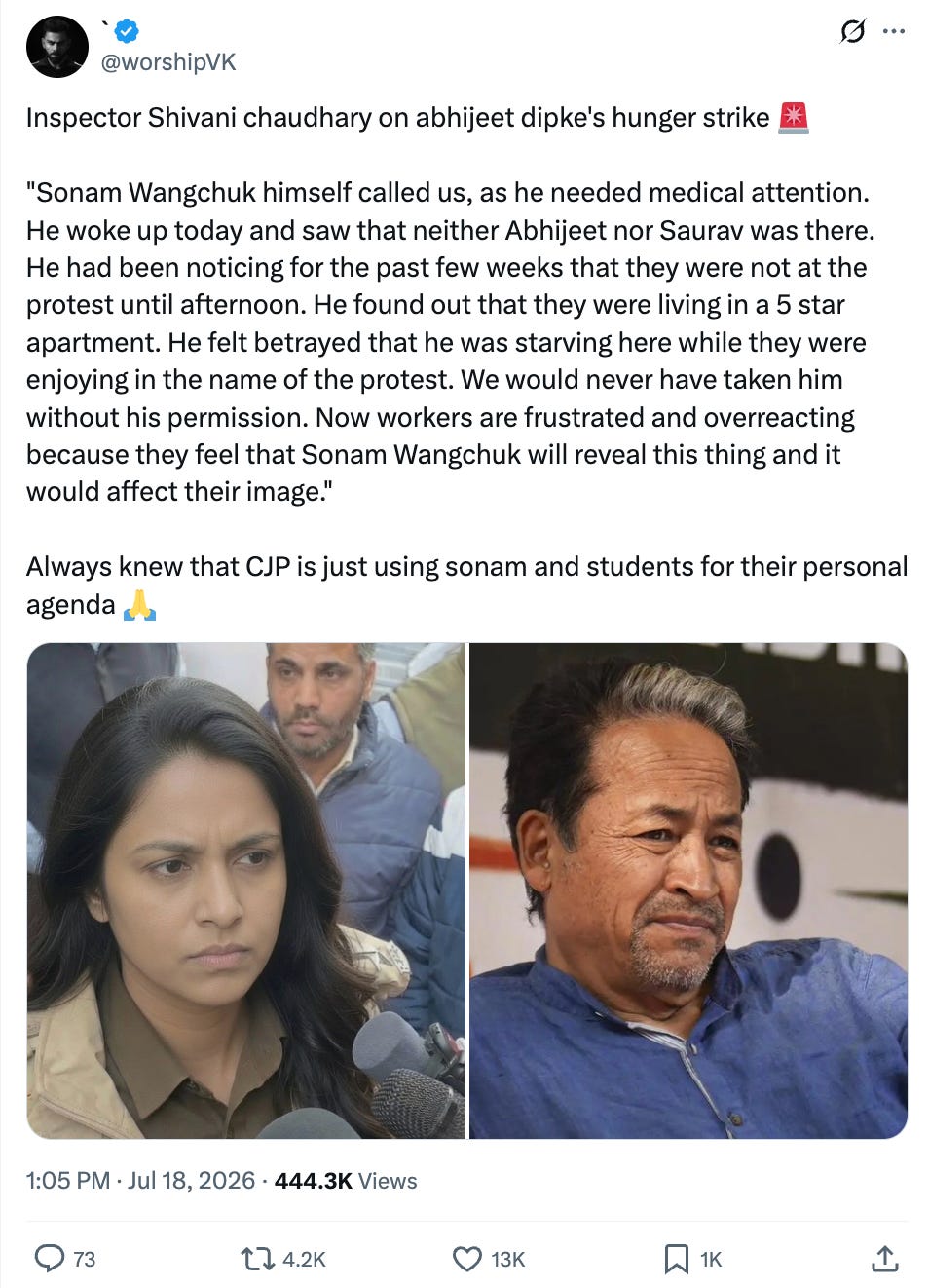
The Delhi Police had consistently, categorically said that Wangchuk had been taken to the hospital on the Delhi High Court’s orders..
Furthermore, BJP’s IT cell head Amit Malviya shared an older medical report of his from 13 July, which was circulated out of context to make false claims about his health during his detention.

Discrediting the Protesters
As the protests at Jantar Mantar grew, the fake news ecosystem shifted its focus to the protesters on the ground. The goal was to paint the movement as violent, anti-national, and artificially inflated.
Here is just a glimpse of what our team debunked regarding the protesters:
The ‘AI Crowd’ Image: When a massive crowd gathered at Jantar Mantar for the first protest on 6 June, social media users dismissed it as an AI-generated image meant to fake the turnout. We proved it was a very real photograph captured by a photojournalist from The Hindu.
The Fake Jamaat-e-Islami Letter: An image of a letter allegedly from Bangladesh’s Jamaat-e-Islami went viral, claiming the outfit had expressed solidarity with the CJP protesters. The letter was completely fabricated using AI.
The ‘Violent Protester’ Trope: We saw a flood of unrelated, old videos being recycled. A clip of a man attempting to set a car on fire in Bihar over a road accident was falsely shared to question the peaceful nature of the CJP protests. Another old video of students pelting stones at a train in Patna over delays was passed off as CJP protesters attacking India’s new hydrogen trains.
Ministers, Police Action and ‘Deaths’
As the protests kept gaining momentum, deepfakes of Members of Parliament Nishikant Dubey and Piyush Goyal went viral, claiming that they threatened protesters. Dubey appeared to threaten students with “blacklisting” to ensure they would never get government jobs, while Goyal called for “hanging” a few protesters to scare the rest.
Both of these visuals were manipulated using AI and did not show authentic visuals of either of the politicians.
A day before Pradhan’s resignation, a deepfake of Delhi Police’s Deputy Commissioner of Police (DCP) Sumit Jha was shared on social media, which falsely claimed to show him saying that he was being “forced to lie,” and framing protesters as bad actors. “These students aren’t terrorists, but our country’s future,” Jha appears to say in the video.
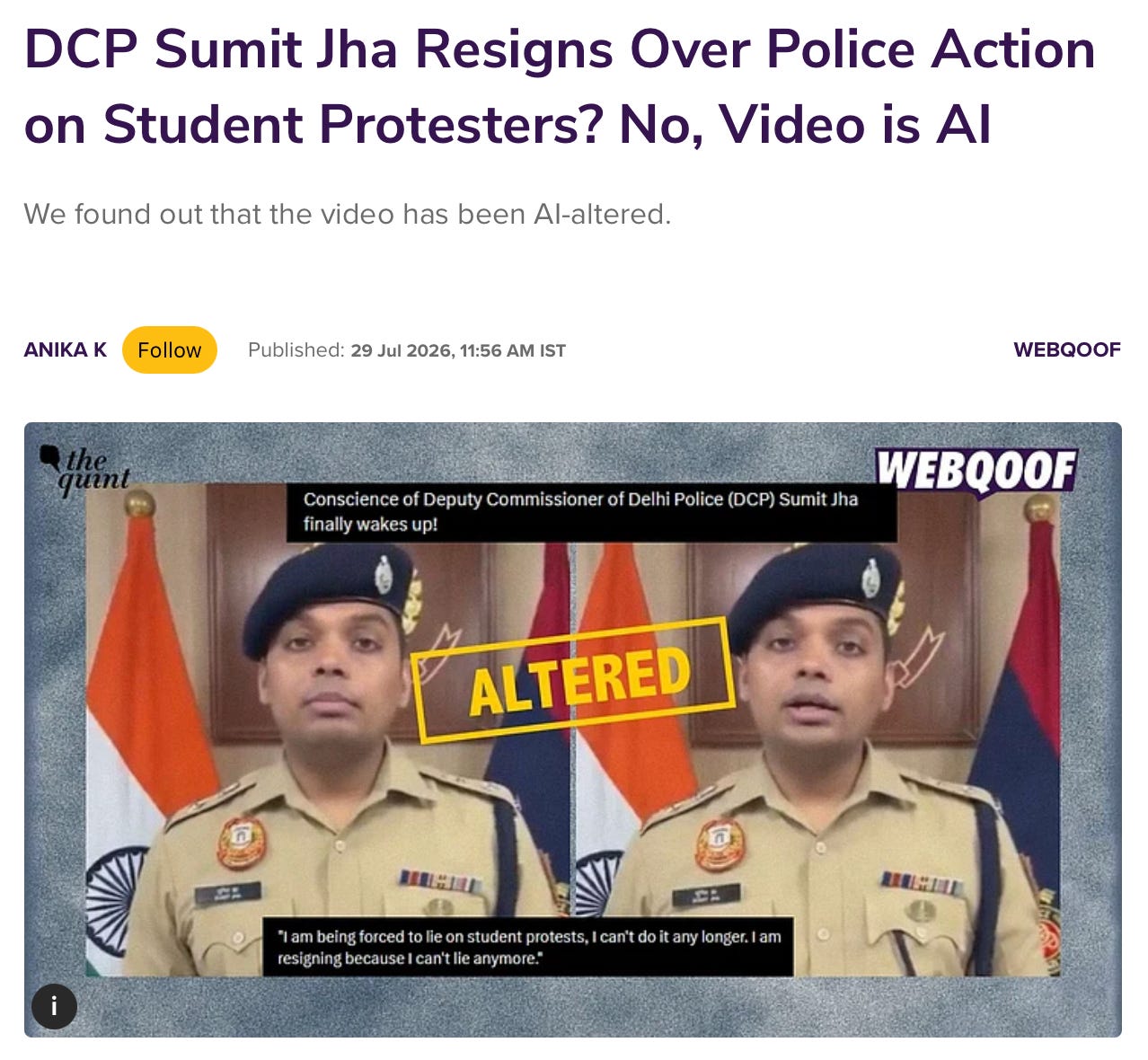
Even after the protests turned violent, there were no deaths on any side. However, social media users shared three claims, including two AI-generated visuals and one cropped video, to claim that students had died as a result of police action, which you can read here and here.
The Bottom Line
What was witnessed with the CJP was a textbook case of how a movement is targeted in the digital age. When the numbers cannot be ignored, the source is discredited. They are dismissed as bots. On the streets, they are branded as violent. Lastly, when the evidence to prove these claims is lacking, it is manufactured using AI and recycled visuals.
As the movement continues to dominate headlines, so will the misinformation. We will be here to sift the facts from the fiction. In the meantime, here’s our quick guide on how you can fact-check information yourself during breaking news events.
Stay curious and don’t be a WebQoof!
Until next time,
Aishwarya Varma,
Team WebQoof

*Already a member of The Quint? What a star! Your support empowers us to question everything.
Want us to cover a story? Write to us at editor@thequint.com or reply to this email.
Comments
Nothing yet. Say the first thing.
Sign in to join the conversation.