
Hello friends,
Before Christmas, I reshared this post by Jamila Reddy about responding to someone who is grieving. Jamilla’s words obviously hit a chord for those who have navigated loss, and have also had to navigate a barrage of “let me know if you need anything”, which it makes sense is basically everyone. I also shared a piece about Carl Jung and intention-setting that people really resonated with. All that to say, my little Substack has tripled in size. Welcome if you’re new here. I really appreciate your presence.
Rather than seizing the apparent momentum of such an influx in subscribers, I have been very quiet. I thought about reintroducing myself here, given how many of you are new arrivals, but I’m currently wandering the halls of dissolution (the cocoon, the in-between, purification; more on this later), so I don’t feel like I’m especially introducible. In lieu, I’d like to reintroduce this body of work.
I began writing The Psychoalchemist at the end of 2023. I had recently signed up for a course with Emmalea Russo called The Alchemy of the Word, which aimed to work through the stages of alchemy as they pertained to art making. As I wrote about at the time, the theory of alchemy had been tap-tap-tapping at the corners of my life for some time, but I was never able to find a way in until I happened across her teaching. It was just the right time.
My life was flooded with symbols and synchronicities. Specifically, and repeatedly, I was visited by imagery of the crow or the raven, the harbinger of the beginning of the Great Work, overseer of calcination, the first stage of alchemy. Crows followed me everywhere, and the concept of calcination recontextualised so many of my experiences, past and present. I think that time learning about alchemy, which coincided with starting this Substack, hallmarked the beginning of the end of the calcination phase of my own initiation, which I think had probably taken up the better part of the last ten or twelve years.
Calcination is the first stage of alchemy. It is also the longest and the slowest. It is the time in the Work where we can wonder if we are even doing anything at all, much less whether it is “working”. It’s hard to even know what “working” would be, because it’s hard to know what the work is.
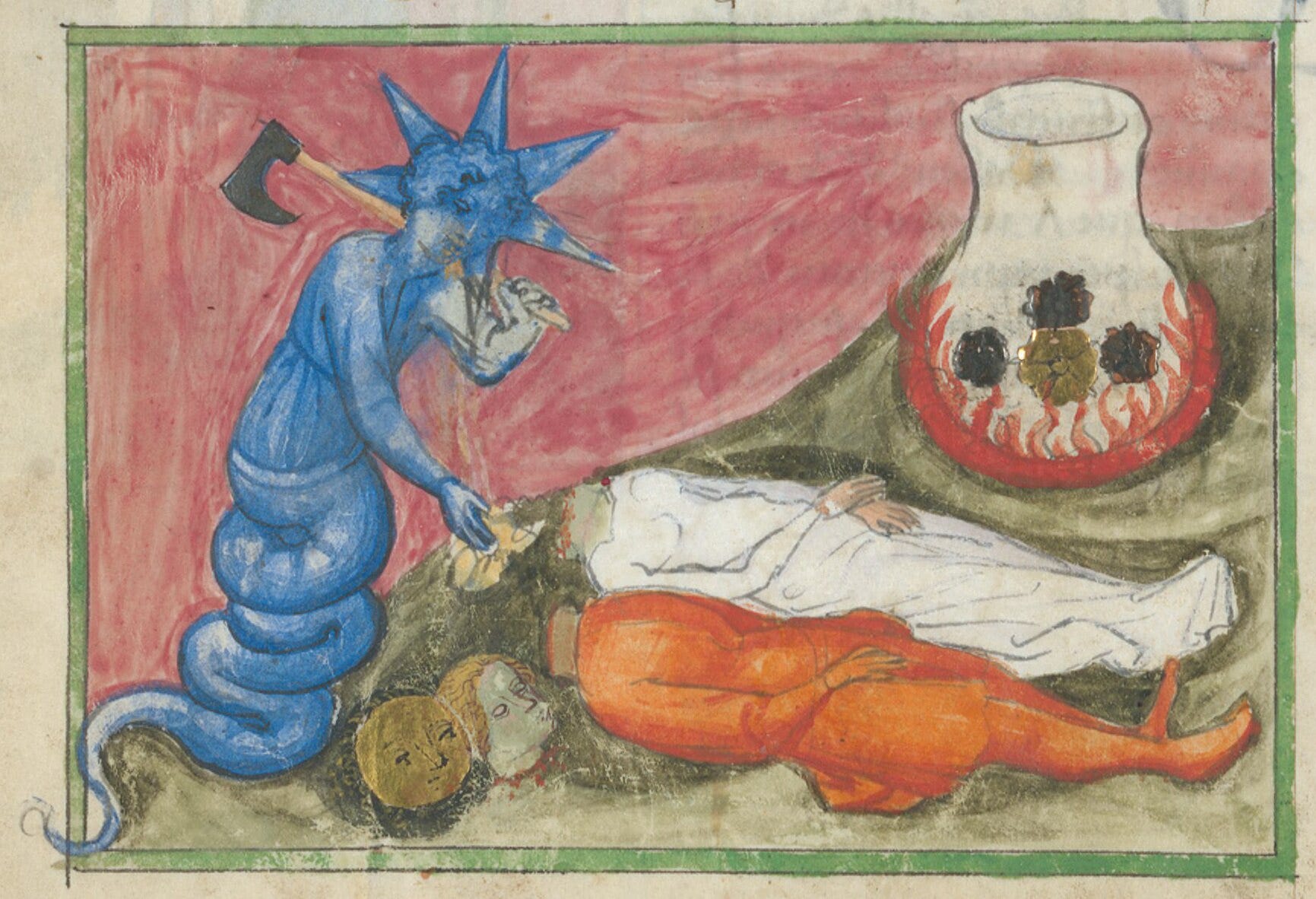
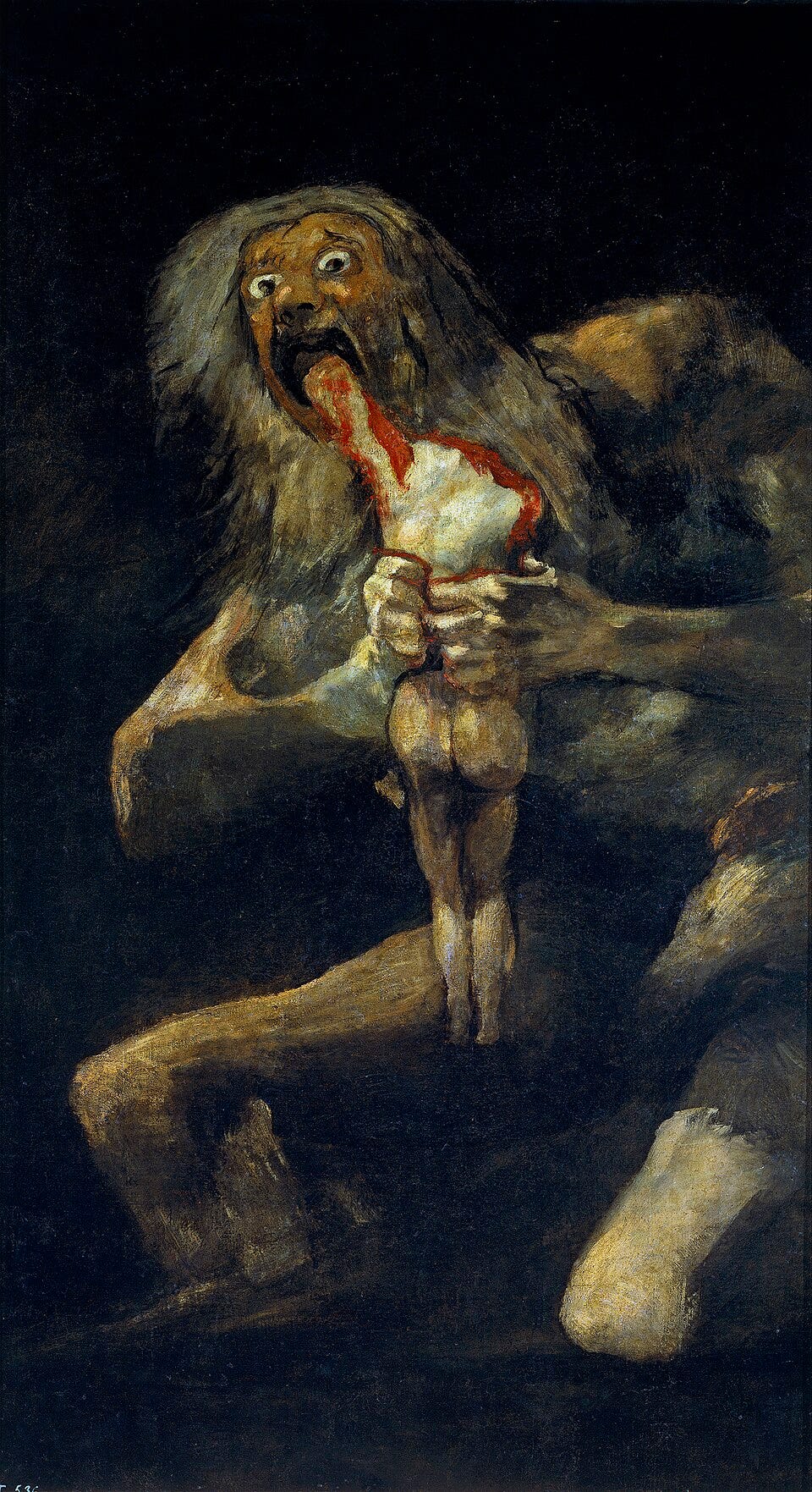
Calcination is ruled by Saturn, the foundational image of the destructive patriarch. Saturn the father in Roman myth is most famous for devouring his children at birth, in the hope of defying a prophecy that they would ultimately overthrow him. He is the setter of harsh boundaries, imbiber of harsh lessons, believer in hardship that builds character.
In alchemical transformation, calcination involves intense heat, the blackening and burning of the prima materia, leaving only ash; and sometimes, a bitter recognition of the real nature of what is left when all illusions are evaporated. Moving through it and beyond it also involves a willingness to acknowledge the sunk cost - everything we have done in vain.
It is a humbling notion for me to arrive at the conclusion that this long, dominant phase of my adulthood might be accurately summarised as “That was step one”. Isn’t that crazy? To think all those hours and months and years - all my egoic striving, all my “clever” achievements, the exhausting procurement of qualifications, the winning of favour and legitimacy, certificates, the office and the network, seeing so many patients, giving talks, and listening to other talks, and arguing about which talks were right - might be reduced to a single word, and a single feeling.
But from the cool, lush waters of dissolution, it really does look that way. And rather than seeming to be a tragedy or an error, actually feels relieving. There is incredible liberation in the idea that the density, and even the fruits, of such dogged striving need not define every subsequent step of the journey.
At the beginning of 2024, I wrote that clinical psychology had been a kind of prima materia for me - the original material onto which the process of alchemy can be applied, that strange substance that seems golden before it is worked on, but that quickly dissolves into the sticky, black, volatile mess of the black beginning. I still think this was right. But I wrote then from further inside the institution, still under the rule of Saturn, still fighting to prove myself from within it. And from the inside, it felt very different.
Psychology is a helping profession, a wonderful way to help yourself feel good, safe, helpful, kind and largely beyond reproach. Its Saturnian nature - a theoretical orthodoxy that has trapped people fighting over what “counts” as psychoanalysis for over a century, the premature whitening (the next alchemical function after the blackening) pseudo-solutions of “evidence-based” practice preventing the possibility of true shadow work, and a terrified workforce of spiritually uninitiated practitioners more concerned about not getting in trouble than really understanding what is true - lies under the gleaming, shiny surface of a job it is impressive to reveal at parties. These are difficult things to name, because psychologists as a group are (mostly) not malicious or ill-intended. Rather, like the initially shiny false-gold of the prima materia, they have become the false priesthood of modern times. (If you have time to read one other thing today, let it be Dr. Roger McFillin’s essay I Need to Run This By My Therapist - he expands on these ideas brilliantly.)
Psychology is also a great profession if you have the idea you should always be working on yourself. I have always been in therapy, always been in training, in supervision, in consultation groups, signing up for an internship, planning an event, giving a presentation. These things are celebrated in the profession, and can be meaningful, rewarding undertakings. At the same time, they can be pursued for a lifetime without resulting in any meaningful change or transformation, adult scout badges to be collected and displayed in lieu of real, rigorous initiation. And I should add, instead of enjoying a joyful, sensual, fun life.
I am still a psychologist, but to be honest, I don’t feel like one so much anymore. Something that felt like my whole identity now feels like something I do, like working in a shop. My actual work and the relationships I have with my patients feel like something separate again, increasingly and finally free of a long held sense of a third presence in the room, a sentry watching me to make sure I was following the script.
I share all this to say that the concepts of alchemy, as ancient, bizarre, and opaque as they might seem, can be a gateway to new perspectives on much of our contemporary life. The notion of calcination has facilitated a sense of liberation in me through permitting me to consider experiences of my life that would culturally be seen as great achievements in a new way - well-intentioned, but ultimately adolescent strivings within a fairly illusory framework, useful not for their fickle shine, but as stepping stones in a far broader journey.
Alchemical concepts have supported me to frame these experiences in a way that feels exciting and optimistic. They feel real. To have moved through what feels like a genuinely complete experience of calcination feels like more of a real undertaking than any qualification handed to me by an institution, especially having had the experience within its ruthless walls that I was stuck in there, with no idea I might ever find a way out, if other places even existed.
In love, and a shared path to a greater truth,
Kate
Thanks for reading The Psychoalchemist! This post is public so feel free to share it.
Comments
Nothing yet. Say the first thing.
Sign in to join the conversation.