
The day after the election, I flew to Portugal.
Well, sort of. I live in Santa Fe, so flying anywhere out of the country takes more than a day.
First, I had to change my flight from Santa Fe to Dallas to beat a historic southern Rockies early November snowstorm.
From Dallas, I flew to Miami. Then I overnighted in Miami, then to Paris, then to Lisbon.
On my Dallas to Miami flight, I sat at the end of a row of people decked out in Trump gear: from their MAGA hat to their golden Trump sneakers. Santa Fe’s a pretty blue place, so this isn’t a sight I encounter every day. Curiously, though, on Election Day itself, I saw a guy wearing a Michael Myers mask waving a huge Trump banner at the city’s major intersection. I actually have no idea whether he was for or against Trump, a confusion I’ve find myself having throughout this election every time fictional serial killers get mentioned.
About halfway through the Dallas-Miami flight, the plane’s wifi sputtered out.
The Trump supporters in my row quickly became agitated. Agitated might be a bit of an understatement, really. Despite the availability of hundreds of movies and TV shows on the screens mounted in the backs of our seats, they really needed that wifi. They called the flight attendant over to inquire about the wifi. Then, about five minutes later, they called her back again to inquire about the wifi. And again. And again. This happened at least seven or eight times.
I and other people started to notice. I’d brought a book with me, and it was just starting to get good, so their constant interruptions were annoying. Sitting where I was, I had little choice but to eavesdrop on the conversation among these three people.
It turned out that what they were muttering about not being able to see was “the news.” And by news, it transpired, they meant “we would like to see or read about liberals being upset about Trump’s victory.”
I could see now why the wifi going out was so distressing to them.
Eventually, they became so belligerent with the flight attendant about the wifi that the co-pilot had to be called back to give them the standard “if you don’t stop this right now I will turn this plane around and we’ll go straight back home and no Disney World this year” talk. That, at least, got them to turn on the seat-mounted screens and not summon the beleaguered flight attendant for the rest of the journey. They didn’t stop being agitated or angry, though. They were mad at various points because a) I had my reading light on; b) they didn’t think the volume on the screens was high enough, and c) we were in a middle row of a 3-4-3 configuration wide body jet.
Scratch that. They weren’t really mad about any of these things.
They were mad—agitated, twitchy, unable to settle—because they couldn’t lick leftist tears for the remaining two-hour duration of our flight.
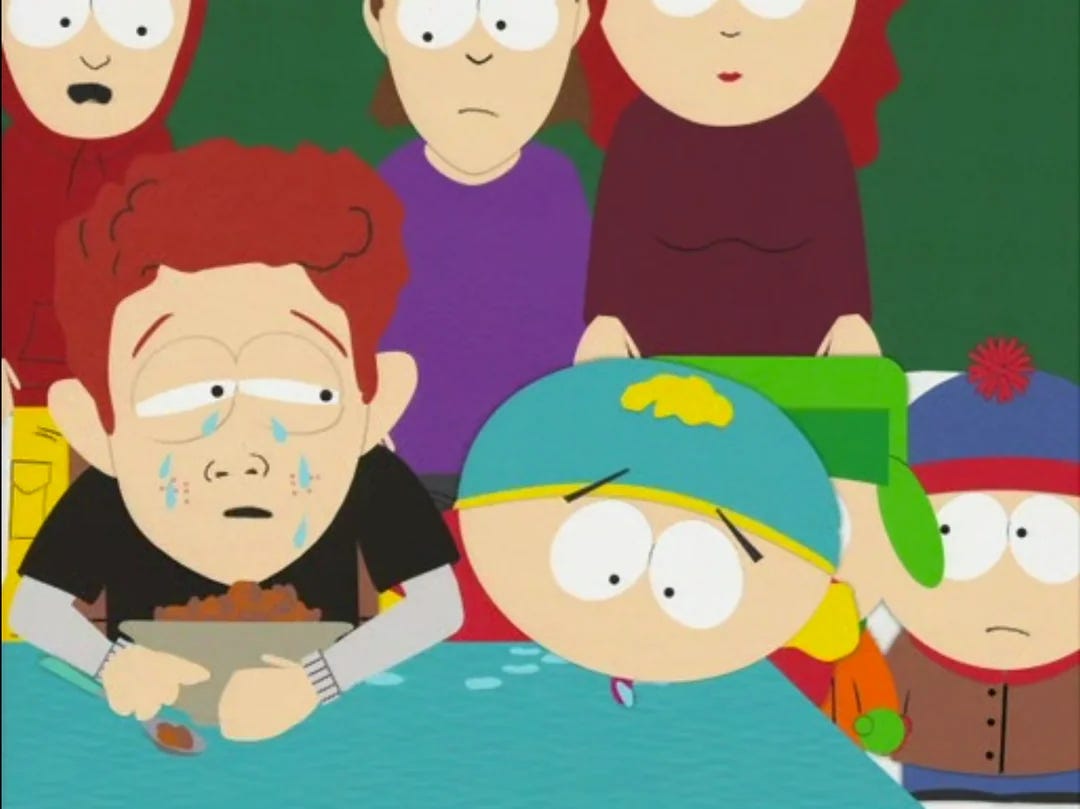
I’m not the first person to say this, and I won’t be the last, but: we’ve gotten to the point in this country where the desire to feel schadenfreude is a major motivating factor in people’s political decision making. People openly say this: “I’m voting against the side that will be more upset that it loses.”
Hopefully smarter and more politically savvy people than I am have some ideas about how we’ve gotten here: I mean the underlying causes of such extreme polarization that three middle-aged adult Americans can’t wait two hours to experience secondhand the suffering, confusion, and distress of others.
And for what it’s worth, I’m not letting the left off the hook on this one. I’m sure there are plenty of leftists who would have primarily celebrated not the defeat of a vindictive, petulant, unstable autocrat and the hope that America might continue reversing the bad decisions from his first term, but instead freebased the distress and grief that this sad, decaying libertine’s loss caused other fellow Americans.
Let me just get this out of the way: Yes, Trump is a bad man. He’s a bad leader. He surrounds himself with wicked people who enable his stunted adolescent whims and fancies, instead of trying to remind him of obligations to American ideals and democracy that he clearly does not feel. I suspect he has never once experienced an unselfish feeling or what it means to have an ideal. On a practical level, he has a child’s understanding of economics. What little he’s made in definite policy proposals would be, if enacted, ruinous to the American way of life, from devastating tariffs to imposing artificial labor shortages by deporting immigrants—many of them the legal ones who voted for him, from the sound of the speakers he frontlined at his Nazi-referential Madison Square Garden rally. Odds are better than even that most of us will suffer extreme economic hardship by the end of his four-year term, provided that another pandemic doesn’t come along to kill us when new head of the CDC Robert F. Kennedy, Jr. refuses to authorize the administration of vaccines. And I would have an easier time explaining the consequences and illegalities of these policies to my six-year-old daughter than I would to Trump, who has shown himself on almost every occasion in his bloated and unjustified arrogance to be incapable of real reasoning or thought. Although I was never enthusiastic about a Harris-Walz ticket and acknowledged that if they were elected they would make mistakes and push for policies that I didn’t agree with, what I could say about them both was that they would attempt to govern honestly and justly, and understand that there was a difference between what might be personally advantageous to them and what was legal and best for the country and its traditions of democracy and fairness. That is so far outside of Trump’s capabilities that to mention these attributes in the same sentence as his name is profane and laughable. And no, I’m not rigorously footnoting or linking any of this because we all know it. I’m also not stating these things to vent my anger or sadness, but because they’re just facts about the likely consequences of what America has just decided to do to itself based on past data and a reasonable knowledge of cause and effect.
Nevertheless, and no matter how bad all of this is likely to be, we need to get out of this cycle of reaction. It’s been quite clear for some time that each side is primarily feeding its fires with the anger and sadness of the other side. What the internet has created, primarily, is nearly endless opportunities to react to reactions, and the illusion that these reactions somehow constitute “events” or “news.” How many people exchanged that Brady Bunch-style JPG of Kamala’s reaction shots during the debate with Trump, and then reacted to that? And then reacted to others reacting to it? Why does disgraced fabulist Tucker Carlson suddenly start linking abortion to rising hurricane frequency? Because he knows that the cycle of reaction and counter-reaction will be focused on trying to figure out how he could possibly yoke those things together for at least the next 15 and a half seconds, and that rage and tears get people’s attention more effectively than employing logic.
I think in our hearts we all know this is true. The better question is: How do we break out of it?
Since we’re on the losing side of this election, we have a certain power here. So, hear me out:
We could—just maybe—stop reacting.
By this, I don’t mean that we need to stop opposing his policies. If you believe as I do, you should take every opportunity to vote against him and any Republican who supports him or public official who gives into him. We should give liberally to organizations that fight his takeover of the judiciary and attempt to suspend the rule of law. We should help the immigrants in our communities avoid any illegal measures taken against them, and we should drive women who need reproductive healthcare to the handful of states where it will still be possible for them to get it, and hope that we’re in time to save their lives.
But instead of breaking down in public, crying, reacting, posting on social media, calling the other side fascists and racists, why not just meet their need for our tears and anger with…nothing? Or, better yet, with mild bemusement or even amusement? Or even honesty, earnestness, and open conversations? “I see from your hat that you like Donald Trump. Can I ask you why? No judgment, I’m just curious.” And while they’re talking, why not try actually listening to what they’re saying, instead of trying to formulate a response or an insult? And if you decide to respond, responding with an honest set of your concerns, rather than whatever insult you just heard Jon Stewart fling at Trump supporters? The important thing is that whatever you say should be calm, reasoned, and as free of emotion as possible.
What we’ve come to want and need from each other is ever bigger and more extreme displays of emotion, preferably delivered online. I believe that this is why you hear Gen Zers talking all of the time about how “exhausting” ordinary life is. As the most online generation, they have to do the most emoting and reacting on a daily basis, much of which they probably do without realizing that it would have been unusual or unthinkable for previous generations. I occasionally even read misguided and confused defenses of constant emoting, especially about politics. Philosophies like Stoicism don’t tell you that you can’t feel emotions. What they do tell you is that feeling something on its own doesn’t really tell you that much about the event that inspired the feeling. Or, put differently, our endocrine systems developed far before our frontal cortices. By acknowledging a feeling but then using reason to pull it out and examine it, you gain some distance between yourself and your adrenal gland.
And more to the point of this post, you put some distance between your adrenal gland and the people who would like to suck its sweet juices because they’re so bored and bereft of hobbies that your emotions are their hobby. That was what occurred to me as I watched the people on that plane ride. Presented with American Airlines’ entire catalog of entertainment options, from recent release movies to TV shows to games, they couldn’t imagine lasting for two hours without their vicarious pain fix. They didn’t bring a single book, a magazine, a bag of knitting, or anything else but their phones. And if we’re being honest, how many of us would have done the same if it had been a Harris-Walz victory? How many of us bring books with us anymore? How many of us have hobbies that don’t involve interacting with the specters of other people’s emotions online?
If you can’t stop reacting for your own sake and your own health, at least think about it like this: What other people want—what social media companies sell—is your reactions. What the “other side” wants is for you to freak out. They want to drink your sweet tears of infinite sadness, or your fiery tears of infinite fury. This is the primary way that we interact with each other online, and since more people spend more and more of their time online instead of with other people in person, this means that this is the primary way that we interact with each other, period. It has to stop somewhere, and it might as well stop with us.
A final anecdote. I have a cousin named Sean who is a big fat bully. He’s always been a big fat bully. He became a Trump supporter—not, I suspect, because he has any real commitment to whatever mysterious policy positions Trump happens to hold, but because Sean just likes seeing bullying happen, and likes seeing bigger bullies than him given a wider arena to bully more effectively. It’s something like aesthetic appreciation of a job well done. In fact, Sean seems to have primarily adopted MAGA because it gives him a convenient vernacular to bully other people online, which he does from a variety of anonymous accounts until he gets banned. Then he picks up with a new account. It probably could have been anything, but MAGA was ready to hand.
Anyway, Sean used to bully my brother when we were kids because I think he suspected that he was gay. He used to play a particularly weird and troubling game after my family’s Christmas dinners, where he’d rub his feet on the carpets and try to administer blistering static shocks to the younger children. (He was an adult at the time—in his 20s at least.) Despite being frequently told that nobody wanted to play this game, he continued. He particularly enjoyed torturing my brother because when my brother would run or cry or tattle, he would use it as confirmation that my brother was no real boy, and inflict further psychological bruising on what he accurately sniffed out was a weak spot.
Eventually, though—after actually dreading Christmas for several years as an apple-cheeked, Santa-believing child because of this Krampus—my brother figured out something crucial: if he didn’t scream and run and cry or tattle, Sean would stop. Yes, the shock was unpleasant. But it wasn’t life-threatening, not even repeatedly. The one thing my little brother could deny to this swinish man was his tears. When he did, the fun went out of it for Sean. I don’t think he ever engaged in that form of bullying again.
I don’t think everyone who voted for Trump is a Sean, but the internet has allowed a lot of us to give into our worst Sean-like tendencies, on both sides. Behavior that was once reserved for 4chan trolls and other cretinous half-beings has become normal and expected for ordinary, otherwise well-functioning humans. I wonder what would happen if we stopped feeding each other with our pain. I wonder what would happen if we stopped letting people like Elon Musk sell our pain to each other. I wonder what would happen if we all resolved to take up some physical hobby in the world—knitting, learning to play an instrument, painting by number—instead of spending all of our time reacting to other people’s reactions online. I wonder.
No posts
Comments
Nothing yet. Say the first thing.
Sign in to join the conversation.