
The (re)Location exhibition took place at the Oriental Mission Church in Koreatown, Los Angeles, from October 5 to 19. The lead-up, the exhibition itself, and the de-install were all-encompassing, leaving us with little brain space to share our thoughts here on Substack. We’re so sorry! The exhibition marked the culmination of four years of research and processing, and we’re still reflecting on this deeply personal and rewarding project. While we continue to do so, we’re pleased to share a recap of the opening reception and gallery, beautifully shot and edited by Matt Green. Thank you to those of you who were able to attend!
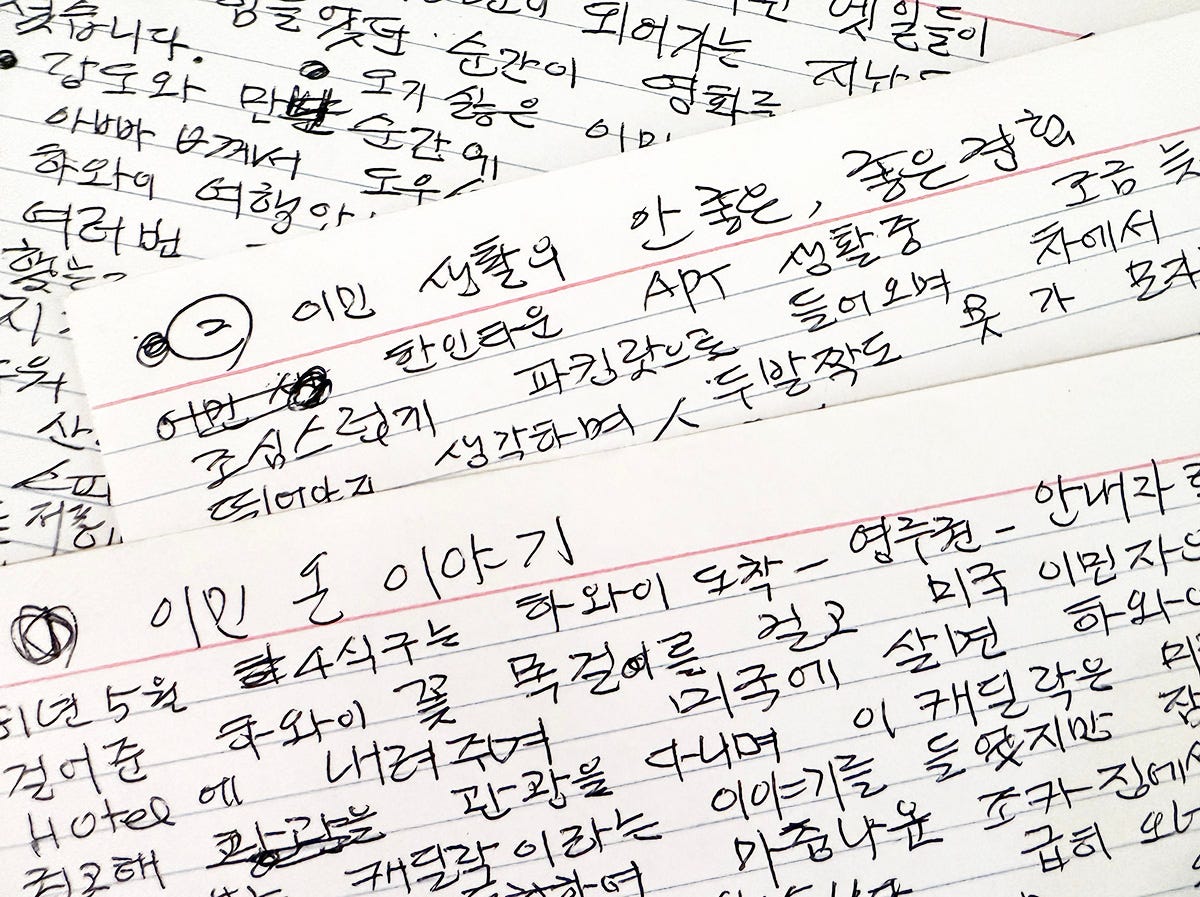
One small regret from the opening is that Helen had to cut short her interview with her mom due to time. With her mom’s permission, Helen has translated her notes and are sharing them here. For those with loved ones who may prefer reading in Korean, we got you!
In May 1980, our family of four arrived in Hawaii and received our green cards. We were told that living in America makes it hard to travel to Hawaii so we made a point of coming here first. With the Hawaiian lei placed around our necks by our guide, we took our first steps in our journey as immigrants to the United States. As he dropped us off at the hotel in his old Cadillac, he told us that most Americans get to ride in a Cadillac only once in their lives—at the end, on the way to their gravesite. I was exhausted and sleepy during our brief visit to Hawaii, but we eventually arrived in LA. After a short stay with the nephew who picked us up at the airport, I returned to Korea with my two daughters to properly close up my pharmacy and settle our house.
I discovered I was pregnant when I returned to Korea. My thought was to return to LA after giving birth and recovering. About a month before the due date, however, my husband sent word that the baby would need to be born in the U.S. to be granted American citizenship. My older brother had told me to bring everything except the coal briquette tongs, so I packed as much as I could without the bags bursting. I packed up all the remaining medicine in the pharmacy into boxes and gave them to a pharmacist friend. Then, with six immigration bags1 and three small bags, I set off for the U.S. again, heavily pregnant. Fortunately, my pregnancy was not visibly apparent, so I was able to board the plane without issue. When we arrived, we settled into the single apartment where my husband was living. Shortly thereafter, I gave birth to our youngest at USC Hospital.
When our youngest was 100 days old2, we moved to a one-bedroom apartment and officially began our new life as immigrants. I resolved to forget everything from my life before and start from the bottom. Those were exhausting days, filled with clumsy attempts at cooking, raising the kids, walking them to and from school. When someone visited from church, we would have to put away the mattress that was spread out in the living room. But thanks to our church pastor’s prayers and comfort, I managed to get through it all.
One of the things I had to do was cut my children’s hair. I’d sit them, one by one, naked in the bathtub and cut their hair. I’d cut rather unevenly so they looked like completely different kids with each new haircut. I even nicked my youngest child’s ear one time, causing quite a commotion.
Another challenge was getting my driver’s license, which was essential for life in America. My husband gave me driving lessons, and his loud shout of “Stop!” startled me so much that I thought I’d crash and die. I ended up sobbing, saying, “I’m going to go back to Korea and run the pharmacy! You can stay here with the kids!” I eventually met a deacon at church who was a driving instructor who helped me get my license. After that, outings consisted of driving to church, the supermarket, and our occasional treat of eating at McDonald’s for $8 for the whole family.
These were the hard but prayerful and tear-filled early days of my immigrant life.
Once, while living in an apartment in Koreatown, I was returning home late at night after English class. I parked the car, thinking I’d need to walk quickly to my apartment, but as I stepped out, a man in a hat suddenly grabbed me and held a gun to my neck. In that moment, I thought, “This is it; I’m going to die. Jesus, please help me.” But then, from somewhere nearby, I heard another man shout, “Hands up, or I’ll shoot!” At his shout, the man with the gun released me and backed away. Later, I learned that the second man had mistaken me for his wife, who he thought was in danger while she was doing laundry. This terrifying experience was a first for me.
As my immigrant life continued, I fell into depression. I lost my appetite and couldn’t bear to look at the refrigerator. Someone from church, a flute teacher, suggested we move out of Koreatown, so we relocated to La Crescenta. Across the street from us lived an elderly white couple who kindly taught us how to fix up our home and make desserts and soups. Experiencing the warmth and genuine kindness of these Americans brought me great happiness. The house has since changed owners, but I occasionally visit to relive the fond memories tied to that place.
When I was first asked to participate, I wondered if I’d be overwhelmed by old memories. As I reflected on nearly 40 years, the painful and challenging times unfolded in my mind like a movie. Memories of these earliest days as an immigrant came back to me:
The guide in Hawaii told us that as immigrants, we might never get to visit Hawaii again. But we ended up visiting multiple times over the years. Thanks to God’s provision, we even got to ride in a Cadillac—a privilege our guide had said was reserved only for after death.
When I encountered the robber in the parking lot at the Koreatown apartment, Jesus came to my aid when I cried out to Him.
On the day of the big earthquake, the ground and house shook, and our whole family huddled together on one bed. And once when a fire broke out, and red flames came down the mountain and we heard a broadcast telling us to evacuate our home, we remained safe under God’s protection.
I applaud first-generation immigrants like myself, who have lived with courage and perseverance. May we immigrants and our children find healing for the pain we’ve endured, find new courage, and come together as family on this immigrant journey.
The term “immigration bag” (이민 가방) evokes a specific image in Korean culture of large, sturdy, often checkered or patterned fabric bags that were commonly used for packing essentials during immigration, especially in the mid-20th century.
In Korean culture, the 100th day of a baby’s life is a significant milestone celebrated with a special event.
Comments
Nothing yet. Say the first thing.
Sign in to join the conversation.