
“In Vivo coding uses words or short phrases from the participant’s own language … and is appropriate for studies that prioritize and honor the participant’s voice, particularly those who come from marginalized communities. It’s a great way of staying rooted in the data.”
— Johnny Saldana, Coding Techniques [video] (2022)
“The first fruit of this [sociological] imagination - is the idea that the individual can understand his own experience and gauge his own fate only by locating himself within his period, that he can know his own chances in life only by becoming aware of those of all individuals in his circumstances.”
— C. Wright Mills, The Sociological Imagination
The Professor and the Artist are now deep in the main portion of their (re)Location data analysis, which had been delayed by administrative work, fundraising, and translation (an unexpectedly arduous process!)—not to mention other responsibilities unrelated to this project. Oh, life! The first step of the analysis was for Joyce and Helen to use In Vivo coding to create codes and labels, individually reviewing the transcripts of all 20 interviews separately so as not to have any bias from the other in their initial reading of the data. In Vivo coding allows for specific cultural contexts to be preserved as the participant’s exact words and phrases are used to represent their lived experiences. Joyce and Helen started the analysis with the respective interviews that they conducted: Joyce with the 10 Lao interviews and Helen with the 10 Korean. They had a Zoom meeting a few weeks ago to mark the start of this first phase, which was already in process.
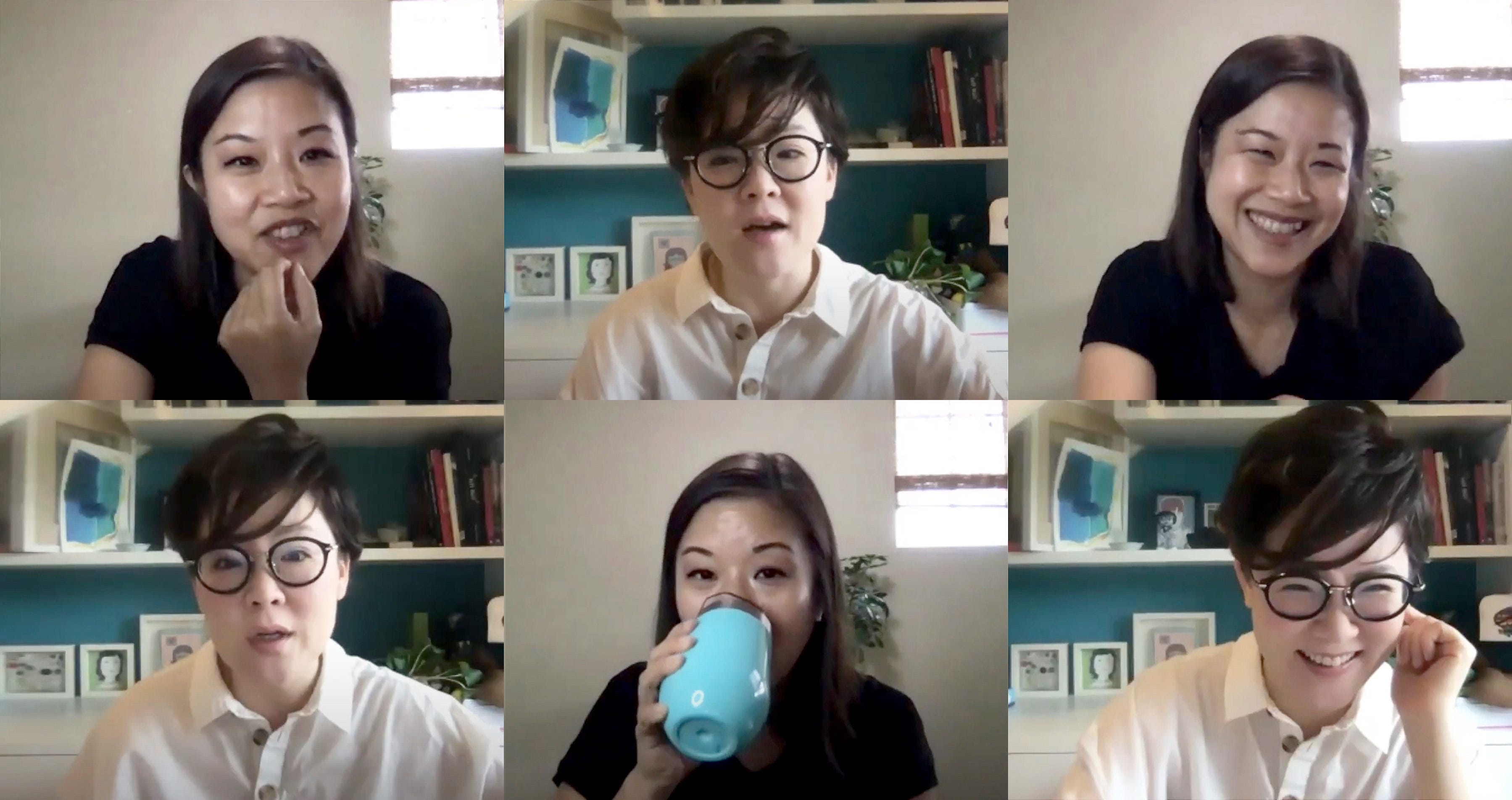
Joyce: So how are you feeling about the start of our analysis process?
Helen: The subject matter and intention of our research are still so compelling and intriguing to me! But when it comes to the actual work, I honestly feel overwhelmed or even resistant at times.
Joyce: Why do you think that is?
Helen: Well, it’s definitely not because I don't care about the work. In fact, I think it’s the opposite. This is my first academic research project but, also, what we're trying to do here—to sift through all these stories that haven’t been told before, that feel so close to home—is heavy work. On top of that, I feel a sense of obligation towards the older adult participants. Some of our participants are quite elderly so I feel anxious that we’re taking too long and they won’t get to see the end result. I don't think I'll feel the same kind of responsibility or weight when we move on to the second tier to interview our peers.
Joyce: I think when we’re sharing the experiences and stories of others, we will always feel that weight and responsibility. And these particular stories, like you said, haven’t been told before...
Helen: We’re experiencing a kind of renaissance when it comes to AAPI content and discourse, and our peers and younger generations have ample access to all of it.
Joyce: It’s true.
Helen: But I don’t see engagement of our parents' generation in much of it. The elders are referenced but I don’t see a lot of things where they’re invited to be an active part of the discussion. There are understandable barriers, namely language. All that to say, it makes me feel like we need to do our project really well. We should definitely be thoughtful and diligent in this work but, saying all of this out loud, I can hear how much unhelpful pressure I’m putting on myself. I’m well aware of the probability that they just went on with their lives after being interviewed for a few hours and they aren’t sitting around wondering, “When is that project gonna be done?” But, anyway, those are some of the things that I think I'm feeling the overwhelm from.
Joyce: So much of that resonates with me. You’re not alone, Helen! It can be heavy work at times. And it’s intensive. Lately, I've been doing the analysis well into the night and my husband will be like, “What are you doing?” And then my son will come in and be like, “What are you doing?” I have to tell them, “Look, I'm in the zone! I cannot be disturbed!” I’ve been relying primarily on the transcript of the interviews, reading and re-reading, taking notes and memoing, envisioning the story—
Helen: Me too.
Joyce: But sometimes I have to go back and listen to the recording, because some things you just have to hear the context, or maybe you catch that the translation was off in some way. All of that means I have to be in a bubble and get into the rhythm, you know?
I have to say, I found that interviews where the recordings go uninterrupted from start to finish were much easier to analyze than the ones that were broken up into chunks, even if they are sequential, because it breaks the flow for me. When there’s a flow, I can better call back on my own experience of being in the room with them during the interview.
Helen: I remember breaking the flow of the interview by fussing with the equipment constantly.
Joyce: Was that because of a technical issue?
Helen: Yeah, there are a few technical issues I didn’t anticipate properly when I first started the interviews. But thankfully they did improve as the interviews went on. Wish I’d been better prepared from the start but I didn’t know I was unprepared!
Joyce: They’re all lessons, you know? I’ve had some moments like that myself. And sometimes there are things beyond our control when we’re in the field.
Helen: So how have you been feeling about the project, overall?
Joyce: We’ve had delays for various reasons and, at this point, I feel like we need to get this out. It's time. I’m ready.
Helen: I feel the same. So, at this point, you have gone through the transcripts and videos of the 10 Lao interviews you did between 2021 and 2022. I’ve done the same with the 10 Korean interviews. We haven’t looked at the other set of interviews yet.
Joyce: No. We’ll do it soon, using the process you and I have separately developed along the way. And we won’t look at each other’s analyses till the end. That way, we will look at all the interviews fresh, without the other person’s input to sway us. After that, we’ll get together later to compare notes and do the final analysis together. It’s iterative and collaborative.
Helen: Wait, can you explain what you mean by “iterative”?
Joyce: Iterative, as in moving back and forth between the data, looking at the transcripts or recordings and the initial analysis and then back again, as we develop and build our understanding of the data.
Helen: Oh, gotcha.
Joyce: So what I’ve done in my first pass of the Lao interviews is to compile all the significant categories and themes, and put them into a matrix, along with notable quotes from the participants. That helps me to look at and compare all the interviews at one glance. But what took the longest time was to prepare the transcripts and check and double check the translations.
Helen: Without really going into your method—obviously—can you tell me a bit about how you went about pulling out or identifying themes?
Joyce: Well, a lot of it is also based on the set questions we established. Our overarching research questions are, in essence: “What is your experience of home?” and “How do you identify yourself?” That was my starting point, and then whenever they provide more details in their answer related to how or what, (or even why) I make notes which eventually turn into categories and themes. Was that your process too?
Helen: My process is different in that I created a color-coded spreadsheet of categories more in terms of an immigrant’s timeline, from the country of origin to their time in the US, and then identified subcategories and themes within that. I’ve been using that to highlight the transcripts with some simple notes, so the spreadsheet is a legend of sorts.
I figured that collating all the data was gonna come later. I just needed to go through and just color-code, to wrap my head around all the information. So, now, even though I can't see everything at a glance right, I can skim through any transcript and go to the parts I identified as essential.
Joyce: It’ll be really interesting to finally get into each other’s interviews!
Helen: Yes, I’m looking forward to that too!
Comments
Nothing yet. Say the first thing.
Sign in to join the conversation.