
What These Conservative Terms Really Mean
By Jeremy McKeown, Editor of CobbProb
November 23, 2025
Walk into any GOP meeting and you’ll hear the same words over and over again: Make America Great Again. America First. Conservative values.
They appear on yard signs, church handouts, fundraising texts, and county-party speeches. Everyone uses them. Very few ever stop to ask the people in the room what they actually mean.
So CobbProb did.
We ran an anonymous survey asking grassroots conservatives how they define these phrases, who they believe represents them, and whether the promises attached to them have been kept. The answers were thoughtful, often sharp, and pointed at a movement that is far less confused than its leadership.
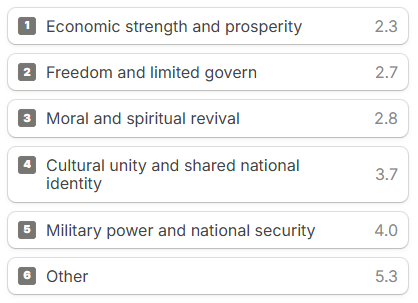
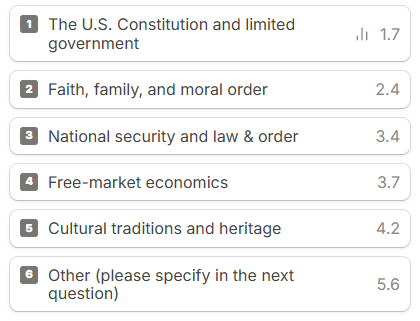
When respondents explained what “Make America Great Again” means to them, almost none described a hazy nostalgia for the 1950s or 1980s. Their answers were concrete. Most tied “greatness” to economic strength - work that pays the bills, affordable living, and policies that reward effort rather than punish it. The next largest group connected it to moral and spiritual renewal, describing a country that openly acknowledges God and shared values again.
Across answers, certain themes repeated: safe streets, a secure border, and elections people can trust. Beneath it all sits a deeper sentiment - the belief that the country is being run by people who don’t share their burdens or their beliefs. For these respondents, “MAGA” has become shorthand for breaking that dynamic.
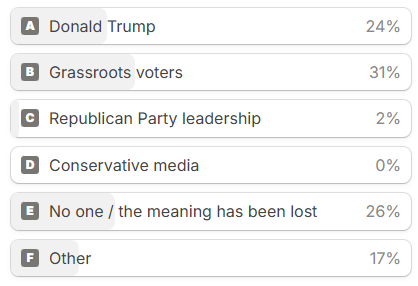
But when the survey asked who best represents “Make America Great Again” today, the responses fractured. Some named Donald Trump. Others pointed to the broader movement. A significant number said that no one on the current stage fully lives up to the promise.
The slogan still resonates. Confidence that anyone in power is worthy of it does not.
“America First” produced a similar pattern.
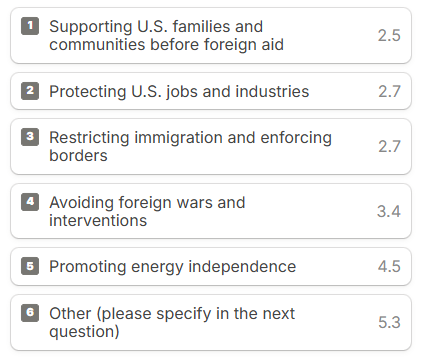
People overwhelmingly tied it to practical priorities: protecting American workers, controlling the border, avoiding unnecessary foreign wars, and ensuring taxpayer dollars benefit Americans before anyone else. But the comment sections told a more frustrated story.
The question many asked, implicitly or directly, was simple: If this is “America First,” why doesn’t it feel that way?
Respondents pointed to large foreign-aid packages, ongoing overseas conflicts, and a government that seems to respond more quickly to events abroad than to problems at home - from grocery prices to home affordability. Many still use the phrase. Far fewer believe Washington governs according to it.
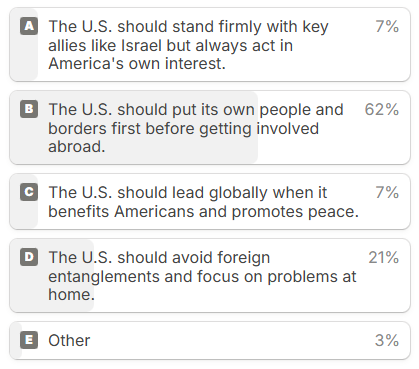
The sharpest dividing line in the written responses wasn’t over taxes, Trump, or even “MAGA” itself - it was over foreign policy, especially Israel and America’s role in overseas conflicts.
In the open responses, people volunteered comments like:
“MAGA has become Israel First.”
“We spend billions abroad while our own border is wide open.”
“The real divide is showing up over Jews and Israel.”
For these respondents, the U.S.-Israel relationship has become one of the clearest tests of whether “America First” is being taken seriously. They are paying close attention to whether elected officials defend the U.S. border, the U.S. economy, and the concerns of American families with the same urgency they show when the topic is a foreign ally.
This article isn’t offering a foreign-policy blueprint or judging any specific alliance. The point is narrower: for many grassroots conservatives, foreign policy, and Israel in particular, has become a symbolic indicator of whether leaders prioritize the American voter.
They do not oppose supporting allies.
They do question a political class that appears more energized by overseas priorities than by the struggles unfolding at home.
When respondents described what “Conservatism” means to them, the tone shifted. They stopped sounding like political volunteers and started sounding like parents, churchgoers, and people trying to hold their families together in a chaotic world.
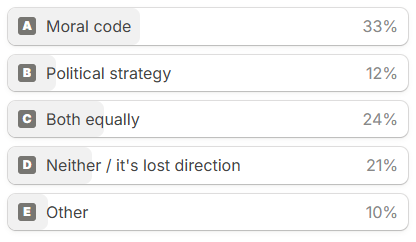
They pointed to faith, family, local community, and a government small enough to leave room for all three. Many described conservatism as a moral code first and a political position second. Several noted that simply trying to live a normal, traditional life now feels almost counter-cultural.
At the same time, many feel the institutions carrying the conservative banner haven’t conserved very much. Over the past decade, they’ve watched schools, corporations, media, and even some churches drift leftward while “conservative” politicians issued press releases and moved on. The label survived; much of what people hoped to protect did not.
That disconnect has made some respondents wary of the word itself. They still live conservatively - they’re just less willing to assume everyone using the word is speaking their language.
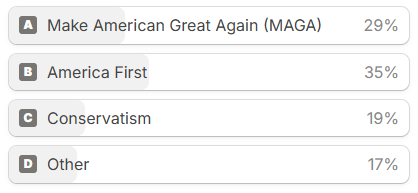
When we asked which term best described their own political identity - MAGA, America First, Conservative, or something else - there was no clear majority. Many said they use more than one label depending on the issue. Someone might feel culturally conservative, vote with the America First wing on trade and national priorities, and still show up at a MAGA rally. Others said they’ve stepped away from labels altogether and now identify simply as constitutionalists, Christians, or “just tired.”
Across all of these differences, three fault lines kept resurfacing:
Foreign policy and the country’s entanglement in endless conflicts
Whether leaders live by the moral standards they claim
How organizations handle disagreement and dissent inside their own ranks
People are not demanding perfection. They are asking for something simpler and harder: that the language of patriotism, faith, and sacrifice mean the same thing on a stage as it does at a kitchen table.
These survey responses don’t hand us a new slogan to slap on a T-shirt. They do something more important: they puncture the illusion that the base is confused or easily managed.
“Make America Great Again” is, for many, a cry against corruption and decay.
“America First” is a demand for reordered priorities, beginning at home.
“Conservatism” is a way of life people are trying to hand to their children, not a brand they rent every two years.
And the debate over Israel and foreign policy is no longer a side issue. It’s one of the places people now measure whether any of the above can be taken seriously.
If party leaders and movement figures treat these words as genuine commitments, there is still time to rebuild trust. If they remain little more than fundraising hooks, the people who answered this survey will not quietly fall back in line. Many already haven’t.
CobbProb’s aim is to keep giving those voices space, without airbrushing what they actually say to fit anyone’s talking points. Future surveys through CobbProb will continue tracking how these terms evolve, and where the grassroots sees the movement heading next.
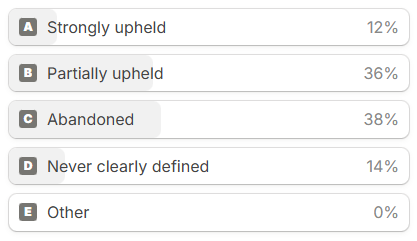
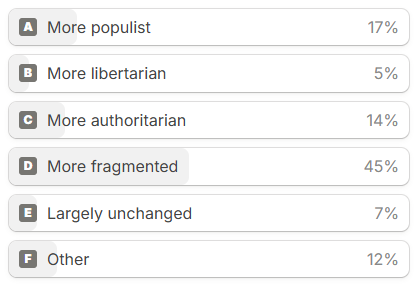
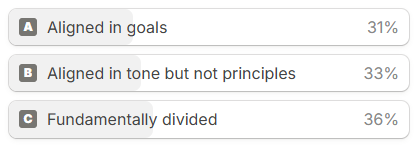
For readers who want to see the hard numbers behind these themes, the full percentage breakdown for every multiple-choice question in the survey is posted at the end of this article.
You can see exactly how respondents ranked the meanings of “Make America Great Again,” which priorities they tied to “America First,” how they defined “Conservatism,” and where they placed themselves politically.
Disclaimer:
This article summarizes responses from an anonymous survey conducted by CobbProb between November 3–22, 2025. Participation was voluntary, and results reflect the views of respondents only. CobbProb does not verify the identity, background, or political affiliation of respondents. Interpretations in this article represent the author’s analysis of the submitted data and should not be treated as scientific polling, legal advice, or official statements from any political organization. All quotations of survey responses are presented exactly as submitted, with only minor formatting adjustments for clarity. Any references to public figures or institutions are made for commentary and analysis.
No posts
Comments
Nothing yet. Say the first thing.
Sign in to join the conversation.