
A hegemon on the ropes in a war of its own choosing. Creeping fears of stagflation. Fresh fever dreams of an oil crisis. An impotent Federal Reserve.
People have been making the analogy that we’re living in the 1970s for a while now. I’ve been a bit of skeptic - America’s financial outlays are at a whole other level, inequality and the lack of unionized labor diminish the risks of any wage-price-spiral, and OPEC isn’t what it used to be.
And yet, I think we can learn plenty from the ‘70s, especially from an insightful new paper from Jared Finnegan, Phillip Lipscy, Jonas Meckling, and Florence Metz. One obvious commonality between then and now is that incentives for countries to ween themselves off oil, off of the vagaries of international market forces, are high. By studying which and how governments adapted to OPEC’s first foray at economic coercion, the paper’s bet is that we can get an eye into today’s potential energy transition.
Economic upgrading, structural transformations like uprooting your energy supply, can take decades. Moreover, they are usually the result of deliberate, long fought over policy choices. So studying what works and what doesn’t work in making countries move up the value chain or reorient their economic foundations is frustrating - you can’t separate out the myriad choices governments are making to assess any individual causal effect.
The 1973 oil shock gives us a bit of cheat code. In three months, the international price of oil quadrupled - from $2.90 to $11.65 per barrel. A second shock hit in 1979 off the back of the Iranian Revolution. Every OECD country faced the same external pressure, at the same moment, from the same source. And it was a result of the Yom-Kippur war that had little to do with say the domestic policy decisions of France or the UK.
By early 1974, the bulk of the OECD had even agreed on the same three goals at a Washington summit. It was time diversify away from Middle Eastern oil, shift energy systems toward alternatives, and increase the efficiency of their energy consumption.
Common shock. Common agenda. Wildly divergent outcomes. Which means whatever explains the variation in how countries adapted is likely to be domestic. The authors run a panel analysis and a generalized synthetic control to compare what countries actually did against what they would have done without the relevant institutions in place. The pre-shock period establishes the baseline. The shock provides the treatment. The divergence tells the story.
And there’s much more variation in how government’s responded than I realized.
Adaptation to the ‘70s was not a rosy story - one where we can have it all via something like the Green New Deal. The starting premise of the paper is that when you are talking about major structural transformations to an economy, there are going to inevitably be winners and losers. Price reforms, asset write-downs, stranded workers. Those people will fight back. And if they can get to the levers of power, they will pull them.
The political economy literature has long had two answers to this problem, usually studied in isolation. Either you insulate decision-makers from the losers - structuring the system so that opposition can’t effectively land - or you compensate the losers enough that they stop feeling like losers, or at least stop fighting. Finnegan et al. put both mechanisms in the same model.
That’s the first major value add of the paper. It doesn’t look like a radical shift, but the payoff is.
Insulation is about limiting access. Proportional electoral rules reduce the sensitivity between vote share and seat share, which means governments face less electoral punishment for imposing diffuse costs on consumers.
Bureaucratic autonomy does something similar on the producer side. When technocratic agencies control industrial policy, organized interests find it harder to block change through conventional lobbying. France is the clearest case here. Its powerful state bureaucracy - the grands corps, the technocrats running the energy ministry - pushed through a sweeping nuclear buildout after 1973 with relatively little industry interference. Japan’s MITI did something similar, coordinating industrial restructuring away from oil-intensive production in ways that private actors couldn’t easily obstruct. It’s about that much prophesied “embedded autonomy.”
Compensation is the inverse. Its about acknowledging and treating the losses. It makes losers whole enough not to fight. Generous welfare states are better positioned here, both because the delivery infrastructure exists and because decades of doing it have made government commitments credible - people believe they’ll get protected.
The key insight is that these aren’t interchangeable. A government with a strong welfare state but a majoritarian electoral system has real compensatory capacity, but may still be blindsided by organized producer resistance that insulation would have neutralized.
The framework is useful precisely because it tells you which tool you need for which fight, and what a government’s toolkit generally looks like.
Whenever I teach undergrad IPE my students get confused by how and why we would talk about the supply and demand side separately. I think the most effective rationalization is that it leads to a very different set of politics when it comes to fighting crises - should we be getting the average person to spend to boost the economy or giving tax breaks to corporations to get them to invest?
I’m on the record saying we need to do more work starting with the demand-side - that’s the premise of the growth models research agenda I’m a part of.
And yet, I love what the authors do in this paper by examining them simultaneously.
If you’re trying to ween yourself off fossil-fuels, demand-side policies impose costs on consumers. Higher gasoline taxes are the textbook case - direct, highly visible, felt at the pump every week. The political threat here is the ballot box. Consumers are numerous. They vote. And in majoritarian systems they can punish governments for price hikes via brute electoral force.
Supply-side policies impose costs on producers. Utilities, oil companies, the firms whose asset bases become stranded when you mandate a switch away from oil-fired electricity generation. The political threat here is organized and well-resourced. Decades of regulatory access, industry associations, and the implicit threat that if you touch their assets, they will make your life difficult in ways that don’t show up in polling. Capital strikes and all that fun stuff.
These are different political problems. And they require different institutional solutions. PR electoral rules and welfare states help on the demand side. They can cushion governments from diffuse voter backlash or give them credible ways to compensate. Bureaucratic autonomy and corporatism help on the supply side. Either by cutting producers out of the room or giving governments structured ways to bring them to the table on manageable terms.
You can see what this translates to on the ground in the UK, Germany, and France in the table below:
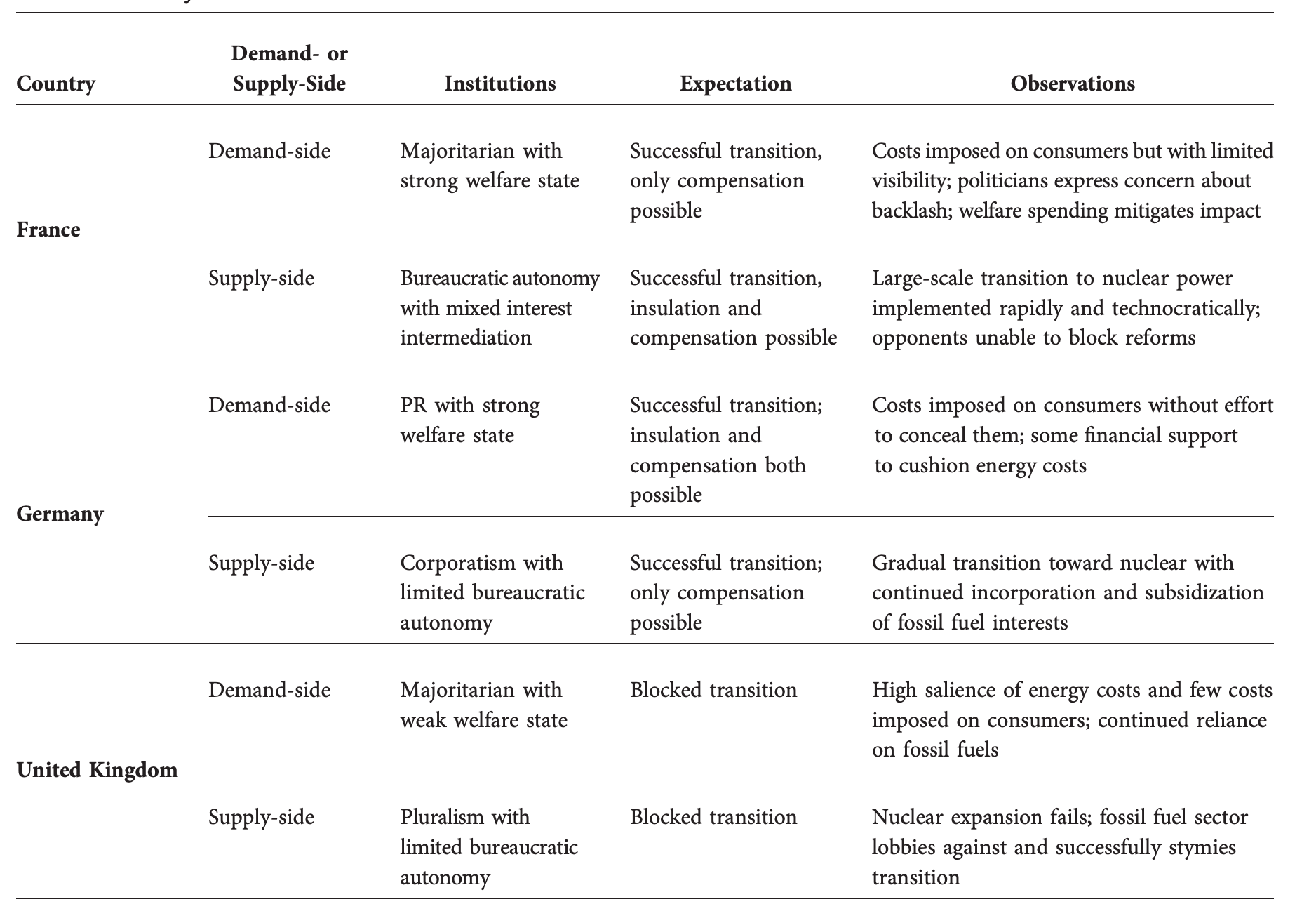
When you’ve got supply-side institutions bureaucratic autonomy (France), or effective corporatism (Germany), you can get capital to come along. France with both autonomy and corporate coordination managed a swift transition to nuclear. If you’re in a majoritarian system, pushing the costs on to consumers is difficult but in a proportional representation system that buys you more time - Germany put in gasoline taxes to weather the storm, relying on the welfare state to cover up the political fallout.
My current homeland, the UK, failed on all fronts.
This isn’t a question of 3 countries - as I said at the top, the authors examine these effects across the OECD, estimating the effects of the supply and demand side institutions separately.
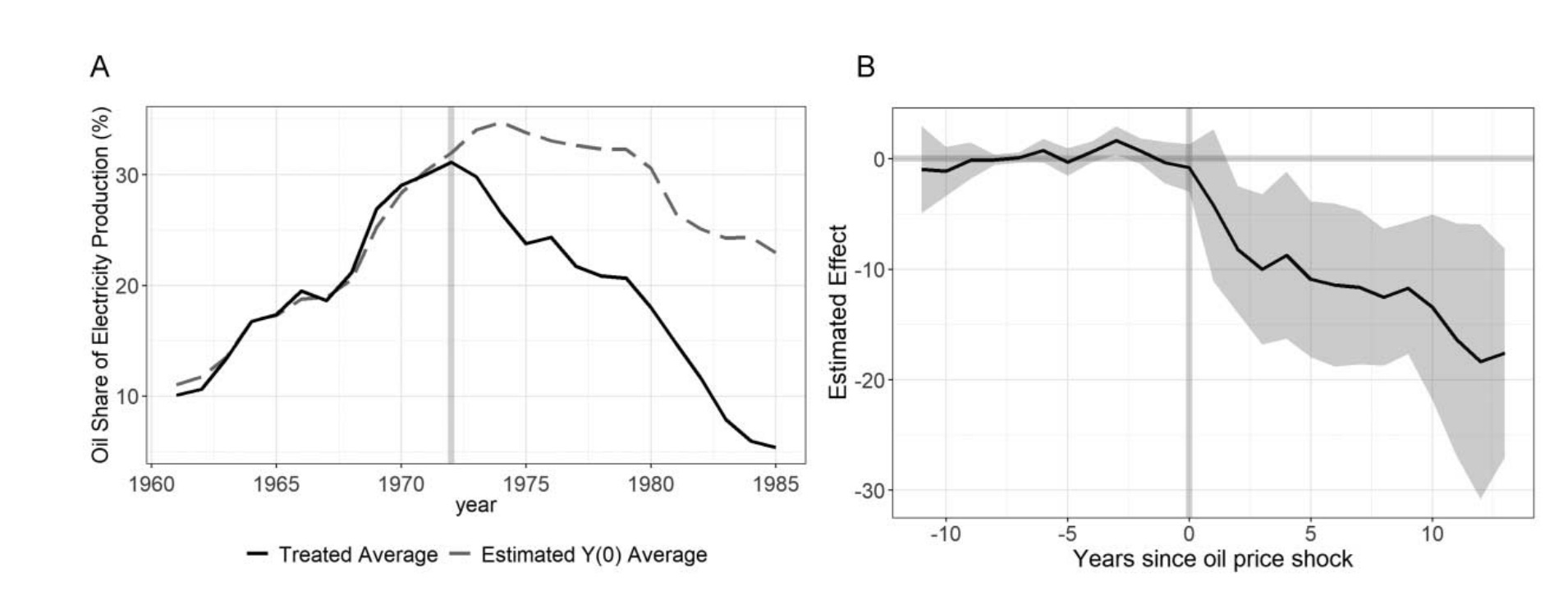
On the supply side, the authors asses how the share of electricity generated from oil changed. Countries with supply-side institutions - autonomous bureaucracies and/or corporatist structures - saw that share fall significantly faster after 1973 than the synthetic counterfactual. Crucially, the pre-shock trends match well, which is what gives the post-shock divergence its bite. These countries weren’t already headed somewhere different. The shock hit, the institutions kicked in, and the paths diverged.
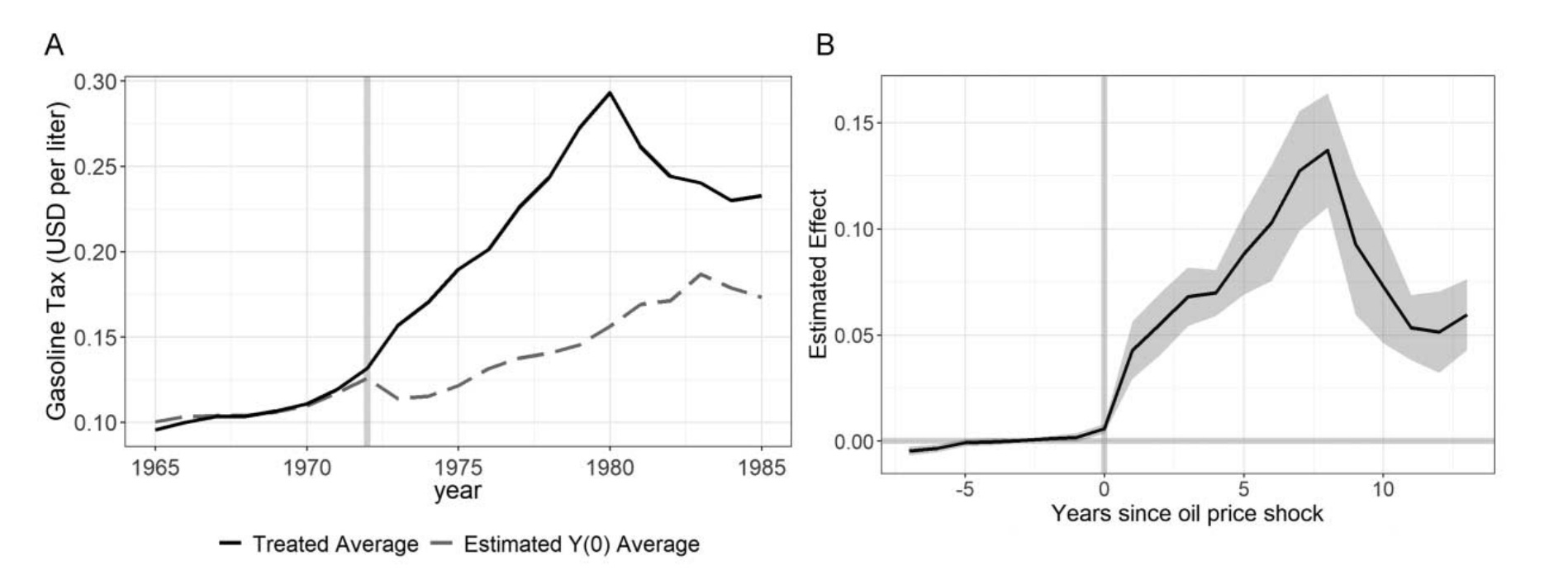
On the demand side, the outcome is gasoline tax rates. Same structure, same logic: countries with demand-side institutions - PR rules and/or robust welfare states - raised taxes faster and further after the shock than their counterfactual equivalents. The gap opens sharply in the mid-1970s and doesn’t close through 1985.
Institutional fit is going to condition not only how countries respond to the current US-Iran war, but also how they are going to generally approach a broader energy transition.
Taxing consumers to change their consumption behavior isn’t going to fly if they don’t have alternate options via welfare or when electoral politics acts more like a cudgel than a knife. Where national bureaucratic autonomy is weak, coordinating a push toward solar or wind is going to get lobbied out as option, especially when go governments don’t have a coordinated bargaining structure with capital. America is no good yet again.
Governments without the right mix of insulating and compensating capacity aren’t doomed, but the default toolkit isn’t calibrated for an energy transition even when costs are skyrocketing. Short-term horizons will win out.
The 1970s weren’t a clean win for anyone. But the period shows what’s possible when the institutions match the task, and more importantly when they don’t.
More on how to bring the demand-side, and international the connections across countries, further into this discussion in a coming post. If you want a thought-provoking piece that effectively puts the current energy moment into democratic context, check out the latest from The BREAK—DOWN.
Comments
Nothing yet. Say the first thing.
Sign in to join the conversation.