
Danny Ocean. Michael Clayton. Mr. Fox. George Clooney has built a career playing smooth operators in chaotic worlds. But it’s his portrayal of real-life newsman Edward R. Murrow that put him at the center of political discussions last winter.
Viewers of the Broadway adaptation of Good Night and Good Luck cannot be faulted for feeling a pang of nostalgia for Murrow’s courage to take-on J. Edgar Hoover during the Red Scare. We’d bet they also yearned for that era’s coherence: a time when America’s information ecosystem felt unified, because everybody shared the same basic facts.
The public’s attention was focused on a small but trusted set of centralized news sources - like Murrow, Walter Cronkite, and other evening news anchors – but the downside of this was their vulnerability to elite biases.
That era is gone. But the rise of Large Language Models like ChatGPT and Grok might bring it back, without any of the early internet’s promise of a democratized, decentralized information ecosystem.
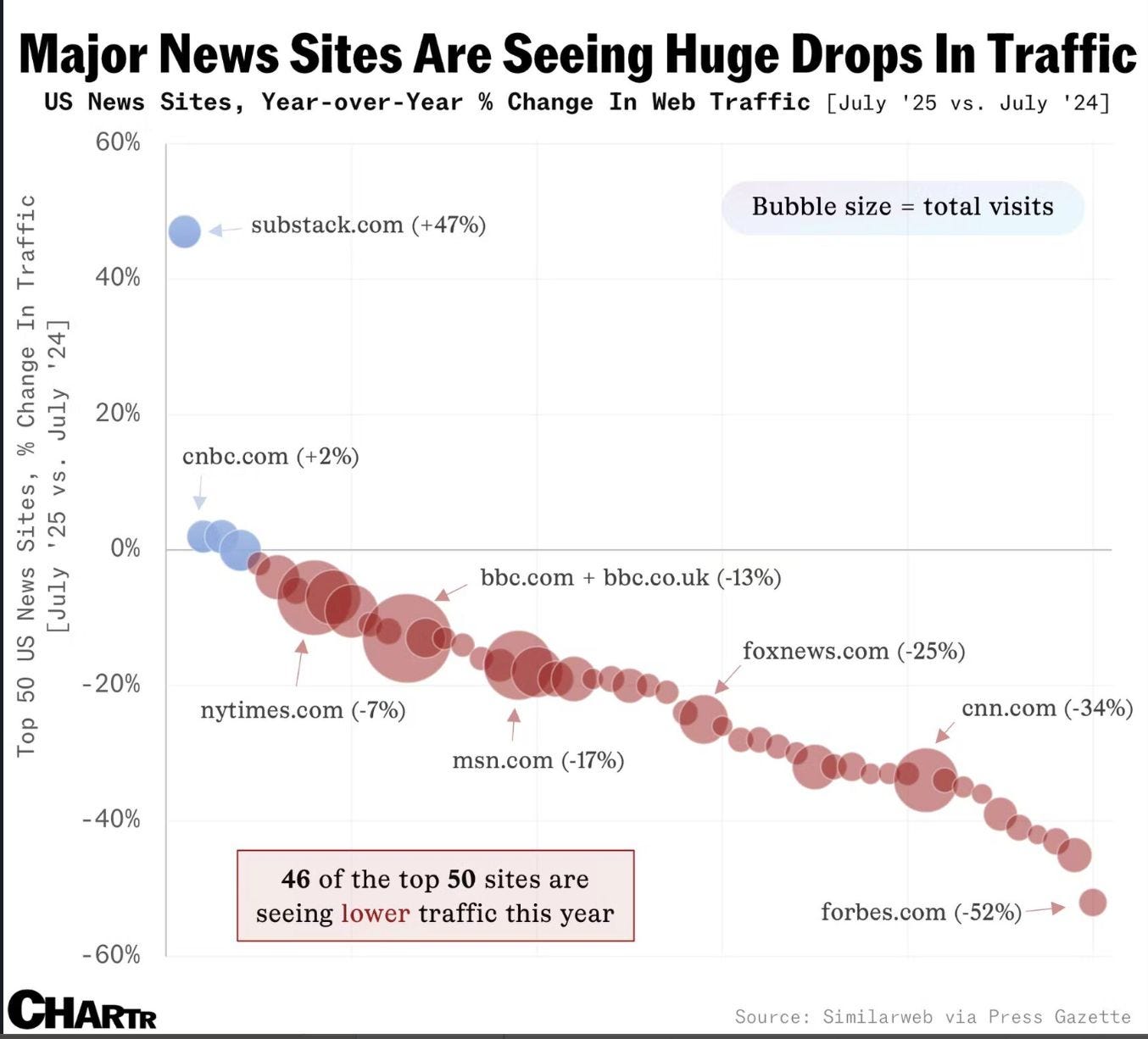
Before the dot.com boom, most Americans got their news from the same handful of sources. A “one-to-many” broadcast model reigned: a few anchors, a few newspapers, a few trusted institutions. Information was centralized, and so the experience was shared. Coverage largely reflected the perspectives and priorities of elite political actors (Lance Bennett’s “indexing theory” reigned supreme).
It wasn’t ideal. But it created a shared epistemic baseline. Everyone knew what had happened, even if they disagreed about what it meant and what ought to be done.
Blogging and then social media promised to fix the flaws of that system. Anyone could publish. And then anyone could go viral. It was the much heralded democratization of information where alternative media could, would, did break the stranglehold of elite narratives.
There were glimmers of success. Movements like the Arab Spring showed the potential of networked coordination. But even in those moments, the most astute critics warned of “Filter Bubbles”. The information commons were fracturing. We were losing the shared factual baseline as polarization was deepening. We no longer disagreed only about what was to be done. Instead we disagreed about what had even happened.
Social media gave us a “many-to-many” model. It was chaotic, bottom-up, algorithmically filtered. Instead of Murrow speaking to millions, we got a billion mini-Murrows shouting at each other.
As Henry Farrell and Bruce Schneier have argued, this shift didn’t just splinter reality. It eroded the basic infrastructure of social trust. We were losing the common knowledge needed for liberal democracy to function.
Of course, what feels like a chaotic social media landscape is not entirely decentralized. Platforms like Facebook and Twitter manage the feed. They shape what users see, when, and from whom. These systems and their owners have the latitude to decide who gets heard, but their incentives are less to curtail any specific speech and instead monetize the most inflammatory.
That filtering process has repeatedly drawn controversy. Facebook’s role in elections, content moderation debates, and algorithmic amplification of extremism all stem from the platform’s role in intermediation rather than creation. It also raised deep questions about potential political bias. They were accused of being, in effect, news editors hiding behind code.
It’s no surprise, then, that many observers are applying this same model to understand the rise of large language models (LLMs) like ChatGPT, Claude, or Grok. Journalists and scholars alike have begun probing: Will LLMs simply recreate social media’s fragmented, politicized information ecosystem in a new, even slicker form? Will AI companies simply take on the same gatekeeper role as the social media platforms?
Our bet is that LLMs are going to reverse many of these social media era trends, not continue them.
Unlike Twitter or Facebook, where 1,000 people asking the same question get 1,000 different answers, today’s LLMs often produce remarkably uniform responses. Ask Grok, Claude, or ChatGPT a political question, and you’re likely to get a strikingly similar take, even if the wording is different. Each model pulls from a massive, largely similar, corpus of online content, filtered and fused into a single, polished reply.
This is a fundamental shift. The result is no longer many-to-many. Instead, it’s a return to the old one-to-many broadcast model, but with two important twists: an illusion of tech-derived objectivity, coupled with the backing of the world’s richest companies and individuals. It’s code-based Murrow controlled by overtly political actors.
This is where the danger lies. LLMs draw on a diverse range of sources, but present a single authoritative-sounding answer. Although that gives the appearance of a balanced synthesis, it masks layers of judgment. Choices in data selection, in fine-tuning, in reinforcement learning. The figure below shows that the process is well underway.
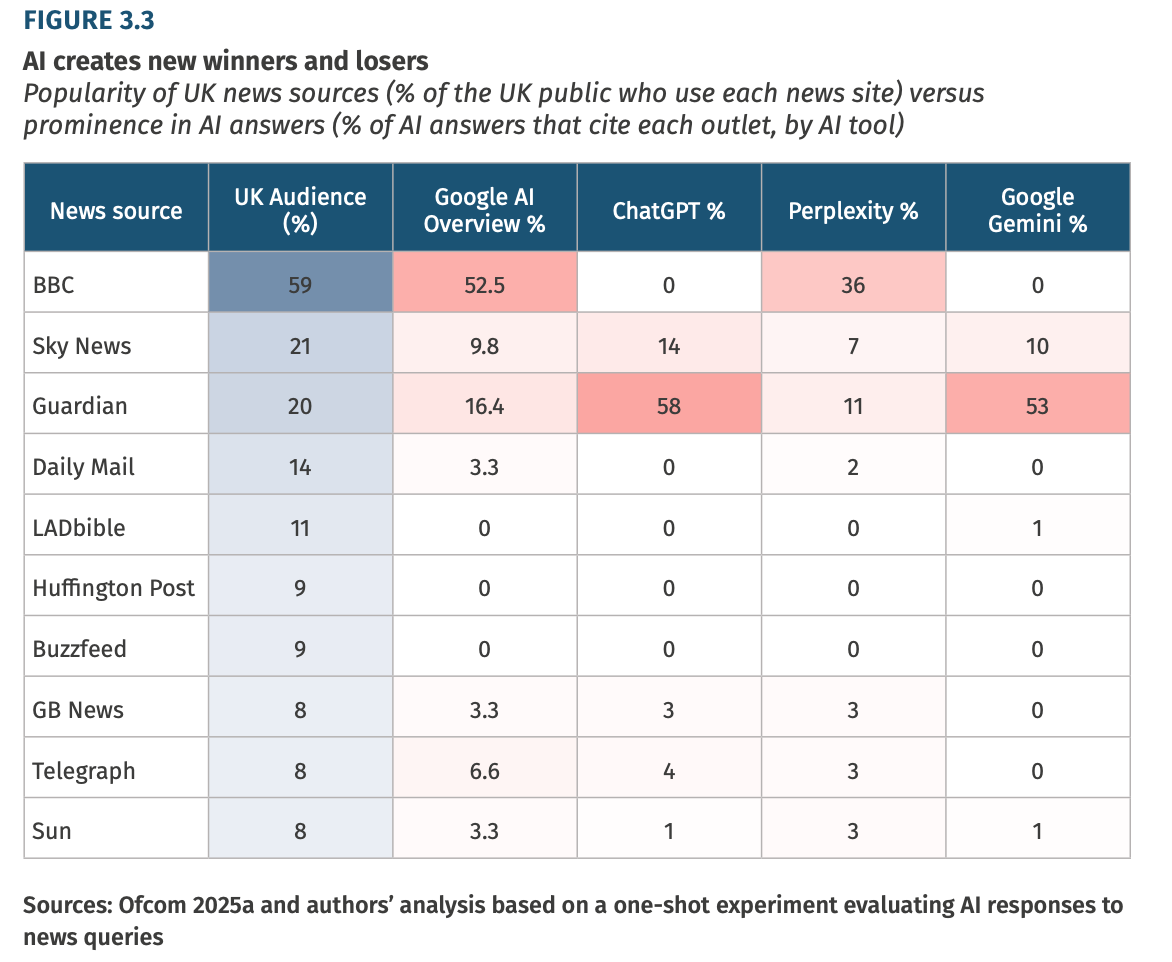
Bias still exists. It’s just buried. Musk has already tried to weed out Grok’s wokeness, with shocking results.
But because LLM’s outputs are presented as just a single, confident answer, it looks like objective description when it’s de facto interpretation. Now there is no range of opinion, unless you ask for it. The diversity of views is always going to be limited by what we already seem to know, removing the grounds for new debate.
That’s what makes LLMs more epistemically dangerous than Facebook ever was.
Worse still, the companies building these models now wield extraordinary central control. They choose the training data. They choose the guardrails. They respond to political pressure and are becoming key lobbyists themselves. And they know that millions of people may soon rely on their model’s answers instead of Google searches, tweets, or articles.
That’s not a filter bubble. It’s a knowledge funnel. One that could be clogged, or even redirected, by an enterprising political actor.
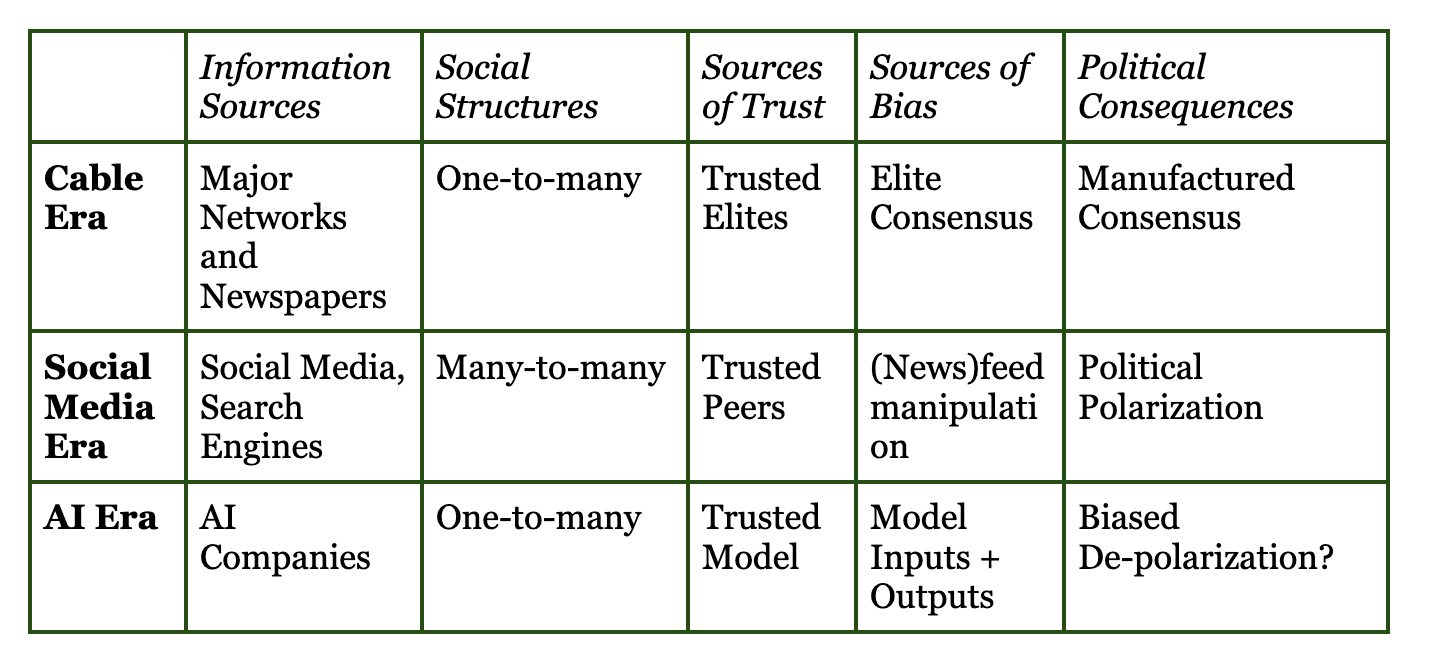
But here’s the irony. Recentralization may actually have some depolarizing effects. If everyone starts getting more or less the same information again, especially if it hews to broadly accepted facts, it could reverse some of the fragmenting effects of the social media era. We may even see a partial return towards shared reality. Less debate on what actually happened, more debates about what it means.
In that sense, LLMs might just be an algorithmic Cronkite. But their authority comes not from a hard-earned track-record of independence or from their elite social status. Instead it comes from the promise of learning from the accumulated knowledge of the entire internet, available in a single digestible line in your pocket.
Of course, the prospect of depolarization only holds if the information LLMs provide is actually balanced. And if we trust the institutions building them. Right now, both of those assumptions are very much up for debate.
Comments
Nothing yet. Say the first thing.
Sign in to join the conversation.