
I can’t shake the beauty, absurdity, and audacity of this year’s NFL halftime show.
Thirteen minutes of the most expensive commercial real estate on earth broadcast almost entirely in Spanish. The only English phrase — “God Bless America” — immediately followed by Bad Bunny listing countries across the Americas. A performance laced with political undertones, delivered on the biggest stage in American sports.
This from a league that spent years trying to scrub politics from its image after Colin Kaepernick.
Benito Antonio Martínez Ocasio has openly supported Kamala Harris. At the Grammys he denounced ICE and the cruelty of the current administration. He wore a bulletproof vest after his performance. None of this was hidden. None of it was accidental.
And yet the NFL chose him. And actively supported him through a political backlash.
Why would the most commercially dominant league in America — whose cultural heartland overlaps heavily with conservative America — willingly step into that friction?
The NFL is chasing growth. And it’s accepted that isn’t going to happen in America anymore.
For those outside the US - even those living on the East Coast - I think it’s difficult to imagine how popular the NFL is. Here are a few of the more ridiculous economic facts about the league put together by Trungphan2 last year:
The NFL’s annual revenue is well above $20 billion dollars putting it in the same league as the likes of Dutch semiconductor giant ASML.
It’s franchise value averages close to double that of the average NBA team, triple that of an English premier league side.
90 of the 100 most watched live events in the US are NFL games.
Here are a couple of my own personal favorites:
Per the National Chicken Association, 1.48 billion chicken wings were consumed during Super Bowl weekend - “Or one wing every 30 seconds since the fall of the Roman Empire”
There are no losers in the NFL. Every team is a profit machine.
More people watched the first day of the NFL draft - when teams pick future players coming out of college - than the final of the NBA. The actual game.
I’m listing this out because it gives you not just an idea of the stakes of the league, but also the challenge it creates for Roger Goodell, the NFL commissioner. He gets to take charge of the draft, with 13 million viewers tuned in, but he needs that number to grow.
Goodell isn’t an owner. He’s appointed by the team “governors” in NFL parlance with the primary mandate to increase their revenue and therefore franchise value.
But when you’ve got such a stranglehold on the American market, when everyone is trying to copy your playbook, where are you going to get more growth? Sure you could keep charging higher prices and trying to bump up the TV deals, but there is a literal finite number of adults in America capable of watching football.
So one route is to try to expand that number — get individuals who historically don’t care about the sport to tune in. Here the embeddedness of the “Fantasy Football” league in office culture has been a major boon. Some 30 million people, more than the population of Ukraine, play.
But one demographic where the NFL has somewhat struggled to gain traction is Latinos. As Marissa Solis, the NFL’s senior vice president of global brand and consumer marketing, put it: “…a community of more than 70 million people here in the U.S. ... so it was very important for us to ensure that we were relevant.”
But there are another billion Spanish speakers out there.
The NFL’s playbook is over a century old.
In 1902, John Hobson published Imperialism: A Study, arguing that when domestic markets become saturated and capital has nowhere profitable to go at home, it seeks new frontiers abroad. Underconsumption at home — too much production chasing too little demand — forces capital outward. Lenin then picked up this logic in 1916, arguing that imperialism was capitalism’s inevitable final stage. When monopolies emerge, domestic markets saturate, and the only way to sustain growth is territorial and, thereby, market expansion.
The NFL isn’t invading countries, but it would love to take over every living room regardless of which language its inhabitants speak. Domestic demand is capped. The NFL is a de facto monopoly. And it still wants growth.
The NFL is open about this. The international games — London, Munich, Mexico City — are means of market development. The NFL plays regular-season games abroad to build fanbases, sell merchandise, and establish broadcast deals in territories that don’t yet care about American football. It’s expensive and logistically complicated, but when you’ve maxed out American eyeballs, you need German and Brazilian ones.
And it’s a particular challenge when no one in those countries plays the game. When the time difference means you’re always going to have a limit on how many people can watch live.
So the best bet is at home, at least in the Bad Bunny sense.
Bad Bunny wasn’t just performing for 13 minutes. He was the NFL’s flag planted in Latin American territory it doesn’t yet control. Hobson would recognize both moves: when you can’t expand the market at home, you either export the product or import the consumers. The NFL is doing both.
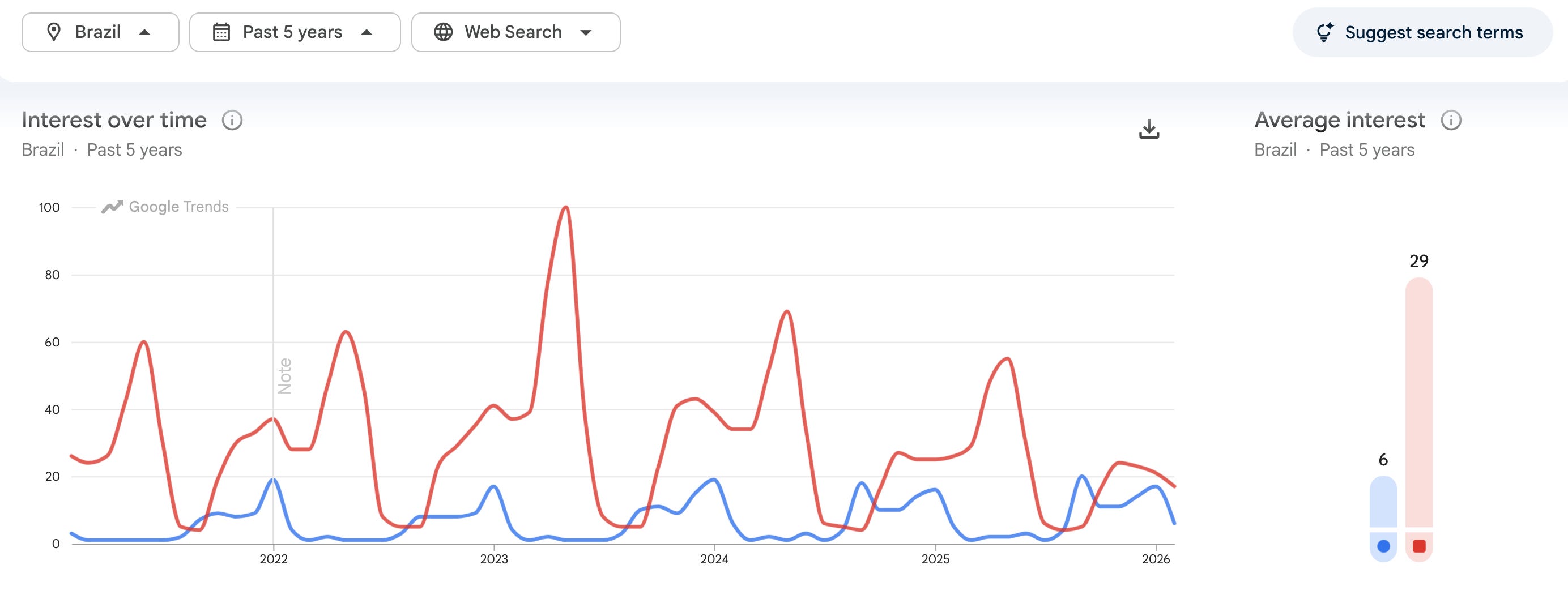
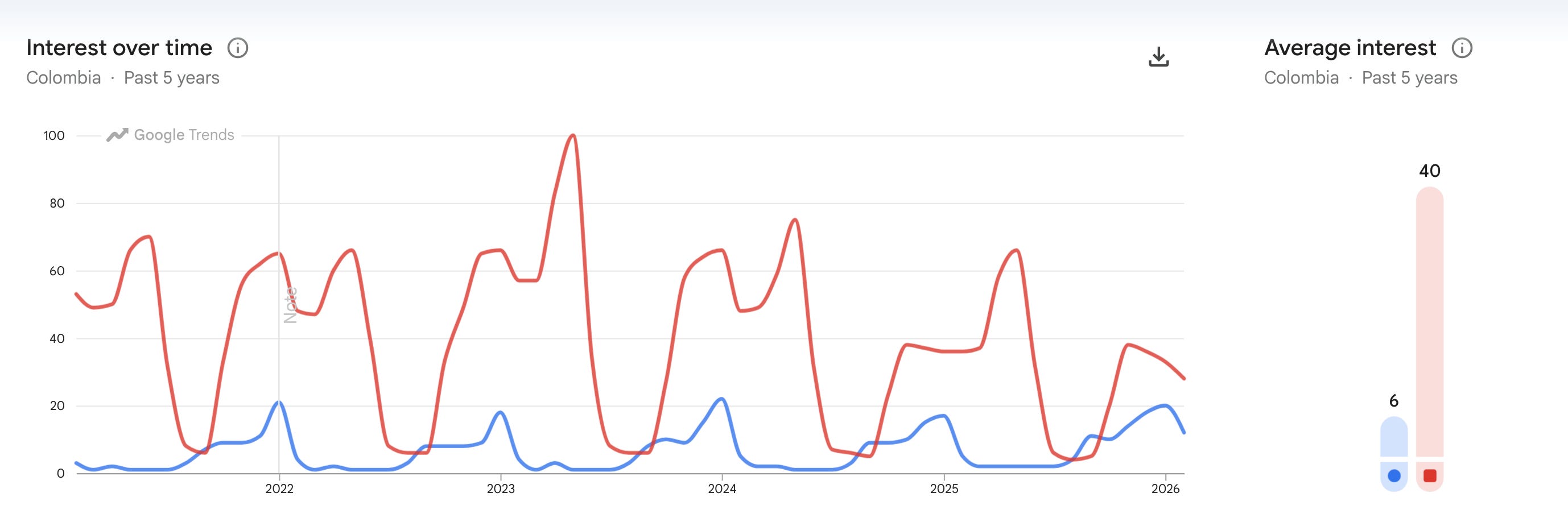
The data confirms the challenge. When you compare NFL and NBA search interest across Latin America’s largest markets, the NBA continues to crush the NFL — contra its American dominance. The biggest spike for the NFL happens in Januarys, with the Super Bowl and the halftime show.
Yet even during this spike, as the figures show, it doesn’t compete with basketball in much of Latin America (“nba” in blue, “nfl” in red).
Of course, the need for international expansion isn’t unique to the NFL. Domestic saturation driving sales abroad is what mature businesses do. Apple doesn’t grow by selling more iPhones to Americans. Most people already have one. Apple grows by chasing India and Southeast Asia.
But we’re living through an era of aggressive protectionism and hostility to globalization. Trump’s tariffs, supply chain reshoring, “America First” rhetoric. The policy mood is oriented toward limiting cross-border flows. And yet there has been remarkably little resistance to corporate expansion abroad, especially for the largest players.
Whether the Bad Bunny strategy actually works remains to be seen. The Google Trends data suggests the NFL faces an uphill battle in markets where basketball already dominates and American football remains foreign. But the NFL’s willingness to try reveals something important about where corporate America is heading.
In a protectionist age, most corporations can’t globalize without political friction. The NFL can. It’s too embedded in American identity to restrict, too saturated domestically to stay home. It’s the ideal monopoly for this moment.
Right now, corporate America’s biggest players are comfortable living off a historic bubble in tech and finance. But what happens when that bursts and they find they can’t easily use the NFL’s playbook without risking political backlash? When protectionism actually binds, and there’s nowhere left to grow?
Capitalism is an unstable search for aggregate demand. Most corporations lack the NFL’s political immunity to take an imperial turn when the home market is exhausted.
Comments
Nothing yet. Say the first thing.
Sign in to join the conversation.