
Venezuela. I think plenty of other people are effectively covering what the kidnapping of Maduro means. Seva Gunitsky rightly, in my opinion, sees this as a gift to leaders that want to reshape the world into spheres of influence (ahem, Mr. P). Rachel Ziemba has the energy market consequences covered. And Maximilian Hess brings in the role of the hedge funds, like Elliot and Paul Singer, who stand to benefit from the US takeover. I want to take a step-back, and try to tie these three trends together by bringing in China.
Venezuela by some estimates owes up to $170 billion. A chunk of that is to China through its various forms of commercial and official lending that boomed through the late 2000s and the early 2010s. With Venezuela plausibly re-entering the global economy, we’re likely heading for another round of debt restructuring - situations where governments and their creditors agree to new terms, often more favorable to the borrower, with the hope of creditors getting something rather than nothing. We’ll probably see the International Monetary Fund come in. China will be central to all those processes. And that will collide with the Donroe Doctrine.
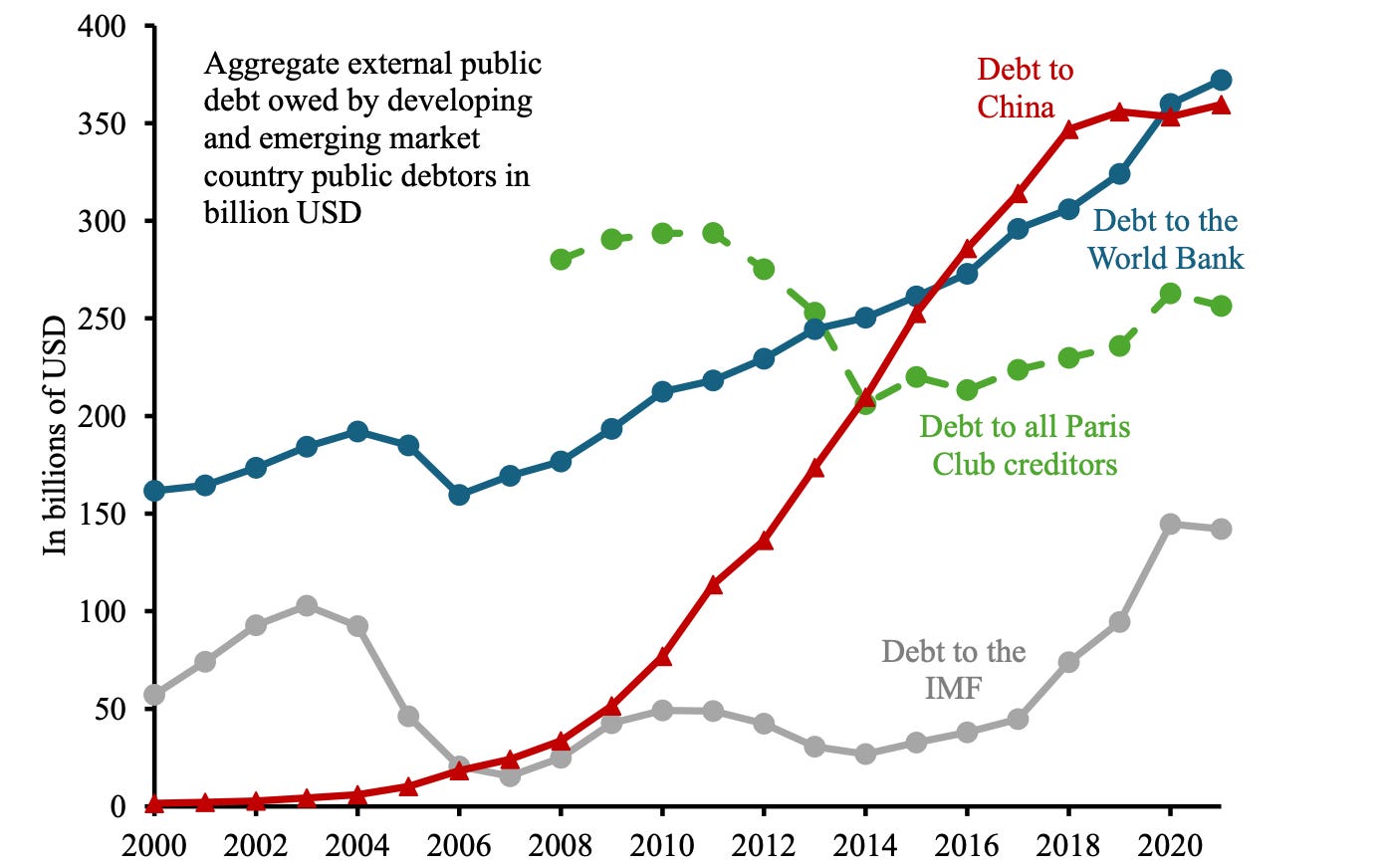
Between the early 2000s and the mid-2010s, Chinese state-owned banks lent over $800 billion to developing countries. As the figure above, from a terrific review by Horn, Reinhart and Trebesch shows, it easily rivals the scale of the World Bank.
Unlike the shift to bond financing embraced by many emerging markets since the 1990s, China pursued a bank-led model. Its loans were commercial, often collateralized, and structured to serve dual purposes: development in borrowing countries and economic gains for Chinese firms.
More plainly, China did lend to countries pretty cheaply but far from a free giveaway bonanza that might garner geopolitical influence. Nearly 75% of the money lent was in the form of US Dollars. This was not a play to internationalize the Renminbi.
It also wasn’t “debt trap diplomacy” - half the loans were collateralized through “liquid assets.” That usually meant cash held in escrow accounts, often with the borrowing government moving money into a bank account in China. Not very many ports to seize here.
But the two features that are going to matter most going forward are:
Lending terms were highly secretive with clauses often specifying that the country would not be allowed to share the terms of the deal with anyone else. Some even prevented the sharing of the existence of a lending deal at all.
The bulk of the contracts also had a “No Paris Club” clause - countries weren’t allowed to bring the Chinese debt into the roundtable restructuring talks with the informal “club” of the big country creditors (the US, France, Japan) when the borrower-country gets into trouble. China maintained autonomy.
Alex Zeitz argues that China’s lending boom left traditional multilateral lenders in a bind. They could either try to specialize - complement the type of projects that China was clearly going to undertake - or they could try to emulate. Zeitz finds that they clearly chose the latter.
Much of China’s lending was focused on big infrastructure projects. Projects that often both private or traditional country lenders were unwilling to put money toward. Not because they didn’t see value in building out public goods. More because, construction projects are rife with corruption, often subject to delays, and bring about a lot of domestic pushback.
China stepped in, and as the figure below shows, the World Bank followed suit, upping its projects in “hard” sectors like energy.
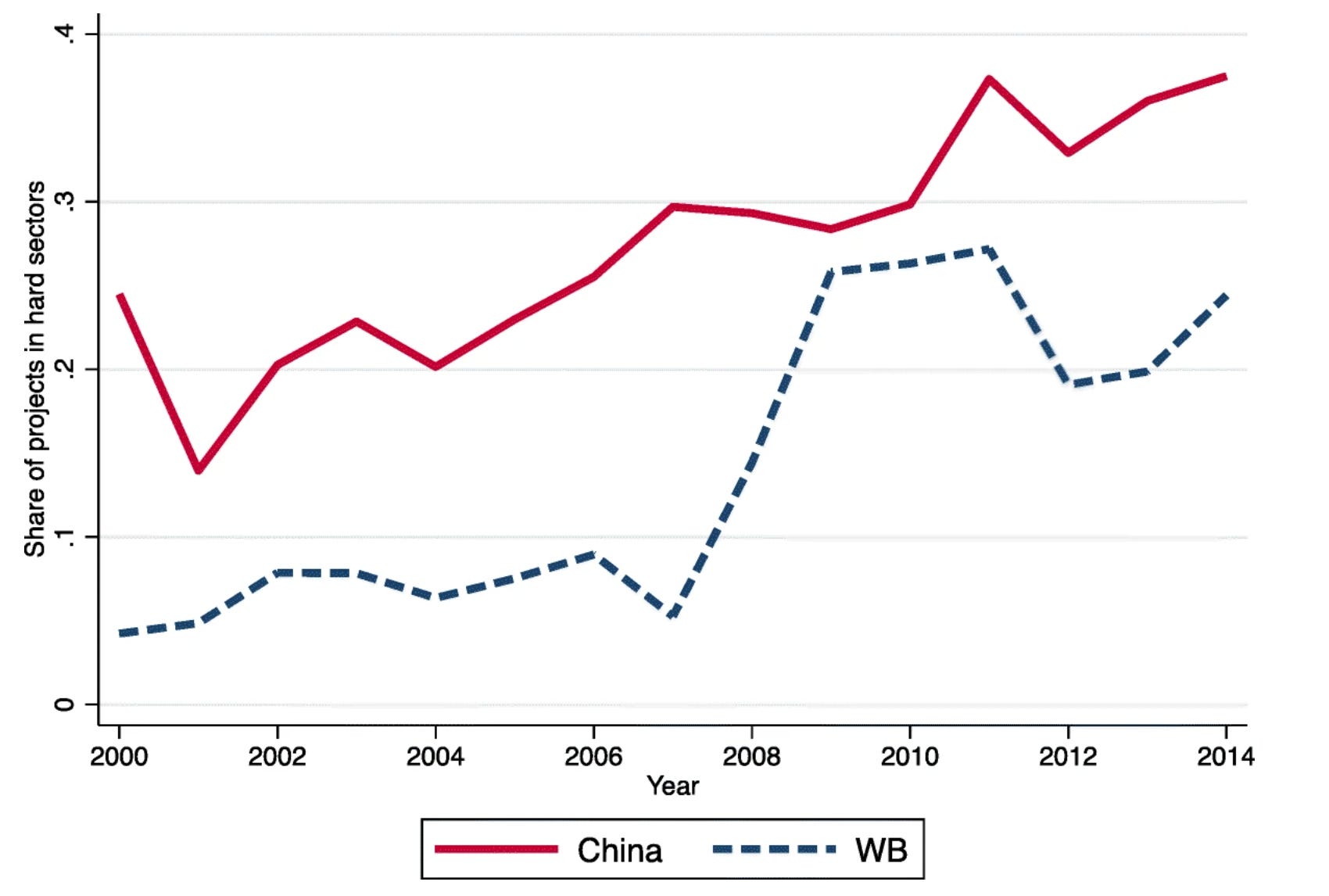
But this is only true for projects that lacked any governance related endeavors - tracking China’s approach to limited conditionality.
It wasn’t just that China changed what kinds of projects were available. It shifted what kinds of projects governments wanted. One of the clearest signs comes from countries that helped establish the Asian Infrastructure Investment Bank (AIIB). These are states that clearly signaled alignment with China’s ambitions. And that alignment showed up in their demand for loans from other institutions.
Using data from 155 countries between 1992 and 2019, Qian et al. find that founding members of the AIIB experienced a sharp drop - about 22% - in the number of new infrastructure projects they sought from the World Bank. As the figure below shows - comparing the real lending by the World Bank to a statistical counterfactual - these states didn’t abandon the World Bank entirely, but their demand for infrastructure funding shifted away.
By contrast, the change wasn’t visible for World Bank projects in governance, education, or health. Just in the hard stuff like energy and transportation. Even if the World Bank wanted to emulate China, some borrowers had other ideas.
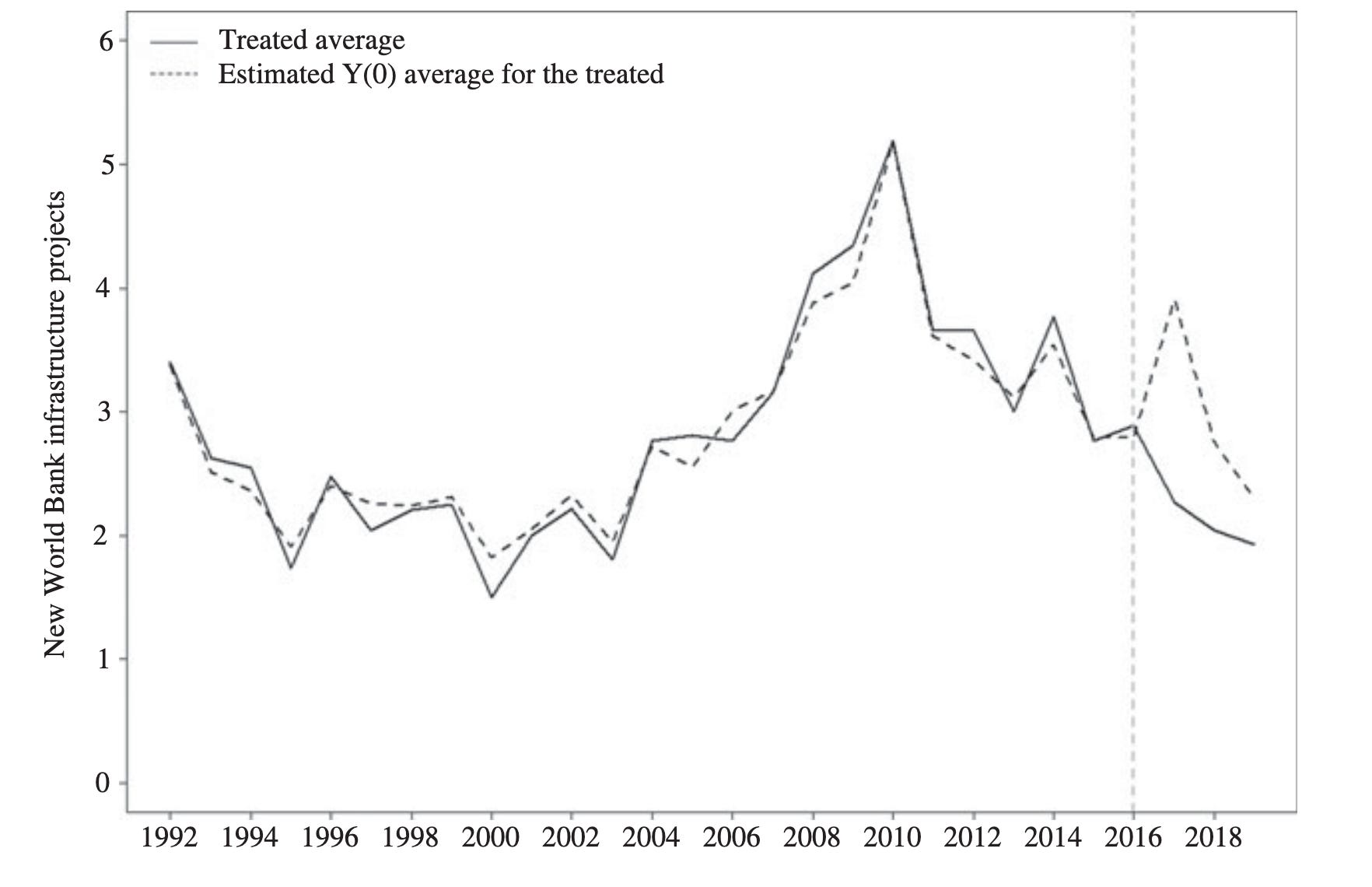
There’s no evidence that the World Bank was retaliating against these countries by cutting back. A demand-side pivot, a shift in where governments thought they could get faster, easier, or more desirable financing is more likely. And it’s one that changed the World Bank’s own portfolio.
We have some further evidence that indicates that borrowing from China made a country less likely to fulfill the conditions on its loans from the World Bank.
When countries struggled to pay back their debts, we had a flawed but clear playbook. Most developing countries owed their bilateral debt to a handful of rich-country governments - members of the Paris Club - who could meet, negotiate as a bloc, and coordinate debt relief. That system helped, even if imperfectly, streamline negotiations and spread the costs of restructuring across lenders.
In 2010, Paris Club lenders held 58% of the external bilateral debt of IDA-eligible countries. By 2021 that dropped 32%. China isn’t part of the Paris Club. Its contracts basically disavow it. China’s share of bilateral debt went from 18% to 49% over the same period.
That shift isn’t just cosmetic. Ballard-Rosa et al. show that higher Chinese debt makes it less likely that a country will get debt relief from Paris Club members.
That could be a result of “fiscal stress”- China has been shown to roll over debts and even steps in with bailout funds through swaps pretty regularly. So that could lead to less need to restructure with the Paris Club.
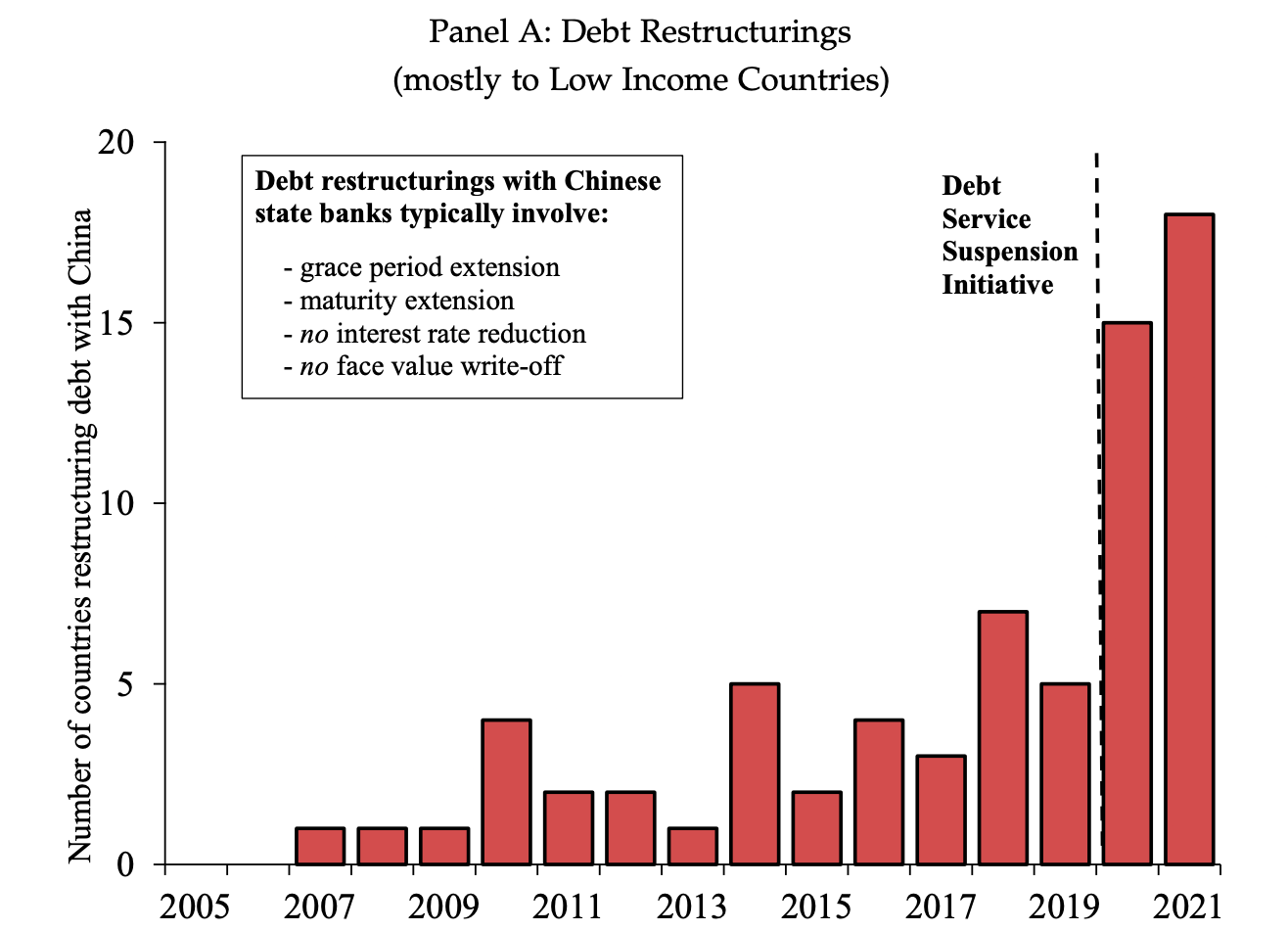
Or Paris Club lenders may be less willing to grant relief when they know the country owes a lot to China. They don’t want their concessions to simply free up cash that gets rerouted to repay Beijing - who, as the figure above shows, is very hesitant to take less money but is willing to drag out repayment. Especially if Chinese loans carry higher interest and more collateral.
Ballard-Rosa and co. find more support for the second story. Paris Club relief is less likely when Chinese debt is high and when the geopolitics are tense. As the figure below represents, countries that are less aligned with the U.S. (based on UN voting) get worse treatment during multilateral restructurings.
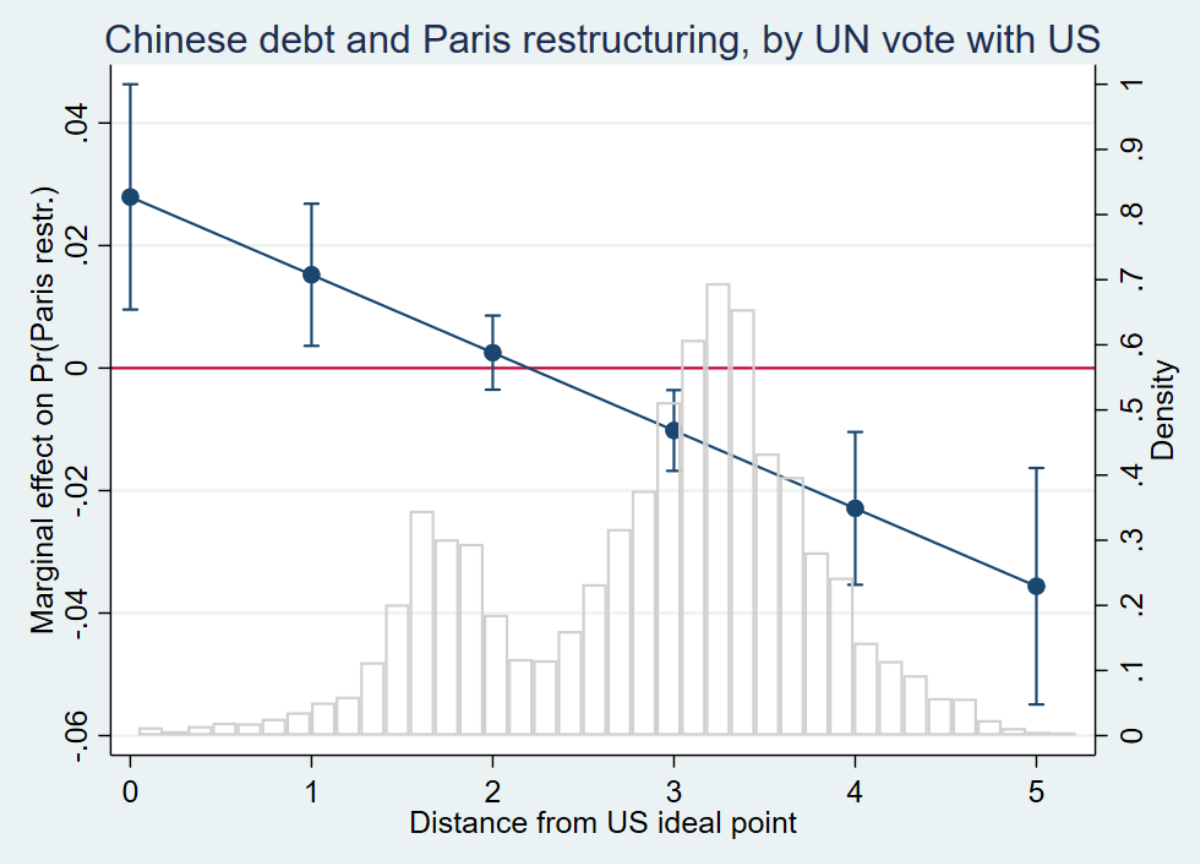
Remarkably, more transparent countries (i.e., when creditors may plausibly see the debt terms) are even less likely to get Paris Club deals. In other words, the more a country discloses, the more likely it is to be punished. Maybe China saw this coming when it decided to make its contracts so opaque?
All of this fractures the old model of coordinated debt relief. China has started participating in newer forums like the G20’s Common Framework, but it’s still a reluctant player. Its “No Paris Club” clauses (mentioned above) make even basic coordination difficult. And with China barely at the table, restructuring becomes messier, slower, and more political. That can stop a necessary bailout coming through.
China’s involvement doesn’t appear to stop private debt restructuring per Ballard-Rosa et al. The opacity of Chinese debt does, however, tend to slowdown negotiations with the IMF.
Using a dataset covering up to 162 countries from 2000 to 2018, Kern & Reinsberg (2022) show that countries who default on Chinese debt are more likely to enter an IMF program, but only when they also suffer a severe external shock - be it oil collapse, political instability, or a once in a generation pandemic. Loss of collateral value drains fiscal breathing room.
These countries are then forced to accept a greater number of IMF conditions. A one-standard-deviation increase in Chinese loans correlates with 2.7 additional IMF conditions - a statistically significant jump.
These countries can’t go to bond markets. They can’t go to private banks. Beijing won’t write off the debt. So the Fund steps in, but with an eye toward discipline and visibility.
And it’s not just a financial story. Kern and Reinsberg find that the effects are especially strong in resource-rich, corrupt, and authoritarian countries. Places where elite rent-seeking, oil-backed collateralized loans, and weak institutions collide to magnify the damage. Once these projects go underwater, there’s nowhere left to turn but Washington, and the money always come with conditions.
All of this is about to collide in Venezuela.
Much of the country’s deals with Chinese state lenders are in the form collateralized oil-for-loan deals struck in the Chávez and early Maduro years. And now, with Maduro gone and the U.S. openly orchestrating regime change, a new government will have to rebuild legitimacy while managing a colossal debt crisis, a devastated economy, and a foreign policy chessboard that includes Washington, Beijing, and Wall Street all at once.
Unless the US is somehow willing to bankroll it all, the new Venezuelan regime - whatever form it takes - will almost certainly seek out IMF support . The economy is in ruins, and without fresh external financing, there is no path to recovery. That means a front-row test of everything outlined above: China’s willingness to renegotiate; the IMF’s appetite for hard conditions; and the broader geopolitical tensions that now define sovereign debt.
But maybe China lets it all go. $10 or so billion is a relatively small price to pay to accede to a spheres of influence international order where they can do as they see fit in East Asia without American imperial overreach.
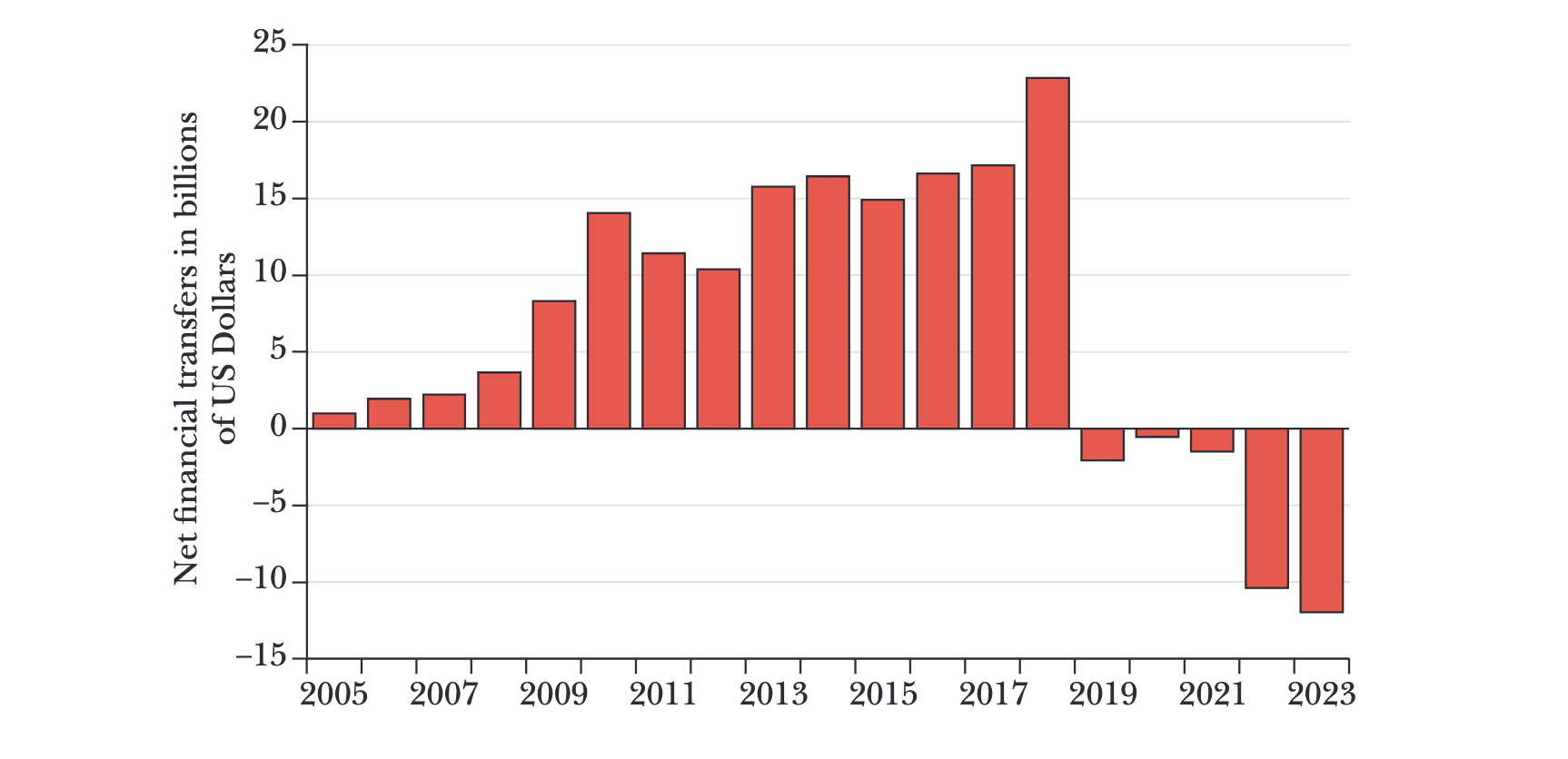
The most remarkable part of this to me, which usually gets forgotten in the freak out over Chinese lending, is that the trend has already reversed. As the figure above shows, countries are paying more to China now rather than borrowing from them. China’s approach has shifted, but as with any half-decent mafia reboot, debts linger. Even after a kidnapping.
This post is part of my Politics Makes Markets series. Each entry synthesizes 5 academic papers that collectively illustrate how specific parts of the global economy work. You can find the post on bonds here and one on central banks here.
Comments
Nothing yet. Say the first thing.
Sign in to join the conversation.