
Every exec wants to shake the quick win money tree. And sometimes there are magical wins that result in high ROI with no long-term issues. But not always.
The reality of quick wins is much messier than getting quick and easy money. Let’s walk through the potential problems and what to do instead.
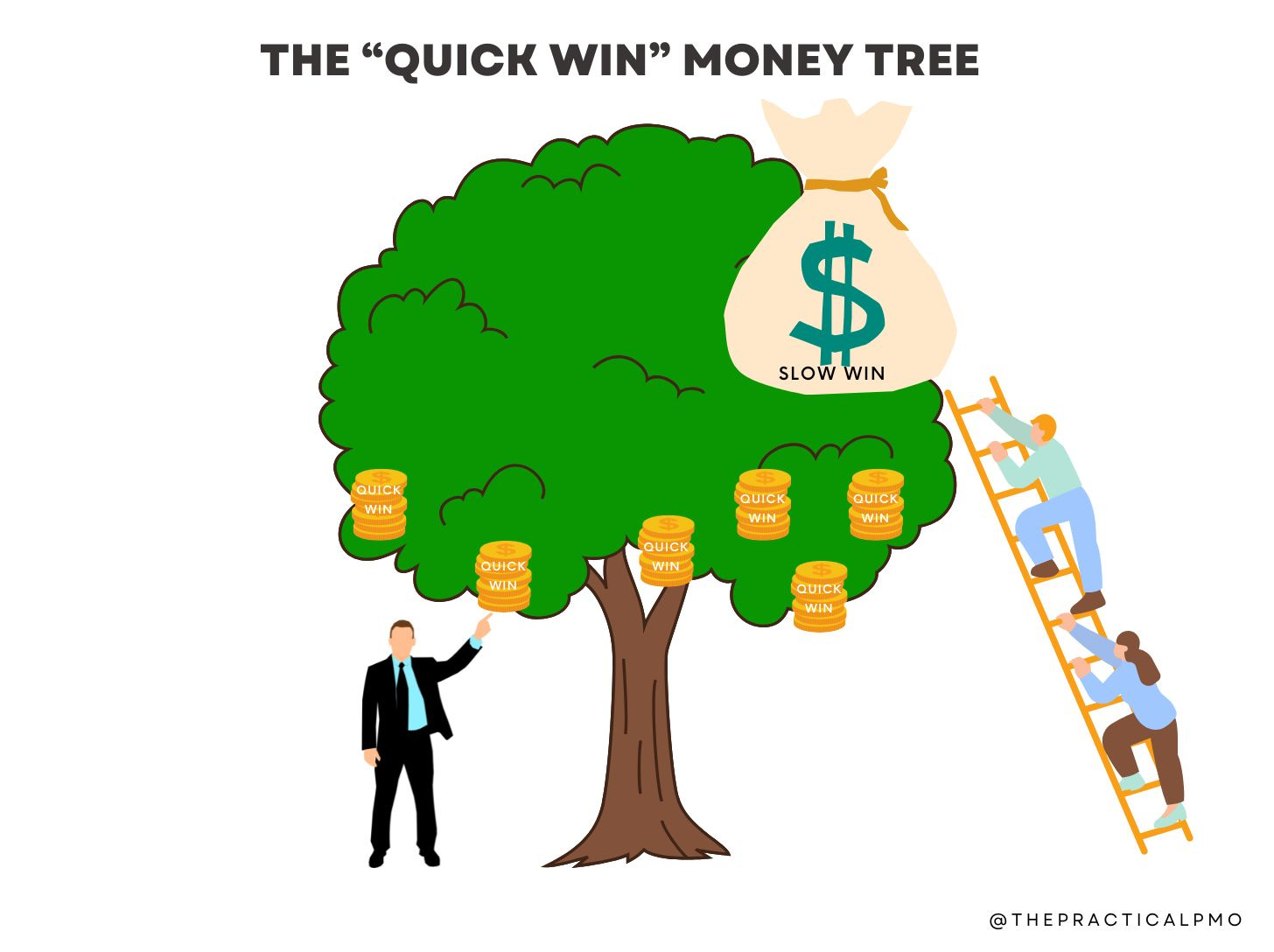
A “quick win” is usually an initiative that makes / saves money and can be completed in under three months. 6Sigma.com defines a quick win as a project with “a single problem and a single solution.” Different companies will have slight definition variations but the main points of a quick win are:
Fast: Short implementation timeline
Cheap: Low / no cost investment to implement
Good: Immediate efficiency unlocked or money earned at launch
Fast, cheap, AND good? All three of these things sound great, right?
In theory, yes. But that doesn’t paint the full picture.
Let’s chat about the (at least) three reasons why below.
Execs, especially new execs, want to make immediate impact.
These same execs also have likely previously worked with management consultants. The consultants typically outline all the quick wins along with some ambitious high ROI transformation initiatives.
But that long-term ROI doesn’t take into account the ROI of the quick win! What does this mean? It means that if you implement a quick win you reduce the total potential ROI of completing the long-term project, thus deprioritizing it from the list of overall business initiatives in favor of higher-ROI quick wins. Which leads us to…
Inefficient processes are often a daisy chain of well-intentioned quick win solutions.
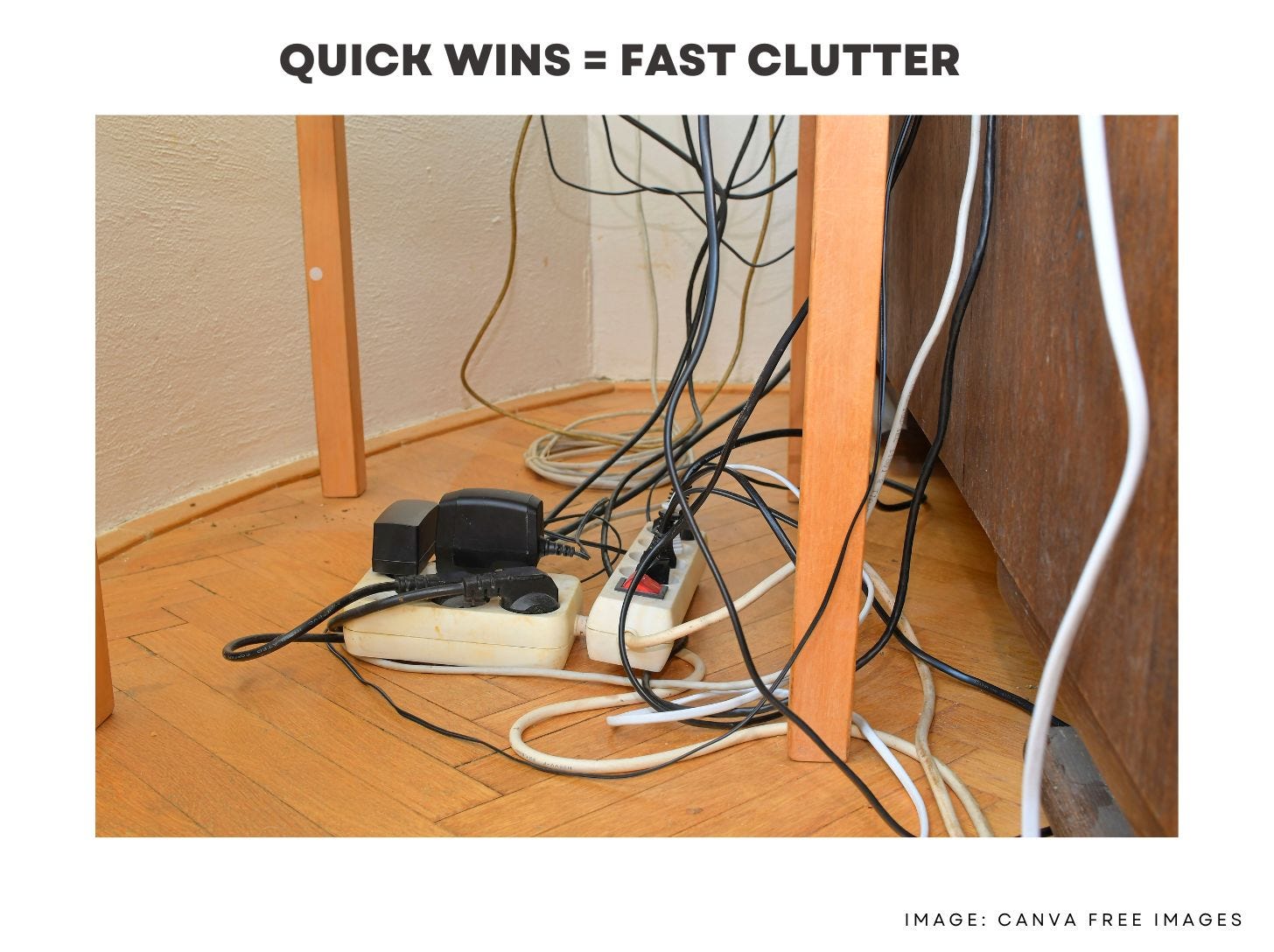
“Process Debt” is like technical debt for processes. Process Debt is a scenario where you have a bunch of convoluted cross-functional processes with some individual logic but no transversal logic. Each quick win lives in a vacuum and plugs into the overall process without thinking about overall efficiency.
This then leads to people managing these large and overly complex process with little hope of the overall process being fixed. There will always be another higher priority quick win. If only there were more people to solve this problem…
Even if you added more people they would likely need to accomplish a few “quick wins” to build up the organizational credibility to push for a longer-term fix. By the time they gain that credibility they have likely been promoted to their next role where (you guessed it) they need to find more quick wins to continually advance.
This incentivizes everyone to search for quick wins with nobody directly responsible for climbing the ladder past the quick wins to future-focused sustainable slow wins.
Maybe. But it’s a tougher sell and requires more upfront work in a short time.
Here’s how I try to win the slow win fight:
Process Mapping: Build out a quick high-level view of the process to show where the identified quick win fits in to the broader process (I use Visio but you could use Powerpoint or Canva and be fine with a little more upfront configuring).
Business Case Creation: I write out the total potential savings of looking at the process holistically vs addressing a quick win. I do a quick resource plan to show how many people would be allocated to the quick win and how redeploying them to the slow win is a better and efficient use of team skills.
Case Study: In a land of quick wins memories are short. If you get a slow win write a case study of what worked and share it to justify your next slow win.
Bargaining: Sometimes you trade a quick win in one process for a slow win in another. Use data to determine if your slow win is actually a better use of time than the quick win and decide where you want to pushback vs where you want to expend your energy. It may not always work but hey, at least you might get a quick win out of it.
I genuinely hope this newsletter helps you, or at least entertained you in the time you took to read through it. If you want more of this type of content, consider subscribing. Good luck on your quest for slow wins!
Comments
Nothing yet. Say the first thing.
Sign in to join the conversation.