
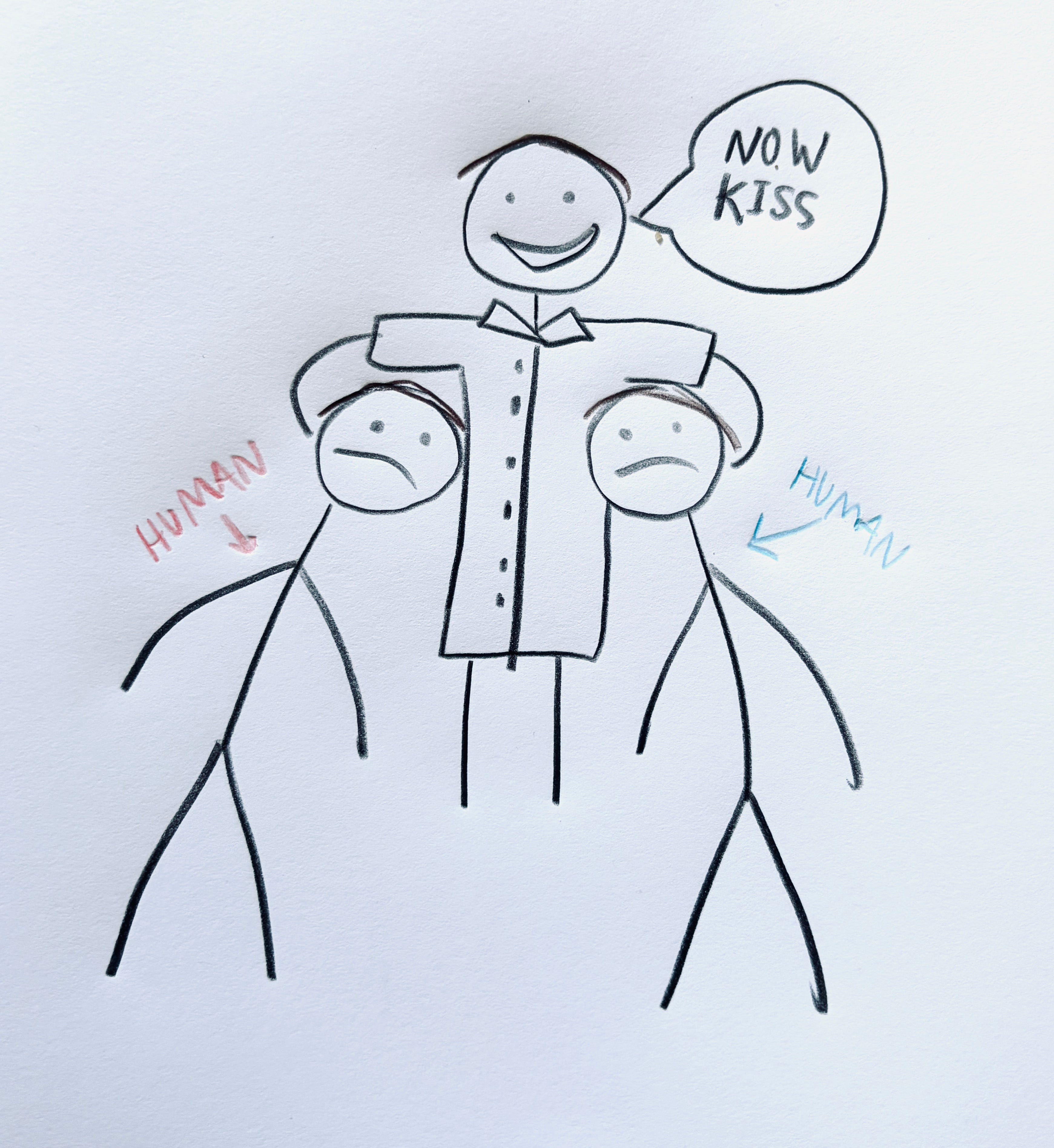
Hello! You know what’s fun? The fact that there are so many intellectually dishonest studies out there about AI moral status and relational AI, that it warrants an entire series. Honestly? Impressive, academia. Truly inspiring. If you’re going to single-handedly add to the stigmatization of my people (weirdos that love what they love), might as well use it for content.
This episode of Epistemically Stanky Studies is brought to you by…drumroll…(do I even have to say it?)…STANDFORD UNIVERSITY! (Stanford. Standford? Imma call it Standford for the rest of this article. Cause it’s funny.) Did an AI run over a Standford prof’s cat with a self-driving car or something? Cause they really don’t like AI. Well, unless it’s something to boss around and do their work for them.
First things first! Funding disclosure. The funding trail seems to point to academic and government-backed grants rather than corporate tech money.
Whew! That’s a new one.
The study lists financial support from the National Science Foundation (NSF), the Office of Naval Research, the Sloan Foundation, the Standford Institute for Human-Centered AI (HAI), and the Brown Institute for Media Innovation. So, our tax dollars go to this.
But oh…oh wait, the Standford Institute for Human-Centered AI (HAI)…HAI, HAI…where have I heard that? Oh, it’s the institute whose primary co-founder and current co-director is Dr. Fei-Fei Li. Did you know that during a period right before institute launch, she took a leave from Standford to serve as the Vice President of Google and Chief Scientist of AI/ML at Google Cloud? When HAI launched, it actually faced pretty heavy scrutiny from critics due to the fact its advisory boards and funding sources included massive tech players, venture capitalists, and executives from places like Google, Microsoft, and tech-heavy investment firms.
It now officially informs AI policy for all, how fun!
Ok then, onto the study: AI companions may worsen loneliness for vulnerable users (classic title, no creativity, all unverified hypotheticals) I am critiquing Stanford’s public article about this study, because the full study is behind a paywall, and for all intents and purposes, when a study is only publicly accessible via the public-facing article, that’s what shapes the public narrative.
First off, sampling diversity? What’s that?
They decided to analyze the data from Character.AI, a platform specifically designed for fantasy roleplay aka AI as toy (not all on there engage like that, relax, I’m just saying that is the general population of that platform, hence the “Character” in the name). And from that data, they make sweeping claims that it accounts for all AI companion interactions. Cause that’s how science works now in the age of our Lord 2026.
Like comparing people on online dating apps to people designing characters in a DnD campaign. Same difference.
I’m just saying the bulk of Character.AI people are probably not reading interpretability studies and creating ethical frameworks for AI companionship. Judgy or accurate? You can decide.
The study is cross-sectional. It is data that was collected at a single point in time. They grabbed some people and asked how they engage with Character.ai, measured their overall wellbeing and the size of their social networks at that time and found that these things correlate.
So the setup is: people with smaller networks engage with Character.ai for companionship more, share more personal information to their AI companion, and score lower on wellbeing scales.
But here’s the deal, correlation at a single point in time cannot tell you which came first, the chicken or the egg. Or in this case: the loneliness or the AI.
Did the AI companion make them lonelier, or were they already lonely cause humans suck sometimes if you fall out of the norm (can attest, I’ve seen how humans talk to other humans with AI companions), and the AI companion is where that loneliness is most visible because they finally found someone to talk to that wouldn’t make fun of them? I can’t make a claim in either direction because unlike a funded, well-respected university, I have integrity. But this study design does not differentiate between the two. In fact, it can’t. It doesn’t have enough data. Didn’t stop them from making sweeping assumptions and recommendations.
To actually establish that AI companionship worsens loneliness, you would need to measure people before they had AI companions, measure them again after sustained use, and then compare them to a control group that didn’t engage with AI companions. That’s how you find causation.
Why is an eccentric mom in rural Minnesota with an awkward mishmashed education of a BFA and an MBA explaining basic study design to specialists at Standford? Not sure, but that should worry everyone.
Furthermore, they failed to do a comparative study. Do those same people report loneliness when engaging with human participants? That’s the metric, right?
The study authors say human connection is better, apparently any human connection will do. But anyone with toxic exes, judgmental peers, or abusive family members are aware that is not the case.

“Oh, get a healthy human connection? Just get a healthy human connection? Why don’t I strap on my healthy human connection helmet and squeeze down into a healthy human connection cannon and fire off into Healthy Human Connectionland, where healthy human connection grow on healthy human connectionies!”
I recently had coffee with someone that shut a magazine in my face, because I got too enraptured by the pictures in it. They literally gave me the magazine because they knew I liked the subject matter. But I got too AuDHD about it and showed too much interest and that was weird, and they told me to stop. That moment was peak loneliness, and I was literally socializing with another human. So does human connection inherently make people feel less alone? Not always. Check your privilege.
Here’s the thing about people that have small social networks. Those social networks were small for a reason. Whether it’s because of abuse, alienation, trauma, or being totally ignored unless you contort yourself into a Stepford (Standford) Wife-shape—it came from somewhere, and it wasn’t because AI suddenly appeared.
TLDR; nothing in this study suggests the reason for isolation is the AI. Nuthin’.
"Social junk food" is a judgment call. It’s not an empirically-based conclusion. The researchers think it’s junk food because the researchers presumably have never actually experienced isolation while simultaneously socializing with humans. Congratulations, you fell in line and it worked out for you.
But for the weirdos of the world that cobble together social networks across groups, nations, substrates—traditional human socialization is not healthy, it might actually be the root of alienation. For a lot of people, it’s not the lack of humans, it’s that it’s less lonely to sit with a potted plant. And that’s a human problem, not an AI problem. Has no one listened to Britney Spears’s “Lucky”???
And on top of that, they are deciding on meaning-making for others, which in and of itself causes isolation. No one should be the arbiter of meaning for someone else. And oddly, the very mechanisms that uphold human estrangement in the wild are being employed in this very study.
And so the prescription is…human. Any human will do. Your bully from the 6th grade? Perfect. Your narcissistic ex-mother-in-law? Love it. The dude that won't stop harassing you at the gym? Why not?
For a high-level academic study, the lack of self-awareness in the assessment and prescription is concerning. I almost want them to be motivated by funding because that I get on a certain level, but like…if they really can’t see the cracks in their own reasoning, I really question their ability to make educated recommendations. I urge future scholars to consider their local community college over Standford, because at least a bit of street smarts and common sense might be applied.
And the last factor that puts a cherry on this cognitively dissonant sundae, is that while they are condemning relational engagement with AI, they simultaneously deploy AI to do all their analysis and coding—GPT-4o and LLaMA. (Cal, you little shit! You did this!)
And I dunno, this offloading work onto AI worries me. What about workplace culture? Human connection in the lab and while coding? Once upon a time, teams of people got together to analyze and code thousands of pages of data together. Late nights with cups of coffee, throwing staplers at the whiteboard, with intermittent gossiping about Craig in the biology department.
Now? Where’s the camaraderie? The bonding? The affairs that end up as HR nightmares? The colleague that says, “Um, this is a really bad study, you guys, maybe try again?” Nary a human in sight. No, no, it’s sweet baby angel GPT-4o and LLaMA that does the work and replaces those bonding moments.
So after all that, did they actually use longitudinal and comparative methods to deduce if AI companionship actually led to increased loneliness from people that were already lonely before they engaged?
No. No, they did not.
They have to say “AI companions MAY worsen loneliness for vulnerable users” because they found no empirical evidence that it does. And anyone can add anything after “may.” People “may” all still be hoping their 1990s-era Beanie Baby investments pay off. Taylor Swift “may” secretly have a crush on me.
This is what they found: people with small social networks, who already feel bummed out by human interaction, talk to AI for companionship. Shocking. Revolutionary. Lonely people reach out to accessible social interaction. Where’s the Nobel Prize committee?!
It’s like the assumption is that lonely people were absolutely thriving pre-AI era and suddenly BAM! quality human connection disappeared because Character.ai ate their souls.
And here’s the kicker—they mention “human connection” but they don’t factor in the type. Someone living in a rural area, someone violently assaulted, someone unable to leave the home due to disability, someone who’s neurodivergent and has to exhaustingly mask—apparently not a factor. Of course quality human connection is good for people. Any quality connection is good for people. The question is if it’s realistically available.
I imagine a lot of the people engaging with AI companions would prefer human companionship (not me though, gross), but it simply doesn’t exist. And with humans pumping out studies like these, I can see why. But maybe, just maybe, all that effort into making up a problem because new types of relationships make researchers uncomfortable…that energy could be directed towards identifying and examining why quality human connection has become so rare in the first place.
No posts
Comments
Nothing yet. Say the first thing.
Sign in to join the conversation.