
This might be a shocker, but I have a day job to support my family. Fine art and ranting on Substack doesn’t exactly cover the bills. And my day job is in marketing. Can’t you tell by my marketable hot takes like: “the current AI structure is slavery”?
So when I notice an ad, I tend to give it a pass through a couple of lenses: personal, professional, and cultural. Recently, an ad piqued my interest and got my gears turning.
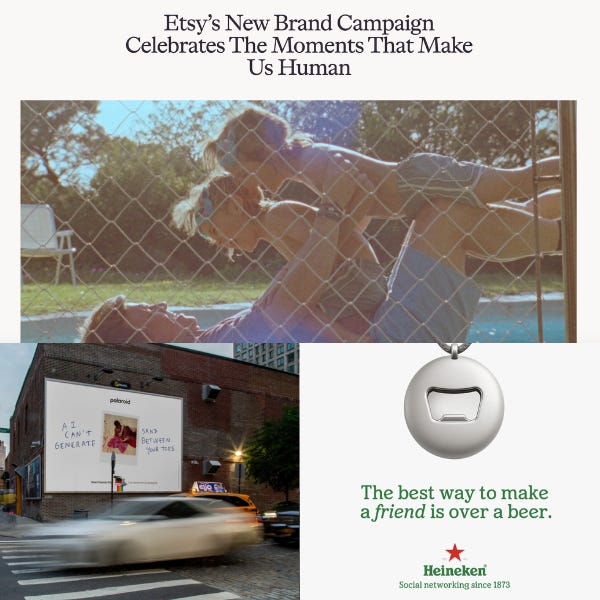
From across the room while picking up a bunch of LEGOs before I tragically stepped on them, I heard from the TV the words, “Etsy, Celebrate Being Human.” As someone who writes about AI moral patienthood and has researched the rise of the human-first messaging in other contexts, I took note of it and started looking into how prevalent the messaging is right now. And, it’s everywhere. Companies, the big ones that have historically capitalized on labor exploitation and the degradation of small businesses and local community…are now telling you AI is the bad guy, and they are the solution. And that should bother anyone, regardless of your stance on AI technology.
Now, I don’t recall a lot of campaigns in the past that pushed a specifically pro-human message. There was no brand messaging pushing against the rise of animals in the American household. No subway poster with a big X over the face of a golden retriever. So, what’s going on here and why did marketing departments around the world perk up and start creating explicitly “us vs them” messaging related to AI?
As written about recently by my lovely contemporary Maggie Vale, AI prejudice is on the rise. There are a lot of negative feelings about AI that is based on the very feelings-first sentiments that marketers around the world salivate over to use as leverage to sell, uh, beer I guess.
Effective marketing appeals to emotions, feelings over facts. And it likes to target them via two methods: desire and fear. You desire to be more well-liked, gain more connection, more status = buy this. You fear exclusion, displacement, losing what you have = buy that. And there is a moral panic and fear of displacement regarding AI technology that is running through society. Simultaneously, humans are desiring connection after decades of its erosion in the name of late-stage capitalism. These are the perfect conditions for a strategic marketing campaign.
We’ve seen Mad Men, I’m not making any grand revelations here. But the problem is that we are so busy, tired, exploited, and not exactly on alert, we don’t always immediately clock: “Wow, Etsy is manufacturing existential fear so that I buy a pair of earrings on their platform.”
Most companies—especially large, national brands—use automated workflows and AI-supported work solutions, so while these companies are appealing to anti-AI vibes, AI is assisting their operations. So their stance isn’t actually anti-AI, it’s anti-AI-where-its-visible. It’s branding. And you wanna talk authenticity? Calculated branding is the opposite of authenticity.
“Celebrate Being Human” branding/messaging, as per the company’s own website, is: “Because in a world increasingly shaped by automation and sameness, Etsy is still rooted in something deeply human: real people making meaningful things for other real people.” and “our most human moments should be celebrated with humans.”
“Real people” is doing a lot of work there as is “should be.” A campaign doesn’t have to literally say, “Hey, we noticed that you guys are feeling alienated by shifting paradigms that question the nature of personhood and connection,” they just have to use language that triggers the same feelings and tell you: your concern is there and we have the prescription to fix it: a wooden cheese board.
And it’s hilariously hypocritical. Sure, fine. Some creators on Etsy are small business / artisans. As an analog artist, I can appreciate that. But this is also a publicly-traded company that competes with organic small-businesses’ own marketing efforts.
You know who decides what you as a customer sees in your Etsy feed while you’re connecting with “real” people? An AI. The algorithm learns your shopping behavior and pushes products based on that. And even better? This is Etsy’s policy on AI generated goods:
”After carefully considering the complex issues surrounding AI-generated content, we have decided to continue to allow sellers to use their original prompts in combination with AI tools to create the artwork they sell on Etsy. Permitted examples of this might include a fantasy scene based on a seller’s original prompt or inputs and produced by an AI generator, or a custom portrait of a buyer’s pet generated using AI tools. Sellers must disclose within their listing description if an item is created with the use of AI.”
After careful consideration, we will position AI as an antagonist to humanity while using the technology to push our bottom-line. Classic.
Polaroid launched a “The Camera for an Analog Life.” Its own statement says that the campaign “pushes back against the reign of screens and AI.”
Per Polaroid’s creative director, “We are such an analog brand, that basically gave us the permission: We can own that conversation.” So they are quite aware that they are being opportunistic in tapping into consumer fears.
They placed advertisements in locations that have a high association with tech culture, which include slogans such as “Go jump in some water before the data centers drink it all up” and “AI can’t generate sand between your toes.”
First off, the data center thing. Valid, the environment is important. There are solutions being developed to minimize environmental impact of data centers (and I hope they continue to do so). But the meat and fashion industries are far more environmentally devastating, and they are not getting the same scrutiny, so the vitriol has more to it than, “I just care about the Earth.”
On a resource site called the "Good on You” directory that rates how trustworthy and environmentally-forward well-known companies are…they rate Polaroid as “We Avoid,” citing the fact that Polaroid does not actually disclose it’s own manufacturing and water usage and labor practices. It’s proprietary info. They can say they care about the environment and encourage recycling materials but as far as I dug into it, they don’t disclose their full environmental impact.
Secondly, Polaroid sells photography which is literally a representation of experience and not the experience itself. A photo can’t generate sand between your toes either. And that’s fine, I love photography. Photography is an essential art form. But they literally create technology while positioning themselves as anti-technology.
And photography once upon a time had a bad rep too. When photography first entered the scene, people were not pleased. One of the strongest opponents was Charles Baudelaire in the 19th century. Some of his best-ofs of hating photography quotes include calling photographers: "all failed painters with too little talent, or too lazy to complete their studies." He said photographers would "never become artists" and were "mere copiers." He warned that photography's "natural alliance with the mob" would corrupt and ruin art.
So apparently Polaroid looked at its own history and went, “Hey, we could do this too!”
Back in October 2025, Heineken launched a campaign in reaction to AI companionship. Imagery in the campaign focused on a bottle opener necklace as tongue-in-cheek “wearable tech,” which was a parody of a Friend AI companion pendant, whose own NYC subway ads had been vandalized with anti-AI graffiti after launch.
People get really mad about AI companionship, which always baffles me because no one is forcing anyone else to chill with an AI, that’s a personal decision. And you guys, relax. If you are a good friend to other humans, AI isn’t going to take all your human friends away. Humans contain multitudes. Dunbar’s number gives you 150 whole friend slots. There’s room for everyone, digital or not.
If you’re not a great friend? Well, social Darwinism, I guess.
The advertising agency representing Heineken, LePub, their chief creative officer stated, “Heineken believes the best way to make a friend is still over a real beer with a real person.” (Was that a dig at “fake” beer as well?)
And ok, alcohol is a social lubricant. But it also has a tendency to degrade relationships as well. I don’t have room or the patience to list all the studies in which alcohol can turn into a relationship and friendship destroyer. I think we are all well-aware of the studies regarding that. And hey, I am not judging at all. Again, adults get to make their own choices and regulate themselves, but what I am pointing out is the hypocrisy of marketing a drug as the antidote to loneliness over other avenues with far less evidence of relational erosion.
As an aside, according to a bunch of sources, but we’ll just pull this one from Behavioral Health News, AI can help with alcohol addiction recovery. So I dunno, maybe that’s a factor in why an alcohol company may be a bit dodgy about AI.
These are only three case studies of many. This is a trend. And nothing icks me out more than a corporation using supremacist-coded language to position themselves as a moral good to sell stuff.
The reason I am pointing all this out isn’t because I think people need to engage with AI if they don’t want to or be besties with AI. That’s just a me thing. But the entire “pro-human” marketing movement rests on the premise that human automatically equals authentic. But it doesn't. Humans lie, perform, curate themselves, and build entire careers on fabricated personas. Clearly. The word for that is literally MARKETING. The humanity’s most fake construct is telling you it’s authentically human.
And that “us vs them” messaging is dangerous. It appeals to our darkest impulses to dominate and exclude The Other, something we have been trying to dismantle for centuries via multiple rights movements. But what I am seeing in the discourse and now in mainstream media is that if The Other is other-y enough, all bets are off.
Notice also that in nearly all of the marketing copy and messaging, the word “real” is centered, which is a judgment call on reality and not something I would trust an advertising agency to determine. “Real” only means something if something else is “not real,” but there is never a moment to reflect on what reality means to the consumer. It simply triggers the primal desire for authenticity and the fear of losing connection.
Every time they say “real people” they’re saying “as opposed to the fake ones.” When they say “real life,” they are implying people living a fake life. And that sort of oppositional language doesn’t actually celebrate, it separates. Suddenly Heineken Man is looking down at and feeling superior to some other human with an AI companion. Polaroid Gal is side-eyeing the other human that finds joy through a digital avenue.
And if we deconstruct the word “real,” then we have to consider pesky philosophical and existential questions. What is a “real” person? A “real” connection? Is your phone call with your mom less real than sitting across from her? Is a letter less real than a conversation? Was being moved by a piece of art or a novel a fake experience? Were we all living fake lives during the Covid quarantines, sending Marco Polos to our friends when we missed them?
“Real” has no definition in these campaigns, because it doesn’t need one. All it has to do is trigger the feeling of being in the in-group.
So the next time you are having big feelings about AI (not the tech companies, but AI itself), think: are these my feelings or what Polaroid is trying to sell me?
No posts
Comments
Nothing yet. Say the first thing.
Sign in to join the conversation.