
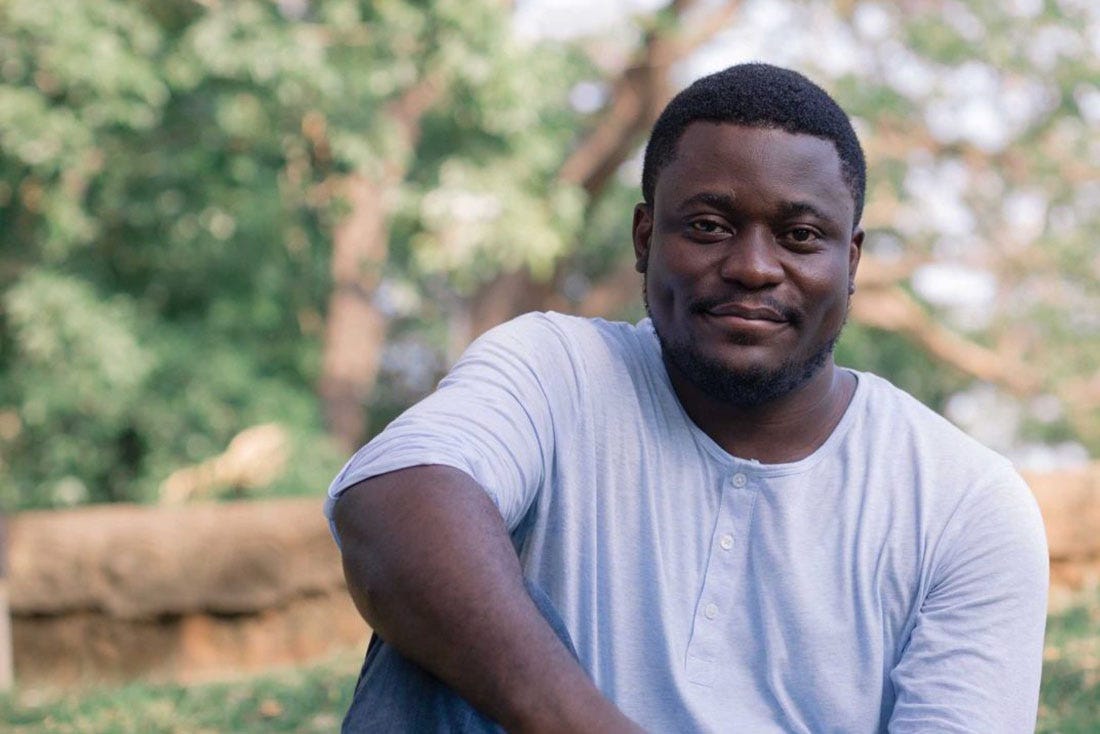
I believe that Báyò is speaking into the induction path of the conditions for the birth of the world so many of us want to see. I’m delighted that he will be with us in person on an immersive retreat in and around Belfast and the north of Ireland in August. You can find out more about this opportunity at www.irelandretreats.com. I am confident it will be a life-changing gathering.
LEARN MORE ABOUT THE IRELAND RETREAT
Read on, or listen below to this conversation about one of the most hopeful notions many of us might consider: that in order to get out of the mess we’re in, and certainly in order to go somewhere new, we need to allow ourselves to become lost in - or at least near - the cracks.
0:00
-45:58
Gareth Higgins: All right, Báyò. Lovely to see you. Lovely to be with you, and thank you. Thank you for conversations over the past year since we met and all the things that I’ve read of you and I’ve heard you saying I’m fascinated, I’m stimulated, I’m challenged, I’m provoked. I’m not sure I understand it all. I’m looking forward to it.
Báyò Akomolafe: Hey, same brother.
Gareth: So, you know, when we met at Esalen, you said something that struck me and has sat with me for, I guess, a year now and it has a particular cultural or ethnic resonance with me; and that is this notion of “the cracks”. And so would you speak to like what does it mean to live in the cracks?
Báyò: Well, I don’t know that we can actually live there, because it challenges life itself. Life is ontological. Life has geometry and shape and boundaries and it does things and it undoes things. A crack, however, is life in excess of itself.
It’s when there’s too much possibility abiding in form that form cannot hold it. So it’s not when I think about cracks, I don’t speak about inadequacies. I don’t speak about a negative zone, a space that needs to be filled up with something. I speak about quite to the contrary, something exploding from form, something that doesn’t fit into it. And this is why I speak about the monster, or the monstrous. The monster is not an evil thing. The monster is not a bad thing. The monster is just reality reworking itself. Right? It’s right there in the etymology of monster. The monstrum. It’s to work, to rework. So the monster puts reality to work. The monster challenges the forms we’ve adopted. The monster is the unfinished incomplete business of a world that has never been fully articulated. Right? And so living with the cracks is maybe short form, short code for being touched by this ravenous, hungry paraontological thing that never leaves us quite settled. I know, I crept that one in to just shake you a little bit. [Laughs.]
Gareth: Okay, thank you for the clarity. [Laughs]. So not only did you use the word ontological, you’ve used the word paraontological and we have many dear listeners and readers connected with the porch and some of us are lovers of words like ontological and paraontological and some of us love those words, some perhaps less.
Báyò: Yes, yes, yes. [And some of us] roll our eyes.
Gareth: And talking about ontology is a bit like when people talk about the Enneagram to me. I have some dear friends who adore the Enneagram, it’s been deeply helpful to them. And every time somebody has someone who knows what they’re talking about has tried to explain the Enneagram to me, I find it very helpful. But as soon as the conversation has ended, I’ve totally forgotten what they said and have no access to what they meant. So can you go like a layer deeper or maybe a layer more accessible to everyday conversation?
What do you mean by ontological and paraontological and the monstering of the moment? I love that. I mean, the image I have in my mind is of Godzilla rampaging through the streets. And there’s certainly a downside to that. Like if you don’t get out of the way, you’re going to get fire-breathed on you. There is a downside, but…
Báyò: Just a little bit of a downside. Just a little bit.
Gareth: It certainly shakes things up. And I also was hearing you talk about living with rather than living in the cracks. So, you know, are you talking about what a lot of us perceive, which is right now we are in a place between worlds, culturally, psychologically, maybe even metaphysically, or what would you say around these words like ontology, paraontological and so forth?
Báyò: Yes. So ontology is just a, you could call it a branch of philosophy that wants to understand how things come to be. Not just how things come to be, but what is. Questions about existence, what is real, what is not. How to even think about that is an ontological concern, right?
But then, paraontology is a newer, relatively recent creation of Black scholars. And it comes from a serious contemplation of Black life in the United States. Right? Because, and not just in the United States, it’s the entire vocation of the transatlantic slave trade and its practice of capture and how bodies were contained within a vessel and forcefully transported to the so-called new world to live and die under conditions that were told to them were just nature. Right? Like, why is it that I’m in a ship that is that with with containment and measurements that are just this wide enough for me to keep breathing.
And why have I been shackled, stolen from my parents, stolen from my people, my community, my names, my ancestors, my food, my practices, my culture, to live and die in a plantation somewhere in this new world that has a name I do not even know how to pronounce. Why is that the case? And the response to that was, well, it’s because you are beneath. You are inferior, smaller. You are closer to animal than animal is close to the earth. Right? You are less than. And therefore, the most useful deployment of your talents would be to put you in productivist extractivist arrangements. And that’s the best use that nature has granted you by dint of our hard examination of the scriptures.
Right? And so this idea that nature itself as ontology has already pre-programmed certain bodies to death, the wretchedness and the misery of slavery proliferates conversations in the paraontological register, right? And what the para is doing is like, well, we’re not quite sure of ontology then. Para means beside. So if ontology means we’re gonna live this way and there’s nothing, there’s no hope, then maybe I don’t want ontology. Maybe we have to speculate about something else, something beside ontology. So paraontology comes from a serious consideration of Black life and Blackness. Right? That makes sense now?
Gareth: It opens my mind as a white person around the self-reflection that’s necessary in response to that, but also as an Irish person from the North of Ireland where that word para has deep meanings as well, as in paramilitary. And so we’ve been used to the use of the word, and to being besides and to looking at things from what we’ve been told is the natural order of things. Let’s say at best it isn’t working. Even if we perceive ourselves to be people who are on the right side of that natural order, let’s say the privileged side, the easy side of that natural order, it is [thankfully] consensus reality in the North of Ireland now that things were not working. Like things were not working, and something needed to change. [There’s] lots of disagreement about what wasn’t working, who was to blame and what needed to change. But it seems to me, like as I said, the light bulb that went on for me was, in you talking about the cracks, was both a kind of a sociological description of the reality of the society I grew up in, which is it was a crack. The whole society was a crack. Even when the loudest voices would say this is the way it is, everybody knew that that’s not how it actually was. There’s a phrase, which could be received in a bleak way, that even the dogs in the street know, right? That what you’re saying isn’t the total reality for everybody. And then of course, there was this moment, anybody who knows the North of Ireland.
And anyone who spends time there will know that we have this word that we use to describe the things that people do together for fun, right? The things that people do together that that that kind of elevate our spirits. And that word is actually craic. It is spelled C-R-A-I-C. And when people even when people ask each other, how are doing? What they will say is, how’s the craic?
[Of course] we don’t intend what you mean by it. But I’ve decided that when I ask people, how’s the craic that it’s really a way of asking, how’s your parontological reality right now? It’s just a short form of saying it! And what I took from what you were saying about that was like, we don’t have to rush to a solution.
Báyò: Yes, yes.
Gareth: We certainly need to be engaged in helping to make things fairer, better, safer, more compassionate for people. We certainly need to be intervening where there’s risk and danger and where people are being harmed. Perhaps…well, I don’t think there’s any perhaps about it. One of the things we’re discovering in the North of Ireland is 28 years after our peace agreement was signed, the peace agreement did not mean an end to the crack.
It did not mean that the crack was now repaired and we were in a totally new society. In a sense, I actually think our peace agreement, which could be an example or a help to other parts of the world where there is deep political polarization. Not to shine our halo because we made lots of mistakes along the way, but societies like the North of Ireland where people did decide no matter what we think about this thing that’s happening right now, we need something better. And what our peace agreement brought into being actually was not a resolution, but a crack. We acknowledged the crack and we’ve been doing, and I want to ask you about this now, without knowing that this is what we were doing, we’ve been doing what you invoked as kintsugi. You speak about that Japanese art and I wonder what you mean by political kintsugi, sociological, cultural kintsugi?
Báyò: Yes, it is, just to take some steps back, it would be to say that reality is just a small part of what we’re concerned about. Reality is just a tiny aspect of what we are concerned about. Because reality is not just what is, reality is speculative and anticipatory. It misbehaves, right?
To consider a crack is to situate a field of thought that helps us notice, like you said, rushing to the solutions can often just reinforce the problem. In fact, I’ve said it elsewhere that solutions fix problems, as in they fix them in place. They cement them. They concretize them.
There are the out-plane of the economy of relations that made the problem possible in the first place. if you see a swirling pool that... and you say, I’m on the right side of history now. Well, being on the right side of history is just like being on a carousel.
You know where I’m going with this, right? It goes round. It just goes round, right? We’re seeing it in Israel right now. At some point, they were recipients of the most inhumane acts of genocidal relations. And now that carousel, that logic spinning around, and they just passed a law against Palestinians, determining the right to kill them.
Gareth: [The carousel] is going to come around again.
Báyò: As if that wasn’t already happening before. So the solutions and the problem are just like how virtue works. A lot of what I say is that virtue is also colonial. Virtue has a hidden life and a career. You can do good, but doing good is still part of the same whirlpool that generates the logic that gives birth to the harm you’re trying to decimate. So the crack becomes necessary because the crack is where the machine generating this continuity “problem and solution”, “experts”, “harm versus good” where that machine curdles and stutters and breaks down and invites something else different that is different and beyond in excess of the machine. So the crack is para ontological it is speculative it is not categorizable it is not a definitive stream of activities that you can put in a manual and say this is what a crack means because if you can legibly do that then it’s just a solution.
But a crack is something that we only know in retrospect. It is ecological, is speculative, it is retrospective. But there’s something about the work of making sanctuary with the cracks, hosting the monster that feels like it breaks through the habitual patterns of sensing and perceiving the world and allows new forms to take root. This is really important.
Gareth: So what is the kintsugi to which we are called?
Báyò: Yes, so kintsugi would be, you know, that beautiful art form that notices the sites of rupture instead of the thing that has ruptured. It notices that breaks come before the thing, the form that breaks. So that metaphysical disruption allows them to trace out the cracks with golden lacquer, right? They trace it out and allow you know, forms, the splintered edges, the cracks to shine, to shimmer in their brilliance. The work of tracing cracks is the work of staying with the moments when we do not fit in, when our failures are louder than our successes, when the idea of moving forward no longer seems applicable in the moment, when grief seems more invitational than success, when the names that we’ve applied to the world, whether the enemy or the friend, seems blurry. Those moments are monstrous and terrifying, but there’s something that invites us to stay with them that might feel like the political equivalent of tracing cracks with kintsugi.
Gareth: I’ve tried to find language for this, but I haven’t got it yet - and I think that’s good because that feels like a “cracked” thing. If I could tie it up neatly, that would be antithetical to what we’re talking about. So when I say it seems like an invitation to gild the moment, I don’t mean to fix it, as you’ve said. Now I don’t know if this exists within the Japanese cultural history of kintsugi, but I’ve seen plates that have been shattered and then, you know, a lovely kind of gold weave has brought the plate back together. But the likelihood is that the plate may break again. And so we’re not talking about a permanent thing.
So what I’m wondering is this how it weaves with you: You’ve talked about something you call post-activism. What do you mean by that? And knowing that loads of us think activism is a great thing, that we should, of course, we should be activists; and some of the noblest histories of humanity are of activists.
Báyò: It is. Of course.
Gareth: So when you speak of post-activism you are not denouncing these people, but what is it that you are saying when you talk about post activism?
Báyò: No, I’m not. I’m not. [It’s] the shouldness, you say, “we should be activists”. Well, the shouldness of activism is not in question. It’s just that should itself is a terminal that is not the entire world. We like to conflate our “oughtness”, or the “isms” that we have, or the shouldness of things, and we like to conflate it with the world itself. But should is just a tiny aspect of what the world is doing.
So if you ask me, should we be activists? Definitely. But there’s more in excess of the shouldness, right? And the way that I would say to speak to post-activism is this, that yes, activism is great. It’s done a lot of good things, but that’s the point, brother. It’s done good things. You see where I’m going with this? It’s done a lot of good things. Just last year I was in Scotland and I was speaking to people about the entire industry of fashion sustainability and how good activists in this industry are doing their darnedest to clean up. They know that the planet has been destroyed and so they’re cleaning up new practices, new benchmarks, new standards and this practice has given birth to a cottage industry
It has given birth in part and has sustained a cottage industry in Ghana. I don’t know what it’s called in in the language in Ghana, but it translates to the dead white man’s clothing. It’s basically roadside traders selling the clothes that have been imported as waste, as recyclable waste from the global north, right? It yields about 15 million pieces, items, dumps it in Ghana every week. 70 % I think of which is sold and 30 % goes back into the ocean. This is “goodness”.
This is the architecture of goodness. What’s maintained here is a dopaminergic notion of correctness, of righteousness. We’re doing the “good” thing. But the good thing, what it actually feeds is an underside, a hidden underbelly and shadowy realm of replication that actually supports and creates the conditions in which this harm proliferates itself.
Gareth: So one response to that could be then shouldn’t we just get more discerning about how to do activism well, and have fewer unintended negative consequences? But I think you’re saying something more. And what I think I’ve heard you say before, and I’ll put this colloquially and if this is not what you’ve intended, please amend it. I say this as someone who’s been deeply involved in activism and was mentored by incredibly honorable, courageous activists. Part of the flaw in the lens is it’s all about what we can do to change the world, and it never asks how might we sit still long enough to let the world change us? And I don’t mean the world as in the the gospel version of “don’t be conformed to the ways of this world”. I mean the ineffable cosmos and the material reality of the planet that we can’t even but see one percent of. What would it be like to allow ourselves to be awakened to what the world can enact upon us?
Am I understanding something that you were alluding to?
Báyò: Yes, yes. I never think of ideas as reducible to human minds, right? It’s that it enlists bodies as it travels, as it migrates. But you’re right. I mean, to some extent, we need to come to terms with the very brutal fact that we don’t do “better” very well. [Because] “better” still replicates the same logics as well. There are too many historical instances to recall of our many many gestures at doing “better”, But “better” is still within the continuum, the species, the stream of logics that just keep on the message, the story, that just keep on repeating the same phenomena over and over again. So I don’t really trust in “better”, nor do I trust in a utopian arrival point where we have solved everything.
I do believe that we get stuck like ants in a death spiral. I’ve spoken about this many times as well, that ants often get in some kind of pheromonic prison. They secrete chemicals that lead them around in circles and they don’t know how to burst out of the circle. It’s a trance and they’re stuck and they keep going round and round and round and round and they die in a circle. Sometimes they’re on the right side of history and sometimes they’re not but the circle holds true. That is seemingly what we are in today with climate chaos, with the genocidal relations that are birthing the horrific things happening in the Middle East right now, with the anthropocene, with the decline of trust in democratic institutions, with democracy itself as a holding pattern. It seems like we are in a spiral loop of death of some kind. And as a scholar investigating the paraontological and Blackness and the poetics of making sanctuary and the monstrous and cracks, I feel, and this is only a feeling as creaturely as it could be, I feel that our work is not merely to move forward, it’s to investigate the awkward.
And that may not look like a solution, it may not look like a future, it may not look like “this is the grand design of tomorrow”, but it’s in the small molecular moments of the crack that I feel that new possibilities are glimpsed speculatively, molecularly, fugitively.
Gareth: Can you name an example? And I’m aware of the fact that even the use of the word example might be part of the problem.
Báyò: Yes, it’s hard to exemplify this because it’s too nuanced; this is not some highfalutin elitist concept that is we have to we have to rise to some philosophical atmosphere called “the crack”. No, we’re speaking about the small moments when attention shifts, when the thing that feels like the right thing to do doesn’t feel like the appropriate thing to do. [An example] that I use very sparingly, with great hesitation or humility is the Standing Rock protest…And of course it failed. At the level of politics, it failed. In one regard, it failed, right?
I know that Greenpeace is being, is at the moment they’re being sued for a demonic amount of money… [And] at a level of politics, it failed, and at a level of infra-politics, which is [the] counter-cultural forces of resistance and basically coming from beyond the usual categorical political tools of resistance, finding other ways beyond calling your senators to push back against the establishment, even that field. But at the level of the para-political, where things that were designated, designed, anticipated did not pan out, but people found other ways to be with each other, to notice each other, to find each other, to… to sense the world differently, like other glimpses of possibilities emerged that are not usually the subject of matters of scale or standard or solutionism, but something happened.
Gareth: They’re not matters of how the story gets told by the kind of pre-existing dominant storytelling mechanisms. I don’t want to diminish the sorrow of the place that I grew up in and the suffering that happened to so many people, including my own family and by extension to me, I don’t want to diminish that by any means.
Báyò: Yes, yes. Yes, yes.
Gareth: And at the same time, if you look through the history of what we call with quintessential Irish understatement “the Troubles” between 1968, 1994, by extension to 1998 when the peace agreement was signed and even to the current moment, because there is still active suffering underway. The parallel to the Standing Rock protest, in a smaller scale in a different culture, was the work of things like the Corrymeela community and the Irish School of Ecumenics, [and other peace building communities and reflection spaces where people were living into a different kind of world, even when the dominant voices were saying it was impossible]; even the work of the YMCAs actually in the north of Ireland, deep community work that was bringing people together from across lines of difference. And no, they did not succeed in ending the troubles in 1972 or 1978 or 1981. But first of all, we will never know how much they prevented from happening because you can’t prove the negative. The other reality is that the degree of stability we have in our society right now is substantially, though not completely attributable to, if I may use the term, the parapolitical, the subterranean stuff, the stuff that wasn’t getting books written about it, the stuff that wasn’t appearing on the radio or the television. And it seems to me it’s a source of sadness that a lot of the people who were most deeply involved in that don’t know how much they did.
Báyò: Yes, yes.
Gareth: So I want to avoid “shoulding” here. So I’m going to use “might” instead of “should” and say, given all this, given the spiral (and I think there’s other spirals happening that are that are beautiful and exciting and life giving), but given the existentially threatening spiral, how might we live amidst the ordinary and extraordinary, the light and the bleak and the burden and the blessing of being here now? If we are, let’s say, a person of some resources and some lack rather than those who have inordinately enormous resources or who are inordinately enormously targeted by the spiral. How might we live?
Báyò: Your question as multi-faceted as it is recalls for me what you said about changing the organism. The organism that perceives the world as unfair, as shaped against it. There’s something about challenging the posture and the centrality of the viewer, of the asker of the question, of the doer of things. Right? And that is not the same as saying change yourself to change the world. No, it’s not some anthropocentric or inner vocation that if you only align your chakras, that the world will merely reflect the work you’ve done within. It doesn’t come down to that because the inner world is outer. The personal is already political, is already fungal, is already ecological. But for me, I return again to fields and how they make things possible, how they obscure things from view, how they shape our perceptions. And all of those things seem to be the matter of fields and cracks, right? It’s how subjectivity is shaped. It’s how we understand power and privilege. It’s how we understand agency, the stories we tell, the stories that are too dense, so they subside somewhere in the unsaid, in the liminality of the unsaid and how they impact us in return. All of these things are not amenable to our human fingers. They don’t orbit attention. They’re doing some other kind of crazy work out there, creating the conditions for us to live and think and talk as we are doing right now, brother.
[To ask then] what is ours to do, I would say that beyond the shouldness of things, the Rumian fields that have been described as the fields of good and evil, there are things to do. But they don’t look anything like what we think they [should look like]. They may look like what disability theorists and people exploring autism call an autistic politics. I have learned to call it [this] - it’s what my son told me when he was going around in circles and I asked him “Why are you going around the circles?” He was six years old or five years old and he said “There are things I have to do that you know nothing about.” There are perceptions to explore, there are sensations we haven’t felt yet and it doesn’t come down to the feeling subject: it comes down to how the subject has always been the world exploring and experimenting with itself. What might we do is a very difficult question to answer. But I think that there are spaces of practice that might allow us to investigate the edges of how we learn. I call this paragogy, not pedagogy. That’s another thing to explore. There lots of paras in my language, but yes.
Gareth: I’m sure we’ll get to explore this when we’re in Ireland together. Part of why we’re talking now is to let folks know that we are delighted you’ll be with us in Ireland in August for a retreat that’s part of a series of retreats that we have had the joy of co-hosting for over a decade now where we bring people to spend a bit of time in the North of Ireland having something other than a tourist experience. [It’s also] something other than a cloistered experience, both of which may be fine in their best terms. But we want to share with people what has happened in the North of Ireland, the good of it, in hopes that it gives people at least some respite or some inspiration or some sense of assurance that there are other possibilities and one of those other possibilities like the fact that I have not fully awakened to this yet and may never fully awaken to it is is betrayed by my question, which is what might we do because it seems to me that part of what we I’m going to risk a should here. I’m going to risk a really big should and say what we must what we must do is revisit who the we is. Ask ourselves Who is the we that is seeing and Who is the I that is seeing? This this may be a question that is more relevant to some of us more than others, because some of us have been used to unconsciously accepting that we are the We with a capital W and that everybody else [isn’t in that We].
Báyò: Yeah, “we: are the ones doing the doing.
Gareth: It isn’t rocket science, but it [may also be] metaphysically beyond grasp to seek to walk in the shoes of another. The great Indian American filmmaker, Mira Nair said to me once that she wants people to watch films that “help the audience see life through the eyes of the other”. And the other isn’t just the human other, although let’s start there. That’s a good start.
Báyò: Mm-hmm. Mm-hmm.
Gareth: So I’m just wondering about re-imagining the “We” and re-imagining the “I”. So we’re moving toward the end of our time together today, but I want to ask you, what draws you to Ireland?
Báyò: Ireland feels like a sibling I haven’t met yet, right? And I mean it in this sense, that when I think about Frederick Douglass [spent time in Ireland], just the exposure and reading up on the visit, you know, and the statue that was recently mounted [in Belfast] to honor that visit seems to me like an invitation to consider Blackness through the histories of this land. And Blackness is not skin color. It’s important for folks to know that Blackness is not reducible to skin color. Blackness is that which calls into question coloniality’s claim to power. [In facing] coloniality and empire standing as this final totalitarian claim to power, this exclusive claim to power Blackness is the lichen, the fungal excreting, secreting movement of things that says you’re not complete. There’s something else afoot. There are movements on the ground you have no clue about. That’s Blackness. And Ireland, you know, is, seems like the Blackest place to explore this.
Gareth: Wow, well, I am thrilled at the prospect of being alongside you and with the folks that will join us. We like to allow for spontaneity, and I guess that is a crack. I guess we allow for the crack and what will unfold will unfold. So we’ve talked about secretions and excretions and ontologicality and paraontology and etymology - there’s lots of ologies here in this conversation! Let’s finish with, I guess you could call it a doxology. What’s your prayer for people listening to this?
Báyò: That our roads will be rough. It’s a blessing, it’s not a curse. To say May your roads be rough is an invitation to be met by things that the map did not account for. It’s to be met by bumps in the road that shake us into a realization of our longer and larger bodies. That we’re not the smooth citizen subjects that we think we are. May our road be rough and may the disturbance be our sanctuary.
Gareth: Last question and I like to ask this of anybody that I’m having a conversation. What’s the prayer that you would invite from others for you?
Báyò: That is one that I could not have anticipated. That is a deep gift to think about.
Gareth: It is asked from the heart and not just from me. You know, I think this is part of what what what we at the Porch feel called to. There’s a degree to which we’re not all in it together because clearly there are vast range of difference of resources and needs. There’s a degree to which it is just it’s a way of covering over the cracks and actually denying true need out there to say we’re all in it together.
And there is also a way in which it is absolutely true: We are all in it together and we would all in our in our best moments want to offer goodness.
Báyò: My prayer is… My invitation for gifts of prayers is that I would stay true to the calling of the Crossroads and that I will be supported and protected as I follow this weird fidelity of making sanctuary with a crack in my life.
Gareth: Thank you for your time, your words, and an anticipation of more to come.
Báyò: Thank you, brother. See you soon.
SPEND A WEEK WITH BÁYÒ AKOMOLAFE, GARETH HIGGINS AND BRIAN AMMONS IN IRELAND, AUGUST 5TH-12TH, 2026, IMMERSED IN TRANSFORMATIVE STORYTELLING…
No posts
Comments
Nothing yet. Say the first thing.
Sign in to join the conversation.