
This is the sixth edition of the Virtue series,
if you missed the beginning you can catch up here.
In 1988, Nike was losing ground to their biggest competitor, Reebok, until they launched a campaign featuring the most unlikely of characters Walt Stack, an 80 year old who ran the Golden Gate Bridge every morning in my home town, San Francisco.
Walt opens with, “I run 17 miles every morning. People ask me how I keep my teeth from chattering in the wintertime…”
Some home spun feel good music plays as he keeps jogging on, until he delivers the punchline, “…I leave ‘em in my locker.” A few frames later, we see a fade to black and Just do it. appears for the first time looking just like a jump cut to the opening titles of a Woody Allen film.
It was the first time Dan Wieden’s now famous three words, which he later admitted he’d borrowed from a murderer on death row facing his firing squad, showed up for Nike. Over the next decade Nike's revenues grew more than tenfold, to $9.2 billion, which is an extraordinary amount of shoes to sell with three words that say absolutely nothing about shoes.
I think the success of Just Do It comes down to the fact that it was actually selling Walt. The relatable Joe Bloggs who gets up every morning and does their thing with no real or imagined enemy, which means this can’t be the virtue of bravery we met last week.
Nietzsche had another virtue for Walt: Mut, or Courage, because unlike bravery, it doesn’t require anyone else to be there.
The only person Walt has to get past is Walt, or more specifically, the voice in his head arguing from under the duvet, quite reasonably, that, “the fog’s looking pretty thick this morning, so it’s probably very cold outside, let’s put off the seventeen miles until tomorrow”.
We may not all be Walt, but we definitely know that duvet voice.
To see how this works, let’s try the same dinner party test from our first issue. Stand up while the mushy peas are being passed around and announce, “I’m taking a leap of faith and betting on myself this year.”
You’d likely get some version of a “You got this!!!” paired with a story about somebody’s cousin who quit Deloitte and now imports olive oil from a hillside near Siena.
Now let’s try it in a way that our man Nietzsche would’ve hopefully approved of: “I’ve decided I’m not listening to myself anymore.”
You’d definitely get some puzzled looks before someone asked if anyone knows where they can buy that cool new olive oil.
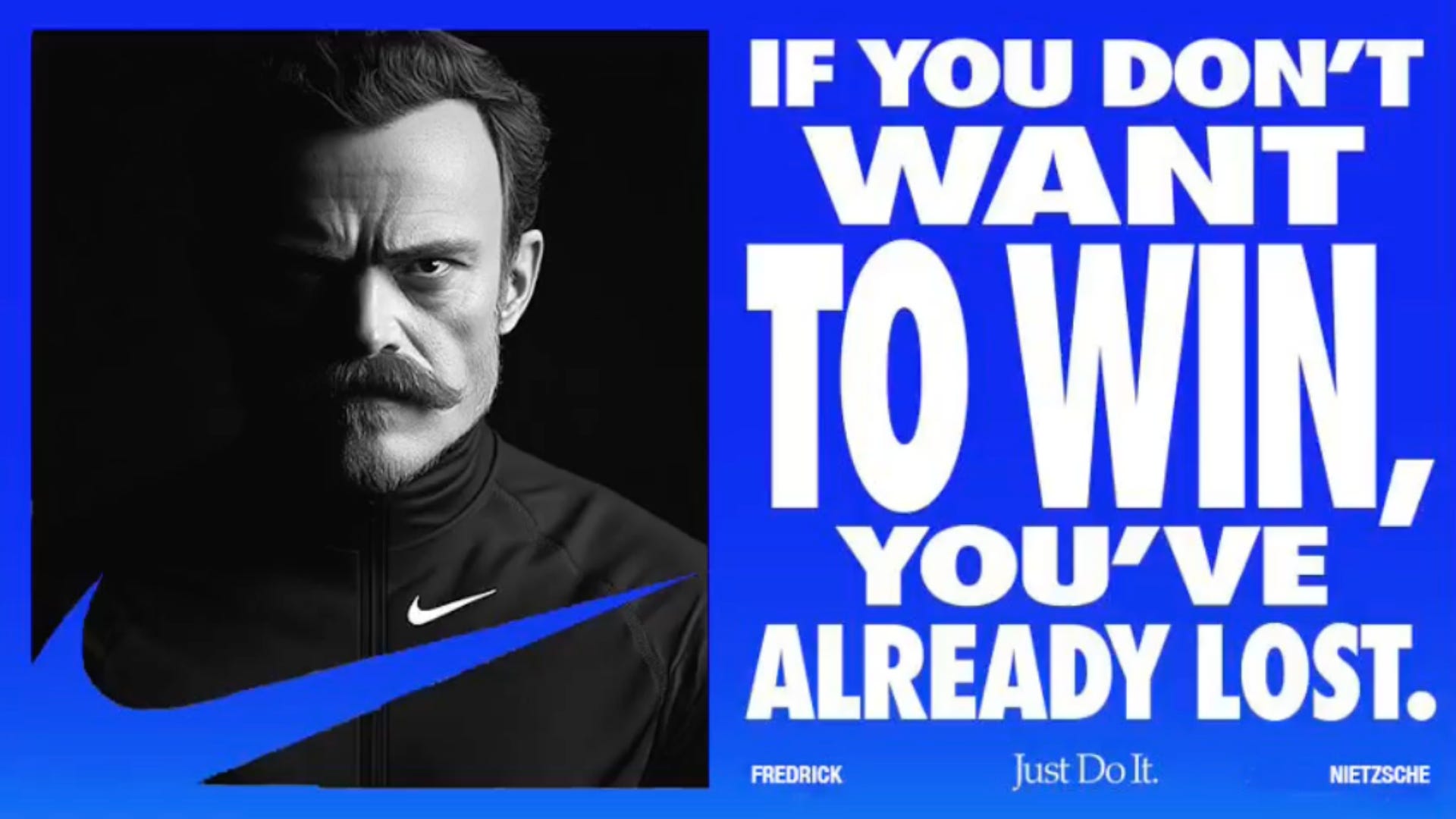
And yet, as strange as it sounds, the second version is much closer to what courage asks of us, and what we must ask of ourselves, as it only truly happens in front of a mirror, and the mirror is optional.
Which, when you think about it, makes Walt a rather worthy patron saint of this virtue, because every morning he hears an entirely reasonable case for staying under the duvet, and yet he runs on.
Which brings me back to our murderer on death row, Gary Gilmore whose actual final words were “Let’s do it.”
Wieden changed the let’s to just, which he later said was partly because he didn’t particularly fancy explaining to Nike that their new slogan had come from a convicted murderer.
But what I think he actually did with his edit was remove everybody else from the equation, and let you keep whatever doing it says about you as entirely your own business.
In 2021, Crypto.com launched an ad starring Matt Damon during Thursday Night (American) Football. It takes us on a time travellers’ journey throughout the history of human endeavour. All the tropes are there from the Wright brothers to what appears to be Sir Edmund Hillary conquering Everest and the music soars like it’s something from Space Odyssey while Damon explains that humanity has always faced a choice between those who cower in the corner or look to the horizon.
By the time Damon delivers the Fortune favours the brave tagline, with a (I’m not sure how he managed it) straight face, the spot has already given us the alibi for the purchase: I’m joining the intrepid and putting myself in a lineage that includes the greatest adventurers of all time with no wrestling under the duvet at all.
Give away the alibi like they did (during the NFL’s biggest night of the week) and you’ll likely find yourself starring in the latest meme-fest.

But an alibi is a peculiar thing, it tends to only work when you get to discover it for yourself.
Which fortunately, we’re very good at.
Just look at the person who finally buys the podcast microphone they’ve been dreaming about for the last six months. Ask them what they’ve been up to lately and they probably won’t say, “Well, I just bought a microphone.”
They’d likely say something much closer to, “I’m starting a podcast.”
Except they’re not.
They bought a mic.
And yet buying the mic feels like something magical happened.
Yesterday the podcast was an idea. Today there’s a microphone proudly perched on the desk of a home-office turned sound studio.
And apparently that distinction is blurry enough for the person with the microphone to start calling themselves a podcaster before they’ve troubled Spotify with an episode.
The purchase has given them a little advance on the person they intend to become.
Which is where courage starts doing some very strange commercial work.
Because buying the microphone lets them overrule the version of themselves who had a name for their podcast, a guest list, and absolutely no podcast.
Fender has built rather a large business around this particular bit of optimism. Almost half the guitars it sells go to people buying their first one, despite the fact that nine out of ten beginners will give up within a year.
The ten per cent who stick with it are worth something like $10,000 over their lifetime, buying five to seven guitars and the amps to go with them.
Which puts Fender in an interesting business.
The fifth guitar is sold to a guitarist.
The first one has to be sold to somebody who might be.
But perhaps that’s the bit Nike understood all the way back in 1988.
They never told us what doing it would say about us.
They simply understood how badly we wanted to be the person who did.
A few months ago I bought the complete works of Robert Greene, which is an absurd thing for me to do when I already knew that I absolutely detest his writing.
I bought them because I’ve been thinking about turning all these newsletters on pleasures, sins and virtues into a book, and apparently at some point I decided that owning six of his books (covering everything from power to seduction) was a perfectly reasonable substitute for actually writing one of my own.
They’re sitting on the shelf in my office now.
And no, before you ask, I haven’t even opened them.
I also haven’t written a word of the book yet.
But I am the proud owner of six books I don’t like, so clearly something is underway.
Angelique
Next time: Politeness, the only virtue on Nietzsche's list granted no conditions, no fine print, and no exceptions ("polite, always"), and why that little word "always" may be the most cynical thing he ever wrote.
P.S. For everyone keeping track of the private sentences the buyer repeats to themselves on the drive home, here’s where we’ve got to so far:
Insight: I see what others miss. Honesty: I admit what others won’t. Sympathy: I recognise my own kind. Bravery: I stood against my enemy. Courage: I overruled myself.
So that’s five down and three to go. Watch out Robert Greene, I’m comin’ for ya!
Comments
Nothing yet. Say the first thing.
Sign in to join the conversation.