
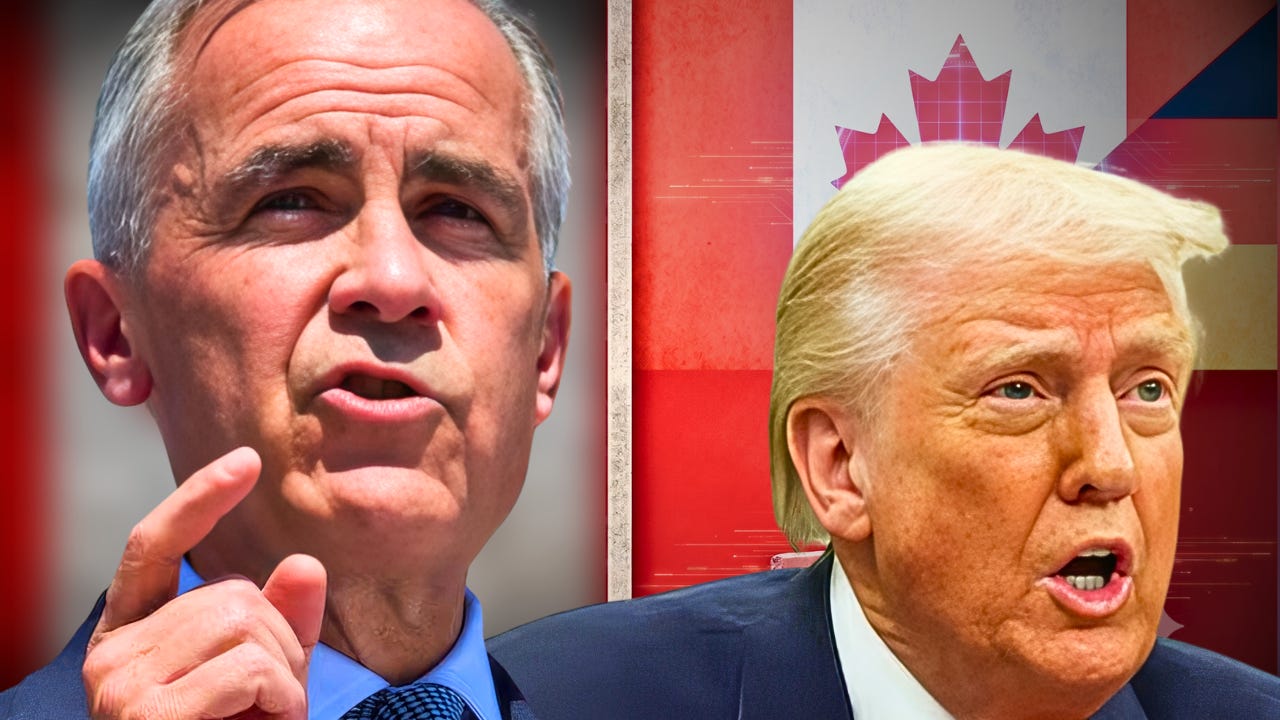
Well, just when you thought things couldn’t get any more bizarre, Trump (looking like he borrowed a wig from Carrot Top) goes off the rails in Vegas, calling Mark Carney “Nasty”. While Mark Carney drops the calmest, Canadian burn on Trump while at a press conference in Toronto.
There are two radically different leadership styles playing out here, and the contrast is almost laughable.
Down in Nevada, Donald Trump takes the stage at a Las Vegas casino. He looks out at the slot machines and flashing lights, puffing out his chest to announce to the world that Canada is “nasty.” Why? Because Canadians had the audacity to stand up, raise a middle finger, and say “no thanks.” In Trump’s mind, refusing to lie down and play dead isn’t sovereign self-defense; it’s just being rude.
Meanwhile, back in Toronto, Prime Minister Carney is standing at a podium delivering an address on industrial strategy when his teleprompter completely dies mid-sentence.
What does he do? He simply pauses, smiles at the room, and dryly quips, “Unlike a certain world leader, I do not view this as a conspiracy.” Then he looks down at his printed paper notes and goes straight back to work. A cold, deadpan burn delivered with zero wasted energy. It doesn’t get more Canadian than that.
Those two scenes tell you everything you need to know about where the two countries are heading. While Trump is measuring our feelings from a casino stage, Canada is quietly building the industrial partnerships that decide who controls the next generation of technology. And the biggest one might surprise you. It’s not Washington. It’s Germany.
There are many reasons that the US should be in panic, and this is another one. Canada and Germany are together again and doing something big..We are already partnering on defence, so why not critical minerals too? When you look at the big picture, it just makes sense. Canada’s got the lithium, the nickel, the cobalt, the graphite, and some of the biggest rare-earth deposits on the planet. Germany’s got the engineering, the processing plants, and the industrial customers who are desperate for those exact materials.
Put those two together and something important happens. Canada stops being just the place where the rocks come from. We start becoming the place where those rocks get turned into batteries, electric motors, military gear, power grids, advanced electronics. That’s the whole game, and most people don’t even know the game exists yet.
Digging a hole in the ground and pulling out raw dirt is the easy part. It’s just manual labor with extra machinery. The real money, the geopolitical muscle, and the strategic control don’t live at the pit mouth. They live in what the mining industry calls the midstream.
Fancy word, simple idea. It’s the gap between the mine and the factory. That’s where the value is hiding, and for decades Canada has been giving that value away.
For generations, Canada played the sucker’s game in this global chain. We dug up our raw minerals, shipped them across ocean shipping lanes for pennies on the dollar, and then turned around and bought back the finished, processed components at four times the price. We kept the low-margin extraction jobs at home while exporting the high-value chemical engineering, processing infrastructure, and advanced manufacturing to foreign nations.
That left us vulnerable and exposed. Because while Ottawa, Washington, and European capitals were busy giving speeches about the free market, China spent thirty years quietly buying up the midstream. They weren’t reading the menu; they were buying the entire kitchen.
It’s actually staggering how much of a stranglehold China has on this market right now. According to the International Energy Agency, China controls the refining capacity for nineteen of the twenty strategic minerals it tracks, commanding an average 70 percent market share across the board. When it comes to separating heavy rare-earth elements, China sits on an astonishing 91 percent global monopoly.
Why does this matter? Well, remember back in 2025 when Beijing decided to tighten export restrictions on heavy rare earths? That ground automotive assembly lines across North America and Europe to a sudden halt. One decision made inside a boardroom in Beijing froze a ton of factory shifts on the other side of the planet. That is insane. No country should hold that kind of power over a supply chain.
Canada and Germany want to change that.
Canada has always held incredible geological wealth. We have massive nickel deposits sitting across Ontario and Quebec, active lithium projects spreading through multiple provinces, rich veins of cobalt and graphite, and more than 15 million tonnes of known rare-earth oxide reserves sitting underground. The one thing we’ve never had enough of? Commercial-scale processing capacity
Enter Germany.
Germany’s the exact mirror image, just with the issues flipped. Their automotive giants, chemical conglomerates, precision machinery firms, and defense contractors burn through massive amounts of refined critical minerals every single day. But Germany has virtually zero domestic mineral extraction, no viable native lithium production expected before 2030, and extremely limited rare-earth recycling capacity.
What Germany does possess, though, is world-class chemical engineering, advanced industrial automation, massive commercial banks, and an urgent desperation to cut off energy and material dependencies on autocratic regimes.
So instead of each country trying to build the entire chain alone, they’re snapping together the pieces they already do well. Kind of like industrial Lego pieces.
Formally launched in August 2025, the Canada-Germany Critical Minerals Alliance targets the exact middle of the supply chain: refining, chemical processing, and recycling for lithium, rare earths, nickel, copper, tungsten, gallium, and germanium. This is an active, operational joint venture backed by hard capital happening right now.
If you want proof that this alliance is already altering global commercial flows, look at the industrial contracts hitting the ground right now.
Consider the Red Rock Lithium Converter project in Ontario. Under a landmark joint agreement, German industrial giant Siemens wants to bring the exact advanced automation, digital twin modeling, and chemical processing tech developed for Rock Tech’s European facilities directly into a brand-new Canadian processing plant.
Building a converter in Ontario means the high-value chemical processing stays right here in Canada. More importantly, it means a European battery maker can purchase battery-ready Canadian lithium without sending a single gram of raw material through a Chinese refining plant first.
That is the ultimate strategic bypass. That is how you open a brand-new door.
And the financial momentum behind this shift is massive. In March, Canada announced thirty additional critical-mineral partnerships, backing more than $12 billion in prospective project capital. Added to earlier funding rounds, the Canada-Germany framework is actively mobilizing over $18 billion in Canadian industrial projects.
And all moving forward while Trump stands at a casino podium calling us names.
Here is the deep strategic dilemma that Trump and his merry band of idiots are completely blind to.
American automakers, defense contractors, semiconductor plants, and battery manufacturers desperately need access to secure, non-Chinese critical minerals. They cannot build an advanced domestic economy without them.
And Trump’s answer to all of it is to tell Americans that Canada needs the US and the US doesn’t need Canada. He’s threatened the trade deal. He’s slapped on tariffs. He revived the fifty-first-state nonsense. And now he’s standing in a casino calling our prime minister “nasty.” That’s his whole plan. Meanwhile, the country holding the resources he actually needs is building a new front door.
Even a fifth grader can see what is going on here. Washington needs and wants our nickel, our lithium, our aluminum, our uranium, our energy — while simultaneously demanding that Canada behave like a dependent territory. You want our stuff, but you treat us like we should be grateful to be in the room. I don’t think so. You want to see nasty? Well, it is coming right at you, and you don’t even see it.
Canada isn’t sitting around waiting for Washington to figure out a coherent industrial policy. We are building alternative global alliances with the European Union, Japan, Australia, and the broader G7 Critical Minerals Production Alliance.
The ultimate goal here isn’t for Canada to single-handedly replace every Chinese mine and refinery on planet Earth overnight. That would be impossible. The goal is to build enough operational processing capacity alongside trusted allies so that neither Beijing nor Washington can ever shut down allied industries by choking off a handful of critical exports.
The message from Canada is clear. We aren’t waiting for the US to hand us an industrial plan anymore. We’re forming partnerships that get our resources to European and Asian factories through Canadian-controlled and allied-controlled processing. We are shedding the dependence. And creating leverage instead.
And that’s exactly why Trump calls us nasty. From his view, any country that won’t accept the terms he dictates is behaving badly. He’s most comfortable with allies who ask permission before making a move. Canada just stopped asking.
So, we will let Trump play to casino crowds in Las Vegas. Let them issue threats on social media and yell at press secretaries. And while they are doing that, Canada will continue to build the exit ramps that it needs to get off the superpower-dominated highway.
Like this breakdown? Subscribe to Unfiltered North for clean facts, sharp satire, and zero corporate spin. Then watch our latest video analysis on YouTube to see the more in-depth analysis, and drop your predictions in the comments section.
We said what we said.
— Dave & Deb
No posts
Comments
Nothing yet. Say the first thing.
Sign in to join the conversation.