
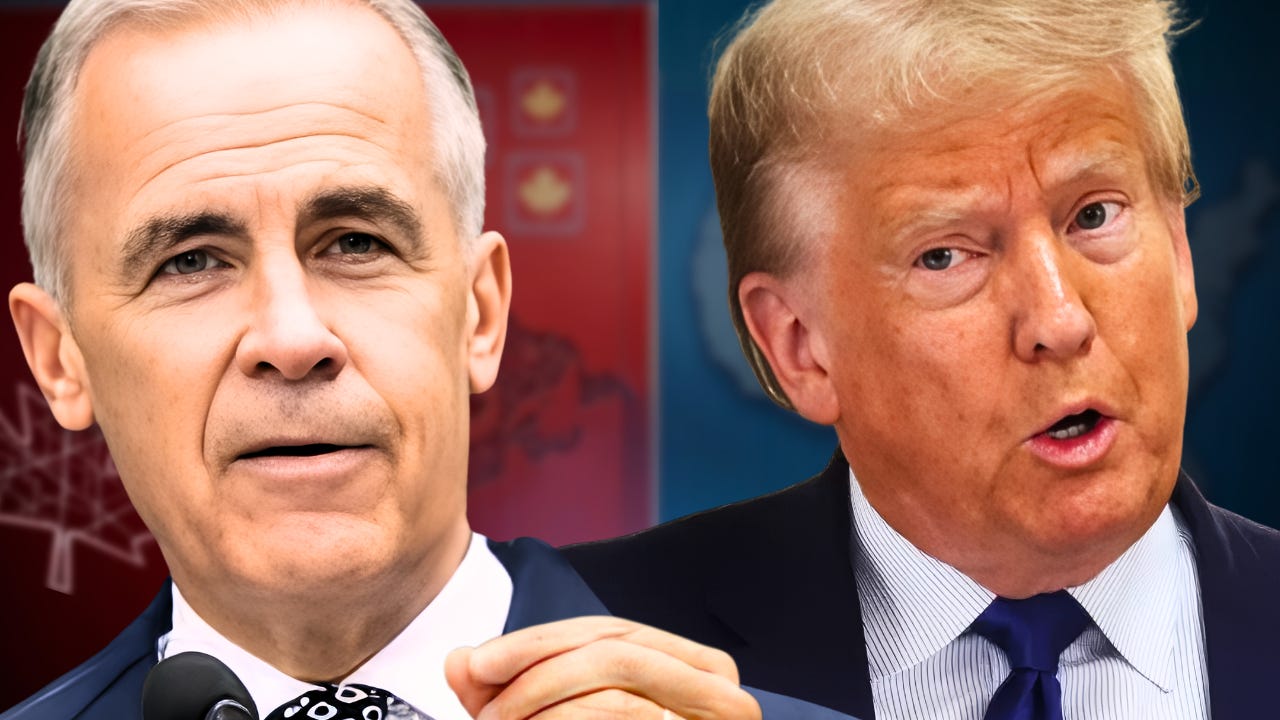
While the self-proclaimed Mango Mussolini and his court jesters down south were busy putting on a theatrical circus for news cameras, something extraordinary was happening in Canada. Nobody in the American press noticed. Nobody on Capitol Hill was even paying attention. They were all too busy hyperventilating over daily White House bluster and arguing over the Iran War.
And truthfully, that was exactly how Canadian leaders wanted it.
While the US was completely consumed by its own performance art, International Trade Minister Maninder Sidhu quietly dropped an administrative bombshell: the formal launch of Canada’s brand-new Strategic Exports Office and its companion Strategic Exports Advisory Council.
Now, I can hear the naysayers already…“Wow! Great! Another Government Office spending taxpayers’ money”. But hold that thought for a second. This isn’t just another government task force full of bureaucrats sipping cold coffee in a basement meeting room. This is a cold-blooded, institutional coordination weapon engineered for one specific purpose: uniting Canada’s top corporate CEOs, financial institutions, diplomats, and trade commissioners into a single, aggressive strike team designed to capture international contracts before anyone else even knows they are up for grabs.
And sure, the SEO and SEAC may be new, but the Team Canada strategy behind it has already facilitated over $28 billion in commercial wins for Canadian enterprises across Europe, Asia, and the Middle East. The US thought they were backing Canada into a corner. Instead, they just watched us walk right out the front door and claim a $28-billion piece of the global pie.
The fundamental flaw in Washington’s economic mindset, and there are a lot of them, is that they treat global trade like a series of fast-food drive-thru orders. They think you can step up to a podium, threaten a country with a tax penalty, demand immediate concessions, and expect a multi-billion-dollar supply chain contract to land on your desk by Friday afternoon.
News Flash Donnie: Real-world international commerce doesn’t work like that. It never has.
Major infrastructure projects, nuclear power builds, aerospace fleets, and critical commodity supply agreements aren’t executed overnight because some unhinged world leader demands it. They take five, ten, or fifteen years of meticulous, behind-the-scenes positioning. They require a whole fleet of professionals grinding away in foreign capitals for a decade before a single dollar ever changes hands.
What the Strategic Exports Office actually does is take a decade’s worth of scattered, highly successful Canadian commercial efforts and lock them into a permanent, centralized structure.
For years, Canadian companies were often left to fight in international tenders as lone wolves, sometimes even competing against each other for the exact same foreign megaprojects.
Maninder Sidhu and Mark Carney took one look at that old approach and killed it. By embedding corporate titans like AtkinsRéalis, Cameco, Bombardier, WSP, Scotiabank, and CAE directly into the federal government’s diplomatic and export finance apparatus through the Strategic Exports Advisory Council, Canada has ensured that when a Canadian company bids on a global project, they show up with the full commercial, financial, and diplomatic weight of the entire country sitting right behind them. (We’ll address the Advisory Board directly at the end of this)
If you want to see how this long-game positioning works in the real world, take a look across the pond at the UK.
While American trade reps were spending the last decade whining about Canadian dairy quotas and regional lumber pricing, Canadian engineering titan AtkinsRéalis was embedding itself into the largest infrastructure and clean energy project in modern British history: the massive Sizewell C nuclear power station.
The Sizewell C Scale: A 3.2-gigawatt nuclear powerhouse being built in Suffolk, UK.
The Household Reach: Designed to supply clean, baseline electricity to 6 million British homes for decades.
The Environmental Impact: Wipes out 9 million tonnes of carbon emissions every single year—the equivalent of taking 4 million cars off the road.
The Canadian Footprint: AtkinsRéalis has been embedded as a core engineering and site-sequencing lead since 2014.
AtkinsRéalis didn’t win its primary role in Sizewell C because of a last-minute government subsidy. They won it because Canadian nuclear engineers have spent over a decade proving they can deliver complex, multi-billion-dollar clean energy architecture on time and on spec.
When the British government decided it needed to completely overhaul its energy security to eliminate reliance on volatile foreign gas, they didn’t look to the USA. They looked to Canada .
And now, with AtkinsRéalis CEO Ian Edwards sitting directly on Minister Sidhu’s new Strategic Exports Advisory Council, that exact nuclear engineering expertise is being packaged with Export Development Canada financing and trade commissioner advocacy to replicate that success across Europe, Asia, and the Middle East.
That is what structural leverage looks like. While Trump threatens to bring Canada to its knees, Canadian firms are literally building the power grids of our primary global allies.
Now let’s head over to Mirabel, Quebec, where Airbus Canada just handed the global aviation market a masterclass in how to steal a multi-billion-dollar deal right out from under the nose of American competitors.
In a landmark ceremony that sent shockwaves through the commercial aerospace industry, Southeast Asian budget airline giant AirAsia signed a historic agreement to acquire a massive fleet of Canadian-manufactured Airbus A220-300 aircraft.
Total Fleet Commitment: 150 Canadian-built A220-300 aircraft, with options for 150 additional higher-capacity variants.
Commercial Deal Value: Estimated at roughly $6.8 Billion USD.
Global Manufacturing Backlog: Increases the A220 production backlog by an astonishing 33% in a single signing.
Historical Significance: Hailed as the largest single order of a Canadian-designed and produced commercial aircraft in aviation history.
Think about the sheer commercial smugness of this deal. AirAsia didn’t go to Boeing down in Seattle. They didn’t sign a contract for American-built narrow-body jets. They flew straight to Mirabel, Quebec, and signed a multi-billion-dollar contract for an aircraft platform engineered right here in Canada as the Bombardier CSeries.
So, why did AirAsia choose the Canadian-built A220 over its American rivals? Because the A220 is the most fuel-efficient, passenger-friendly, quiet narrow-body aircraft in its class, offering operational economics that blow traditional jets completely out of the water.
And with Bombardier CEO Éric Martel sitting alongside top aerospace executives on Canada’s Strategic Exports Advisory Council, Ottawa is making sure that Mirabel’s assembly lines remain backed by Canadian diplomatic pressure, export financing, and trade infrastructure for the next thirty years.
Washington can scream about trade dominance all day long on television. Meanwhile, Canadian aerospace workers in Quebec are building the actual jets flying the busiest air routes across Asia.
If nuclear power in Britain and commercial jets in Asia sound like major wins, look at what Canadian resource giant Cameco has been quietly doing in India.
As the world’s largest nation is trying to transition toward clean baseline nuclear power to feed its industrial grid, India needed one critical thing above all else: a decades-long supply of high-grade uranium.
They didn’t want to rely on politically unstable regimes, and they certainly didn’t want to get trapped in an unpredictable trade setup with a U.S. administration that threatens tariffs every time its feelings gets hurt.
So, who did India sign verified, long-term commercial supply agreements with? Cameco. Saskatchewan-based Cameco locked up long-term uranium supply contracts that ensure Canadian-mined nuclear fuel will power Indian reactors for generations.
And with Cameco CEO Tim Gitzel serving as a leading voice on the new Strategic Exports Advisory Council, Ottawa is leveraging those deep energy partnerships to open up broader trade channels for Canadian technology, agricultural exports, and engineering services across the entire Indian subcontinent. (See a trend developing here?)
This is how real economic power operates. You don’t get long-term geopolitical influence by bullying your allies or throwing administrative tantrums every 5 seconds. You get it by becoming the indispensable, reliable, high-tech provider of the exact raw materials, clean energy components, and transportation infrastructure that the world’s fastest-growing economies need to survive.
What makes this new trade posture different from anything Canada has done in the past is the sheer private-sector firepower assembled under one umbrella.
Minister Maninder Sidhu didn’t fill this Advisory Council with partisan staffers or ivory-tower academic theorists. He went straight to the corner offices of Canada’s most powerful, aggressive export corporations and told them to take the steering wheel.
Look at the executive heavyweights sitting at this table:
AtkinsRéalis (Ian Edwards, CEO): Controlling global nuclear engineering and civil infrastructure megaprojects.
Cameco (Tim Gitzel, CEO): Controlling global clean nuclear fuel supply chains.
Bombardier (Éric Martel, CEO): Driving high-end business aviation and global aerospace manufacturing.
OpenText (Ayman Antoun, CEO): Commanding enterprise software and global digital infrastructure.
MDA Space (Mike Greenley, CEO): Leading satellite technology, space robotics, and defense communications.
WSP & CAE (Alexandre L’Heureux & Matthew Bromberg, CEOs): Dominating global engineering consulting, defense simulation, and aviation training.
Scotiabank & Manulife (Scott Thomson & Philip Witherington, CEOs): Providing the massive institutional banking, trade financing, and insurance muscle required to back multi-billion-dollar international bids.
Canadian Chamber of Commerce (Candace Laing, CEO): Unifying Canada’s business network into a single export strategy.
This is the commercial arsenal that Ottawa has officially deployed. The mandate given to this council is crystal clear: double Canada’s exports to non-U.S. markets by 2035. No excuses.
If an international government wants to build a nuclear reactor, buy a commercial aircraft fleet, upgrade its digital infrastructure, or secure minerals, Canada doesn’t send three different companies to compete against each other. We send one unified Team Canada delegation, backed by federal trade commissioners, institutional capital, and Export Development Canada financing, to shut the door on international competitors before they even get off the plane.
Let’s address the obvious political elephant in the room before the Conservatives start screaming about it in the comments: yes, if you look at the names sitting on Minister Sidhu’s Advisory Council, it reads like an invitation list for a private gala at the Toronto Club. You’ve got the CEOs of Scotiabank, Manulife, Bombardier, AtkinsRéalis, Cameco, and CAPP all sitting in one room.
The optics-first crowd is going to complain that Carney is just stacking the deck with corporate elites while ignoring labor unions, small businesses, and Main Street. And from a pure political PR standpoint, that criticism is fair.
But here is the real-world reality: when you are bidding against state-backed industrial conglomerates in Tokyo, London, or Berlin for a $6-billion aerospace fleet or a nuclear power build, you don’t send a 50-person consultative committee of academic interns and policy theorists. You send the heavyweights with the multi-billion-dollar balance sheets who can actually sign a binding commercial contract before the end of the week.
Is it Bay Street-heavy? Absolutely. But in the middle of a global trade war, Ottawa isn’t trying to win a PR contest—they’re trying to win the contract.
In the end, with all that has been happening with trade and the economy here in Canada, you can’t help looking at the irony of Trump’s posturing and bluster. It has basically accomplished the exact opposite of what he intended. He thought that by threatening Canada with economic penalties, they could force us into a state of panic, make us beg for exemptions, and bind us closer to their domestic political agenda.
Instead, they gave Canada the ultimate justification to build a permanent, multi-billion-dollar global export bypass. The $28 billion in commercial wins already on the scoreboard isn’t a final result, it is just the baseline. We’re just getting started.
Like this breakdown? Subscribe to Unfiltered North for clean facts, sharp satire, and zero corporate spin. Then watch our latest video analysis on YouTube to see the more in-depth analysis, and drop your predictions in the comments section.
We said what we said.
— Dave & Deb
No posts
Comments
Nothing yet. Say the first thing.
Sign in to join the conversation.