
For context, I wrote this essay in November 2020.
Since I was as young as I can remember, my mother has been full of entrepreneurial spirit that has nowhere to go. Every so often, she would comment on a small accepted facet of daily life that could be made better. She had ideas for travel accouterments, better pillows for airplanes or smart suitcases that charged our devices. When the devices inevitably came into being she would point a finger at that object she once envisioned and say, See! I thought of that, and we would nod and say, Yes, yes, you’re a genius.
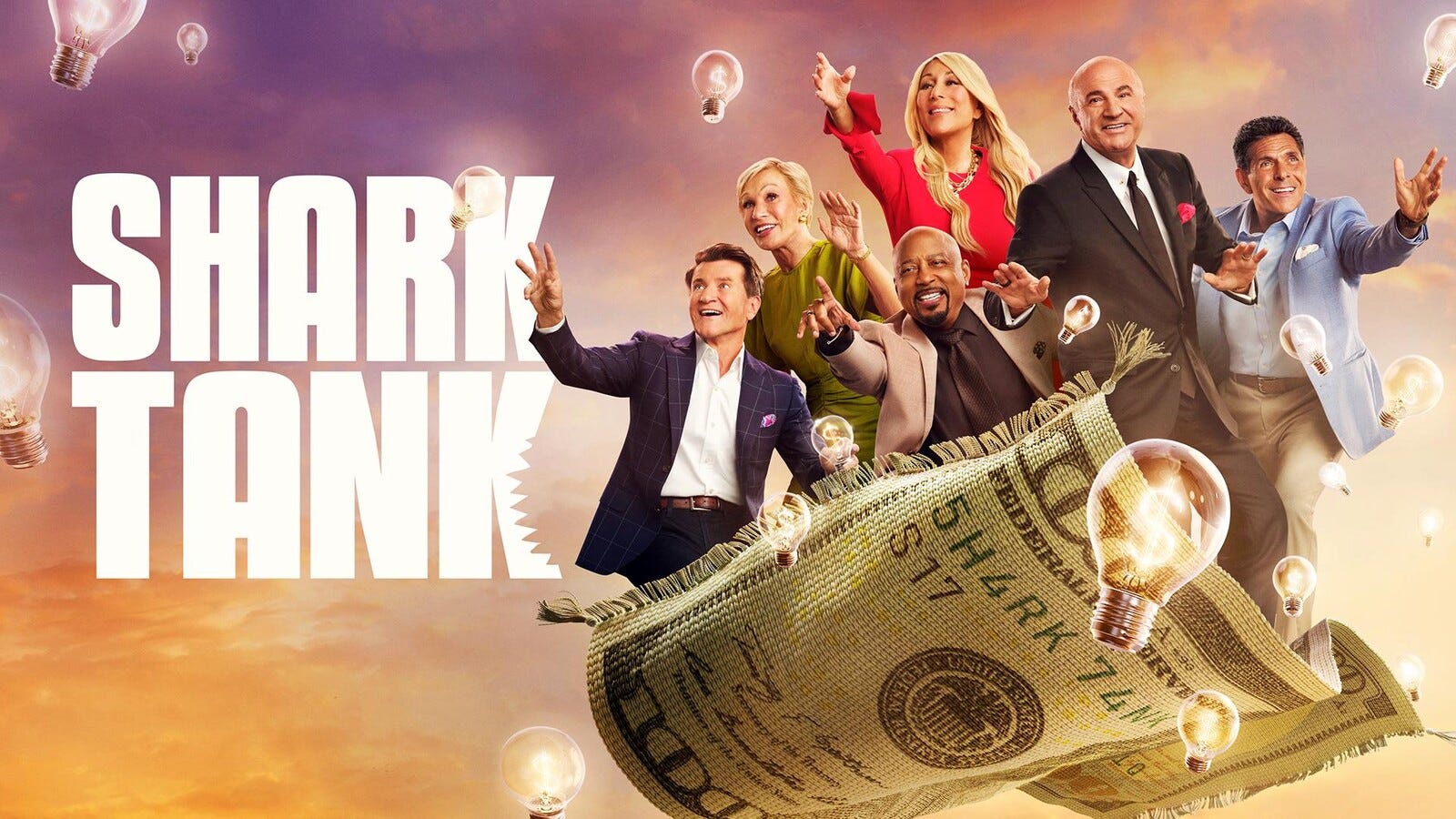
Her ideas would have been better than half the shit I see on Shark Tank. Shark Tank features a panel of angel investors who decide whether or not to invest in small businesses whose founders come and pitch them with overly rehearsed dog-and-pony routines, free samples, and (ideally, though not necessarily) some tear-jerking backstory involving toil, dead beloveds, and the American Dream. The stupidest product I saw on Shark Tank recently was an electric knife made to look like a chainsaw. The husband-and-wife entrepreneurs described it as a fun tool for Dad or Grandpa to cut the turkey with at Thanksgiving. Never mind that outside of the Shark Tank COVID bubble, American health officials were exhorting members of the public not to fly home for Thanksgiving, to try and celebrate just with their immediate household or over Zoom. Never mind that in some enlightened families maybe it isn’t the man of the house who cuts the bird (and maybe there isn’t a man of the house, or maybe there isn’t a bird). The chainsaw knife received an investment.
A couple of the Sharks rotate out each episode. In the last one I saw, Mark Cuban, Daymond John, Lori Greiner, Kevin O’Leary, and Guest Shark Blake Mycoskie sit on wide armchairs and gamely nibble at mushroom jerky samples, sip a beverage in an attractive gradient can that promises to let you “drink your meditation,” and try on filter masks intended for dogs.
Shark Tank makes me think of my mother because she actually was an entrepreneur. She started a private afterschool and enrichment program called Seeds of Learning out of the garage of the first childhood home I remember, in Renton. We huddled at long tables in the winter afternoon chill and L., a preacher’s daughter studying architecture at UW, taught us how to do our times tables. I’m not sure if Seeds of Learning was at all profitable, or if my parents mostly subsidized the cost of paying L. to teach my sister and me and the other kids. My mom didn’t really run Seeds of Learning for the money; I think she just liked having something to run. In parallel, she operated another business called Bilingual Career, a job-posting site for companies to find bilingual employees and for bilingual workers to look for jobs. We knew a guy named Tetsu who designed websites, early aughts HTML shit, those sites with a static homepage picture and a ton of clickthrough links. He made Bilingual Career dot com. The homepage picture was a stock photo of happy-looking white-collar workers in button-ups with black headpieces on, like the first hit you’d get if you searched “diverse professionals.”
My mom probably came up with Bilingual Career because she had a bilingual career: in addition to running Seeds of Learning and keeping us clothed and fed, she had a full-time job as a telephone interpreter for an offshoot of AT&T called Language Line. The job was remote before remote work was cool. There had to be a market solution to address the fact there’s always going to be a doctor or police officer or credit card company customer service agent who needs an interpreter. My mom was that interpreter. She worked nights from home, 6pm to 2am with a short break in between — she’d use it to try and nap. When she worked we heard her voice through the walls, exasperated Mandarin into the phone for call after call. Sometimes she had to translate the worst moments of people’s lives. She spoke to people who had experienced credit card fraud, patients in hospitals, to a distraught father about his daughter, dead by suicide.
Telephone interpretation wasn’t what the late anthropologist David Graeber would call a “bullshit job,” a redundant white-collar job that doesn’t have much of a point. Instead, it was definitely a shit job — crucial for someone to do, but with late hours, sucky pay, sometimes screaming callers on the other end. She quit interpreting for a period of several years, when I was still too young to travel by myself but was receiving invitations to keynote at conferences around the world, and became my full-time manager, even selling Bilingual Career, though not for much money, considering how long she’d been running it. Someone was willing to pay a couple thousand for the domain name; now it redirects to job-applications dot com with “Bilingual” pre-filled in the search field.
The year I went to college, my mother went to work at a tony private school in San Rafael, north of San Francisco. My dad had a year-long contract there as a science teacher, replacing a teacher who was on leave. They hired my mom at the same time to work in the school’s communications department, tasked with promoting the school on social media and making it look like an attractive place to apply and attend. The academy costs more than $40,000 a year and accepts a quarter of the students who apply, all of whom seem to be white, sporty, and beautiful. They excel at soccer and cross-country and swim and lacrosse. The campus buildings are called Halls and look cream-colored and house-like. Many of the teachers also coach athletics, and the administrative staff dressed and spoke very differently from my mother.
It was not the most natural place for either of my parents to assimilate, but my mom particularly struggled. In between classes my freshman year I tried to respond to her texts for help. She started the messages with apologies for troubling me, but could I look at this draft post for the school’s Facebook? I resented the incursions, felt worse about the fact that I knew she was stressed out in a place that made her feel like an outsider while I was partying in college. I found errors in her sentences often, nothing that changed the meaning but big enough to be noticeable. Little quirks that screamed out loud to her communications colleagues. She had worked so hard to get them to like her, to fit in around the office; she even bought new clothes, like a matching two-piece set from Ann Taylor, to try and keep up appearances. These women, she marveled, seemed to wear new clothes everyday.
After a few months they had a polite, distant conversation with her, saying that they needed someone who could author more polished copy, and they let her go.
This had absolutely been a bullshit job, snapping photos of diverse-looking student groups and writing feel-good schmalz about how great the school was, but it also paid decently and had come with good benefits. That it ended so quickly was a smarting cut. Discouraged by the results of this foray into an office job, she went back to the interpretation company.
The company had changed since she last worked there. In 2016 it was acquired by a French firm that implemented numerous cost-saving measures. What had been a shitty job with OK benefits got shittier, period. New policies reimbursed translators differently depending on call volume, so my mom would make less money on quieter nights, even though she still had to be awake and alert either way. The company made it harder to take paid time off and workers had to do more interpretation over video and not just audio. For the video calls, they sent my mother two thick white cotton button-up shirts with the company logo emblazoned over the breast pocket and a giant blue screen to use as background on calls. Being awake at 1 AM and ready to interpret complex medical terminology was already exacting; having to be presentable on camera on top of that required even more resilience.
To this day, though she complains about the way the interpretation company’s new owners have slashed benefits and implemented more extensive systems of surveilling workers to ensure they are active and on-time, my mother says she likes the flexibility of her work. That it was a gift, earlier in life, to be able to spend time during the morning with us as we were growing up, and that it is nice now to have the daytime for walks and gardening. I wonder if that was true why she always had her hand in a side hustle, and if her glass-half-full attitude glosses over precarity and makes excuses for a capitalist system that is more rapacious than it needs to be. When my mother and I see each other I think the crux of our arguments stems from this difference of interpretation. She is allergic to ever seeing herself as a victim. I think that most of us are bound up in a structure that produces few winners, and that recognizing this for what it is, in all the grimness, is prerequisite to fixing things. This year, Lyft, Uber, Doordash and other gig economy companies invested a record-breaking amount of money into advertising for Proposition 22, legislation that would reverse California legislators’ earlier decision to make the companies treat their drivers as employees instead of independent contractors. Many of the advertisements they paid for featured drivers. I like the flexibility, they said.
It frightens me how you don’t need to shout at people or lock the doors to the factory floor a la Triangle Shirtwaist or hire Pinkertons to exploit them. How you can do it with stories we want to believe so badly instead. Stories like Shark Tank. They say it’s a reality show but I think it’s more accurately a fable, in the spirit of all those other American fables — manifest destiny and exceptionalism and self-reliance and pulling yourself up by your bootstraps. In the Shark Tank narrative anyone can found a company, and if you apply enough elbow grease, you can achieve the dream (what is the dream? Is it security, stability, riches beyond compare?) and live happily ever after. It’s wretched and immoral because it is almost never true. According to the Small Business Administration’s Office of Advocacy, only about half of small businesses survive past five years, and only one in three past ten.
Anyway, I still watch Shark Tank because it’s good TV, with the dramatic music at just the right points and shark Lori nodding with luminous eyes and telling the Pakistani woman co-founder of the pretty gradient-can beverage company, “You do all women proud, and your packaging is beautiful.” Sometimes the people on Shark Tank remind me of my mother. They say things like “In America you can be anybody you want to be,” and they speak of their ceaseless hustle and the depths of asceticism to which they have committed in pursuit of larger goals. Once, looking at imitation crab in a supermarket, my mother said, For three years when I first came to this country, I didn’t eat real seafood because it was too expensive, I would just buy some of this imitation crab for $2. If my mother said that on Shark Tank, Mark Cuban would nod approvingly and say “Good for you,” which always makes me want to punch him in the face. Like fuck you, Mark Cuban. It’s not “good for you,” it’s shit for all of us. How many people have to hustle not because they had all the choices of vocations in the world lined up on silver platters, but because making some new shit with your hands and trying to sell it is the only thing you can do when the formal economy doesn’t let you in? I want to snap my fingers and send Mark Cuban into a Freaky Friday where he’s an immigrant who just can’t get the tenses of her sentences to agree quite right. Or better yet, go fly to one of the dusty metropolises of the Global South, sit in the backseat of your chauffeured Mercedes-Benz as you lurch down a traffic-clogged street, look at the man twisting balloons into animals or the woman hawking bracelets or the child holding up water bottles dripping with condensation and banging on car windows for a buck, and sing your praises of entrepreneurship then.
My mother and I went to Beijing in the winter of 2008. Right before we embarked on a whirlwind Asia trip she had decided to quit her job. Beijing then was ice-cold and gray; we went schlepping through the chill to see sights, and sometimes bought snacks off the street, like a sweet potato warmed on burning coals in front of us. My mom tries not to accumulate kitschy souvenirs, but she has a soft spot for starting up conversations with vendors and haggling. That was perhaps why we ended up in front of the wizened woman on the sidewalk bent over hanging decorations she had threaded together, stiffly, by hand. She was dressed shabbily and appeared to have no customers when we walked up to her small display. My mother asked her where she was from, and the woman said, Kaili. My mother exclaimed in shock something like No way, me too, and they reminisced about the hometown they shared. At that time, my mother hadn’t been back to Kaili, not since leaving China two decades before. She and her countrywoman were both from a village that was now a medium-sized township in Guizhou Province; separated by at least a generation, they had wound up facing each other on this Beijing sidewalk. You’ll forgive me for not finding entrepreneurship attractive or reassuring — it’s never seemed to me like a barricade against a freefall into deprivation. I see that street, my mother and me and the vendor from Kaili. Who’s to say that, with a different roll of the dice, it couldn’t have been the other way around?
Recommended reading:
Felisa Rogers’ “I’m an American relying on food stamps. This country has turned us into lab rats” in The Guardian
Pete Hegseth is a piece of shit who hates women (The Baffler)
Comments
Nothing yet. Say the first thing.
Sign in to join the conversation.