
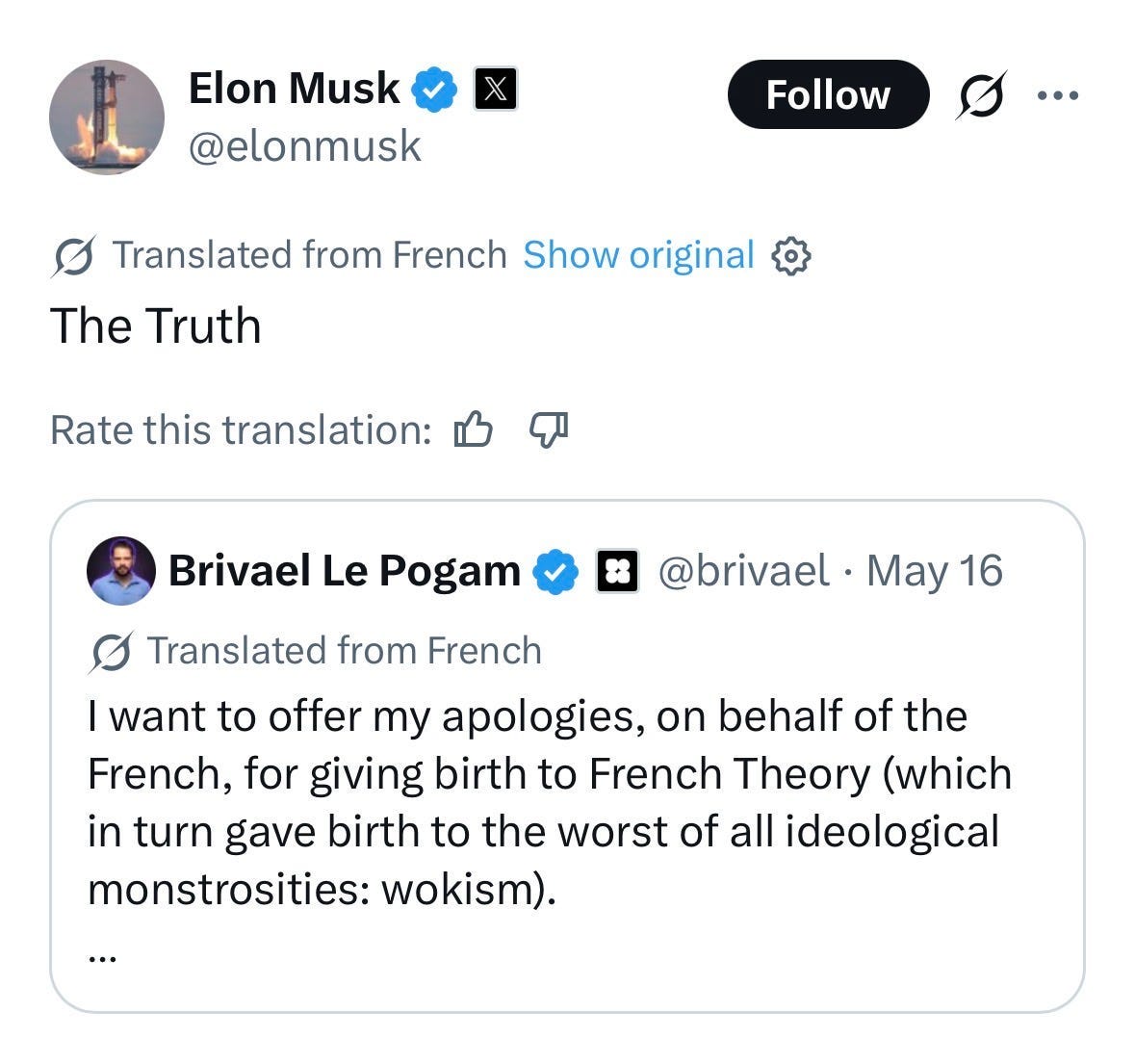
On May 16th, a tweet by French entrepreneur Brivael Le Pogam went viral, racking up tens of millions of views on X after Elon Musk replied with a single phrase: The Truth.
The text charges French Theory, the philosophical current associated with Foucault, Derrida and Deleuze, with having spawned wokism and paralyzed the West. Its conclusion is unequivocal: “a civilization is rebuilt by builders, not by commentators.” The builders are in startups and AI labs. Philosophy, the argument goes, produced the problem.
The text is effective. It delivers exactly what social media rewards: a simple causal chain for explaining a confusing era. The West is in decline. American universities have dismantled the very idea of truth. Silicon Valley is rebuilding. It is.
Beyond the fact that it is something of an honor for French philosophy to be singled out as Elon Musk’s adversary, the problem is that this text fundamentally misreads what Michel Foucault actually said.
Let us be clear. Michel Foucault never argued that “truth does not exist.” What he said is far more precise and far more elegant: every society produces the conditions under which it decides what counts as true. Truth never emerges in a vacuum. It appears within a particular state of knowledge, a particular set of rules, concepts, institutions and available techniques. Foucault calls this an episteme.
The word may sound daunting, but the idea is concrete. In certain eras, certain ideas are simply unthinkable, not because they are forbidden, but because the intellectual tools needed to articulate them do not yet exist.
Take the French Nouvelle Vague. Its emergence is often told as the sudden irruption of a handful of individual geniuses. But what Godard and Truffaut accomplished would likely have been impossible ten years earlier. It required lighter cameras, faster film stock, a new criticism of cinema, a different relationship to reality, an entire generation that had come through the war. Something had shifted in the very conditions of what it was possible to film and to watch.
Foucault offers another example in “The Order of Things”, drawn from economics: the passage from Adam Smith to David Ricardo. Smith thinks the economy through the lens of exchange. In Ricardo, labor becomes the source of value. With this shift, the economy changes its very object. Production, scarcity and finitude move to the center.
Ricardo does not simply improve on Smith. He displaces the very ground on which Smith was standing.
The same holds for science. The world that produced Einstein had to exist before Einstein could emerge. Newton could never have thought what Einstein thought because the necessary conditions were simply not in place.
This is what a rupture produces: a change in the conditions of what can be thought.
In “The Discourse on Language”, his inaugural lecture at the Collège de France delivered in 1970, Foucault describes what he sees as a fundamental operation of human societies: commentary.
He begins with a simple observation. In every culture, there exists a hierarchy among discourses. Some utterances vanish immediately, the small talk of everyday life, words that dissolve as soon as they are spoken. Others become texts that a civilization returns to endlessly: religious, juridical, scientific and philosophical texts. They are reread, interpreted, reformulated and updated. An entire culture speaks through them. The Bible has been commented upon for 2,000 years. Shakespeare has been analyzed for 400.
This act of return across time is what he calls commentary. Foucault identifies its structure with remarkable precision. Commentary has a double and paradoxical function. On one hand, it makes it possible to generate an endless supply of new discourse from an existing text. On the other, it constrains that new discourse to remain within the orbit of the original. One may say something different, provided that what is ultimately said remains, in essence, the same thing.
Foucault states this paradox as follows:
“Commentary must, in accordance with a paradox it endlessly defers but never escapes, say for the first time what had, nonetheless, already been said, and must tirelessly repeat what had, however, never been said.”
Hence this formulation:
“The new element lies not in what is said, but in the event of its return.”
Commentary produces something new, but that novelty remains bound to a pre-existing corpus. This is precisely what distinguishes it from rupture. Darwin does not comment on fixism. He dismisses it. The Nouvelle Vague does not comment on studio cinema. It renders its very ground obsolete. Ricardo does not comment on Smith. He displaces the ground on which Smith was standing.
In 1970, Foucault could not have imagined the internet, let alone large language models. And yet, what is an LLM if not a machine for producing commentary at industrial scale?
A language model is trained on the available corpus of human text. Its function is to statistically reproduce the regularities of what has already been written. Each output is new in the sense that this precise sentence has never existed before. Yet it is still produced from what has already been said elsewhere, by others, in other forms.
The LLM is not a rupture in the economy of human discourse. It is a scaling operation.
Commentary has been scaled.
The structure is the one Foucault described, but industrialized: billions of tokens per day, in every language, on every subject, at a speed and scale no civilization had ever known.
Brivael pits builders against commentators at the precise moment Silicon Valley is constructing the largest commentary machine in human history.
LLMs do not produce ruptures in the Foucauldian sense. They produce extraordinarily sophisticated recombinations of what has already been said. A model trained on all pre-Einsteinian physics would probably have refined Newton. A model trained on French cinema of the 1950s would have produced optimized studio cinema. A model trained on classical economics would have produced an improved Smith. Not a Ricardo.
This is not a moral indictment of LLMs. It is a description of how they work. A machine trained to maximize the statistical likelihood of what has already been written will produce, by design, what most closely resembles what has already been said. It perfects the existing. It cannot displace its ground. This is not a flaw to be patched in the next release. It is the very structure of the operation.
AI is no longer a mere software product. It is beginning to alter the very conditions under which human discourse is produced: writing, learning, searching, summarizing, persuading, teaching, coding and staying informed. Hundreds of millions of people already mediate their thinking through these systems.
An infrastructure capable of reshaping cognitive practices at this scale necessarily becomes a political and critical object, not in the moral or partisan sense, but in the most elementary democratic sense: something a society must be able to interrogate collectively.
Yet Brivael’s tweet performs the opposite move. It does not merely critique certain forms of critique. It reframes critique itself as a symptom of cultural decline. “Stop deconstructing. Build.” The problem, it implies, is no longer the concentration of technological power, nor the discursive infrastructures now taking shape, but those who persist in asking what these systems produce.
The paradox is then hard to miss. Silicon Valley is building systems capable of massively transforming our relationship to writing, knowledge and information, without any society having genuinely deliberated, collectively, on this shift. And at the same moment, some are arguing that the real problem is philosophy’s excess of critique.
There is an additional irony. Brivael’s tweet is itself a perfect specimen of the discursive regime it claims to denounce: a simple narrative, an efficient rhythm, an immediately recognizable causal chain, nothing genuinely discontinuous. It is precisely the kind of text a well-trained LLM could generate.
Brivael indicts the commentators. He is himself, in the strict Foucauldian sense, an excellent commentator. Silicon Valley believes it is burying Foucault today. It may well be technically realizing what he described back in 1970.
In the end, who constructs a thought? Foucault? The LLMs? Or Brivael?
Aucun post
Comments
Nothing yet. Say the first thing.
Sign in to join the conversation.