
We say we want to be seen.
But often, what we mean is we want to be recognized. We want to be met in the version of ourselves we’ve already made digestible—shaped, named, knowable. We want to be seen in our clarity and our coherence, not in our chaos.
We don’t really mean: see me as I change. We don’t mean: stay when the shape blurs. And we certainly don’t mean: watch me as I unravel and revise.
But that’s what it means to love a protean—an ever-changing, mutable, shifting self (and what it means to be one).
Proteus was old—he was older than the gods of Olympus, older than the tides that curled around his toes. They called him the Old Man of the Sea. He was not a hero. Not a villain. Not a king. Mostly he was a witness.
Proteus could see everything—past, future, consequence, catastrophe. But he had no interest in telling you what he saw. He didn’t offer wisdom. He didn’t volunteer prophecy. If you wanted the truth, you had to seize him, and then endure what came next.
The moment you touched him—skin to skin, hand to shoulder, grip around the waist—he would change.
Lion. Serpent. Waterfall. Flame. A bolt of lightning. A column of smoke. You would hold him, and he would become everything you could not hold.
Only those who could withstand his shapeshifting—who refused to recoil when he scorched or slipped or writhed—would be rewarded. If you could meet every transformation without letting go, he would finally stop. Return to form. Then (and only then) would he tell you what he knows.
This is the ancient cost of intimate knowing—of knowing (and loving) a changing, whirling, swirling, oceanic thing. Not asking. Enduring. Not grasping. Staying.
Not control. Continuing.
To know anything deeply, you must survive it in all it’s forms.
To love a changing thing, then, is not to possess. It’s to stay steady in someone else’s evolution and to let your own shape shift in response. We learn this with lovers, yes—but it’s life, too, that asks it of us again and again.
Proteus is a model for the difficulty of knowing. His transformations are not obstacles to understanding. They are understanding. His many forms—smoke, the flood, the unbearable heat—these are what truth looks like when it refuses to be easy.
So, when we say we want to understand someone—what we often mean is: we want something that won’t hurt. (Again, be it lovers, but more interestingly, life.)
Real understanding doesn’t sit still. It flares. It stings. It burns. It tests your grip. It asks: Can you stay with this—not just as it is, but as it becomes?
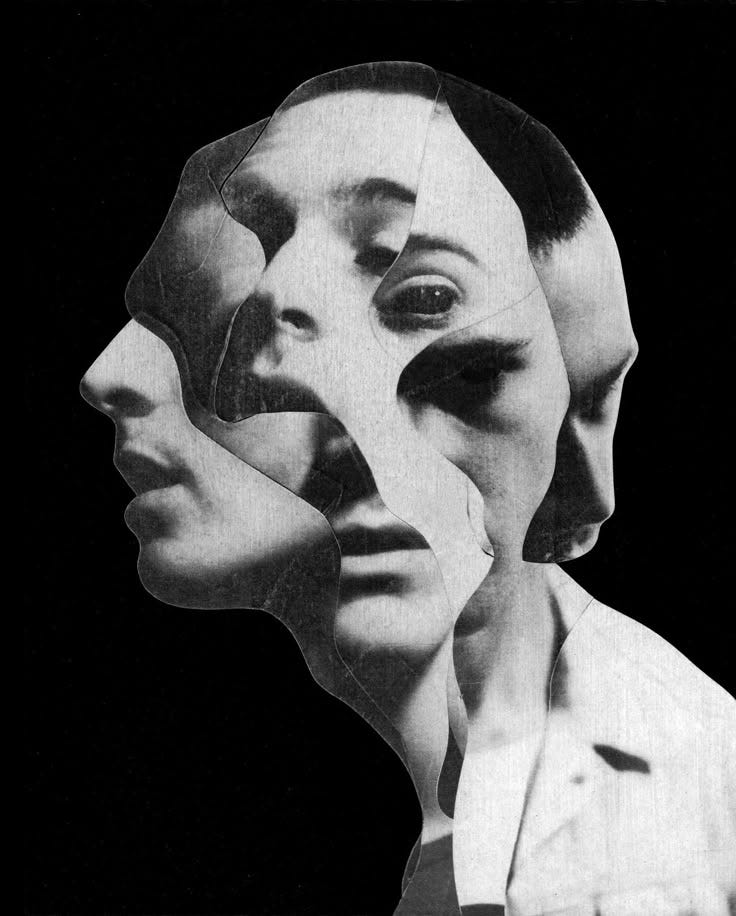
To love someone (or something) who changes—who is still becoming, still breaking and remaking their own form—is to give up the illusion of relational certainty. It’s to accept that intimacy will not be built on consistency, but on willingness. Not on recognition, but on attention.
This isn’t about volatility or chaos (or on the other end complacency). A protean self isn’t unstable; they’re unfinalized. Their identity isn’t incoherent. It’s evolving. And that evolution isn’t a phase—it’s the structure. It’s what they are.
To love that kind of self requires a shift in orientation. From outcome to observation. From possession to proximity. From “I know you” to “I’m here while you change.”
This is not how we’re taught to do love.
We’re taught that love means finally arriving. Feeling a constant feeling. Settling down. Locking in. “Knowing” your partner becomes a badge of closeness—as if the goal is to make the other person predictable. As if love is an episode of some 1960s gameshow. As if deep intimacy requires resolution.
But for a deeply protean self, being “known” too quickly can feel like being pinned to the wall. They don’t want to be decoded. They want to be witnessed in ongoing process. To be loved not for who they are in a single moment, but for their capacity to become—and perhaps for some profound essence that even they are still trying to fully know.
The paradox is that even as the protean self longs for that kind of love, they—we—often test for it before they trust it.
We shift shape—not always dramatically, but subtly. We withdraw. Contradict ourselves. Offer versions of the self that are harder to hold, not to sabotage connection, but to see if the other person can tolerate uncertainty. Can you stay with me when I’m not performing stability? When I’m messy, frenzied, in-between? Can you handle motion?
This architecture of intimacy asks: Can you stay close to a self that doesn’t consolidate? Can you bear the discomfort of seeing someone you love become unrecognizable—and trust that something real still exists between you? Can you fundamentally believe in the belief that we all (dare I say) contain multitudes?
To love a protean self is to relinquish the desire for symmetry. You don’t meet them in a fixed center. You meet them again and again, each time slightly altered, and you decide—without guarantee, without permanence—that you’re willing to meet them again.
We are all protean—shifting if we’re alive enough to be moved by life. And if love is real or worthwhile, it starts here: with the willingness to be seen in the sea-change, and to love what is always in motion.
There’s another story—a myth that lives like a counterweight to Proteus.
It is the myth of Psyche and Eros.
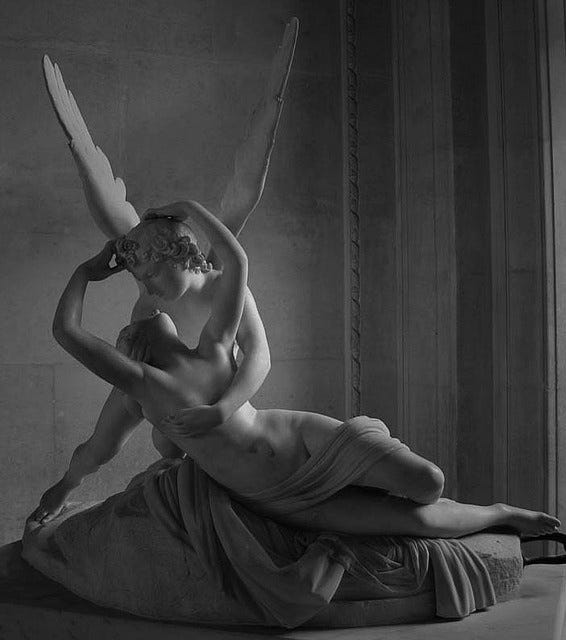
Psyche, whose name means soul, and Eros, desire itself. They do not meet face to face. He comes only at night, in the dark, in silence. A lover she can feel but never see. A presence without a name. No questions. No vision. No certainty.
Just touch. Surrender. And for a time, this is enough.
Ah, but Psyche is human. Which is to say she is curious. She wants more than sensation. She wants to know. Eros is her Tree of Knowledge of Good and Evil. And so, one night, while Eros sleeps, she lights a lamp. Tilts it toward his face. Leans in. Takes a bite of the forbidden fruit.
And just like that—he vanishes.
True knowing is always a kind of exile—from innocence in the garden (funny how God is more erotic abandonment than protean wisdom) to to Psyche’s lamp.
This is the tragedy at the heart of love and knowledge. That the moment you try to pin love in place—define it, see it, make it legible—it might disappear. The human story is always a story of desire over comprehensive understanding. And the consequence for seeking concrete, complete truth always seems to end in some kind of absence, abandonment, vanishing.
The desire to understand love can sometimes kill the thing itself.
But this is not the end of the story.
The rupture is real, but does not end in ruin. The myth does not leave Psyche in grief; it sends her into the fire. Into a protean jaunt. She must descend into the underworld! Sort seeds by the millions! Fetch beauty from Persephone! Carry water from the river Styx! She must, in other words, survive her own transformation.
And when she emerges—no longer just the girl who wanted to see, but the woman who has lived—only then does reunion become possible. Not a return to how it was. But a new form of love. One built not on blindness, not on fantasy, but on mutual recognition.
Because love—the real kind, the enduring kind—is not the moment of union. It is what comes after the spell breaks. After the illusion shatters. After the fantasy burns off and you are exiled from Eden.
It is the choice to love again, knowing what you now know. To love someone not because they complete you or remain consistent—but because they don’t. This is love after the lamp. Love without idealization. Love that lets the Other keep becoming. Love that knows the self is also unfinished.
Psyche didn’t fail by lighting the lamp. She began.
This is the shape of love that can hold the protean self.
There’s a kind of desire that doesn’t fit easily into our cultural vocabulary.
It isn’t about wanting a person. It isn’t about wanting a thing. It’s about an interior pressure toward truth, even if that truth has no clear form yet. It’s the sense that something in you is alive and moving, even if you can’t articulate what it wants.
Let’s call it the inner erotic—the protean self desiring intimacy with its own protean self. The self—very much touched by life—aching to know itself without ever holding still.
Audre Lorde alluded to this more than four decades ago in her essay “Uses of the Erotic: The Erotic as Power.” “The erotic,” she wrote, “is a resource within each of us that lies in a deeply female and spiritual plane...firmly rooted in the power of our unexpressed or unrecognized feeling.” In other words, the erotic is the part of you that can’t be easily justified but refuses to be denied.
The inner erotic doesn’t manifest as clarity. It shows up as pressure. Restlessness. The quiet but persistent knowledge that something about your current form—your rhythm, your life—is misaligned.
You might not even be able to name what you want instead. That’s not the point. The inner erotic doesn’t deal in answers. It deals in integrity—not the moral kind, but the existential kind. The kind that desires for my inner life and outer life be entwined, penetrated, tangled up in—even if it’s constantly changing.
This is where Proteus becomes useful. Proteus doesn’t resist capture because he’s withholding. He resists capture because truth, in its most vital form, won’t hold still. Every time you try to finalize it, he shifts. Not to avoid being known—but to insist that real knowing is participatory. Ongoing. Contingent.
That’s what the inner erotic insists on, too. Not a final version of the self. But a deep relationship to the self that can tolerate change. A tree rooted while its leaves change, a river reshaping its own banks, a flame flickering but not going out.
This is not about reinvention. It’s not about walking away from your life to chase novelty or freedom. It’s about refusing to settle into a version of yourself that does not reflect what’s real.
And it is—often—deeply inconvenient.
Because the inner erotic only asks: Is there more life available to you than the life you’re currently living?
If the answer is yes, it will keep pressing. Silently, relentlessly, until you listen.
This isn’t indulgence. It’s orientation. Lorde understood this. “The erotic functions for me,” she wrote, “in several ways, and the first is as a reminder of my capacity for feeling.” To be in touch with the erotic is not to escape responsibility; it’s to root yourself more deeply in what is actually true.
Proteus only spoke when he was held through his shifting—when someone had the patience—or the nerve—to stay with him as he became fire, flood, lion, smoke.
Psyche lost Eros the moment she tried to fix him in the light. But what came next wasn’t punishment. It was work.
Eros, desire, love—all just the more marketable sides of life itself—is not to know, but to be pulled toward knowing. And to stay in that tension without collapsing it.
French philosopher Jean-Luc Marion calls this the erotic phenomenon—a state in which love isn’t defined by clarity or comprehension, but by excess. “To love,” he writes, “is to accept that one might be loved without being able to return it, and above all without being able to understand it.” In Marion’s world, “to love” never resolves. It overflows. It surges past the boundaries of intellect, refuses to be reduced to knowledge. To attempt to finalize it—to name it, pin it, explain it—is to miss its essence entirely.
Knowledge and love don’t culminate in a final arrival—they live in the asymptote. The curve that nears endlessly but never lands. Because to touch would be to collapse the very thing that makes it alive.
This is why in these myths—from Psyche and Eros to Proteus to Eve—seeing too soon, knowing too directly—shatters the thing.
Audre Lorde put it this way: “The erotic is a question of what we do with our deepest feelings.”
Maybe the most faithful response to life—and therefore to love, desire, knowledge—is to let it remain a question.
And to meet it not with an answer, but with another question. And another. And another. And another.
Full fathom five thy father lies;
Of his bones are coral made;
Those are pearls that were his eyes:
Nothing of him that doth fade,
But doth suffer a sea-change
Into something rich and strange.
-William Shakespeare, The Tempest
No posts
Comments
Nothing yet. Say the first thing.
Sign in to join the conversation.