
Life has this way of moving with or without you. The sun rises, the light lands in the same place on your wall, the air conditioner hums. You may join in when the alarm goes off and you rise, you check your phone, you brush your teeth, you shower, all with a fluency that precedes any intention. Each gesture completes itself, and each task folds into the next. The day advances by mere substitution: one completed thing replacing another completed thing replacing another, each one pretty much structurally identical in what it demands of you.
By the time you notice yourself, you are already inside a sequence that does not require your noticing at all. You move through it as through a hallway whose doors you no longer register, because you have learned, perfectly, how to get from one end to the other without opening anything. Nothing is missing, and yet something essential has thinned.
Roland Barthes gives us a way to understand this. In Camera Lucida: Reflections on Photography, he starts from a simple premise: a photograph is not just something we look at, but something that establishes a relation between what is seen and the one who sees. The camera frames, isolates, fixes, transforming the flux of life into something that can be held, studied, known. The title, Camera Lucida—“light chamber”—inverts the older camera obscura, the dark box that captures and stabilizes the world as image. Where the obscura models perception as containment, the lucida suggests exposure: not the world brought safely inside, but the world meeting you in the unstable space of seeing.
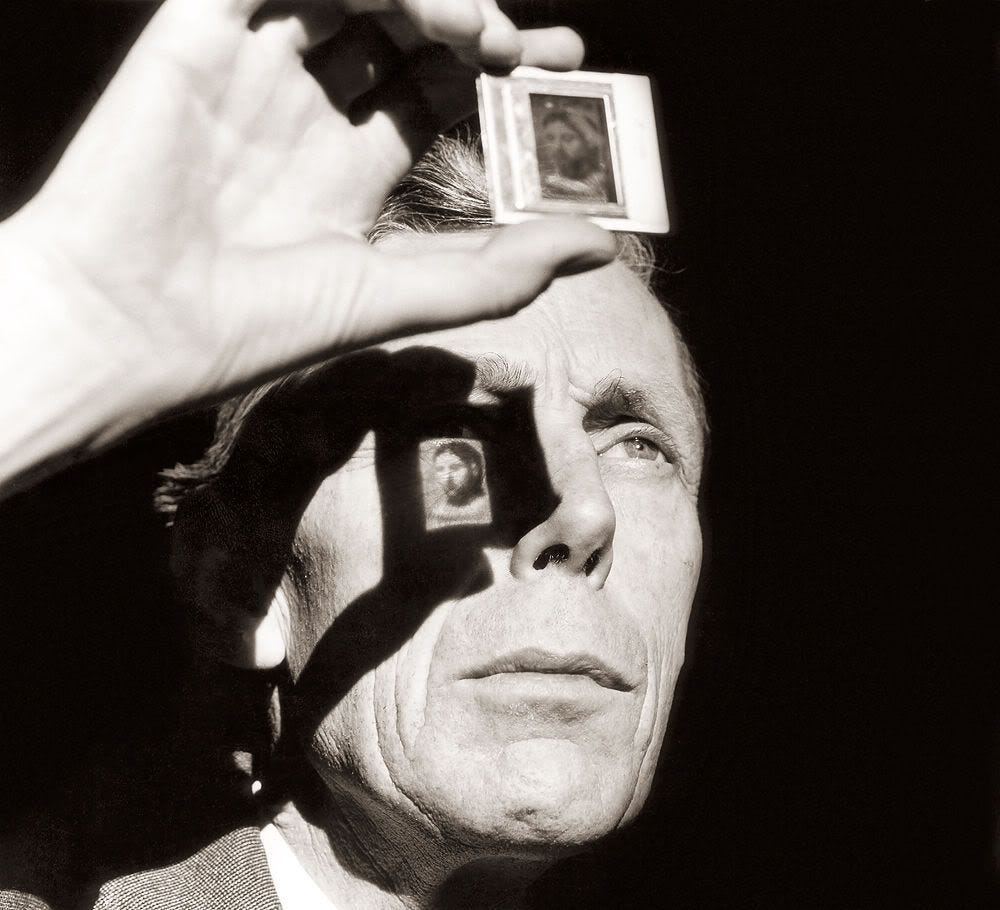
But Barthes is not ultimately interested in what the photograph shows. He is interested in what happens in the encounter, and it is here that he names two modes: studium and punctum.
Studium is the field of the obvious, the already intelligible, the shared. It is how the photograph makes itself available to you as something you can understand. As Barthes writes, “it is by studium that I am interested in so many photographs…I participate in the figures, the faces, the gestures, the settings, the actions.” You recognize what is there, you situate it, you complete it. The image resolves at the level of recognition. This is what he later calls the voice of banality—“to say what everyone sees and knows.”
This voice is what allows the world to cohere, to be communicable, to be navigable at all. But it is also a form of closure, because what is recognized is, in a sense, finished. It no longer demands you. It no longer requires you. We can live a whole life by studium, seeing and knowing the same things everyone can see and know. A life lived entirely within this mode is not devoid of meaning—it is saturated with meanings that resolve entirely too quickly to leave any residue. Everything is seen, but nothing is felt—nothing punctures, nothing pierces—long enough to matter.
And yet, within that same frame—within the same image that is otherwise fully legible—Barthes notices that something occasionally refuses to stay in place. A detail, often marginal, often unintended, does not collapse into the obvious. It catches and lingers and expands beyond its scale. He calls this punctum: “that accident which pricks me (but also bruises me, is poignant to me)….which rises from the scene, shoots out of it like an arrow, and pierces me.” The violence of his language is very much intentional. Because punctum what happens when understanding fails to complete the encounter: “The Photograph is violent: not because it shows violent things, but because on each occasion (i) it fills the sight by force (ii), and because in it nothing can be refused or transformed (that we can sometimes call it mild does not contradict its violence: many say that sugar is mild, but to me sugar is violent, and I call it so).”
Here, Barthes introduces the second voice: the voice of singularity, “to replenish such banality with all the élan of an emotion which belonged only to myself.” The tension between these two voices is life’s condition! You cannot abandon banality—you must still participate and describe what is there and what everyone can see—but neither can you remain within it if you want to account for what actually happens. Because what happens—the thing that marks you, that stands out, that means something to you—is always singular. It cannot be generalized without losing its force. It is not what the photograph is; it is what the photograph does to you.
And this is the paradox: “the punctum is what I add to the photograph and what is nonetheless already there.” Nothing has changed in the image. The same scene, the same objects, the same composition remain. And yet the relation has shifted. Something in the image has escaped its function as something to be understood. It has become inassimilable. It has crossed the distance that allowed you to remain intact as a viewer. The image no longer stays where it is. It enters you. The camera captured a moment, but punctum makes that moment unfinishable.
Like looking at a photo of a family at a picnic. It’s perfectly ordinary—blanket, sandwiches, a mother, a father, two kids. You register several things immediately: Happy family! Egg salad! Green grass! Summer sun! And then your attention fixes on the father’s hand resting awkwardly on the grass to support his leaning away. There’s nothing objectively significant about it. But for some reason it tilts the image and you can’t unsee the hesitation.
Or like being in an Uber where everything about the ride is interchangeable—streets, lights, buildings—but then you notice the driver has taped a tiny photo of a child to the dashboard, slightly faded, corners peeling. Perhaps a longing for your own child or your own parent settles in.
Or maybe simply flipping through old photos and you stop on one of an empty room. In the background, a clock on the wall shows a time you suddenly recognize, tied to something you hadn’t thought about in years.
Singular, specific, meaningful, violent, punctum.
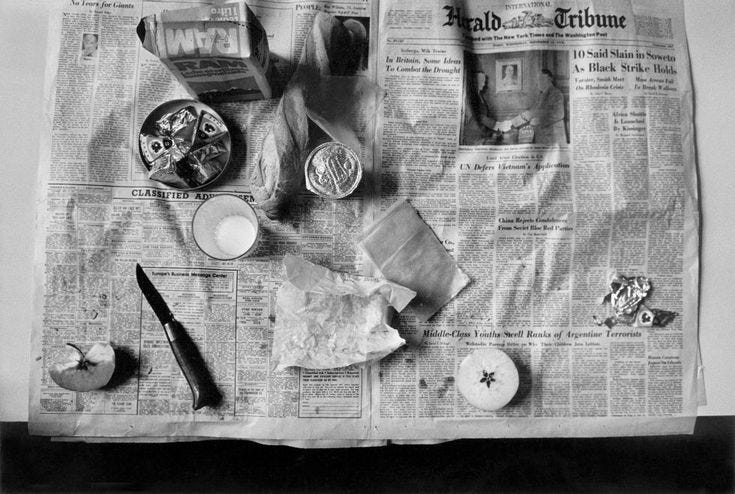
A day can move with a kind of quiet coherence—you answer what needs answering, move from one task to the next, eat when you remember to, scroll when there’s a gap, respond when prompted—and by any reasonable metric, it holds together. There is structure, continuity, even a low hum of accomplishment. If someone asked you what you did, you could tell them.
Life does not feel empty so much as it feels frictionless, as if everything that happens is immediately processed, categorized, and cleared. You are present in the technical sense—you are there, you are doing, you are responding—but the sense of being inside what is happening, of something registering as singular and lived, becomes increasingly rare. Once you notice this distinction, it becomes difficult not to see how much of experience is structured to prevent exactly that kind of registration.
This distinction—between life as something that simply continues and life as something that appears in a particular way—is what Aristotle names in his separation of zoē and bios: zoē as the sheer fact of being alive, the animating continuity shared by all living things; bios as the form a life takes, the way of living that gives it shape, texture, and intelligibility. One names life as process; the other, life as lived.
Comments
Nothing yet. Say the first thing.
Sign in to join the conversation.