
Reading time: 3 minutes
Some of the qualities that make you highly effective become obstacles under pressure.
Willpower is one of them.
The same drive that leads you to persist can also make things worse.
Some time ago, I wrote about why we lose access to rational thinking under stress.
Today, I want to build on that idea and dismantle one of the biggest myths about emotional regulation in high-stakes environments:
That enough willpower can save you.
During our latest live webinar, Neto said that one of the biggest realizations in his way to becoming a consistently profitable trader was that willpower was an illusion.
I see this belief all the time in coaching.
We tend to think that if we push hard enough, we can turn the situation around — end the trading day green, fix the conversation, finish the work, regain control.
But most of the time, that willpower is the thing that gets you in a deep hole.
A great and common example of this is the trader who comes into the chart fresh & ready to trade. He starts with a loss, then another loss, and all of a sudden finds himself using willpower to find another trade and at least get back to breakeven.
The same drive that got him to the charts early, prepared, and disciplined is now making him override every signal telling him to stop.
There is a point during emotional activation where willpower stops being effective.
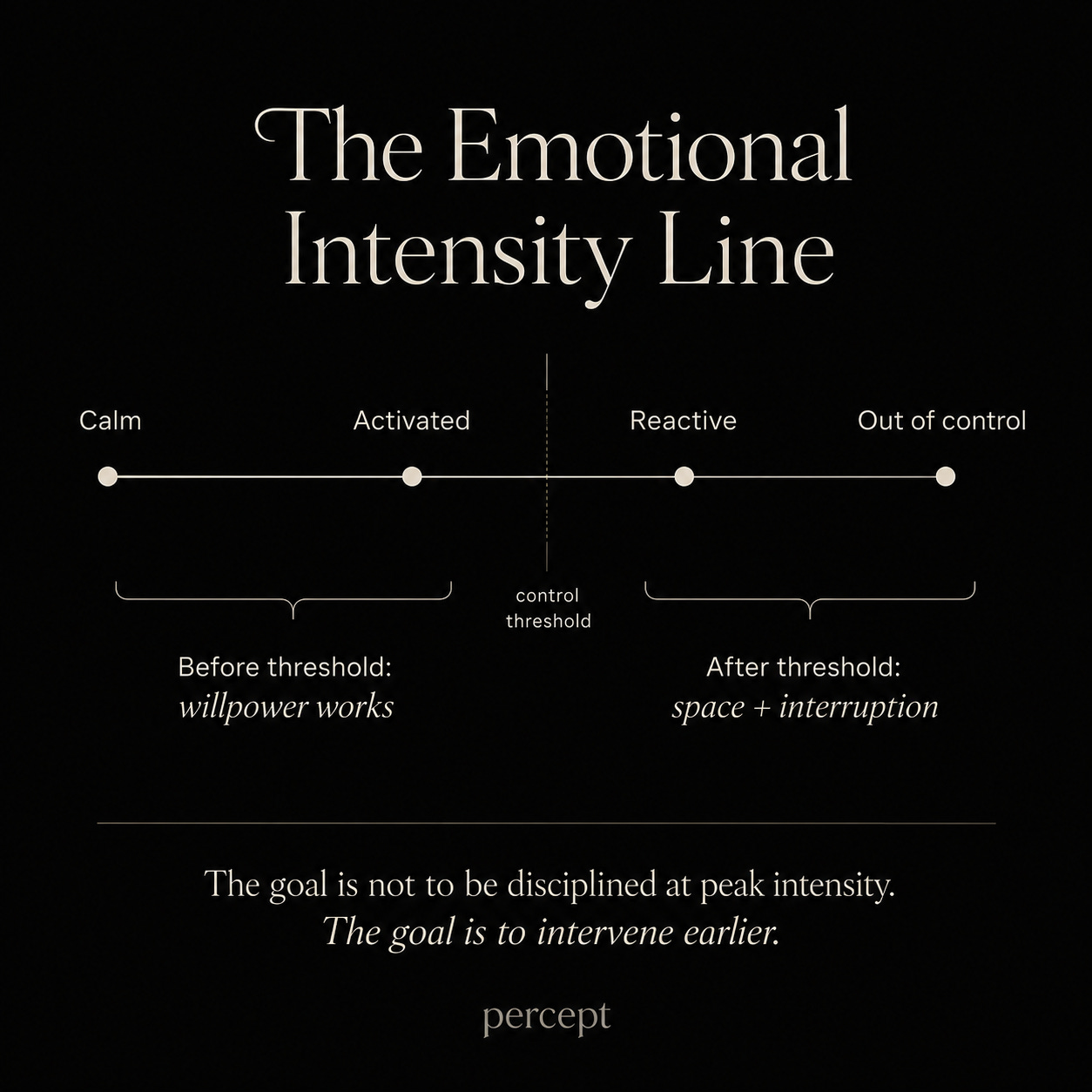
Before that threshold, you can still notice what is happening, question your thinking, and redirect your behavior. After you cross it, your ability to see alternatives drops. You become more attached to immediate relief than to rationality.
At that point, space + interruption are the answer, not more willpower.
This is not about being or not being capable. It’s about biology that you can’t escape from.
Accepting the inevitability of our own humanness is crucial.
Questra Advisors LLC put it brilliantly in the comment sections of Sunday’s post. I asked him what helped him create space between trigger and reaction. He said:
Accepting that we’ll never overcome our bias towards action. Accepting our numerous biological deficits creates purpose to develop awareness, which is what the pause behaviorally supports.
It’s much easier to “blame biology” than ego (...) Instead of assuming we’re better than most; assume instead that we’re not. This makes it easier to reframe avoidance of stupidity as a win (and helps keeps the ego at bay).
We are wired to avoid losses, defend the ego, seek relief, act under uncertainty, and underestimate how differently we will think once emotionally activated.
Accepting those biological deficits is a form of self-accountability that opens doors to better self-awareness.
You know that after two losses, you become more willing to force a trade.
You know that when you feel criticized, you start listening only to defend yourself.
You know that when you are exhausted, short-term relief becomes more attractive than the promises you made when you were clear-headed.
Once you see it in real time, you can interrupt the urge and take a different route. The one you rationally want.
The goal is not to prove that you can remain disciplined at peak emotional intensity. It is to protect your standards.
Sometimes discipline is pushing through. Other times, it’s stepping back & knowing when to practice restraint.
Real discipline means knowing which response the moment actually requires.
Love,
Sara
If you loved this post, you’ll likely enjoy these too which are related topics:
TradeZella 20% off code: sara
Comments
Nothing yet. Say the first thing.
Sign in to join the conversation.