
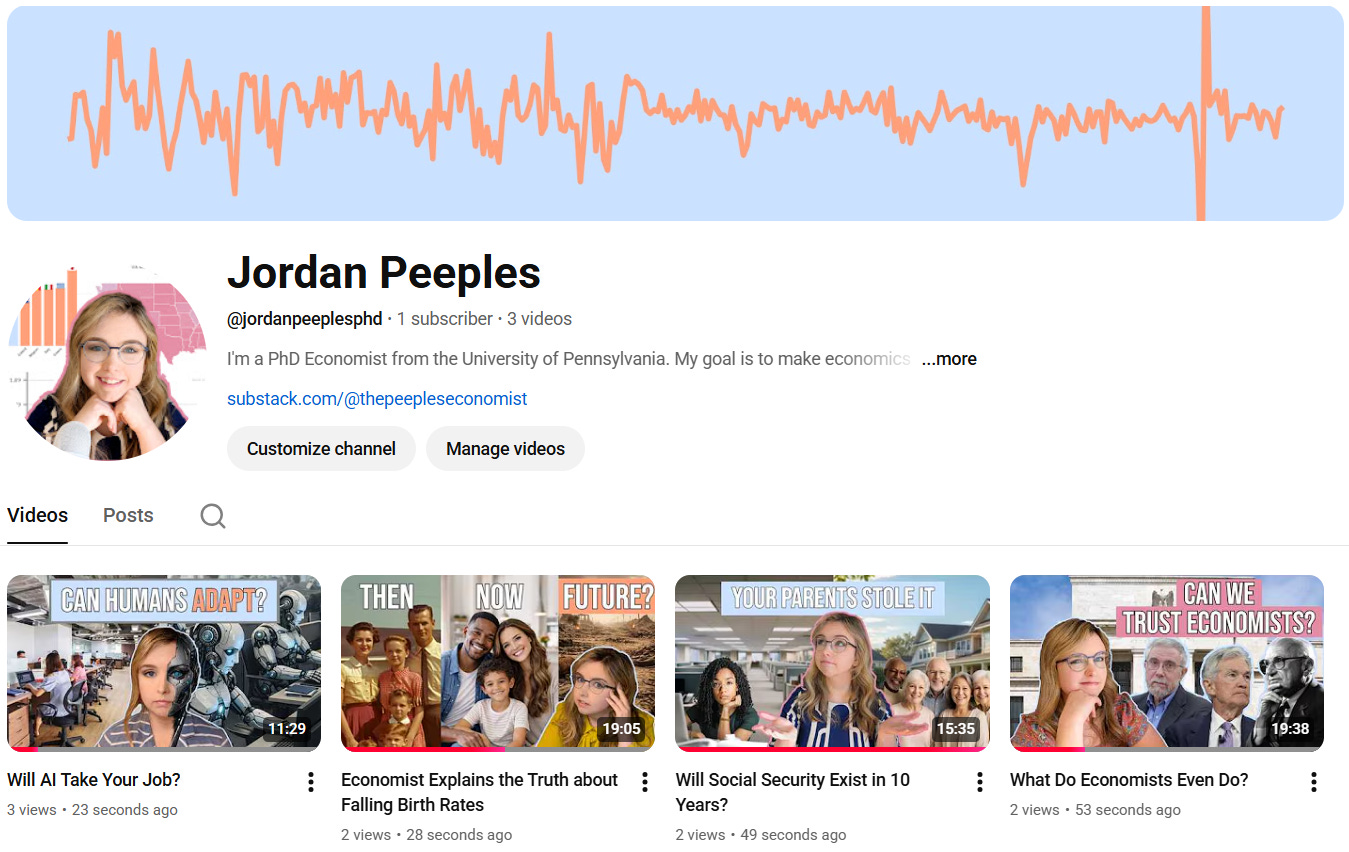
I have been working on a big project over the past 5 months, which has taken over a substantial amount of my free time. Introducing: my Youtube channel.
After spending four years working on research in graduate school and continuing that work even now, I often found myself wondering, “Who is actually going to read this paper?” I presented my work at conferences and shared it with other economics researchers, but I couldn’t help but question whether it would meaningfully influence policy discussions or reach anyone outside academia. I enjoyed the research, and I still feel fulfilled refining these papers for publication — but then what? What comes next? Unlike work in the physical sciences, the real world applications of my research were not always immediately obvious.
I grew up in the middle-of-nowhere, rural Georgia. I attended the same school system from Kindergarten until graduation. There was only one school system in the county, so I knew almost all 200 of my peers at graduation. When I was a junior in high school, I took AP macroeconomics; AP courses are college-style courses offered in high school. That’s all it took for me to pursue a lifetime of studying economics. It was the only class I never had to study for, yet consistently earned top exam scores — largely because I enjoyed the material so much that every lesson stuck with me. A wonderful teacher made that possible as well.
Until then, I had never even heard of an economist. In that class, I learned about Milton Friedman. I was inspired by his famous speech on how a pencil was created — every single detail that went into a pencil was some feat of the free market optimizing logistics to give us the power to own a pencil. At the same time, Janet Yellen was serving as Chair of the Federal Reserve. I didn’t really understand what economists like these two influential figures actually did. I just knew that I wanted to become one.
Two years prior to taking that course, when I was only 14, I had an experience that was unlike most kids my age: my older brother — only 19 — passed away in a car accident. My childhood had already been a complicated one, but this was the worst tragedy I have experienced to this day. It completely changed my perspective on life and what I wanted from it. The day after he passed, I vowed I would make a difference in the world, and I have held onto that in his memory. So I make sure my days are spent living fully and working on the things that genuinely excite me.
Soon after this happened, I wrote a list of ways I thought I could change the world. One item on that list was starting a YouTube channel. Had I actually put more focus into that item, I would have been way ahead of my time. However, it never truly left my working list over the past 15 years. The idea of providing knowledge or information to someone who may have never seen it otherwise is inspiring.
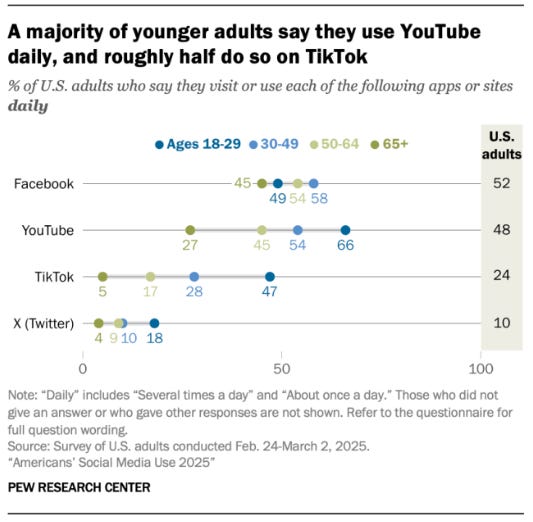
Moving forward to today: YouTube is a platform I check every day. It’s a platform approximately half of the U.S. visits every day. It’s potentially the most popular platform. And I think the information provided by some Youtubers is incredibly useful and entertaining. I watch Hank Green, Good Work, Veritasium, Mark Rober, A Show about the News, and other cooking channels like Epicurious. There are also a few other economists here on Substack who have YouTube channels, like Decode Econ and The Econ Nerds. In general, I gain a lot of knowledge watching these videos. And I’m not alone in watching these channels. Many of these channels reach millions of subscribers, delivering real value through education at massive scale.
When I started working on my channel a few months ago, I had minimal experience with video editing. The only time I had ever edited was in Windows Movie Maker in middle school. So, these videos are a learning experience to me. I have already made quite a few mistakes: talking too fast in most areas (a weakness I will forever be working on), talking too slowly in a few areas, a couple of bad editing cuts here and there, and audio… audio is my biggest enemy. But the messages and information the videos convey are still there.
Each video will be similar to what I do here on Substack; I will answer a broad, popular question using economics research. I plan to dig a little deeper in most of these videos, and I plan to continuously improve with each posted video. I realize growth, both in my editing abilities and viewership, will come very slowly, but if my passion for this subject can at least inspire one other person to have the same passion while informing a few others, I will call that a success.
If you are also on Youtube and reading this, I am happy to collaborate on future videos, and, who knows… maybe I will begin interviewing authors of the papers I will be including. I have a big vision for this channel. I’m also happy to receive criticism!
What does this mean for posting on Substack? Once I have posted a couple more YouTube videos over the next couple of months, I plan to post on Substack whenever possible, especially for people who don’t care for YouTube. I have a list of endless questions I still want to answer and write on. It will be a careful balance of making videos, making Substack posts, doing well at my full time job, continuing research, and spending time with family. But I still plan to post when possible.
Anyway, I hope you enjoy these videos. I hope you learn something from them or are inspired by them in some way. My inspiration always came from listening to my teachers and economists talk about the world and research, not just reading their papers or textbooks. But their papers deserve to be discussed and taught to everyone because these papers have important real life implications.
Also, on a side note: thank you to all the new subscribers over the past couple of months who brought me above 500 total subscribers!
A very simply TL;DR: I started a YouTube channel.
No posts
Comments
Nothing yet. Say the first thing.
Sign in to join the conversation.