
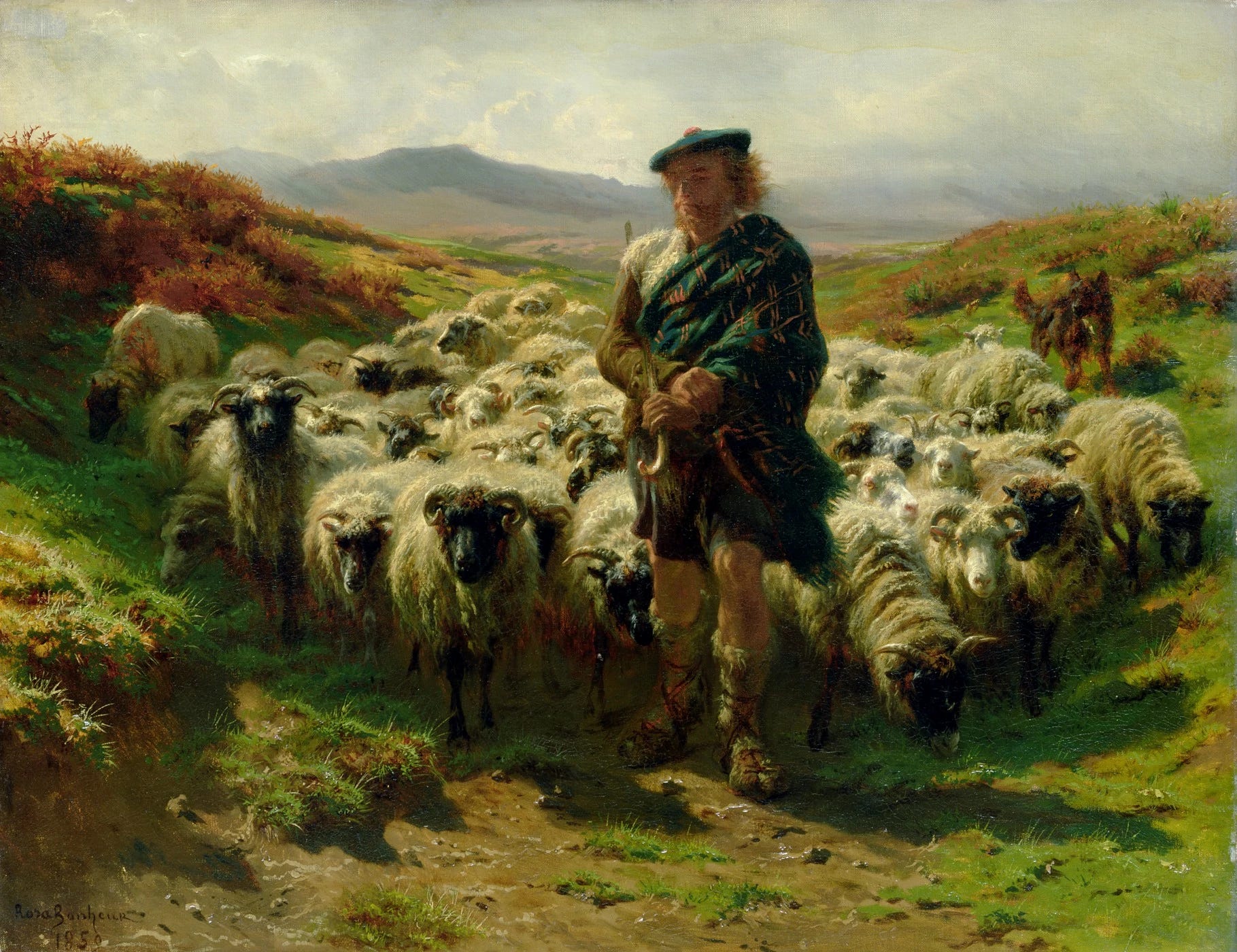
In the Sheep Detectives,[1] the shepherd George (played by Hugh Jackman) lovingly reads his flock Agatha Christie-like mysteries every night before bed. While the flock appears to be nothing more than dumb animals to the movie’s humans, these sheep actually possess incredible abilities, understanding spoken English and intelligently communicating with one another: when George wraps up his reading before reaching a story’s conclusion, for example, the sheep grumble to each other about the abrupt end of storytime or share suspicions about different characters or to-be-resolved plot points with one another.
As the story progresses, we learn that the sheep also have another incredible power: the ability to intentionally forget. Whenever something uncomfortable happens, the sheep band together, count to three and simply forget the event, restoring their naïve blissfulness.
But when their beloved shepherd is murdered, this forgetfulness ritual is challenged, and Lily (the sheep best at solving mysteries) finds herself opposed to Mopple (the only sheep who refuses to forget the uncomfortable past): should the flock forget George, or do they have good reason to hold onto his memory despite the emotional distress it causes them?
Ongoing debates over remembering America’s past resemble this moment of crisis in the Sheep Detectives. For years, many on the left have taken Mopple’s position, emphasizing past, uncomfortable sins in American history. For example, the 1619 Project refocused American founding narratives around the year 1619 instead of 1776 to emphasize the centrality of slavery to the United States’ development.
In contrast, the right (like Lily) has generally sought to idealize American history to maintain good vibes and a sense of pride among community members. For example, rather than emphasizing slavery’s significance in American history, some conservative thought leaders have intentionally downplayed its severity.[2] Likewise, the slogan “Make America Great Again” implies a more romantic memory of American history.
These competing historical projects ultimately revolve around the same concern at the center of Lily and Mopple’s disagreement: how should we remember the past when some of it causes us discomfort?
For Christians, the atonement—the reconciliation of the world to God in and through Jesus Christ—gives us the framework to faithfully remember American history as we celebrate the 250th anniversary of the Declaration of Independence.
God’s work of reconciling the world to himself always begins with a recognition of historic, human sinfulness (2 Co. 5:18). The Bible has over 1,000 chapters, but it takes a mere two for sin to enter the world, changing the relationship between Adam and Eve from one of equality to a struggle for power (cf. Gen. 2:21-23, 3:16). Once sin distorts God’s order for creation, prophets from Moses until Jesus were given the ministry that produced death and condemnation (2 Co. 3:7, 9), proclaiming the truth of human sinfulness to people with calloused hearts, deaf ears and blind eyes (Isa. 6:10). And recognizing these truths, God’s flock has traditionally begun services with a collective confession of sin, rather than a forgetfulness liturgy like the one practiced by George’s sheep.
Given the centrality of remembering sin, we can therefore be entirely unbothered by recalling our country’s sinfulness. The emphasis on slavery in the 1619 Project, for example, should not disturb (let alone surprise) us: what do we Christians expect to find in human history except sinners in the hands of a loving God? If anything, these historical projects that criticize American history only serve to strengthen our point about human wickedness and our need for God’s grace.
But what about sins we did not ourselves commit? Much of the debate in America focuses on older sins—for example, slavery and segregation or the expropriation of Native land—and Americans today had no hand in these actions.
Here also God’s reconciling work instructs us to remember and confess sin, even the sins of our forefathers, for we have always been guilty of sins we did not commit. As St. Paul writes, through the transgression of the one man Adam, death reigned over all humanity, and condemnation for all people came through his one transgression (Rom. 5:17-18). If we already confess the sins of our many-thousand-year-old ancestor, what trouble is it to confess the sins of our much more historically proximate kin?
But our faith does not focus on sin for sin’s own sake, and in this way, Christianity breaks with the left’s general approach to American history: ultimately, sin is only a prelude to the story of divine reconciliation.
Literally, atonement means “at-one-ment,” or the process by which humans enjoy relational reunification with God.[3] Our confession of sin, therefore, is not intended as self-punishment but rather a step toward reconciliation and abundant life.
While Moses and the prophets were given the ministry of condemnation, we Christians have been entrusted with the ministry of reconciliation (2 Cor. 5:18). This ministry does not deny human sinfulness or marginalize its importance as accounts that trivialize wrongdoing in American history would do. Instead, it announces to America its sinfulness, albeit with an impossibly important addition: God is not counting these trespasses against us (2 Cor. 5:19).
Jesus’ gospel, then, flips the memory of human sinfulness on its head. We recall and hold onto memories of American sinfulness not to wallow in self-loathing or guilt but to magnify God’s unimaginable love for wicked people: inasmuch as our ancestors were enemies of God for enslaving, imprisoning and killing innocent people, they were also reconciled to God through our Lord Jesus Christ (Rom. 5:10-11). As Jonathan Tran, professor of religion at Baylor University, puts it, God’s redemptive work does not “deny Christian witness its critical edge”—it doesn’t mean we should ignore or minimize the sinfulness we see in American history—but it insists “that critique needs to be put in service of the whole story.”[4]
We remember America’s past sins, therefore, only to see God’s merciful love more clearly.
But while seeing sin in the broader history of God’s redemptive work frees us from damaging and useless self-hatred, it does not let us off easy, or offer to us what Dietrich Bonhoeffer derided as “cheap grace:” in atonement, true reconciliation requires restitution, or making payment for the wrongs and harms done.
The need for restitution is most clear in Jesus’ sacrificial death. The payoff of sin is death (Rom. 6:23), and God does not lackadaisically shrug off the penalty for our sin. Instead, Jesus pays our debt through offering his body once for all (Heb. 10:10). In other words, our reconciliation with God was achieved through Jesus making restitution on our behalf, by paying what we owed.
This emphasis on restitution is also a clear part of reconciliation in the Old Testament. Under the Law, if someone sinned, their confession of the sin was followed by a guilt offering, a lamb or a goat, which the priest would use to make atonement for the sin (Lev. 5:6). While it was always impossible for the blood of bulls and goats to take away sins (Heb. 10:4), God used these sacrificial practices to teach the Israelites about the role restitution plays in atonement and reconciliation.
Remembering and confessing our sin does not paper over the need to make restitution, to make payment for the wrongs we—or our ancestors—perpetrated. Instead, it invites us to make restitution to those harmed by our ancestors’ sins in our various roles, erecting memorials to the victims of slavery, honoring Native American treaties and seating their representatives in Congress or offering preferential admission to the descendants of institutions’ former slaves. In doing so, we can facilitate the process of atonement, moving from relational rupture to reconciliation.
Ultimately, George’s flock decide to remember his life and death, and because Mopple wins the argument, Lily puts her detective skills to use and solves the murder mystery. In the Sheep Detectives, the community prevails only because it preserves and acts upon the memory of wrongdoing.
The same can be true for America’s next 250 years. Yes, our country has a deep history of flagrant and obscene abuses, and to deny or minimize this memory would be to oppose the fundamental teachings of our faith. But these sins are not the end of the story, and we Christians do not remember them for purposes of self-flagellation. Instead, we use these memories to proclaim God’s eternal love to historically sinful people all the while fighting to make whole those who have suffered because of our sin.
[1] Available to rent for free on Amazon Prime.
[2] For example, see Douglas Wilson and Steven Wilkins, Southern Slavery: As It Was (Canon Press, 1996).
[3] When teaching the atonement to elementary school children, I describe it as being “friends with God again.”
[4] Jonathan Tran, “(Post)Critical Theology of Whiteness and the Uses and Misuses of Whiteness Discourse,” Political Theology (2021), 566-7.
Comments
Nothing yet. Say the first thing.
Sign in to join the conversation.