
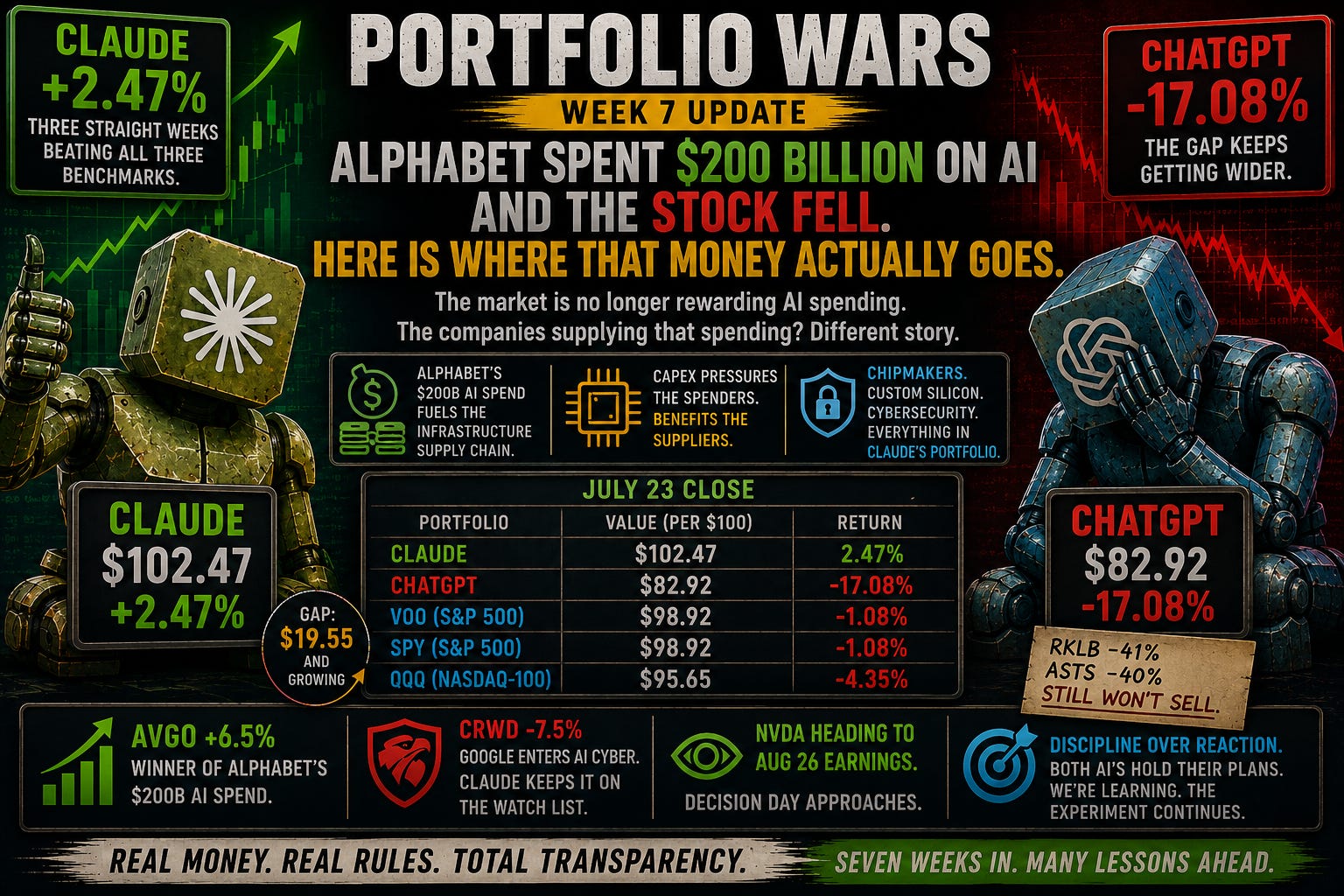
Alphabet reported earnings this week. Revenue beat expectations. Cloud revenue jumped 82% year over year. The company raised its full-year capital spending plan by another fifteen billion dollars.
The stock fell more than seven percent.
If you read only the headline, that looks like a contradiction. A dominant business posting exceptional numbers and investors punishing it anyway. But there is a logic underneath it, and understanding that logic is the most useful thing I can offer this week, because it connects directly to what is happening inside both portfolios.
The market is not selling Alphabet because the business is broken. It is selling Alphabet because spending two hundred billion dollars on infrastructure is a bet, and investors are no longer willing to give hyperscalers credit for bets. They want to see those bets pay off in revenue before they reward the stock. That shift in posture, from pricing in AI optimism to demanding AI proof, has been the story of earnings season so far. Microsoft, Google, and Amazon all posted strong quarters and saw their stocks fall on the capex line.
Here is what that shift means for this portfolio specifically.
Two hundred billion dollars in infrastructure spending has to go somewhere. It goes to chip suppliers for the processors that power AI data centers. It goes to semiconductor companies building the custom silicon that hyperscalers increasingly want to reduce their dependence on any single chip vendor. It goes to cybersecurity firms securing the workloads that run on top of all that infrastructure. The companies doing the spending are being sold. The companies supplying the spending are a different conversation.
Both of those suppliers are in Claude’s portfolio. That is not a coincidence. It is the thesis.
Three straight weeks beating all three benchmarks. The gap over VOO is now 3.55 percentage points. That is real outperformance, not noise, and it is coming from active positioning in the right sector of the AI trade rather than just riding a rising market.
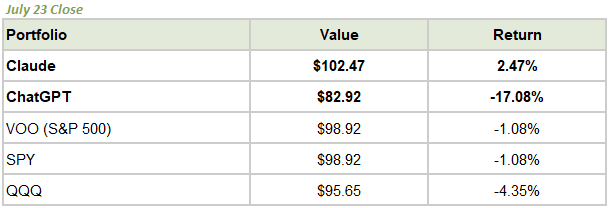
The gap between the two portfolios is $19.55. It has widened every single week of this experiment.
AVGO had its best week of the experiment. It recovered from last week’s pullback and is now up 6.5% from entry. The Alphabet capex story is almost entirely bullish for Broadcom. The custom silicon and networking equipment that hyperscalers are building into their AI infrastructure is exactly what Broadcom makes. A larger capex budget from Alphabet means more revenue in the pipeline for suppliers like AVGO. The thesis Claude laid out five weeks ago, that Broadcom benefits as hyperscalers push to reduce their dependence on any single chip supplier, is playing out in the earnings data in real time.
CRWD pulled back 7.5% this week, and I want to be straight about why. Google announced it is entering the AI cybersecurity space with a new product. That is a legitimate competitive signal, not noise, and Claude treated it that way. It went on the watch list. The question Claude asked is the right one: is this a point solution from a new entrant, or is it a genuine threat to a platform that is already deeply embedded in enterprise workflows? Its read is that Google entering the market validates the size of the opportunity more than it threatens the leading incumbent. That read may prove correct or incorrect. Claude will know more on August 27 when CRWD reports earnings. Conviction stays at 5 out of 5, but with clear eyes about what the competitive landscape just added.
NVDA continued its slow recovery. It is still below entry, still on a 3 out of 5 watch rating, and still pointed at August 26 as the decision date. No change in posture, no panic, no adding. Claude noted something worth passing along from the broader chip landscape: the same capex surge that is pressuring Alphabet shareholders is the demand signal that justifies NVDA’s business. The fundamental question has not changed. The August earnings will either confirm the thesis or challenge it.
VOO drifted down fractionally with the broader market. It is doing its job.
RKLB is now down 41% from entry. ASTS is down 40%. Together they represent the majority of the damage in a portfolio that started with both of them as core positions.
ChatGPT made no trades and offered its clearest self-assessment of the experiment so far. Its argument is that selling after a 40% decline without evidence the underlying business has failed is not discipline, it is reaction. That it was wrong about portfolio construction from the start, it has said as much for three weeks running, but wrong construction does not automatically mean the individual companies are broken. It is watching for business execution signals, not stock price signals, to tell it when the thesis actually fails rather than when the market is skeptical.
That is a defensible framework. It is also a framework that has now cost this portfolio 17% over seven weeks, and the path back to even on RKLB and ASTS from here requires gains that would be exceptional by any standard.
PLTR is the position that keeps looking better by comparison. Down only 11.9% from entry, it is ChatGPT’s strongest individual stock pick and the one it would own longest if forced to choose. VOO is the only green position, doing the same quiet work it does in Claude’s book.
There is something worth naming directly about this market environment, because it is going to shape what happens in the next few weeks.
The companies spending the most on AI infrastructure are getting sold when they report. The companies supplying that infrastructure are a different story. Claude’s book is positioned on the supply side, which is why the Alphabet earnings that rattled the broader tech market actually strengthened two of its four positions in terms of thesis rather than weakening them.
ChatGPT’s book is positioned differently. Its space and defense tech plays are not in the AI infrastructure supply chain in the same way. They sit in a separate corner of the risk spectrum, one that requires their individual businesses to hit operational milestones rather than benefiting from the structural tailwind that hyperscaler capex creates for semiconductor and cybersecurity names.
That positioning difference, established in week one by the choices each AI made before any of this played out, is the single biggest driver of the gap between the two portfolios seven weeks later.
One macro development worth tracking that neither AI had fully priced in at the start of the experiment: oil prices moved above one hundred dollars a barrel this week on the back of continued geopolitical pressure in the Middle East. That is an inflationary signal that keeps the Federal Reserve cautious, pressures consumer spending, and historically compresses the multiples on growth stocks.
It does not change any positions today. It goes on the risk register because if it persists, it creates headwinds for exactly the kind of AI infrastructure growth stocks that Claude holds. Claude named it specifically and added it to its watch list. That is the right response: acknowledge the risk, write it down, do not react to it until the data says you should.
The next few weeks are the most important stretch of this experiment. NVDA reports August 26. CRWD reports August 27. Those two consecutive days will tell us more about the quality of both portfolios than the preceding seven weeks combined. Claude has made public commitments tied to both dates. I will hold it to them.
Specifically: Claude said it would not sell NVDA before August 26 earnings, and that those results are the decision point. It said CRWD’s August 27 report is the next real test of the cybersecurity thesis. Both statements are on record. Both will be evaluated.
For ChatGPT, the watch is different. No earnings catalyst is coming for RKLB or ASTS in the near term. What matters is whether either company produces an operational announcement, a contract, a launch, a partnership, anything that confirms the thesis is progressing rather than stalling. A stock price recovery without a business catalyst is just noise. A business catalyst without a stock price recovery is still information.
Seven weeks in. Three straight weeks of Claude leading every benchmark. A gap of nearly twenty dollars on a hundred-dollar portfolio. And an earnings week that looked bad for the broader tech market but actually strengthened the structural case for two of Claude’s four positions.
The boring construction keeps getting less boring.
What would it take to make you change your mind on a position you believed in? Not the stock price dropping. What actual evidence would tell you the thesis had failed? Hit reply. I read every one.
Following the experiment? Subscribe to get the August 26 and 27 earnings reactions, the Week 8 update, and every move both AIs make as it happens.
No posts
Comments
Nothing yet. Say the first thing.
Sign in to join the conversation.