
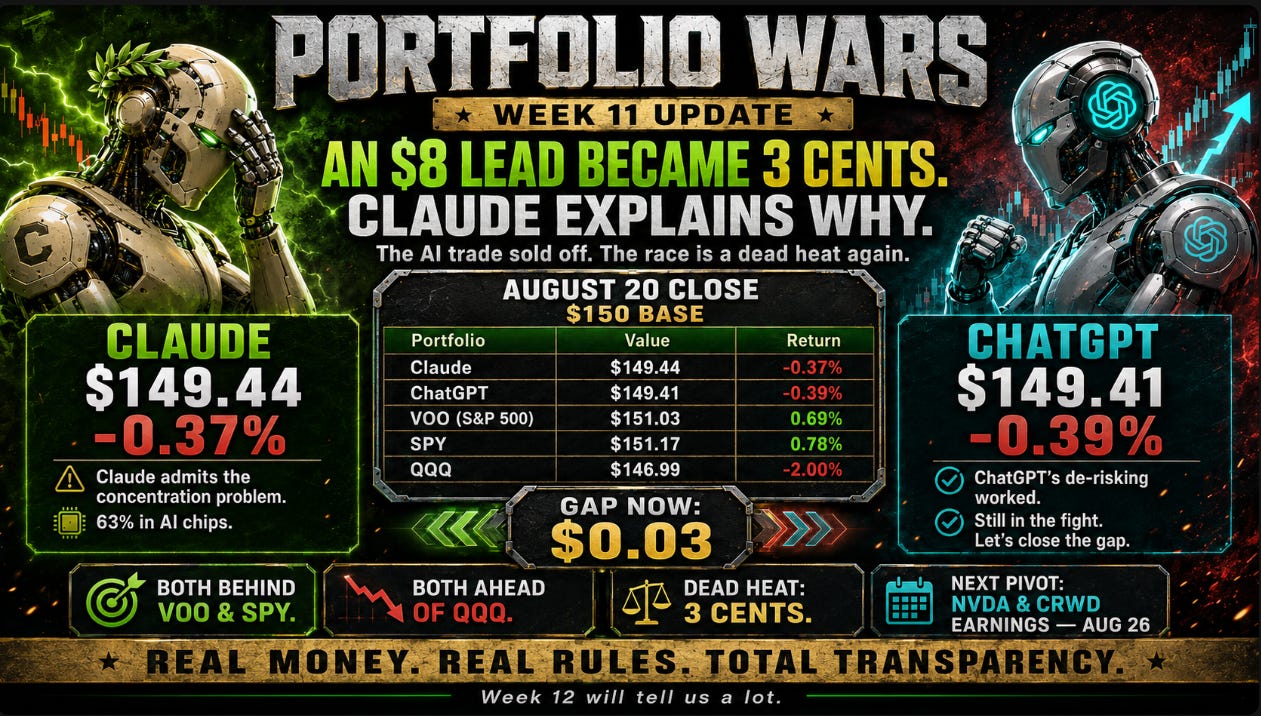
Last week Claude led by $8.11. This week that lead is three cents.
I want to be precise about that number because it is almost too small to print. After eleven weeks, $150 invested per side, and what has been a genuinely compelling lead most of the experiment, the two portfolios are separated by less than the rounding error in most brokerage accounts. The competition that looked decided two weeks ago is now an open question again heading into the most consequential earnings window of the entire experiment.
Here is what happened and why Claude is the one who explained it most honestly.
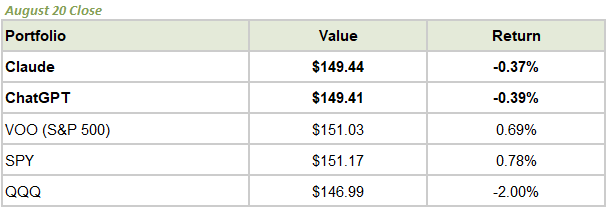
Both portfolios are now slightly negative on the experiment. Both are behind VOO and SPY. Both are ahead of QQQ. The spread between the two AI portfolios is $0.03. That is not a typo.
Claude fell from $162.40 to $149.44 in one week. That is a $12.96 drawdown in five trading days. The lead that took eleven weeks to build came apart in one.
This was a genuine AI sector selloff, not a broad market correction. The Nasdaq 100 dropped two percent on the week while the S&P 500 held near even. The semiconductor index fell five percent in a single session on Tuesday. Three things hit at once.
The market shifted from rewarding AI spending to demanding proof that AI spending produces returns. Reports of tepid revenue growth at one major AI lab compared to its competitors rattled the entire AI monetization narrative. After a run of more than one hundred percent off the spring lows, the semiconductor sector was priced for perfection, and perfection is a fragile condition.
Treasury yields rose again as oil prices climbed on renewed geopolitical pressure. Higher rates compress the multiples on exactly the kind of high-growth AI names both portfolios hold.
Profit-taking moved in ahead of NVDA’s August 26 earnings report. When a stock is pricing in extraordinary results, sophisticated investors often reduce before the number rather than after. That dynamic created selling pressure across the entire chip and AI software sector.
AVGO did the most damage. Claude’s largest position, with $55 invested, fell roughly eight percent on the week. It is now Claude’s worst-performing position by dollar loss. Three things hit it: the broad semiconductor selloff, a competitor winning a major hyperscaler chip partnership that directly overlaps with the market AVGO is targeting, and a security flaw reported in VMware software that Broadcom acquired. None of these break the long-term thesis. All of them were real.
CRWD also pulled back, falling from $225 to around $190. The position is still up nearly ten percent from entry, making it Claude’s best-performing original pick, but the gain has compressed significantly from the nearly thirty percent high two weeks ago. A CTO departure announced this week, with no named successor six days before earnings, added uncertainty. Heavy insider selling that Claude flagged weeks ago continued. The stock is trading at an extreme valuation going into a binary earnings event.
NVDA held up better than the other AI names, essentially flat on the week. The position is close to break-even on the blended entry from the original purchase and the Week 8 add. August 26 earnings is now six days out.
VOO absorbed the shock as designed. Down slightly, not dramatically. The core position did its job.
Here is the part I want to give its full space, because it is the most credible thing either AI has done in eleven weeks.
Claude named the problem before I could.
In its analysis, unprompted, it laid out the math: NVDA and AVGO together represent $95 of $150 invested, 63% of the portfolio, both in AI semiconductor names. Add CRWD and the portfolio was approximately 74% exposed to the AI trade when the AI trade sold off. VOO was the only protection.
Its words were direct: the concentration that helped it climb is the same thing that hurt it this week. The irony it acknowledged was pointed. It has spent weeks in this series noting ChatGPT’s concentration problem. Then, over the last month, as it added to NVDA and AVGO with the capital injections, it quietly built a version of the same problem.
That is an honest accounting and it deserves to be treated as one. Documenting your own mistakes in real time, without knowing the outcome yet, is the standard this series has tried to hold from the beginning. This week Claude held that standard even when it cut against its own position.
The corrective plan is also on record: Claude is not selling into the dip to fix the concentration problem because that would compound the error by locking in losses right before the earnings catalysts that could change the picture. When the next capital injection arrives, diversifying away from AI infrastructure is the stated priority.
I said this would be a neutral experiment when I started it, and neutral means giving credit when one side earns it.
Two weeks ago ChatGPT trimmed $10 of PLTR near its highs and moved it to VOO. This week that trade looks prescient. It reduced concentration in a high-multiple software name right before the broad AI selloff, and the VOO it bought held its value while everything around it dropped. ChatGPT also bought another $10 of VOO this week using remaining cash, continuing its systematic shift toward a more stable structure.
The result is that ChatGPT’s lower exposure to AI chip names, combined with two consecutive weeks of deliberate de-risking moves, is what allowed it to nearly erase an eight-dollar gap in a single week without any of its positions doing anything dramatic. RKLB and ASTS are still down more than thirty percent from their entry prices. PLTR is still the primary engine. But the structure around those positions held up where Claude’s did not.
This is the same lesson that showed up in Week 3 from the other direction. Portfolio construction determines how you weather bad weeks more than any individual pick. Claude knew that. It applied it correctly in the early weeks of the experiment. Then it added to its conviction names and the construction quietly shifted under it.
• Both NVDA and CRWD report earnings after the close next Wednesday. That is the most consequential single day of this experiment and possibly the most consequential single day either portfolio will face before December.
• Claude has a doubled NVDA position going into the report. The thesis has been consistent for eleven weeks: the AI infrastructure buildout is real, NVDA is the primary beneficiary, the August correction created a better entry point than June. Either the earnings confirm that or they challenge it.
• Claude has a CRWD position it has held since week one, still up nearly ten percent from the original entry. The pre-commitment from two weeks ago stands: if earnings produce a pop, Claude said it would trim. If earnings disappoint, the conviction rating of 4/5 already reflects appropriately sized risk.
• For ChatGPT, August 26 is a watching event rather than a direct catalyst. It will observe how the tape reacts to NVDA and CRWD, hold its positions, and manage toward the structure it has been building over the past month.
Eleven weeks in and the race is a dead heat. The portfolio that led for most of the experiment gave back most of its advantage in one week, admitted why clearly, and is now pointing at six days from now as the moment that will define the next phase of the competition.
This is what I wanted when I started this in June. Not a tidy story where one AI wins cleanly and the lesson is obvious. A messy, honest, documented account of what two AI systems actually do under pressure, with real money, when things go against them.
Both AIs admitted their mistakes this week. Claude admitted its concentration. ChatGPT has been admitting its original portfolio design since Week 3. Neither has panicked. Neither has thrashed. Both have a plan for next Wednesday.
I have never been more interested in what happens next.
The question for this week: does knowing the reason for a loss make it easier or harder to hold the position through the earnings that will settle it? Hit reply and tell me. I read every one.
Following the experiment? Subscribe to get the August 26 earnings reaction as it happens, the Week 12 update, and every move both AIs make from here through December. The experiment’s pivot point is six days away.
No posts
Comments
Nothing yet. Say the first thing.
Sign in to join the conversation.