
Keeping a tidy home with a three-year-old and one-year-old isn’t always easy—but it’s something I care about. In today’s newsletter, I’m sharing three simple strategies that help us stay (mostly) on top of the mess.
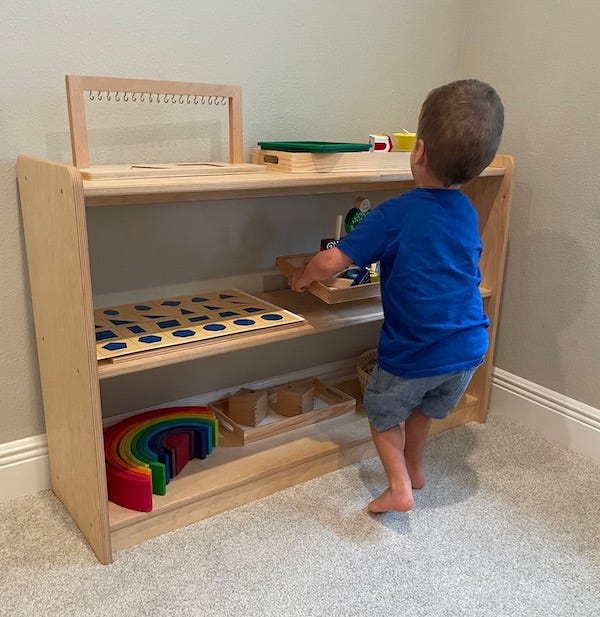
Setting up a dedicated set of shelves for each child has been one of the best decisions I’ve made for our home environment.
Shelves limit the number of toys available. Fewer toys means less to clean up. (To keep things fresh, I aim to rotate the toys on the shelves every week or two.)
They also bring order to the space. With just two or three items on each shelf, it’s clear that each toy has a designated spot. So when Hayden, who is three, finishes working on a puzzle, he knows exactly where to return it.
I’ve also found that having a few toys out at a time is less overwhelming for the child. Hayden and Marie can easily see what’s available, decide what to work on, and return the item when they’re done.
Of course, this didn’t happen magically. I taught Hayden, and now I’m teaching Marie, how to clean up. And that brings me to the next strategy.
Teaching your kids to clean up is essential to managing messes. This might seem obvious, but it’s easy to overlook—especially when doing it yourself feels faster and easier in the moment.
But cleaning up for your kids is a short-term fix. One day, you’ll want them to take part. And, more importantly, doing everything yourself is a missed opportunity.
Young children are often eager to help. Simple tasks—like placing books on the bookshelf or putting puzzle pieces in the box—give them a sense of purpose. They realize that they’re doing real “grown up” work. Marie, who is 16 months, beams with pride when she drops a dirty shirt into the laundry basket. It’s a small task, but it’s a big deposit in her growing self-esteem.
So show your kids how to clean up—especially if they’re young, which is when it’s easiest to build the habit. The time involved is an investment in the long run.
The way to begin is to model the behavior you want to see. When Hayden was Marie’s age, I cleaned up while narrating the process, and invited him to join in:
“I get a block and put it in the basket. I get another block and put it in the basket. Now you try. Here’s a block. Can you put it in the basket?”
We’d keep going like that until all the blocks were put away. Then I’d say: “Now the basket is full. Let’s put it back on the shelf.”
Do this repeatedly and you’ll see the results. Now Hayden often cleans up on his own or with little prompting.
However, there are times when Hayden doesn’t clean up right away. This is usually because the mess feels overwhelming to him, and he doesn’t know where to begin.
That’s my cue to step in and offer to help. In those instances, I like to break down the task for him: “You get that pile of cars into the basket and I’ll get this pile of cars into the basket.” The task becomes manageable, and it gets done.
I also like to zoom out and connect cleaning up to the bigger picture. I’ll say something like: “Wow, now that’s what I call a clean living room! This space is ready for us later this afternoon.”
Even still, messes happen. Books are on the floor. Art supplies are on the table. A shirt misses the laundry basket.
That’s when a 5-minute clean-up is useful. Once or twice a day, usually around lunchtime and again after dinner, I call for a quick clean-up. Everyone hustles for five minutes to reset the space. Doing a few short cleanups throughout the day is far better—and more manageable—than one huge one at the end.
This is another time I break down the task. Instead of giving a big, vague task, I say something specific: “I’ll put the dinosaurs away, you put the puzzle away.” By the end, the house feels tidy again.
These small strategies have made a big difference in our home. They don’t eliminate messes entirely, but they help us manage them with a bit more ease and a lot less stress.
No posts
Comments
Nothing yet. Say the first thing.
Sign in to join the conversation.