
You could very easily waste your twenties and thirties trying to “be the change you want to see in the world” because you don’t understand the waters you are swimming in, or because your expectations for what that change would look like and how to make it happen is based in bad theory from a bygone century. That’s why this piece matters and I hope it saves people some time, if not now, then in the future, once we figure out a better way—and have overcome the paradigm currently dominant in change-making spaces.
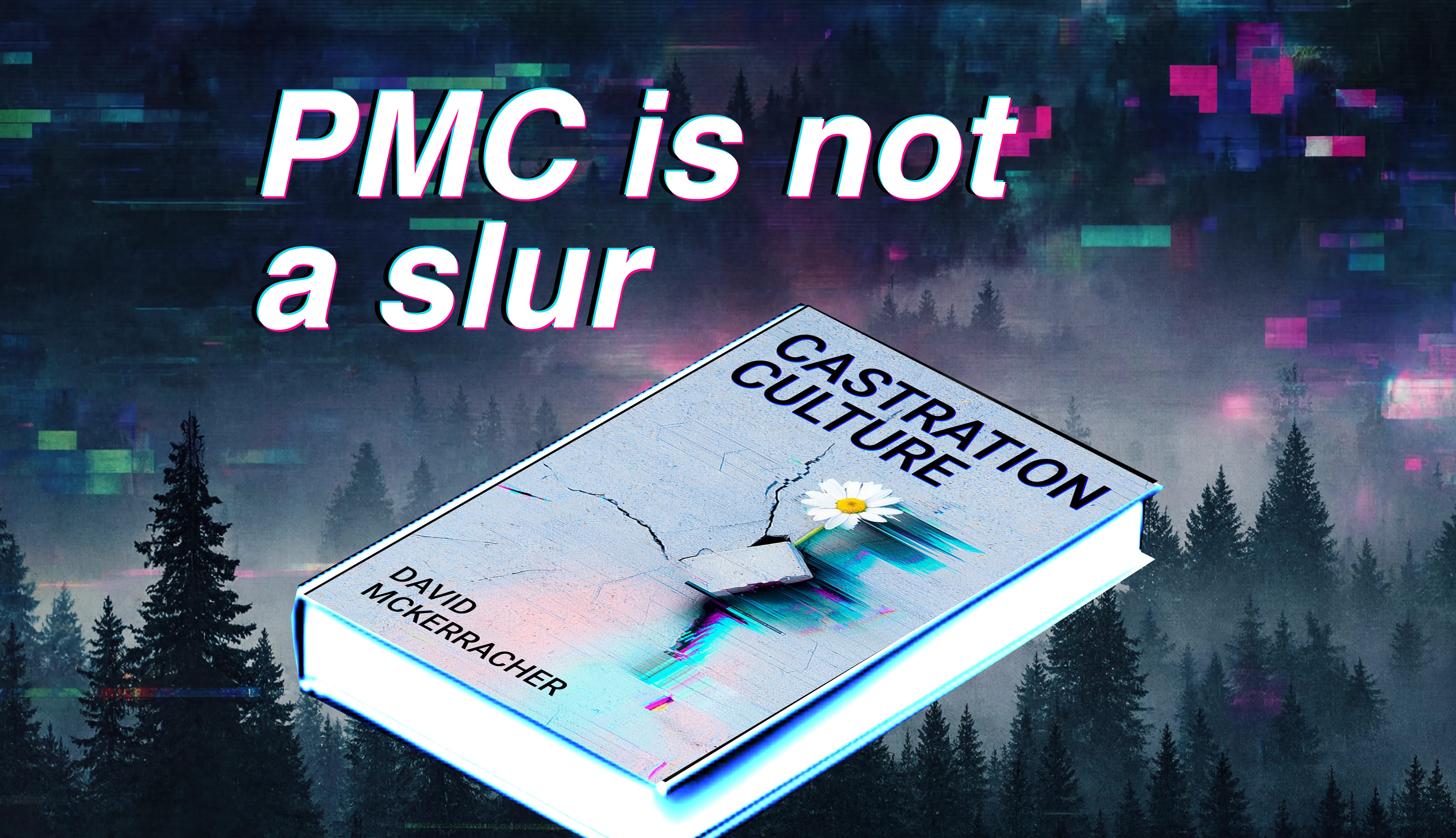
This is a part of the Castration Culture series. If you’re new here, that’s ok because each piece stands on its own. If you want, you can read the others here: The Natality Pill, Castration Culture, The Breakup Liturgy, and Relationships Aren’t Colonized Enough, Actually.
“PMC” has, for some people, become a slur. Because of this, there are those who presume that I use it in that way. They are mistaken. I have never been anti-PMC. The term is only considered so spicy because of the way others use it, and such uses are generally employed without any real knowledge of why it matters in the first place.
What I do hate is the rebel priest class (RPC) which you can read about in the sequel to this piece.
Why I Hate the Rebel Priest Class
·
Jul 28

This is part of the Castration Culture series. Part 1: The Natality Pill. Part 2: Castration Culture. Part 3: Why I Am Not Anti-PMC. The latter explained the class formation. This one is about its worst outgrowth.
The PMC, on the other hand, is simply a big reason old organizing theory and practice has become null and void.
“PMC” stands for “Professional Managerial Class.” This term helps us understand what became of modernity when its phase characterized by industrialization entered a new phase characterized by an anti-regular working class managerialism that institutionalized nearly every aspect of human life.
My decade spent studying in and organizing as a part of the “Left” opened my eyes to many things, chief among these being the existence and relevance of the PMC.
If you care about large-scale structural change that would free up energy and time for families, communities, and culture, then you need to understand how the existence of the PMC changed things forever when it comes to basic organizing for working class power. All of the weird stuff activists get into, the weird ways they talk, the super polarizing, exclusive, and niche issues they “center,” all of this is a feature of the PMC, not a bug. People who either went to college or who wanted to all sounding like therapeutic H.R. legal teams is merely the tip of this much greater iceberg.
My idea of class used to be the same old basic “there are those who own everything and then the rest of us, more or less the 99% who own nothing but our labor power that we sell to capitalists if we don’t want to be homeless.” The PMC thesis complicated that for me and, slowly but surely, changed how I view everything. I have to add that the change it had on me was true despite the fact that its popular employment by podcasts like Red Scare or What’s Left (Aimee back in the day, not the new one) is counter-productive and confusing.
In an attempt to make clear the difference between a theoretically rigorous and principled employment of the term, I launched a public and free lecture series taught by myself and Elton L.K. on January 11th of 2023.
The title of that course was PMC Consciousness & Ideology.1 None of the people who should have watched it did so, but a lot of people who were averse to using the term (including many of the writers and speakers associated with Sublation Media, Platypus Affiliated Society, and Compact) have since accepted “PMC” into their lexicons — while at the same time tending to miss the point.
Those who adopt the term frequently misuse and abuse it by lumping “PMC” together with the term “petty bourgeoisie.” This only compounds the confusion, because the petty bourgeoisie signifies a totally different, though often overlapping, class formation.
The petty bourgeoisie is made up of small businessmen, who either were wage-earners who saved up enough to then start a business or, in many cases, are indebted to banks or larger investors. Small businesses matter (in fact, they are one of the few remaining good things left in America), but they are not in the same position within the relations of production as credentialed professionals.
Such college-educated specialists work for massive institutions. They are the products of both state and corporate funding to research and develop technology and functionaries that are then used to make corporate or state power more competitive.
The small business (or ppetty bourgeois) interests rarely align with big corporate interests, but thanks to the Republican party for the last forty years, both the American left and right assume that those interests do, in fact, match up. PMC intellectuals who lump the PMC together with the petty bourgeoisie may as well be saying that my dad, who used his saved wages to start his own one-man appliance repair service operation, is in the same class as a tenured professor at Yale, an investment banker at Goldman Sachs, or a lobbyist for the U.S. Chamber of Commerce.
Of course, the PMC is a broad grouping that includes a lot of middle and lower-middle class people who will never see the inside of such elite institutions. It includes nurses and teachers.2 This is beside the point.
Where people go wrong with the PMC discourse is in making it about privilege and identity, basically a workerist identity politics. What actually matters is 1. what the change in class composition did to undermine older theories of social change, and 2. habitus formation, i.e. the cultivation of assumptions, attitudes, and a certain way of projecting oneself forward upon an institutionally captured horizon of possibilities.
In the latter sense, what I am getting at is that the mode-of-life unique to the PMC functions as a serious blockage to understanding or being understandable by the working class. This is why most issues “centered” by the PMC feel removed, or even opposed to, the concerns of regular working people.
Suffice it to say that there’s been a lot of confusion by people who assume they understand how I use the term “PMC.” It does not help that many second generation political theory educators who were against its usage have since adopted it. In doing so, they only confuse things more.
People hear Catherine Liu go off on the PMC in her polemic Virtue Hoarders or related podcast appearances, such as her repeat appearances on Joshua Citarella’s Doomscroll, and then they assume that we agree and are, in some way, cut from the same cloth.3 Not only are we cut from very different (class) cloth, but we also do not agree on either the diagnosis, solution, or strategies for achieving social change. Liu is a renegade PMC doing important work in an attempt to speak truth to power and reform the Left of which she considers herself to be a part. I say more power to her, and you should definitely read her — with that said, I am not interested in reforming the Left, nor do I think the PMC term is most meaningful when used as a slur.4
As much as I enjoyed Virtue Hoarders and have gleaned some important insights from Liu, I go a different direction with all of this, one that is more theoretical than polemical while simultaneously being informed by my working class experiences, commitments, and mode-of-life. There’s a kind of anti-PMC spirit that really just hates intellectual things and, with it, theory, and those people are just never going to get it — they probably won’t even make it to the end of this piece. They think they’ve already got everything figured out and that theory is not needed.
People who don’t read me, who are allergic to the usage of “PMC” or who use it in the dumb way will assume that I am “anti-PMC.” This has served as a reminder that I should clarify my position. I can’t expect everyone to have read my piece from 2023 called “Lefter Than Thou” in Underground Theory Volume I.5 I have the choice to either stop using “PMC,” or to correct the misperception. I’m going with the latter.
Let’s take a moment here to lay out what’s really going on with the PMC.
The idea is that in the olden days of early industrial capitalism it seemed likely that the two new classes, the bourgeoisie and the proletariat, were going to replace all of the other classes. Eventually the majority of the peasants, monarchs, aristocrats, the middle class, and the priest class, would get “proletarianized.”
They believed that once basically everybody was de-classed, then class war would become simply a matter of the few wealthy and incompetent factory owners vs. the overwhelming industrial proletarian majority. Then, since the proletariat had its hands on the levers of power and was already so well disciplined, it would go beyond mere trade unionism and, through socialist organizing, force capitalism to birth a communist society, i.e. one wherein no classes exist and everybody who is able to help can get everybody whatever they need to survive and thrive.
In the times of Charles Dickens we can see where Marx and Engels were coming from in their Manifesto of the Communist Party. Putting my biases out on the table: I’m sympathetic when it comes to 18th and 19th century leftism, but here, from the privileged heights of hindsight and the fresh air of the pine forests of North Idaho, I can say that I am significantly less sympathetic when it comes to the 20th Century Left, both Old and New. “Less” does not mean “not at all,” but my 20th Century sympathies are always for tragic figures torn between bad and evil, where “evil” was, much like it has become today, defined more by one’s fundamental disposition, position, and usually a lot of ignorance and bad information (more on that later).
By the time Lenin was trying to force the revolution in Russia to birth a proletariat, it was because he, like Stalin after him, believed that Marx had cracked the secret code of history: the revolution to end all wars must come from an industrial proletariat. Because that revolution wouldn’t come from the “comfortable” proletariat of the more developed world, he concluded (conveniently) that it would only spark from an anti-imperialist under-developed country like Russia. Since Russia lacked a proletariat at the time, the Bolshevik solution was to force one into existence.
Lenin’s attempt to do so required using terror and torture in an attempt to forever destroy long-standing traditions, superstitions, and other more primordial relations tied to family and place. I get that Russia was torn by war and an oppressive regime, which is why I said 20th century figures are always tragic, choosing bad vs. evil. The problem with “necessary evil” was that it created and justified the counter-revolution — which helped birth the final boss of the workers’ movement: the PMC.
To reiterate, the 19th Century idea was of two new classes becoming dominant, the proletarian one being much more well-organized, large, and powerful vs. the bourgeois one becoming smaller and having nothing going for it but its ownership of capital. But working class struggles developed their own contradictions, and the ruling class responded in ways unforeseen by 19th Century revolutionaries.
Chief among these changes was the parallel rise of managerialism with a new political movement called progressivism.
Progressivism was embodied in Theodore Roosevelt and Woodrow Wilson. Though from different parties and bitter rivals, both were aligned on reforms that co-opted radical energy by easing worker grievances (e.g., child labor bans, compensation laws) without yielding to socialist demands like public ownership. This weakened movements like the Socialist Party, whose support waned as those progressive gains came in.
Word on the street is that Roosevelt was more charismatic and interventionist in labor disputes, while Wilson was more repressive and idealistic. But despite their differences, both opposed European revolutions spilling into the U.S., and sought to preserve elite power by fragmenting class unity.
Notably, Woodrow Wilson sent U.S. troops to aid the allies against the Soviets in 1918. Progressives were not sleeping on working class unrest but were, in their entire approach, aiming to appease, co-opt, or crush grassroots organizing. In essence, the indirect collaboration of Roosevelt and Wilson turned reforms into a counter-revolutionary safety valve that forever changed the way the two parties operated.
Managerialism was the other major 20th Century current that. combined with progressivism, came through intellectuals like Frederick Winslow Taylor (Principles of Scientific Management), W.E.B. Du Bois (“Talented Tenth”), and Edward Bernays (Propaganda). I don’t see them as the founders or creators or conspirators, the point is that they were the most successful versions of the emerging tendency. Reading them is reading the self-narration of a class selling itself to power as a final solution to the Worker Question.
Managerialism emerged as a parallel anti-worker strategy, designed to neutralize revolutionary potential by deskilling and displacing the advanced, skilled workers most capable of organizing strikes and leading class struggles.
The height of working class power in the days of industrialization was achieved, in large part, because advanced workers knew how to do everything and had built trust relationships with everyone else in the factory. Advanced workers were a force to be reckoned with. Progressive managerialism replaced them with college kids and left the regular rank and file workers with no real horizon for meaningful competence or advancement. The explicit goal of modern education, as articulated by Woodrow Wilson in 1909:
“We want one class of persons to have a liberal education, and we want another class of persons, a very much larger class, of necessity, in every society, to forego the privileges of a liberal education and fit themselves to perform specific difficult manual tasks.”6
When you think of “professionalization” you should think of Taylorism, i.e. Taylor’s Scientific Management that broke complex jobs into simple, repetitive tasks under strict managerial oversight.7 Taylorism rendered workers interchangeable and reduced their bargaining power, explicitly to curb deliberate slowdowns and union influence.
In the “Talented Tenth” Du Bois proposed the formation of an educated racial elite to lead and uplift the black masses through higher education and professional roles. In practice, this fostered a managerial layer that could co-opt radical demands under the banner of racial uplift. Enlightened leadership got prioritized over mass worker empowerment. The cooperation seen at the end of the previous century was consequently sidelined as the racial divides both parties had used to undermine those movements became the main issue of the century.
Bernays, the “father of public relations,” openly marketed himself as developing a science of propaganda to manipulate public opinion and herd instincts. Propaganda was developed as a science used to, in part, undermine labor movements by framing unions as threats, or engineering consent for corporate interests.
Taylor, Du Bois, and Bernays were not a part of a conspiracy or team, nor were they operating alone; they were early members of the new 20th Century PMC, a class whose role and function was to divest from advanced workers the skills that would be hoarded via formal education. If you read their works, they are not writing to the public, but to their class peers or the bosses of capital like the Rockefellers and Carnegies. They sold themselves to capital as the solution to the labor problem.
Professionalization combined with progressive reforms created a buffer class of managers and leaders that displaced skilled worker-leaders, atomized the proletariat, and integrated potential revolutionaries into the system, ensuring capitalism's stability as class tensions rose.
However, a couple of presidents and some intelligent writers do not a new class formation make. The managerial-progressive nexus is a direct response to the Reconstruction Era populist unrest where black sharecroppers, white miners, and factory workers across the U.S. said “neither left nor right” by rejecting the Republican and Democratic parties. Without that unrest, the presidents and authors of progressive-managerialism would not have received the financial support they did from the billionaires of their time.
This unrest took several forms. The Readjuster Party in Virginia (1879-1885) united black and white workers to challenge debt peonage and elite control. The Farmers' Alliance and Colored Farmers' Alliance in the South and Midwest (1880s-1890s) saw millions of black sharecroppers and white tenant farmers organize against monopolistic railroads and banks. The Knights of Labor put on massive interracial organizing drives, peaking with the 1886 Great Southwest Railroad Strike. The Populist Party's 1892 Omaha Platform fused labor and agrarian radicals in a third-party challenge.
These movements terrified emerging elites by threatening to dissolve racial divides that propped up exploitation, prompting violent suppression (e.g., the 1898 Wilmington Massacre targeting biracial fusion governments) and the strategic pivot to managerialism and progressivism to rechannel dissent into controlled reforms.
My two favorite reading recommendations on this shadow-banned yet absolutely essential moment of American history are in Judith Stein’s “Of Mr. Booker T. Washington and Others: The Political Economy of Racism in the United States”8 and Thomas Frank’s The People, No.9
Carnegie violently crushed unions, most notoriously in the 1892 Homestead Strike. Then he turned around and donated over $350 million (equivalent to billions today) to libraries, universities, and the Carnegie Foundation for the Advancement of Teaching. The "scientific" education and efficiency models he promoted aligned with Taylorism, all of it suited to training a compliant workforce and managerial elite. Through it all, he opposed government intervention and union power.
Carnegie advocated “useful” (practical, vocational) knowledge over broader liberal education, which he saw as potentially harmful by instilling “false ideas” and a “distaste for practical life.” He said, “If you want to make labor what it should be, educate yourself in useful knowledge.”10
The Rockefellers had a huge role to play. John D. Rockefeller Jr. was notorious for the 1914 Ludlow Massacre that killed striking miners and their families. But on the less flashy though even more powerful side, his father had established the Rockefeller Foundation in 1913 with $100 million to start. It funded public health, education (via the General Education Board), and "industrial relations" programs. Those programs pushed company unions and employee representation plans designed to preempt genuine organizing.
When we think of the PMC, we’re not just talking about a “class” or a social group, we are talking about the institutional-matrix that arose in the 20th Century. It was a massive project funded by billions spent by Rockefeller and Carnegie, to get presidents like Roosevelt and Wilson to put their vision for public education into action. The Rockefeller General Education Board put the vision of this progressive managerialist schooling system best:
“In our dreams... people yield themselves with perfect docility to our molding hands. The present educational conventions fade from our minds, and unhampered by tradition we work our own good will upon a grateful and responsive folk. We shall not try to make these people or any of their children into philosophers or men of learning or men of science. We have not to raise up from among them authors, educators, poets or men of letters. We shall not search for embryo great artists, painters, musicians, nor lawyers, doctors, preachers, politicians, statesmen, of whom we have ample supply. The task we set before ourselves is very simple... we will organize children... and teach them to do in a perfect way the things their fathers and mothers are doing in an imperfect way, in the homes, in the shops, and on the farm.”11
This vision for public education is what birthed modern schooling as we know it. The model where children are not truly taught to think within the fields of the liberal arts, but are instead measured on how well they can sit still, pay attention, memorize, and regurgitate, is something that goes back to the progressive-managerial strategy to undermine working class agency.
The changes in the schooling system that have made it less disciplinary and hierarchical are not better and are, in some ways, worse — but whether your schooling was the more authoritarian or permissive version, it ultimately boils down to socialization into a particular kind of meritocracy that separates the deserving from the undeserving on the basis of, basically, how well one attends meetings. In this sense the term “professional” has more to do with showing up, paying attention, and playing along than it does with the actual kinds of competence demanded by almost any practical or theoretical endeavor.
Universal education was always a working class demand. What are we to make of the fact that this “demand” was met by some of the greatest enemies to the working class?
First of all, we have to accept the fact that they won. The existence of a distinct new mediator class between the regular workers and the owners of capital is the story of the 20th Century. Mission accomplished.
Taking the PMC-pill means giving up on old Marxist or Leninist solutions of self-organizing proletarian masses or small cadres of professional revolutionaries somehow harnessing the power of the state to lead to a higher stage. This does not mean giving up on any or all large-scale structural change, it just means that we are foolish to act as though the 20th Century did not happen.
Some kind of new political formulation or strategy for taming the forces of both capital and the state might be possible, but any experiments in that direction will only prove a waste of time if the intellectuals, theorists, influencers, organizers, and leaders continuously fail to get the memo that the times have changed.
This means having a sober assessment of why mass movements and cadres are destined to fail. The advanced workers are gone and have been replaced by college-educated specialists presumed to know what must be done. They don’t, and even if they did, they wouldn’t know how to communicate it without alienating everyone.
There is a mode that is cooked up within PMC activist spaces that I think is self-defeating and harmful, but there is nothing wrong with belonging to the “Professional Managerial Class.”
PMC critique can indeed turn into a really superficial form of identity politics, but at its best it helps activists remember their position in the relations of production, the responsibility that comes with that, and more importantly, the differences between their common sense and the people they supposedly represent.
If the previous piece in this series, “Castration Culture,” showed what happens when this class formation is applied to motherhood and family life, this piece has tried to show where that class formation came from and why it exists. The de-skilling of advanced workers and the de-skilling of mothers are not two separate stories. They are the same institutional logic applied to different domains, bankrolled by the same foundations, built by the same class of professionals, and oriented toward the same outcome: a population dependent on credentialed expertise for things it used to know how to do for itself.
Though I am not “anti-PMC,” I most certainly find it aggravating when would-be PMCs act as though the PMC changed nothing and continue to get their marching orders from a bygone era (18th Century radical literature, for instance). It also sucks to see working class people internalize the PMC’s representational obsessions and self-congratulatory social change theories.
The PMC reproduces itself culturally through schooling and the medium. It functions as a kind of secular priesthood, except that where the old priesthood initiated people into an intergenerational community, this one tends to initiate people out of one. How that happened, and why almost every bohemian cultural vanguard of youth over the course of the last seventy years of counter-culture since the Beats has functioned as anti-family shock troops of capital, is the subject of the next piece in this series.
Thanks for reading.
This piece is a part of the Castration Culture series. Other parts you can go read: The Natality Pill, Castration Culture, The Breakup Liturgy, and Relationships Aren’t Colonized Enough, Actually. NOW AVAILABLE: Why I hate the Rebel Priest Class. I will also be back with a piece that goes beyond the PMC and the Rebel Priest Class by showing how these are mere pieces of a more fundamental puzzle that I’ve theorized as the “PCFM” (post-class fractured mass) — but that’s later this year. Just make sure to subscribe if you don’t want to miss all this.
Course at Theory Underground taught by David McKerracher and Elton L.K.: PMC Consciousness & Ideology, January 2023.
This was highlighted by Barbara and John Ehrenreich in their seminal piece on The Professional Managerial Class (1977, Radical America).
In Virtue Hoarders: The Case against the Professional Managerial Class, Catherine Liu critiques the PMC as a credentialed elite that perpetuates inequality while masquerading as progressive heroes through meritocracy and philanthropy.
This is also why Geoff Shullenberger is correct about how he and his “post-left” Twitter milieu from the early 2020s usage of “PMC” has passed its experiation date. He just doesn’t go far enough with it — they were missing the point all along, it’s not just that it “expired.” Moreover, I think Geoff is wrong about the “post-left” itself, i.e. what it was, what it is, and what it will always be in its inner truth and greatness as a frontier, not a specific line of critique or social formation (reasons touched here). But we’ll come back to that in a different piece.
Underground Theory Volume I (Theory Underground, 2023). “Lefter Than Thou: Enjoyment and Discursive Taylorism” is my autopsy of how “the Left” became its own master signifier. It is also the first place where I presented the concept of “radical responsibility.”
Pt. 1 here:
The "Left" as the Master Signifier
·
August 16, 2024

This is part 3 of one of David McKerracher’s most important piece in Underground Theory. Part 2 is here. More info on him, how to order a physical copy, and ways to support, at the end of this post.
Woodrow Wilson, “The Meaning of a Liberal Education” (1909). Full text at Wikisource.
Frederick Winslow Taylor, The Principles of Scientific Management (New York: Harper and Brothers, 1911).
Judith Stein, “Of Mr. Booker T. Washington and Others: The Political Economy of Racism in the United States,” in Kenneth W. Warren and Adolph Reed, Jr. (eds.), Renewing Black Intellectual History: The Ideological and Material Foundations of African American Thought (2010).
Thomas Frank, The People, No: A Brief History of Anti-Populism (New York: Metropolitan Books, 2020).
Andrew Carnegie, speech to workers in Braddock, Pennsylvania, 1889, quoted in Paul Krause, Battle for Homestead, 1880-1892 (Pittsburgh: University of Pittsburgh Press, 1992).
Frederick T. Gates, Occasional Letter Number One (New York: General Education Board, 1906), as quoted in John Taylor Gatto, The Underground History of American Education (New York: Oxford Village Press, 2000).
No posts
Comments
Nothing yet. Say the first thing.
Sign in to join the conversation.