
Many online subcultures are obsessed with authenticity. “Just be your authentic self” is the most throwaway advice I’ve received amid attempts to find my audience. Mostly because my “authentic self” is dependent on the company I keep. Some people get me at my most vibrant, open, inquisitive, supportive self, while others get a different performance of me. It's still me, but playing a desired part. Is that so bad? Should my ability to perform be read as anything other than a survival mechanism? Deep down, I understand that this obsession with authenticity is rooted in a fear of being duped. We are anchored by a belief that—in interpersonal exchanges—someone is risking just as much because it makes us feel safer, and more willing to be open about our “true” selves. Yet, this insistence on pinning people on social media, for example, as inauthentic seems to be driven by nothing more than ensuring that whatever we deem as the “appropriate” performance of personhood, or however we have decided to categorize the objects of our parasocial fantasies, is maintained.
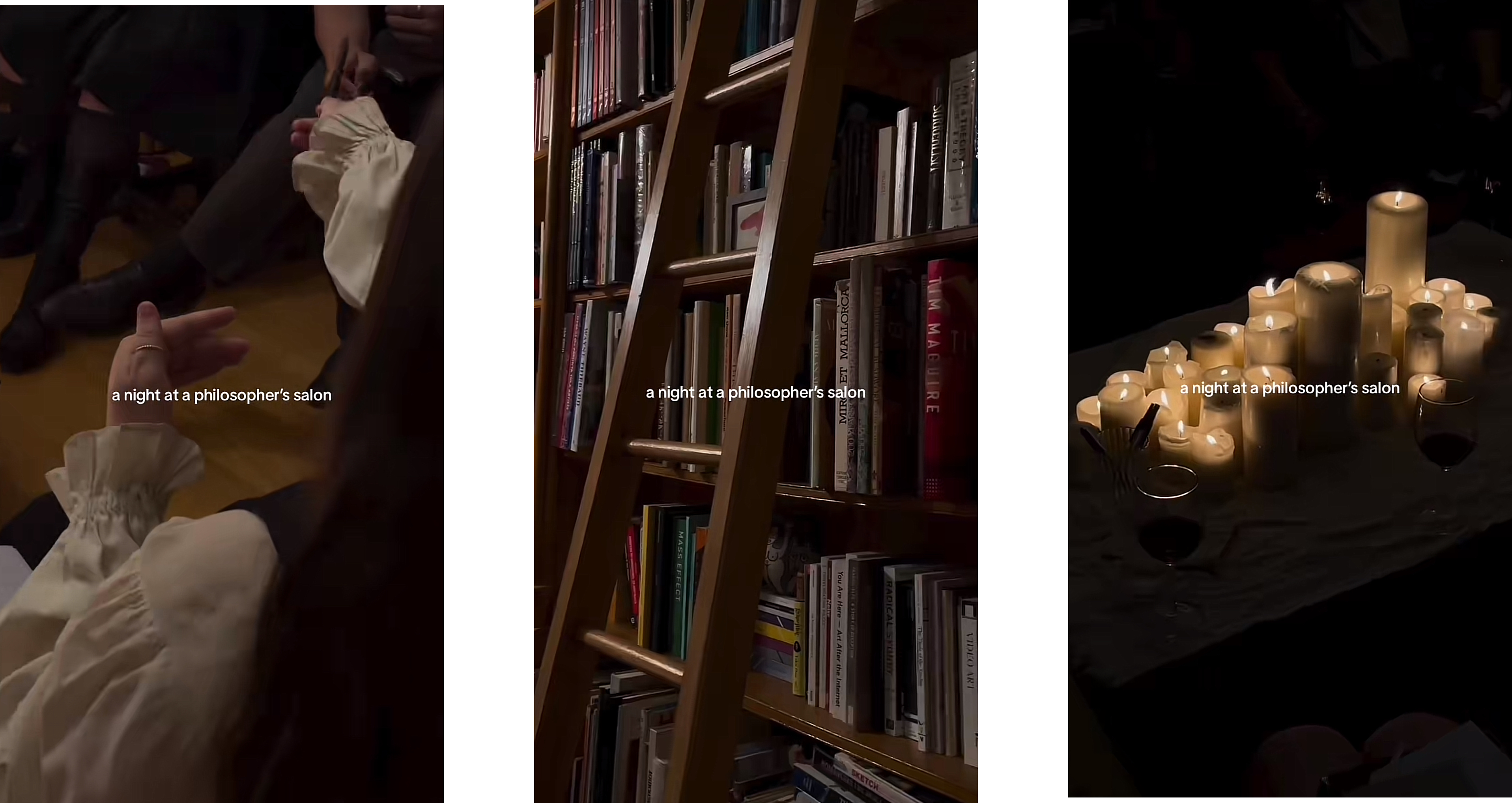
A few months ago, this video of philosophy students in a salon became TikTok’s fixation of the moment. It was beautifully constructed: Italian music playing over romantic clips of hands gesturing, students throwing their heads back with laughter, glasses of wine in hand, bookshelves, and a mountain of candles as the scene’s centerpiece. The overlayed text reads: “A night at a philosopher’s salon.” It did, as many commented, scream dark academia.
Who knew that a video of intellectuals (presumably) indulging in the art of aesthetics would send so many people into conniption? “Dark academia theme circlejerk,” “embodiment of privilege,” “Brian Griffin would go to these,” and “intellectual posturing,” are some of the tamer hateful comments I saw. Admittedly, I giggled at some of these, especially the Brian Griffin one (don’t read into this—or do, I don’t care).
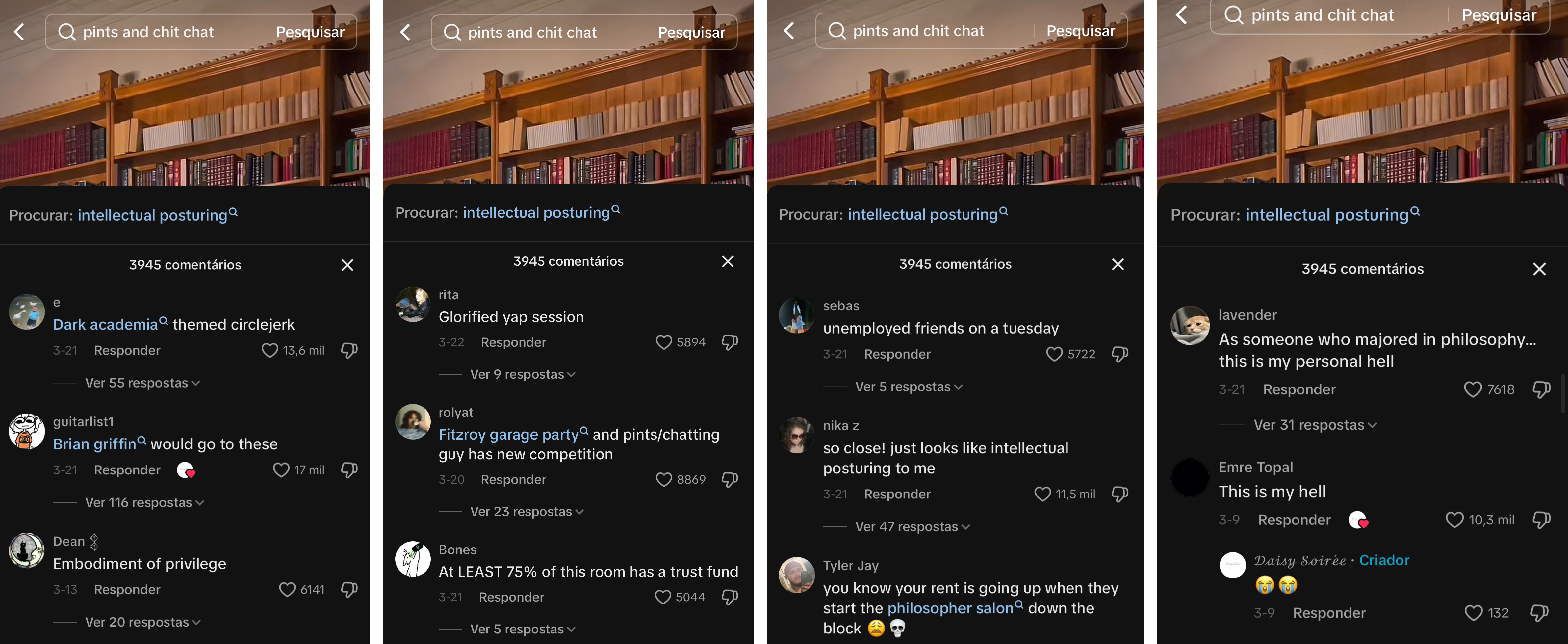
This essay will not discuss the dynamics of privilege at play—I find that too obvious. What grabbed my attention were the repetitive comments about intellectual posturing. Why were so many people concerned with the alleged posturing of these students? Surely their goal was not to intentionally mislead or boast about their ability to participate in such events. Maybe they meant to impress—inspire a sense of FOMO. After all, it was promotional. The hashtags #melbournevents #philosopherssalon #thesecrethistory #darkacademia give that away. As does the profile identifying the hosting party as an events company. But would it be so bad if the students staged such a scene themselves? Does framing yourself in a certain light have to be read as posturing? A show of insincerity? Dare I say—inauthentic?! Or does being an intellectual, a writer, an artist—a creator of public works—require us to indulge in exhibitionism?

First, what is authenticity anyway? We all mean different things when saying it. For example, when people say “be yourself” in job interviews, they don’t mean that. They want you to be a distant, performative, version of you that is a palatable non-threat to the establishment. This feels obvious to many people but proved quite a learning curve for me. Richard Handler explains this type of performance when he argues, in “Authenticity,” that society is the locus of role-playing and insincerity. He leans on the theories of Rousseau and Trilling to explain:
As Rousseau puts it, discussing the emergence of a fully-formed civil society, ‘It now became the interest of men to appear what they really were not.’ And, as Trilling points out, sincerity itself, when practiced because it is a social virtue, recommended to us by the Poloniuses of the world, leads to insincerity: ‘we play the role of being ourselves, we sincerely act the part of the sincere person, with the result that a judgement may be passed upon our sincerity that it is not authentic’(3).1
So when Hobbes states that if a person’s actions are considered his own, then they are a natural person, but if they represent the words and actions of another, then they are considered a feigned or artificial person, how can we tell (1)?2 If we are, as the Handler demonstrates, being made to act the role of a sincere person then we may, at one point, be forced to distance ourselves from our natural behaviors and adopt a performance that is instead believable. For our behaviors to be believable—to be classified as authentic—an audience must be convinced that the performance represents our true selves, which sometimes requires excessive “over-performance” of specific parts of our identity.
(Stick with me, I’m going somewhere with this.)
However, it seems that for Rousseau authenticity is more straightforward. For him, it is “a sentiment of being”, “knowing what you are, and acting in accordance with that knowledge” (822).3 So, it should be enough for us to stake claim over chosen identities and go on performing the required duties. Yet, Jonas Barish acknowledges in “Exhibitionism and the Antitheatrical Prejudice” that “a man who can compose his character without being intimidated by the onlookers or the others in the cast, but without pretending to ignore them either, has accepted the hazard of being human, and asserted his humanity […]” (29).4 I read this to mean that while performing the duties of our chosen identities, we are privy to the opinions of onlookers. The act of becoming—a writer, an intellectual, an artist—then involves a constant conversation between the audience and us as performers.
Judith Butler points to this notion in their theorization of gender as a series of performative acts:
In this sense, gender is in no way a stable identity or locus of agency from which various acts proceede; rather, it is an identity tenuously constituted in time—an identity instituted through a stylized repetition of acts. […] The act that gender is, the act that embodied agents are inasmuch as they dramatically and actively embody and, indeed, wear certain cultural significations, is clearly not one's act alone. Surely, there are nuanced and individual ways of doing one's gender, but that one does it, and that one does it in accord with certain sanctions and proscriptions, is clearly not a fully individual matter. […] When this conception of social performance is applied to gender, it is clear that although there are individual bodies that enact these significations by becoming stylized into gendered modes, this "action" is immediately public as well. (519, 525, 526)5
In explaining how the performance of gender necessitates constant engagement between a performer, the gendered body, and an audience, society, Butler perfectly describes the nature of chosen identities as well. Chosen identity, like gender, is part of both an individual and social/cultural meaning-making process.6 It may be enough for me to write in a vacuum—essays I never share with anyone, short stories that build dust in my documents folder—and still call myself a writer, but it would be naive to think an audience will receive me that way.7 “Oh, have you been published anywhere I would know?” is always the dreaded question. But isn’t receiving acknowledgment in our chosen practice necessary on the road to becoming? I like you watching me write because it affirms my identity as a writer—as an intellectual. It’s an act of becoming—of being. As Butler states, there are nuanced and individual ways of performing such identities—for example, an essayist and a novelist are both still writers. However, to be recognized as such they both have to engage in the stylized repetition of acts that mark their identities—abide by certain codes, sanctions, and proscriptions. Part of this practice involves a dialogue with the world about how we choose to present ourselves, which requires performance. And when a budding chosen identity is short of output, we must guarantee onlookers that we are indeed the “real deal,” by performing in other ways. By joining peers in Salon, for example, discussing the subject matter we aim to be recognized for.
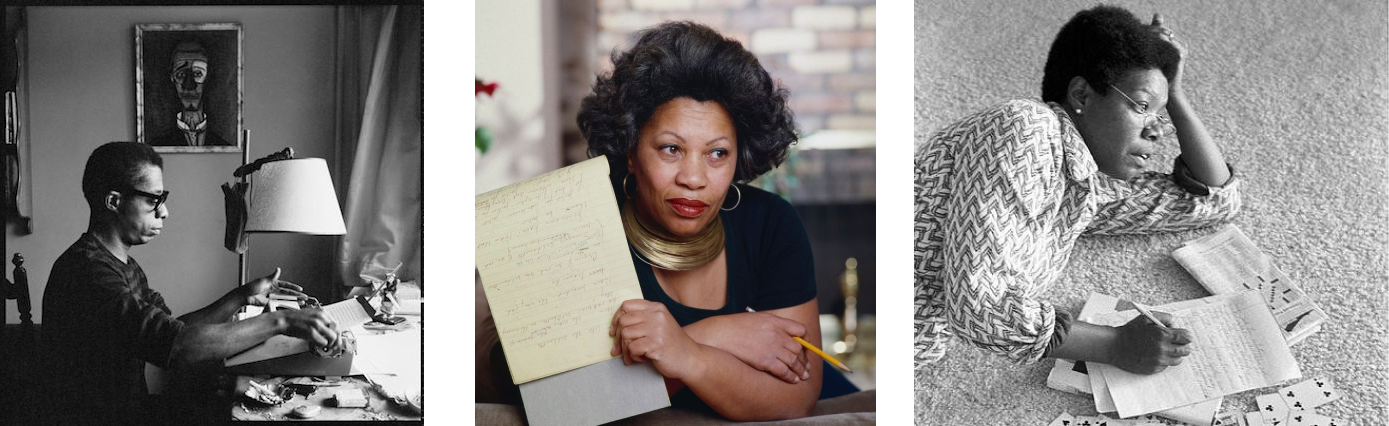
In the process of becoming, before onlookers have confidence in the quality of our output, how is a stranger to build faith in our work if not through watching us in the performance of being? Before we are published writers, we fill up journals, start blogs, give writing advice, send out tweets, or provide close friends with an “inside scoop” into our process, all to affirm that we are indeed writers. This may not seem like a performance to us, but for many—I would argue society as a whole—one is not a writer until you’ve been published by a source they deem reputable. To them, we are becoming. Before they say you are, they demand proof that you’re more than a hobbyist who happens to write—they demand a performance of sincerity out of us. Why do you think we have so many cyclical conversations about what constitutes a “real” writer on Substack? Why do publishers gravitate toward writers with an existing readership? For many reasons; one being wanting proof that we have performed the role of writer enough—convinced enough people of our chosen identity—to be worthy of an opportunity to wear the title without question. Yet, when we are clocked for “over-performing”, as Trilling points out, we are classified as frauds and accused of posturing. What of the budding philosopher, then? Beyond the confines of their classroom, how are they to build confidence with onlookers if not through these displays of becoming, of indulging in an intellectual lifestyle?
For many, though, it’s not the act of being there, in Salon, that constituted this intellectual posturing. The act of recording and publishing the video for a greater audience is what irked them. To them, recording the event transformed it from a permissible tendency toward wanting to be acknowledged to pure exhibitionism—and not in a fun way (I guess). In the very first page of “Exhibitionism and the Antitheatrical Prejudice,” Barish acknowledges this societal bias against those who lean into self-display:
And our language contains various expressions of disapproval for those who too grossly misplay themselves. Terms like ‘showing off,’ ‘playing to the gallery,’ ‘upstaging,’ ‘making a scene,’ ‘making a spectacle of oneself,’ all refer to an insistence on being at the center of attention.
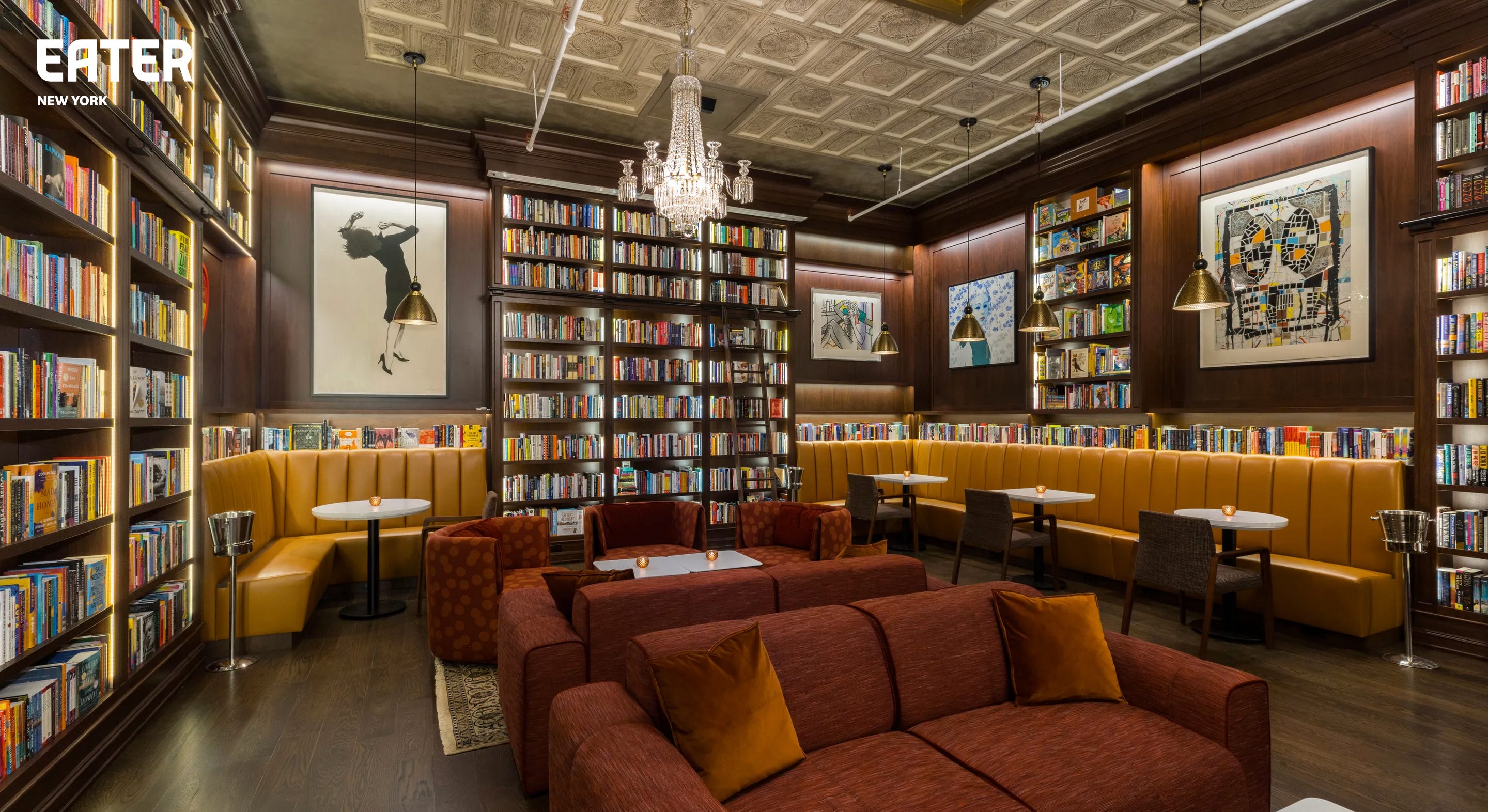
This is where I inserted myself into the conversation. In my initial response, I commented how the act of recording such an event could be interpreted in the same way as the reading bars that are popping up in New York City. No one really knows if the people visiting and recording themselves in those spaces are actually reading. Even while there, no one really knows whether you are reading or just pretending, all to signal belonging. You dare not be compared to those Americans who can’t bring themselves to read even one full book a year! Right? The act of being in that space alone—being witnessed in that space—is enough to access whatever affirmation you may seek from an association with readers, intellectually curious people, who also happen to be social butterflies!
Thank you for reading Theoretical Sirens. If you think anyone else might benefit from these words, please share them 🫶🏾.
In my response, I initially worried that our tendency to self-surveil was pushing us toward the performance of being knowledgeable rather than the pursuit of knowledge itself. But now, I bring even myself to task by asking, yet again, is performance not a stop on the road to becoming? Eventually, there will be enough videos of going to reading bars, and participating in salons before the “pretenders” are weeded out. People will start wanting recommendations from you, they’ll ask what you are learning at these salons—in those instances, opportunities will present themselves for you to “prove” that the performance is indeed who you are.
I look at this intellectual exhibitionism as a gateway of sorts. Perhaps the gateway appears in the middle of our journey when we already regularly behave according to our chosen identity. At times, it may present itself at the beginning, when we have decided that this is something we’d like to do and need to be held accountable to becoming, so we bring an audience with us. Let’s again return to the philosophy student. Among the group were likely people who had been studying philosophy for years and needed an opportunity to showcase themselves as knowledgeable. Equally as likely is the participation of students who were maybe in the middle of their first class, or year, and being part of this public display served as a gateway into considering whether this is how they would like to continue engaging with the subject—whether this is how they want to be seen, the identity they want to embody.
Three years ago, Youtuber CJ The X released this incredible video essay titled Bo Burnham vs. Jeff Bezos. At about 1:23:35 they go into this monologue that I thought was really important for me to transcribe for you:
The sensation of constant performance and having a million eyes on you, that used to be reserved for celebrities, now belongs to everyone at all times—self imposed and arbitrarily disseminated. And I’m not trynna say that performance is bad and you shouldn’t perform. I’m passionate about this because I have a deep reverence for performance. I’m a performer, It’s the thing I’m good at. I want it. I know that that means that my identity and my body and my mind will be commodified and consumed. I know that means that people that I don’t know will form a parasocial relationship with me. I know that means that many of you will want to be my friend—cool, I don’t want to be your friend. I want you to be in awe of me. [….] What I want to do with an audience is give them that shock of authenticity. I want to give the joy of excellence. I want to provide the transcendent high of art. I want to communicate something long-form, intentionally, in a curated fashion designed to affect people and create more beauty in the world.
Which brings me to this: all those who create great work—or are trying to—want acknowledgment. As Julie Levin Russo asserts in “Show Me Yours: Cyber-Exhibitionism from Perversion to Politics”, exhibitionism is a fundamentally relational engagement (133).8 We enact the work of becoming with an audience in mind. We present ourselves on a stage so that we may be applauded—or even jeered at, what we dread the most is silence. Bara Kolenc, in “Voyeurism and Exhibitionism on the Internet”, states that “what triggers desire in the voyeuristic, exhibitionistic interplay is the very discrepancy between what one shows and what the other wishes to see, on the one hand, and between how one wishes to be seen and what the other sees, on the other” (207).9
Whether it is from a peer, or a greater audience, those of us who write, or seek to be perceived as intellectuals, or seek to create for an audience of many, want to be regarded with awe—with deep reverence—so we put ourselves out there in exhibitionist display. As intellectuals—writers, creators, artists, etc—we have this tendency toward exhibitionism because it becomes a part of performing how we wish to be seen, of embodying the aesthetics of being. Without the eyes watching, we may still engage in the practice (after all, it is the process that became our first love), but are we not also affirmed by the gaze of the camera? By those strangers online that may be in awe of us? I think yes. Our tendency toward capturing these moments of performance is therefore not an act of posturing, but rather an attempt to finally have how others see us reflect how we wish to be seen.
So here I am, finally ready to admit that I am indeed an exhibitionist and, perhaps, so are you.
If you’ve made it this far, thank you. Holding your time and attention means a lot to me. I can’t promise that all my letters will feel or sound exactly like this, but if you are open to receiving whatever I’m able to give, I invite you to stay. — ana

The Slow Burn Back to Eugenics - Desirability Maximization as Eugenic Politics
Please Stop Policing Black Women’s Sexual Expression - On the Hyper-Sexualization of Black Women’s Bodies
The Imperium Needs You! - The Celebrity Industrial Complex as an Essential Element of U.S. Imperialism.
Handler, R. (1986). Authenticity. Anthropology Today, 2(1), 2. https://doi.org/10.2307/3032899
Barish, J. A. (1969). Exhibitionism and the antitheatrical prejudice. ELH, 36(1), 1–29. https://doi.org/10.2307/2872141
Barish, J. (1994). Is there “authenticity” in Theatrical performance? The Modern Language Review, 89(4), 817. https://doi.org/10.2307/3733895
Barish, J. A. (1969). Exhibitionism and the antitheatrical prejudice. ELH, 36(1), 1–29. https://doi.org/10.2307/287214
Butler, J. (1988). Performative acts and Gender Constitution: An Essay in Phenomenology and Feminist Theory. Theatre Journal, 40(4), 519. https://doi.org/10.2307/3207893
I fear that my application of this theory here may be interpreted as minimizing the unique role that gender plays in our society. It may be received as me collapsing gender into other chosen identities in a way that dilutes the specific harms caused by societal expectations of how we perform our gender, but this is not my intention. I recognize that gender is imposed in a way that other chosen identities are not. Still, I think the broader applications of this theory are useful in encouraging us to understand that holding certain identities often requires performance.
Let me add a caveat by saying it’s unnecessary to create public-facing work for us to consider ourselves artists/creatives. In a capitalist society, we are all too often pushed to commodify so many elements of ourselves. Choosing to withhold our creations from the world, to create for ourselves only, regardless of who may be watching, is admirable.
Julie Levin Russo; Show Me Yours: Cyber-Exhibitionism from Perversion to Politics. Camera Obscura 1 May 2010; 25 (1 (73)): 131–159.
Kolenc, B. (2023). Voyeurism and exhibitionism on the internet: The libidinal economy of the spectacle of instanternity. Filozofski Vestnik, 43(3), 201–237. https://doi.org/10.3986/fv.43.3.09
No posts
Comments
Nothing yet. Say the first thing.
Sign in to join the conversation.