
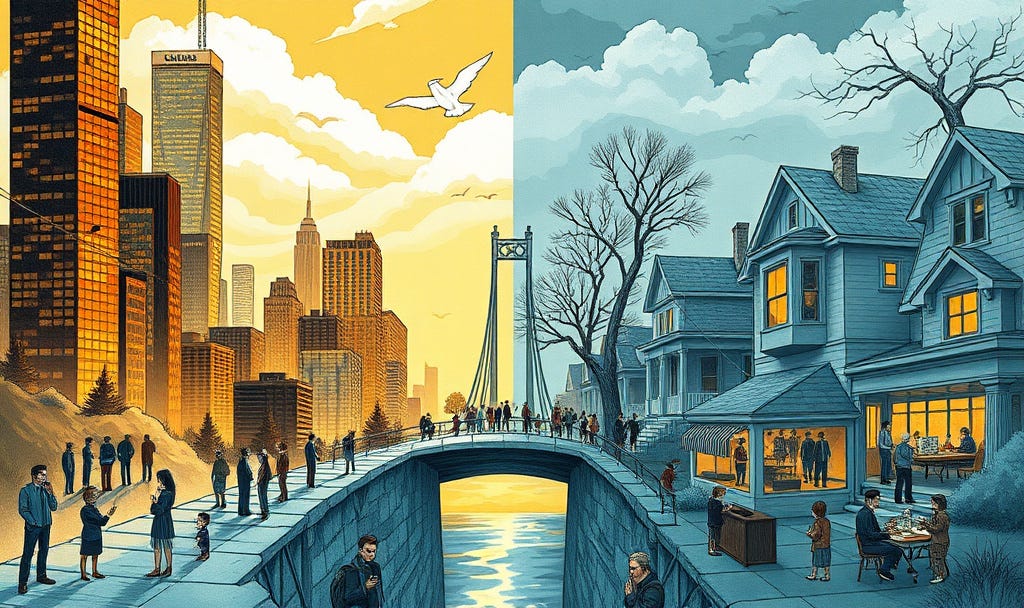
Everywhere I look these days, I see loneliness.
I see it in elderly people sitting alone in nursing homes with no visitors. I see it in young adults struggling to make friends despite being connected to thousands of people online. I see it in neighborhoods where people no longer know the names of the families living next door. I see it in workplaces where employees are treated as disposable. I see it in politics where compassion has become a weakness and cruelty is marketed as strength.
Something has changed in America.
We are wealthier than previous generations in many ways. We have more technology, more convenience, more information, and more opportunities than most people in history could have imagined. Yet many Americans feel disconnected, isolated, anxious, and alone.
How did we get here?
I believe part of the answer lies in an idea that quietly reshaped the American mindset over the past several decades: the belief that the individual matters more than the community.
For years, Americans have been taught that success is primarily an individual achievement. Pull yourself up by your bootstraps. Take care of yourself. Compete. Win. Look out for number one.
On the surface, that sounds reasonable. Personal responsibility matters. Hard work matters. Independence matters.
But when taken to an extreme, those values begin to erode the very things that make life worth living.
We stop asking what we owe each other.
We stop investing in public institutions.
We stop caring about whether our neighbors are struggling.
We begin viewing people not as members of a community but as competitors in a marketplace.
The result is a culture where everyone is expected to fend for themselves, regardless of their circumstances.
Over time, this philosophy found its way into our politics, our businesses, our healthcare system, and even our personal relationships.
We increasingly celebrated wealth as evidence of virtue and viewed poverty as evidence of failure. We praised billionaires as visionaries while dismissing the struggles of working families as personal shortcomings.
We treated economic success as a measure of human worth.
The language changed.
People became “makers” and “takers.”
Workers became “human capital.”
Patients became “consumers.”
Citizens became customers.
The idea of a shared responsibility to one another slowly faded into the background.
As this thinking spread, so did inequality.
Corporate profits soared while wages stagnated.
Healthcare became more expensive.
Housing became less affordable.
College became increasingly out of reach.
At the same time, many of the organizations that once helped bind communities together began disappearing.
Church attendance declined.
Civic organizations shrank.
Labor unions weakened.
Neighborhood groups faded.
Third places, those spaces where people gathered simply to be together, vanished from many communities.
The irony is that humans are not designed to live this way.
We are social creatures.
For thousands of years, our survival depended on cooperation, trust, and mutual support. We succeeded because we worked together, not because we competed endlessly against one another.
The happiest societies in the world understand this.
They invest in healthcare, education, public spaces, and social safety nets. They recognize that freedom is not simply the absence of government. Freedom is also having the ability to live a healthy, secure, and dignified life.
A society that leaves millions of people behind is not demonstrating strength.
It is demonstrating failure.
What troubles me most is how normalized selfishness has become.
We celebrate people for accumulating wealth but rarely ask how they contribute to the common good.
We admire success but often overlook kindness.
We reward competition while neglecting cooperation.
And then we wonder why so many people feel disconnected from one another.
Loneliness is not simply a personal problem.
It is a social problem.
It is the predictable outcome of a culture that teaches people they are on their own.
When community breaks down, loneliness moves in.
When compassion disappears, isolation grows.
When every relationship becomes transactional, trust evaporates.
The good news is that this is not inevitable.
We can choose a different path.
We can rebuild the idea that we are responsible for one another.
We can strengthen public institutions instead of dismantling them.
We can invest in communities instead of simply rewarding individuals.
We can support policies that recognize healthcare, education, housing, and economic security as foundations of a healthy society.
Most importantly, we can rediscover something our grandparents often understood better than we do.
People need people.
Not algorithms.
Not influencers.
Not billionaire saviors.
People.
Neighbors.
Friends.
Families.
Communities.
The future of America will not be determined by how many billionaires we create.
It will be determined by whether we can rebuild the bonds that hold us together.
Because at the end of the day, no amount of wealth can replace belonging.
No amount of success can replace connection.
And no society can thrive when everyone is told they are alone.
Maybe the answer to America’s loneliness epidemic is not more individualism.
Maybe it is remembering that we rise or fall together.
No posts
Comments
Nothing yet. Say the first thing.
Sign in to join the conversation.