
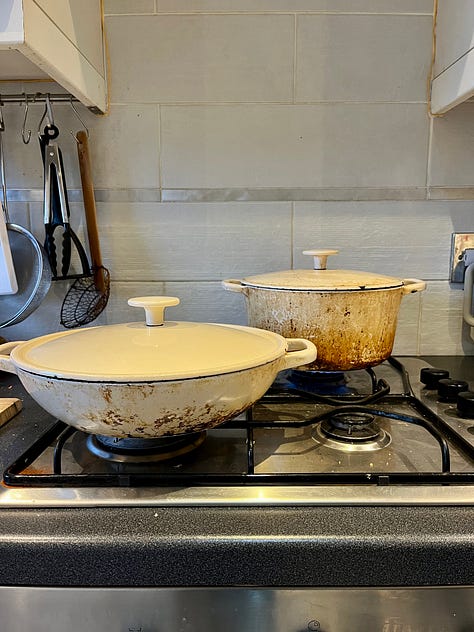
I am standing in an unfamiliar kitchen which, like mine, is a sunset feast, west-facing, but the hob here lights up in gas. I must readjust to the pace of a flame when soft boiling the eggs. I tell L that we have to cook a risotto while staying here, because there is no crunch like scraping cooked rice off a cast-iron pot after the risotto has settled over a cold fire. There is a pot rack screwed to the wall above the counter, to which a flat wooden spoon as I like them hangs, along with plenty of utensils. As I turn to reach the kettle behind me, I am reminded that we haven’t owned a toaster for years. The knives are sharp and come with varied blades; I am chopping carrots and a courgette, easing into the evening. This is my friend’s kitchen, but my friend F isn’t here.
I met F about two years ago, soon after I moved to Glasgow and sent F an embarrassing message on Twitter, asking if she would like to meet. We were both interested in food, openly bamboozled by the configuration (and freezing micro-climate) of our respective tenement flat kitchens, and I could use a pal. We went for a drink at the Weatherspoon in central Glasgow, spent the night talking about tinned meals and bread loaves, freelancing and campsite dinners, and have nurtured one of those late life’s adult friendships, meaning that we haven’t seen as much of one another in the past two years, but each encounter is honest, and never had I felt as close to F than when I was cooking in her kitchen but in her absence. There is an undeniable sensuality that comes with cooking in someone else’s space, to be reunited with a distant person, scouting for pans and bowls after them, to be puzzled by a logic that isn’t yours but theirs. It is effortful, a careful endeavour.
Like F, her kitchen is practical, resourceful and no-waste oriented. Scanning over the name tags she sticked on various shelf edges, reaching for the immersion blender, finding two of different sizes, beaming, and lifting the casserole up to the hob, its scarring making it the obvious favourite, I could hear F’s enthusiastic tone of voice whenever she tells me about her last foraged meal, as she drags the letter -r at the back of her throat, just like I too enjoy to accentuate the rascal letter. I can because people, like their ideas, leave and go, but their memory remains. A reminiscence may be tormented, manipulated, unreliable, but it lives long and deep inside us, whether consciously or subconsciously. We recollect, and this is why we create – despite everything else that is happening in the world as I type this. Despite everything else that is happening in your life as you read this, you create things. Some of us paint, others knit, bake, work wood; we write books based on true stories or set in speculative places, and we write memoirs and biographies, and we read books and talk about them; some of us make babies, others opt for fostering or look after friends’ children, or none; we build bridges and railway tracks and homes. Humans have always sheltered their kinds by projecting images of themselves, by evolving into imaginative beings capable of exploring diverse ways of being human.
In F’s kitchen, I made a minestrone. I had found a safe space to simmer a warm meal for L and I during a troublesome time, while being houseless and living outside of our ordinary context. Minestrone is the dinner I cook the most often, and there is no recipe for minestrone, other than it being broadly a thick soup (often red; often beany) that is made with whatever is available in the fields and/or the cupboards.
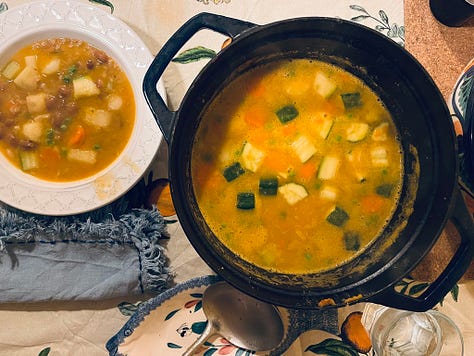

If there are countless theories, blog entries, cookbook recipes, hearsay about “how” a minestrone should be cooked, it is because there could never be an automatic minestrone. It is a dish “fourre-tout”, like we called its sibling in my childhood home, or the simple flavour of home as we say with L, chopping a little carrot, biting into that carrot, passing on the stock box to pick a day’s flavour. A minestrone doesn’t track calories and rarely poses well for the grid. It is changing and ordinary at the same time, relatable but unpredictable, a progress; it is a developing memory thus a story being transmitted, or a touch of humanity holding its hand up before the galloping tides of artificial intelligence – present, physical.
And I’m afraid physicality is under a tremendous amount of threat. The planet is becoming uninhabitable; our societies are increasingly traditionalist and ableist, therefore unsafe to anyone who doesn’t conform to arbitrary, appearance-based expectations about gender and bodies; the multinational corporate and data centres that fuel the AI machine are burning down forests, drying up rivers and soaking up common sense and artistry equally. News and viruses are travelling faster, but there are fewer people left to face the consequences. The world may be global, but it has become wireless, fast-paced perhaps but faceless nonetheless, so a projection rather than a lived experience. It is disconnected, out of touch.
Touch is a physical sensation foremost. It is the act of using a body part to come into contact with something else, to feel or apply texture, temperature, pressure. Touch also refers to the sense itself, the emotional impact of something, a small amount of something or maintaining communication by ‘touching base’. Primal emotions such as happiness, fear, anger, disgust or sadness can be both triggered and expressed by any form of touch, even if the touch is light. It may be a silent touch of affection or someone reaching for your hand in a startle. Toddlers familiarise themselves with their environment and objects by touching them, families and lovers reunite in a hug, a grandparent presses the palm of their hand against a distanced grandchild’s face so they can recognise them. Touch nurtures sensory intelligence and helps humans to remember; touch has informed our decisions and fed our imagination as a species, until now.
Compared to other animals, humans had already started with a disadvantage: we are the only species that need to agree on what reality is for anything to become real. We are mindful animals who perceive the world around them through a series of associations and dissociations, instead of using our senses, and, with the rise of automation, we are losing our ability to be intuitive furthermore. We are trading our hard-earned instincts for the sake of efficiency. At what cost? Streamlined processes, normalised aesthetics, patternable behaviours that can be duplicated and multiplied fast, all of which lessens humanity into homogenous individuals who are easier to label, box, segregate. All of which limits us.
Data don’t have memory. Further than that, data impersonate memory through a systemic approach to reciprocity, hence uniformity. I am a slow cook, so bear with me, but inconsistencies make a minestrone, and they are the reason why there are plenty of unmemorable minestrone and very few minestrone worth remembering. Truth be told first, minestrone is slurpy, earthy, gassy. It shares no aesthetics with a salad composed of pink, purple and green leaves, staged with a drizzle of vinaigrette, shaved parmesan and oversized serving spoons, with a golden loaf of sourdough bread or a plate of pasta alle vongole by the seaside. It is a homey dish for the jolly, rainy and unremarkable days. I will never forget the first minestrone we cooked in our flat in Livorno with L or the minestrone for one I cooked for myself after moving into my yellow kitchen, but I have forgotten most of the ones I have cooked and eaten, and this is coming from someone who cooks at least one minestrone a week all year long, perhaps two, maybe more, qui sait! Close your eyes now – uno due tre – open your eyes. Yes, you too have a minestrone of your own, and it may have nothing to do with soup. It is, in this very iteration, yours only, but you don’t have to keep it to yourself, and if you know of such a variation in the first instance, it is because humans have always adapted to survive.
Recipes aren’t inherited through automatism but via a reciprocity that invites us to remake that one dish time after time, just like the process of whacking out a quick minestrone from whatever is left in the fridge.
So: grab some parsley, a celery and two carrots. Chop chop chop, fry up gently.
Trim the cavolo nero. . .
. . .now return to that dish of yours, your ‘minestrone’,
and consider who teaches us to be normal.
Why is there always one queue outside the same café while all the others are empty? How good can that egg on toast be, realistically? Some of the hardiest species living on Earth have adopted counter-intuitive, sometimes self-sabotaging, stratagems to survive. Think about the water bears as they expel all the water inside their bodies to face extreme (cold) temperatures, or the Malaysian exploding ants who contract their abdominal muscles violently enough to rupture their own bodies, releasing a toxic fluid to kill their predators and essentially sacrificing themselves to protect the rest of the colony. Beauty is a complex topic, a subjective quality, so is how intelligence manifests on a planet that hosts millions of species and billions of people as they evolve across diverse landscapes and climates. Think about books and movies: we used to disagree about how much we liked them, resent characters in our favourite tv shows, praise others; we used to read long and dense books, not be afraid of describing characters physically; tragedians staged horrific events and complex feelings; we used to eat varied meals at various restaurants, make non-faff suppers, and once upon a time we enjoyed a holiday a short way from home. We lived before being told about how to live, so we had to be imaginative about our respective lives and the world around them.
We had to cook slurpy, gassy minestrone time after time, and keep our soups interesting and fuelling enough, thus find alternatives. Be imaginative, open-minded. Be human for god’s sake.
Going back to my minestrone. I like it red, with a teaspoon of rose harissa. Here you go – that is my secret ingredient, though you would know if you have been reading me before – until I am cooking in F’s kitchen and turns out F has ginger, which I never store in my kitchen and the minestrone is brothier than ever, greener than before, with a touch of ginger. L said a minestrone shall be red, before taking a spoon of it and, ‘oh,’ he said, ‘this is delicious.’
Please don’t stop cooking minestrone. Don’t stop writing odd sentences. Don’t stop mixing colours and patterns as you please with your clothes. Don’t stop eating intuitively or be spontaneous. Be. Imagine, here, just pause and think, and imagine how, in this world, if we cooked and spoke with our minds, up and confidently, respectfully of others, imagine the relief, the decisions then changes we would make, the possibilities that would rise after them, bubbling and warm but never too hot, not since the aunts would tell you that a soup shall never be boiled, pacified yet curious beings.
margaux
PS. F is no-one else than Fliss Freeborn, fantastic forager, cook and the author of Do Yourself a Flavour.
PPS. Allow me to state the obvious: there is far more to say about the rise of AI, especially about the environmental, cognitive and labour impacts this is having, but I must acknowledge the limits of both my knowledge, let alone my expertise, and that there is as much a home-cook can blitz into one newsletter about minestrone. I do owe a lot of thinking about AI to Karen Hao’s book, Empire of AI, ‘inside the reckless race for total domination’.

thank you for reading The Onion Papers. i’m margaux, a writer adrift, and this is my hybrid newsletter. if you enjoy my work, remember to subscribe and/or invite friends to the party as you keep me going. read more about TOP here.
PS. I write novels too. And I write them with my own hands!!
No posts
Comments
Nothing yet. Say the first thing.
Sign in to join the conversation.