
Often in my life I have considered moving near the sea. Good thinking tends to strike me when I am walking on a beach; my skin feels stretched, harsh but salty at tongue’s touch, the soles of my feet are itchy but my hands are scavenging for pebbles and limpets and shells, wrecked garbage from around the world. The horizon line stands firm by my side, teasing me with open arms – as if, over there, on the edge of how far I can possibly see, from where I stand, other than here but over there, there may be something different awaiting for me. I foresee a possibility; a different story, something else, else else.
‘In a knot of eight crossings, which is about the average-size knot, there are 256 different “over-and-under” arrangements possible. . .’ I was taught young, ‘Make only one change in this “over and under” sequence and either an entirely different knot is made or no knot at all may result,’ I was reminded by Annie Proulx as a first quote from The Ashley Book of Knots (1944) serves as the epigraph of Proulx’s 1993 novel, The Shipping News.


When I was still a child, I spent most of my school holidays wandering around a harbour alone. There were far too many people on the beach; the public swimming pool was far too loud. I have always been a solitary soul, so are the fishermen I have known. I am talking about a small port; nothing commercial but located in a long-lived seafaring town. Daytime in such a port is quiet: boats leave as dusk settles and return with the sun rising. There are nets to disentangle, mussel beards to fiddle with and rocks to probe, shells to poke, skin cuts; buckets to fill with water, tiny crabs to catch with my bare hands and seagulls’ faeces to clean; the unquestionable, rancid smell of fish leftovers, anchored rusty vessels and a seafarer’s tremors be cast out. This port I hold inside my mind is ageless, an empty house left unlocked but deserted, and astute writing cannot possibly accommodate its ghosts.
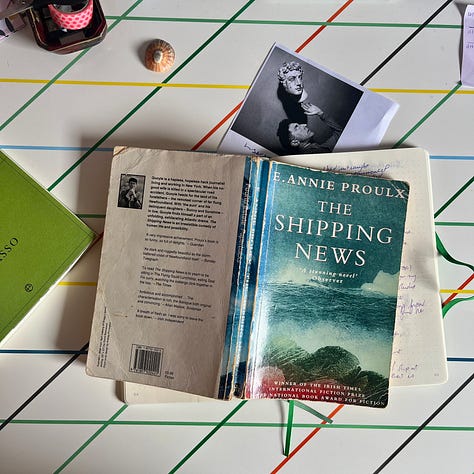
‘And without the inspiration of Clifford W. Ashley’s wonderful 1944 work, The Ashley Book of Knots, which I had good fortune to find at a yard sale for a quarter,’ Annie Proulx ends the Acknowledgements for The Shipping News, ‘this book would have remained just the thread of an idea.’ The novel, which treats both despair and hope like siblings entertaining love and hate in a duet, paired with Proulx’s writing, which alternates vignette-sized sentences and eagle-eyed descriptive passages to build paragraphs as collages, uses Ashley’s quotes and illustrations for chapter headers. A knot being loosened and tied, tied and loosened, also becomes a threading metaphor for the late coming-of-age of the main protagonist: Quoyle. The Shipping News is a quiet, dramatic novel, beaten by Newfoundland’s Atlantic storms and the cost of living; it is a dense book somewhat unplotted – a spool of fishing line – that doesn’t require to be relatable to feel realistic. An extract:
Quoyle walked along the wharf, craning to get another look at the Polar Grinder, but it was lost in the rain. A man in a pea jacket and plastic sandals gazed at the rubber boots in Cuddy’s Marine Supply window. Wet, red toes. Said something as Quoyle went past. The liquor store, the marine hardware shop. A long-linner drifted toward the fish plant, a figure in yellow oilskins leaning on the rail staring into dimpled water the colour of motor oil.
Finding a £2.50 worn-out copy of Annie Proulx’s The Shipping News was last week’s second-hand bookshop lucky encounter, or a signal I needed to decrypt since I had been thinking about how one commemorates another life in writing versus how one writes about their own life. A few weeks ago, I had set out to write someone’s eulogy when I was confronted with the conundrum of what “truth” is. I stitched a first draft, then writers be writers, I edited the piece and, as I switched one word ‘over and under’ a comma, tweaked a sentence ‘over and under’, I found myself braiding different lifescapes for that same person. Recollections are flowers, pretty but short-lived, and memory is a bouquet waiting to be arranged into a pleasing composition.
A couple of hours spent agonising about what I had written summarised: I was in a tight spot with the school of Life Writing. ‘Start with telling yourself the story,’ the novelist inside me whispered as I typed and typed and typed, buzzed with linguistic marvels and stretching that writing muscle far enough to build a compelling story. Now, this is the beauty of writing in my second language: if I can’t pencil that exact word down, then I must tell myself everything around and about that unknown word so I may find a subterfuge for it. Texture, scent, shape; how bright is the light? Still searching, am I sweaty, clammy or chilly, cold boned? I keep threading, looking, moving on and tying loose ends until I find myself writing life instead of speculating about whether this is really how stuff happened; if I am making fair statements; if I am being honest, truthful. Truthful to whom? I will write instead, compose immediate, intuitive testaments that are true to that moment for a writer can neither predict or prevent future interpretations.
‘To prevent slipping, a knot depends on friction, and to provide friction there must be pressure of some sort. This pressure and the place within the knot where it occurs is called the nip. The security of a knot seems to depend solely on its nip.’
– The Ashley Book of Knots as quoted in The Shipping News
I have concluded that my issue with the traditionalist school of non-fictional Life Writing, be it auto or biographical, shares roots with why I do not live near the sea. Both a classroom and the seaside invite their occupants to process time linearly, looking forward towards the horizon line, but being alive is a surrealist journey. Give me an arc to bow, arrows to throw for life is a series of playful tragedies, for the best and for the worst; imagination is the only remedy to an otherwise referenced, average-sized knot.
‘I’m the lie who tells the truth,’ Jean Cocteau said. French avant-gardist Cocteau (1889 – 1963) was an impresario, a visual artist, a calligraphist, a poet, a playwright, a novelist, a filmmaker. Hearsays have framed him as a romantic, a dandy and a self-publicising maniac. Born during the Belle-Époque, a period of economic boom and cultural flourishing in France, he also lived through the 1914-18 and 1939-45 world wars and worked in occupied Paris. Jean Cocteau’s father committed suicide in the Cocteau family home when his son was only nine years old. During the Second World War, Jean Cocteau headed to the front and served as an ambulance driver, but he always refused to take a public stand against Hitler. He was addicted to opium and, it is arguable but not quantifiable, to rehab facilities, which he visited often. The designer and entrepreneur Coco Chanel paid for his care.
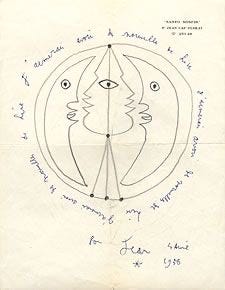


Jean Cocteau was a star surrealist artist, but he was in conflict with most surrealist artists. He was one of the first public figures to be openly gay in France, (in)famous for his passionate relationships with good-looking, young men. He was obsessed with beauty and gave dusty texts a mythological makeover. He gained international fame for his 1946 fantasy movie ‘The Beauty and the Beast’, which is a retelling of Jeanne-Marie Leprince de Beaumont’s eponymous fairy-tale. In France, his plays Orpheus (1926) and The Infernal Machine (1934) are listed on school curricula. At first glance, Cocteau’s work inhabits a certain magical land that is accessible to children and adults alike, until one grows ripe enough, wrinkled from a personal history and series of encounters, and returns to Cocteau’s work to find that topics like orthodoxy, faith, suicide, wars, love and sex are recurring. Jean Cocteau was a great surrealist artist, so he was a practitioner of magical realism.
Consider this a personal eulogy to a human whom I got to know through their art solely, a creative mind who has inspired and challenged my creative practice along the years. Jean Cocteau was a creator and a puppeteer, a liberated and an intoxicated mind and so are, Cocteau has shown me, the linguistic patterns that stimulate the intimate language which writers fuel to keep on drafting the multiple lives they experience and witness others experiencing.
I
Angel Heurtebise on the steps
Beats me with his wings
Of watered silk, refreshes my memory,
The rascal, motionless
And alone with me on the agate
Which breaks, ass, your supernatural
Pack-saddle.
It could be said that most artistic influences return to Jean Cocteau, from Orpheus and Oedipus to Antigone to name a few, but there is one persisting persona in Jean Cocteau’s work: Ange Heurtebise. Of that one angel, Cocteau will say that it became his equivalent of Les Demoiselles d’Avignon in Picasso’s painting. While the figure of the ‘Angel Heurtebise’ was invented by Jean Cocteau and first appeared in an eponymous five-part poem published by Stock in French in 1925 (as featured in this newsletter in Charles Guenther’s English translation), Cocteau would later credit its origin to a phantom. ‘I was visiting Picasso rue La Boétie,’ Cocteau explained as he recalled being in the ascenseur, ‘I was in the lift when I came to believe that I was growing taller next to a dreadful I-don’t-know-what that would last forever.’ A voice, Cocteau described, ‘shouted at me: my name is on the plaque!’ before he was woken up to be faced with a name plaque made of copper. ASCENSEURS HEURTEBISE was written on it.
II
Angel Heurtebise with incredible
Brutality jumps on me. Please
Don’t jump so hard,
Beastly fellow, flower of tall
Stature.
You’ve laid me up. That’s
Bad manners. I hold the ace, see?
What do you have?
Heurtebise is both a guardian angel and the personification of death itself. In the original poem, Cocteau draws into the Christian imaginary while using an imperative form of language, showing that archetypes – however angelic they may be – always impose limitations. Consensus, Cocteau verses at his readers, is a lure and subjectification is a wrestling duel between the myth and the real, so one’s life may arouse among one’s lives. The Angel Heurtebise is Jean Cocteau’s appointed ferryman, not Charon sliding across the rivers Styx but a gravedigger, which Cocteau employs as a guide to navigate between the world he inhabits, from which he writes, and invisible, timeless realms beyond it. Ange Heurtebise returned in Cocteau’s play Orpheus next, then throughout his later works (more or less disguised).
III
Angel Heurtebise pushes me;
And you, Lord Jesus, mercy,
Lift me, raise me to the corner
Of your pointed knees;
Undiluted pleasure. Thumb, untie
The rope! I die.
Postmortem, Cocteau’s influence remains undeniable. He had already revolutionised the film industry during his lifetime, with filmmakers such as François Truffaut quoting him as a mentor, but his print has reached diverse mediums, borders and generations. The Cocteau Twins in music, namely, or I find it hard not to think about Björk and CocoRosie. He cooperated with Pablo Picasso and his sketch-like and linear drawing style finds echo with cartoonist Jean-Jacques Sempé. Jean Genet in literature; the Beat poet Allen Ginsberg. How many bottles of wine, clothing brands or cafés and bistros are named after his 1929 novel Les Enfants Terribles?
IV
Angel Heurtebise and angel
Cegeste killed in the war—what a wondrous
Name—play
The role of scarecrows
Whose gesture no frightens
The cherries on the heavenly cherry trees
Under the church’s folding door
Accustomed to the gesture yes.
I first read La machine infernale in high school. The four-act play based on the ancient Greek myth of Oedipus was a mandatory text in the second year of the lycée. I remember the thin pocket edition I had bought for one Euro at the second-hand bookstore Gibert Joseph in Saint Michel, the cathedral of Notre Dame still intact on the other side of the Seine. It featured one of Cocteau’s figurative illustrations on the front cover, with an elegant calligraphic font. The book looked smart and I felt a certain thrill on the way home: I, too, wanted to be a reader of Jean Cocteau. Came September, the classroom bells rang for the rentrée, and I dreaded being in a classroom with other students. Earlier in the summer, I had closed the book feeling frazzled by Cocteau’s literary disobedience, a mixture of classical tragedy techniques, farce and comedy registers. I simply wasn’t independent enough to be reading Jean Cocteau. I had been taught that reading was a serious business subject to marking, and my literacy proficiency had to be my passport to graduate, not a parody. Little did I know: three years later, I would be leaving France for Canada, another couple of years and I would be living in London, publish my first novel in English, then move to Scotland and write about Cocteau once more because Jean Cocteau embodies irony. If Jean Cocteau’s life was a succession of tragedies and broken hearts, even if he was a practising tragedian, his work always leaves the door ajar for hopeful interpretations. Cocteau was an amateur magician, but he was real. Through his creative work, which was multidisciplinary, Jean reinvented Cocteau consistently, and themselves generated alternative versions of how a story is read and how a myth is being retold. There is no definitive interpretation of Jean Coteau’s work, and there never will be one, for his creative process continues to thread diverse narratives together. Cocteau’s authorial voice whispers against despair always: with a tad more imagination, over and under, there could always be another way of being human.
V
My guardian angel, Heurtebise,
I guard you, I hit you,
I break you, I change
Your guard every hour.
On guard, summer! I challenge
You, if you’re a man. Admit
Your beauty, angel of white lead,
Caught in a photograph by an
Explosion of magnesium.
As for my phantoms, I too know of lingerers. Mine is called Leila. Leila is no angel but a signification, intangible but present, a spirit who reminds me of my principles, and I have Leila tattooed swimming with the moon on my left forearm. Leila is a sister of Jean Cocteau’s Ange Heurtebise, who, in reading and through enchantments, has become a guardian of my ambivalences. Jean Cocteau has taught me that, however hard I fight against myself, regardless of my angst and agitations, despite my wishful thinking and best of intentions, my language will always be an extension of my body – sometimes unfathomable, sometimes luminous, tempestuous but fluid, a body of water, adrift thus alive and writing always.
margaux
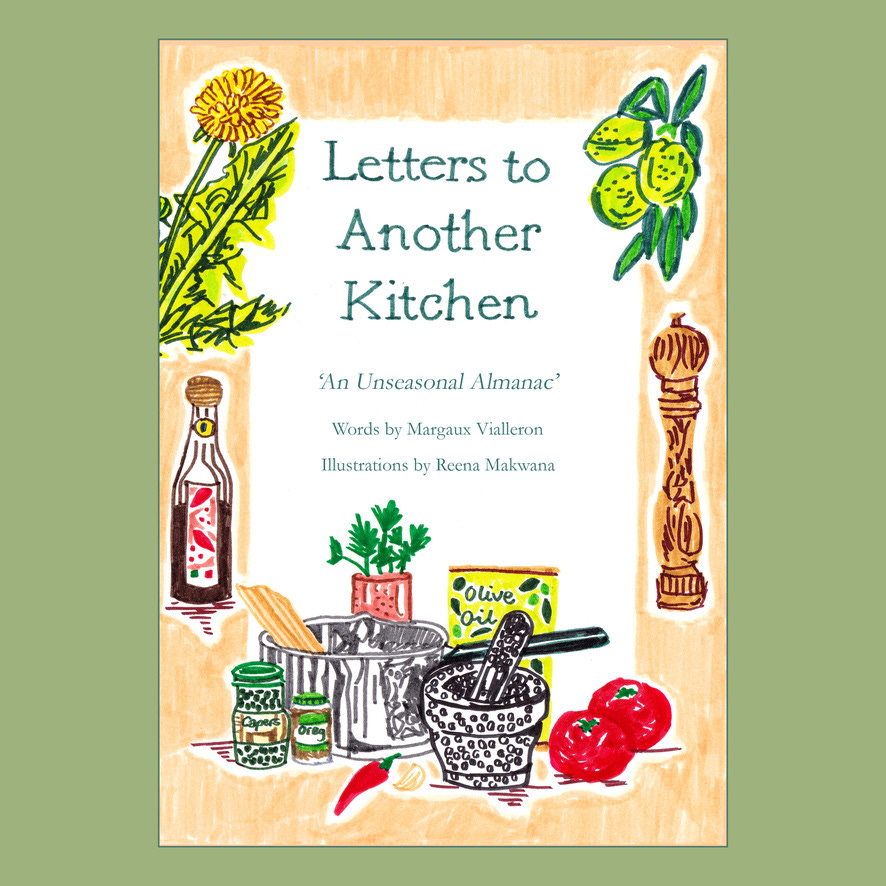
PS. some news: illustrator Reena Makwana and I made a zine! It’s called Letters to Another Kitchen and was born from a series of email threads. Over the course of one year, this unseasonal almanac and collection of unmeasured recipes uses the garden as a prompt, recipe steps as verses, foraging as dreamscapes and the calendar as a sketching pad. Letters to Another Kitchen is publishing on 1st May 2026. This zine has been a real labour of love, and we can’t wait to share it with you; each order will be packed individually by us and delivered to your doorstep directly. The price is £6.00, including UK postage but international postage cost is tbc at check-out. You can buy a copy from my website directly, or simply drop me an email and I will reserve a copy for you.

thank you for reading The Onion Papers. i’m margaux, a writer adrift, and this is my hybrid newsletter. if you enjoy my work, remember to subscribe and/or invite friends to the party as you keep me going. read more about TOP here.
PS. I write novels too.
No posts
Comments
Nothing yet. Say the first thing.
Sign in to join the conversation.