
A few months ago Professor Eric Kaufmann (Director of the anti-woke Centre for Heterodox Social Science) published a report titled “The Decline of Trans and Queer Identity Among Young Americans.” Although the report wasn’t peer-reviewed, it sparked a viral moment. Many anti-trans culture warriors were jubilant that the end of trans had finally arrived.
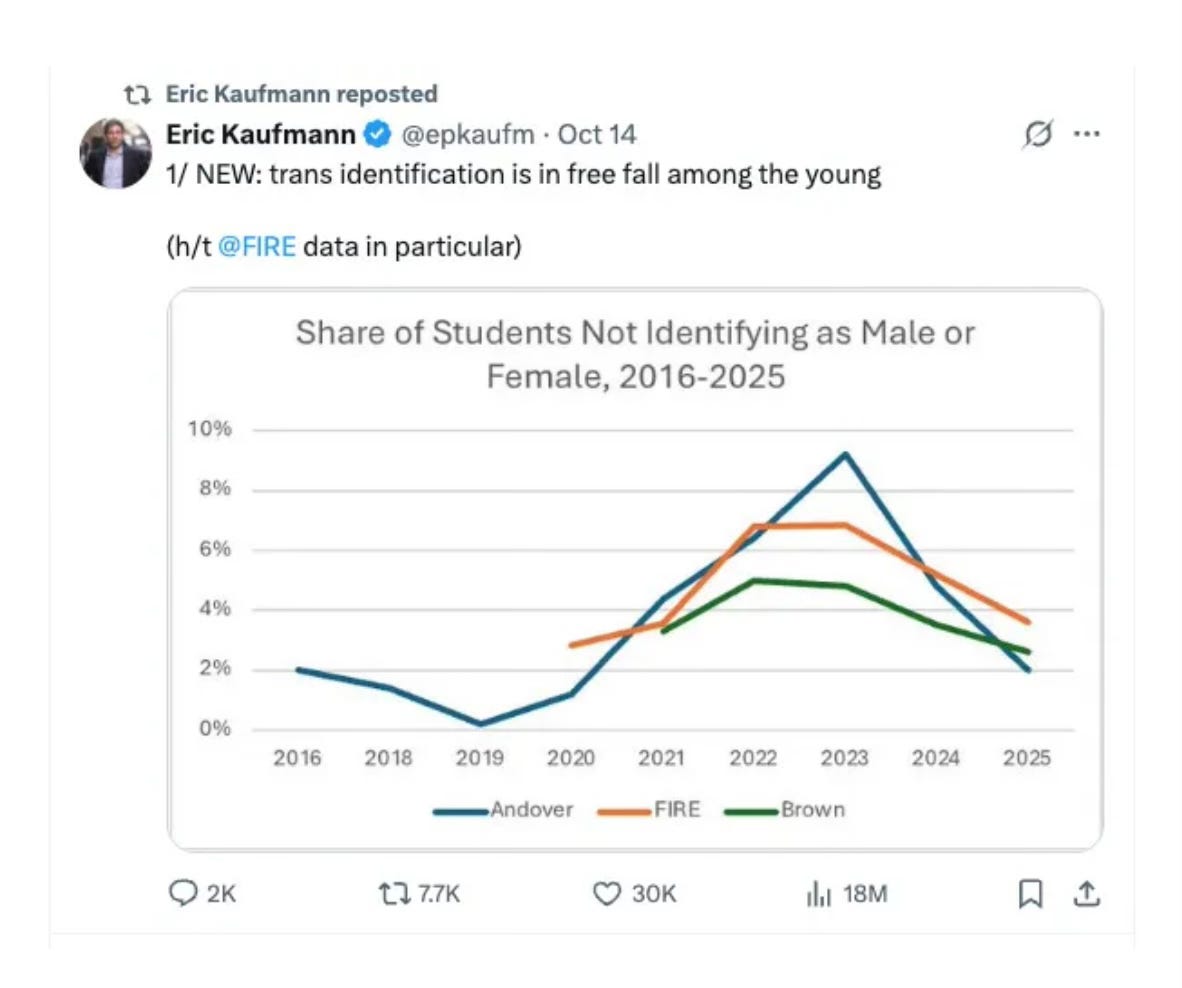
Several important and valid critiques were raised in response to Kaufmann’s study. First, many noted that the survey was poorly designed, and unlikely to capture how trans and nonbinary people would actually conceptualize and report their sex or gender identities on a survey. Erin Reed’s article goes into this aspect, as well as further methodological critiques.
To dig deeper, psychologist Jean Twenge got her hands on multiple big datasets that sent a stronger and potentially more reliable signal of declining trans and nonbinary identities in young adults and adolescents between 2022-2024. Twenge is the author of iGen: Why Today’s Super-Connected Kids Are Growing Up Less Rebellious, More Tolerant, Less Happy--and Completely Unprepared for Adulthood--and What That Means for the Rest of Us. She is also the lead author of a paper I cite frequently indicating that the last decade’s rise in trans/nonbinary/gender-diverse (TGD) identities was disproportionately driven by racially-white transmasculine young adults (born female/AFAB; “Gen Z”). The paper is titled “Increases in Self-identifying as Transgender Among US Adults, 2014–2022.”
Contrasting with Kaufmann and Twenge, Aella’s survey data drawn from “many corners of the internet” seem to show a much higher prevalence of TGD identities among young people, especially young AFABs. It revealed the drop only occurred among liberal AMABs.
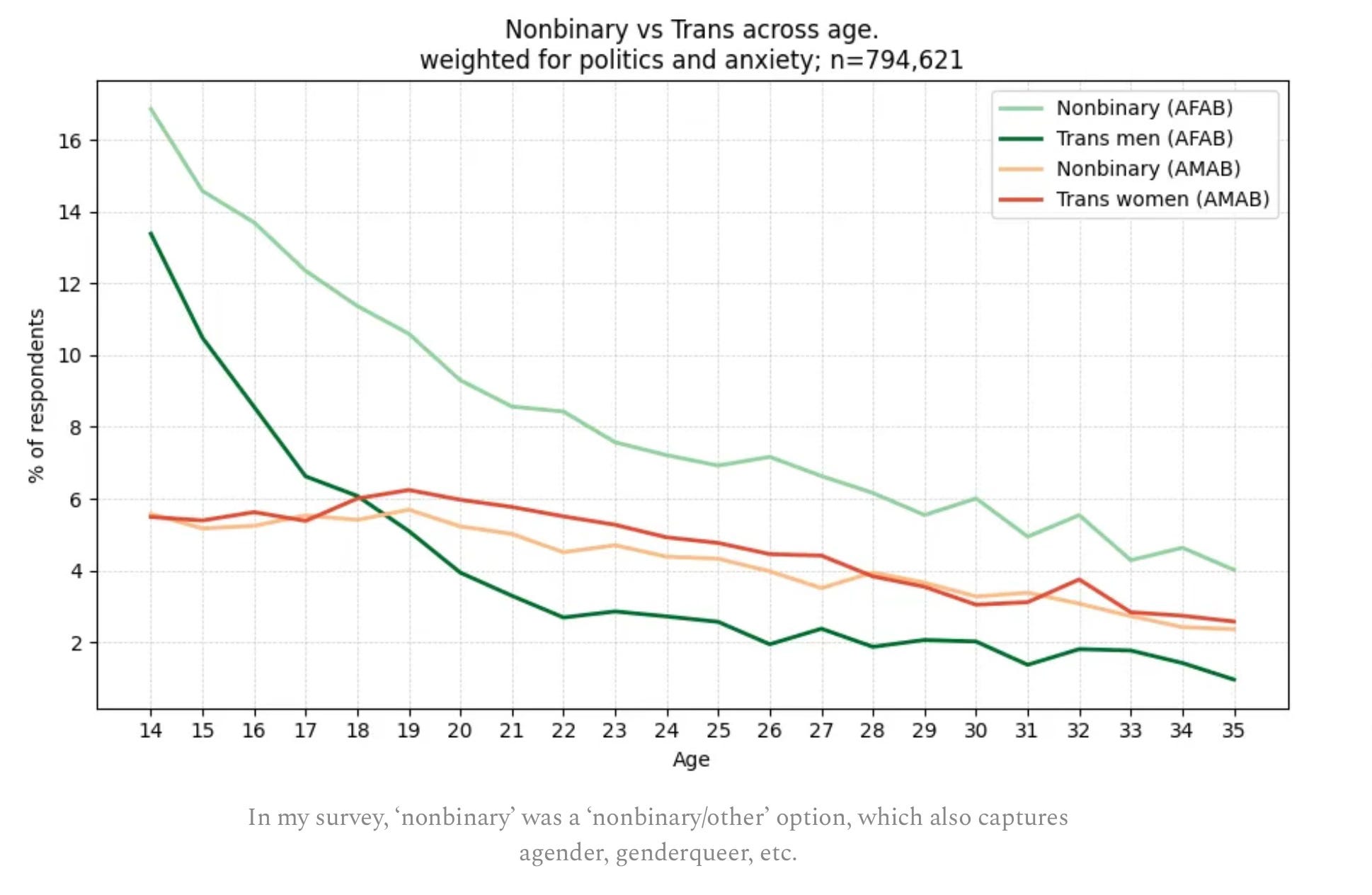
(Note: Twenge’s and Aella’s recent Substack posts are also not based on peer-reviewed studies.)
So, how can detransition research help to make sense of these potential trends? First, “detransition,” as a sociological phenomena and an area of research, is extremely young. Even as a word, it hasn’t been in circulation for very long. There is also a big difference between youth reporting TGD identities on a survey, and actually taking material steps to transition their sex/genders. So a substantial drop in TGD identities does not necessarily imply a big wave of detransition is happening in the real world.
Recent research studies examining detransition do seem to support the temporal identity trends highlighted by Twenge and Kaufmann, though. For example, one study relying on healthcare administrative data in Norway found that 10.2% of the youth who’d medically transitioned in the year 2018 subsequently detransitioned (the authors don’t give the detransition years, but the study’s cut off year was 2023). Of those, not all detransitioned because they no longer identified as trans (but that was true for about 60% of the cases). 100% who detransitioned were born female.
For the rest of this post, I’ll use the DARE study as an example, since it’s a study I led and it focused on North Americans.
The DARE study was among the largest LGBTQ+ community studies ever designed to understand detransition and post-transition gender identity fluidity. Data collection occurred between December 2023-April 2024. In other words, we were collecting retrospective data on gender identity development and gender transitions/detransitions precisely when TGD identities were apparently in “free-fall,” as some have put it.
It’s a cross-sectional, non-representative survey that was advertised to several hundred gender clinics and LGBTQ+ serving organizations. Like Aella, we also advertised via “all corners of the internet.” More information on the study design and demographics is available here and here.
957 people took the survey and we interviewed 42 of them over Zoom. A few highlights:
mean age of 26 (76% of the sample were aged 29 or younger)
79% of the were AFAB
86% were racially-white
74% resided in the USA (rest were in Canada; we used IP/geolocation to verify and remove respondents from outside these countries).
To be eligible, some kind of gender transition (social transition, social + medical, or medical treatment only) was required. ~64% reported a social+medical transition. The vast majority currently identified on the LGBTQ+ spectrum (bisexual/plurisexual and lesbian identities were the most common).
Although the study wasn’t designed to be representative, the data seem to provide another signal of shifting TGD identity and temporal transition patterns, including how people identified when they began transitioning, versus years later, at the time of the survey. One of the more common patterns was moving from trans man/transmasc/nonbinary as youth, to bisexual woman or lesbian by young adulthood. It’s important to state that this is a select sample of people who’ve transitioned and then paused or reversed the process. The study probably doesn’t apply to most trans/nonbinary people.
Still, in light of the larger datasets discussed, there’s some interesting timelines to look at (these data are already peer-reviewed and published).
Here we can see the most prominent years of TGD identity realization:
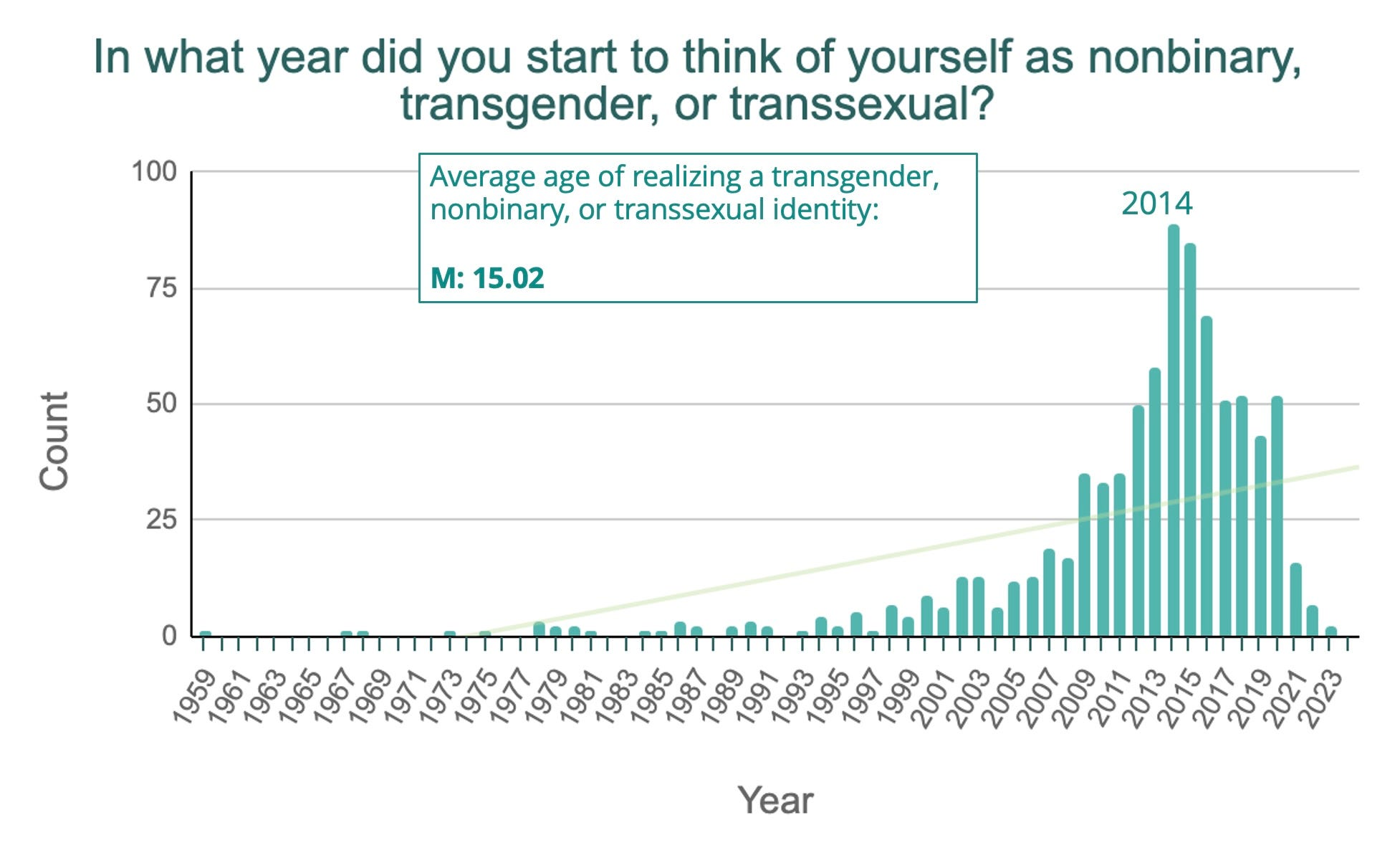
The average age that participants began to think of themselves as TGD was age 15. 2014 was a peak year, closely followed by 2015, and 2016.
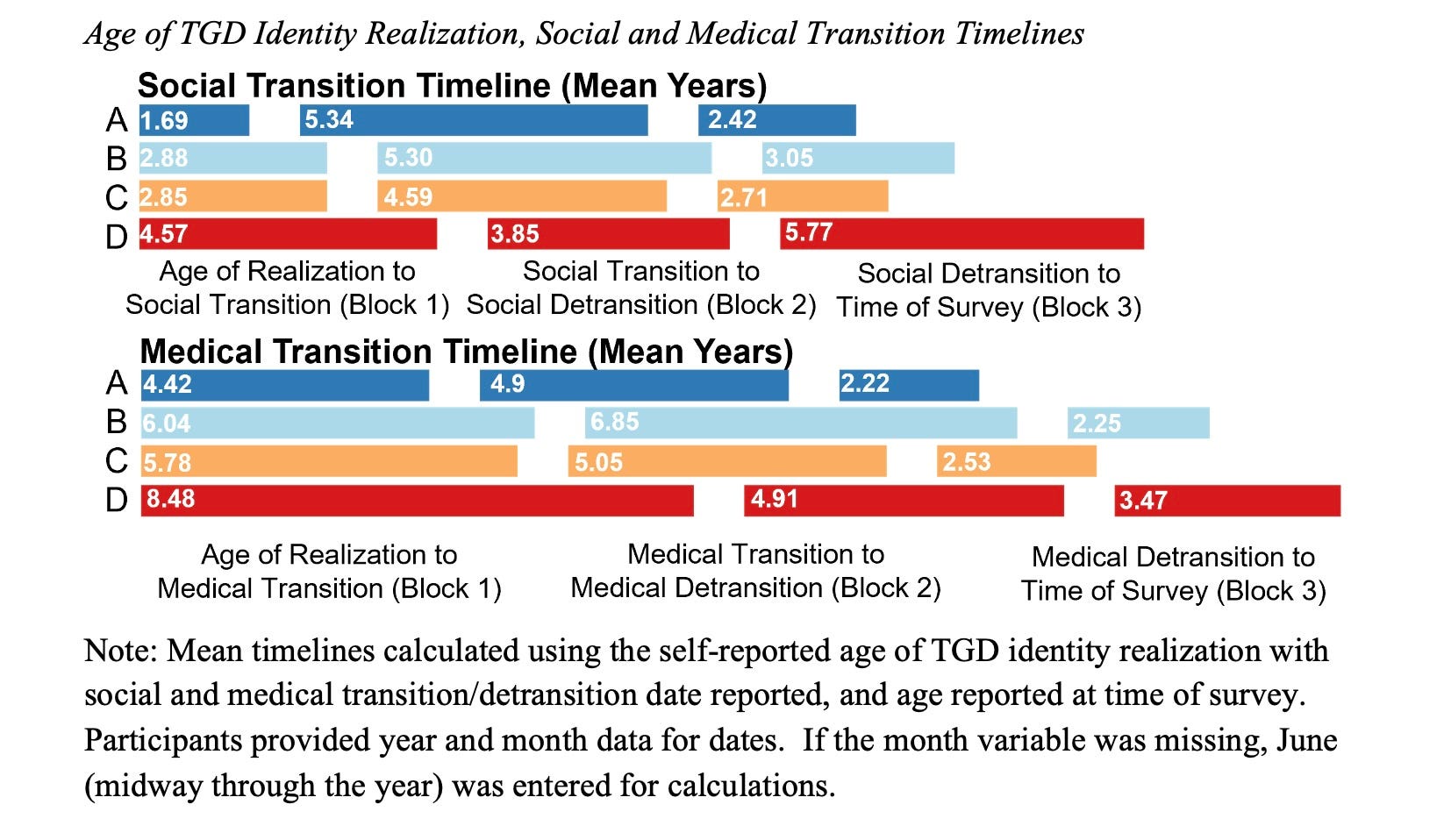
The average timeline from TGD identity discovery to taking steps to socially transition was about 3 years. ~65% engaged in a medical transition, having accessed at least one gender-affirming medical treatment—an average of 6 years after initial TGD identity realization (there was a wide range, though). Scroll a bit further down and there are timeline charts, broken down by four different types of detransition.
Here, we can see the years participants began to socially detransition, followed by medical detransition:
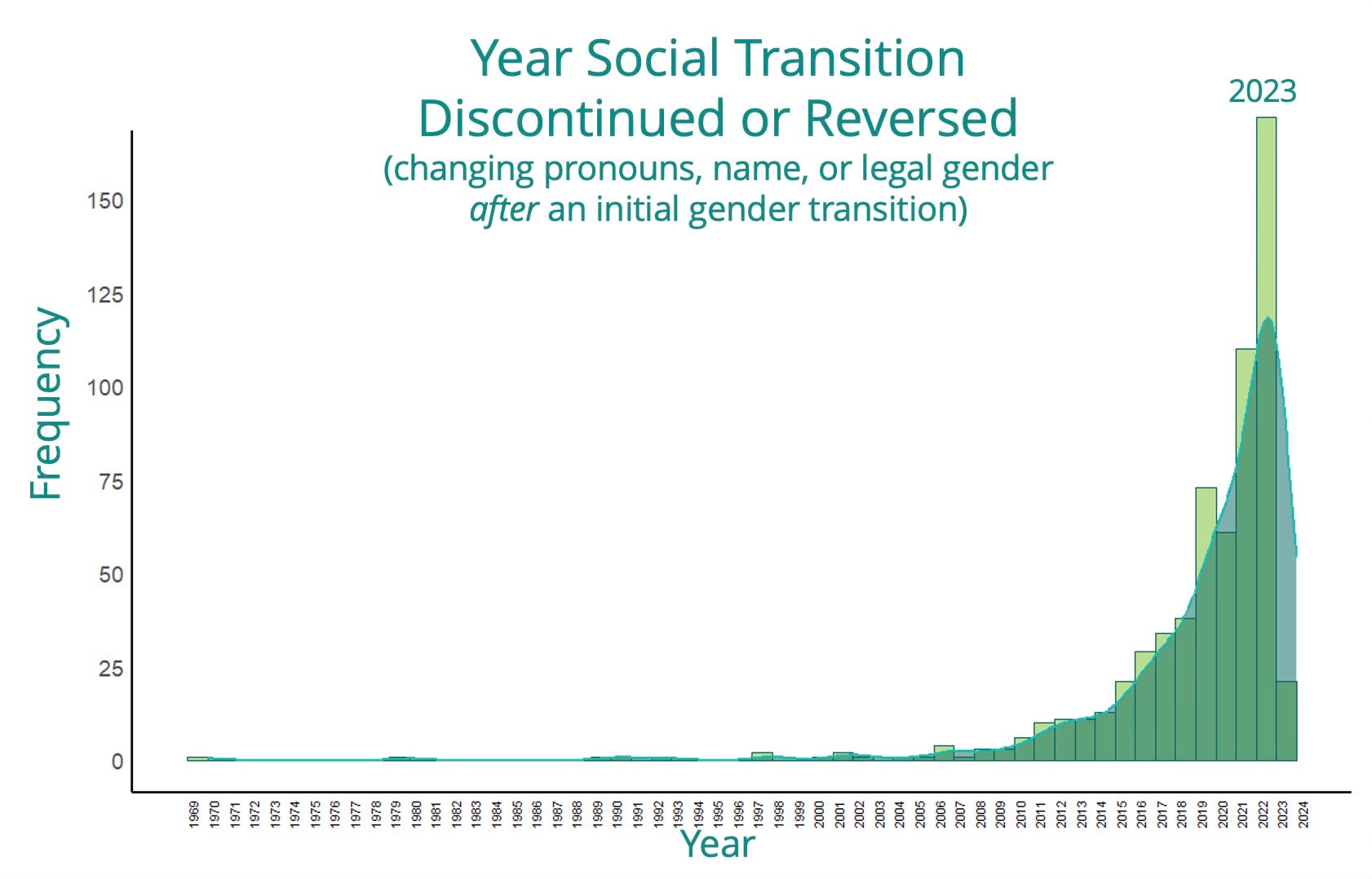
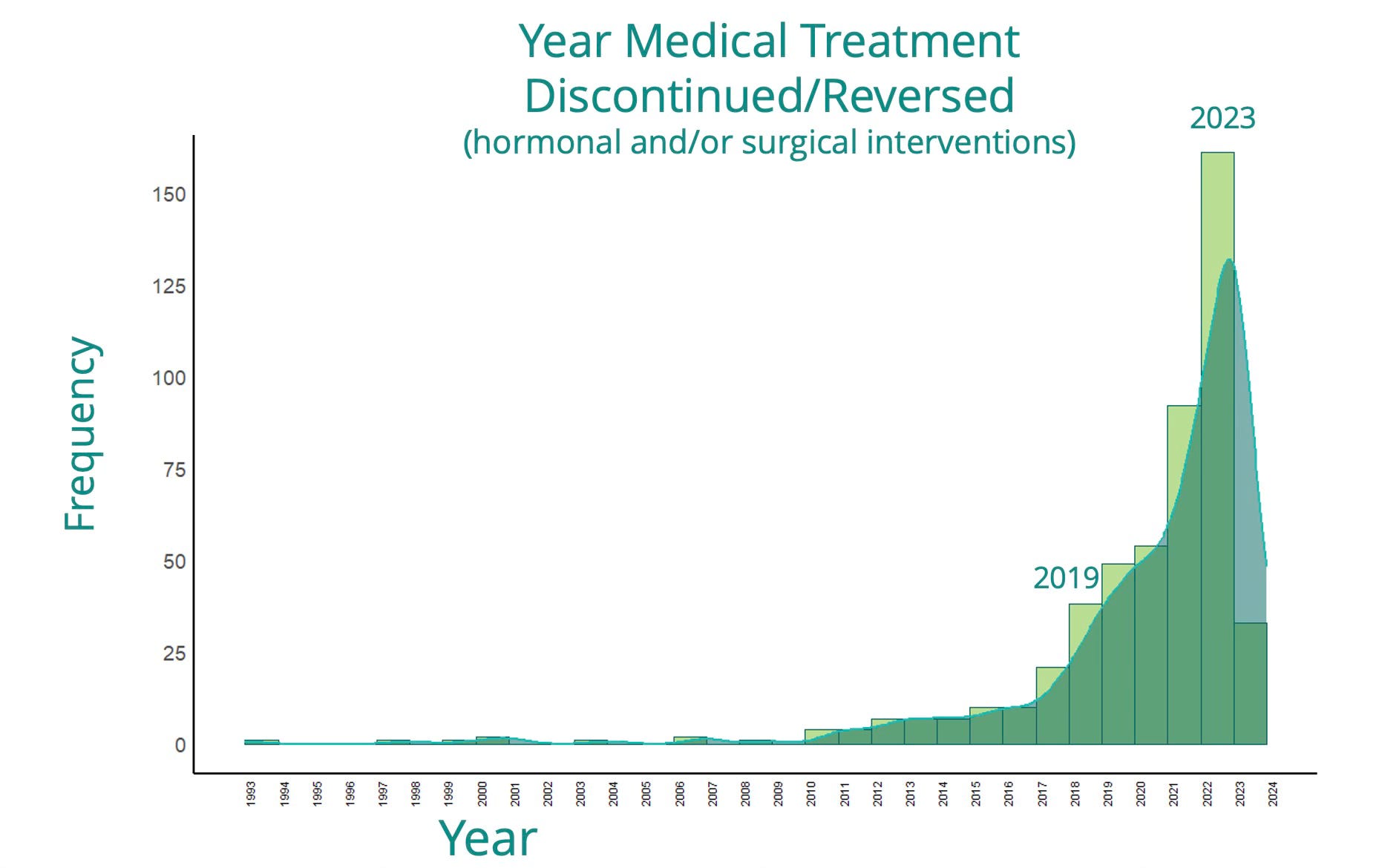
So, 2020-2023 were years when it seems that many people in the survey began detransitioning. Some of this could be explained by self-selection bias. People earlier in detransition, when it’s more acute and distressing feelings are more pronounced, may be likelier to participate in a study about their experiences, especially if they are very tapped into detransition networks that tend to serve as sources of peer-support and information sharing.
Anyhow, here’s where we can start to pull apart possible explanations for trends found in the larger datasets with adolescents, young adults, and US college students.
Using latent class analysis, these are four different clusters of detransition experiences. To establish these groups, participants were provided a list of 20+ possible reasons to stop/reverse their gender transition that were grouped into internal (e.g. mental health, identity change), external (e.g. lack of support, romantic rejection, bans on gender-affirming care), and intervention-related (e.g. satisfaction/dissatisfaction or complications with treatments).
A & B could be said to be more internally-driven, D is more externally-driven, and C composes a mix of internal and external factors.
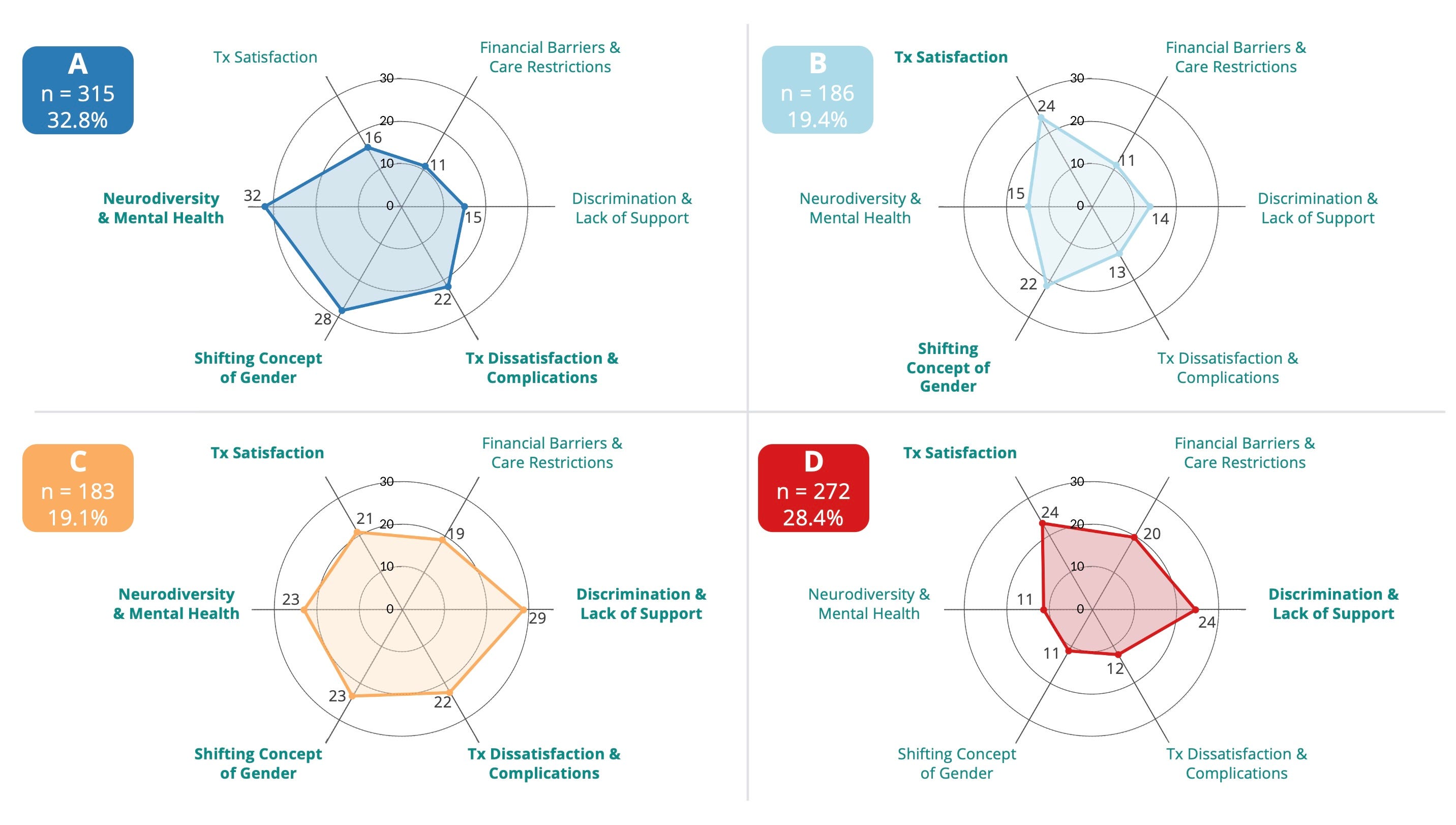
If we were to extrapolate to the larger scale, these offer some explanations for TGD and detrans patterns among young people. There are also some sex/gender differences in these groups, with a large majority of the AMAB/trans women participants in the groups reporting more external factors, like discrimination and barriers to gender-affirming care. Group A & B are between 87-90% AFAB.
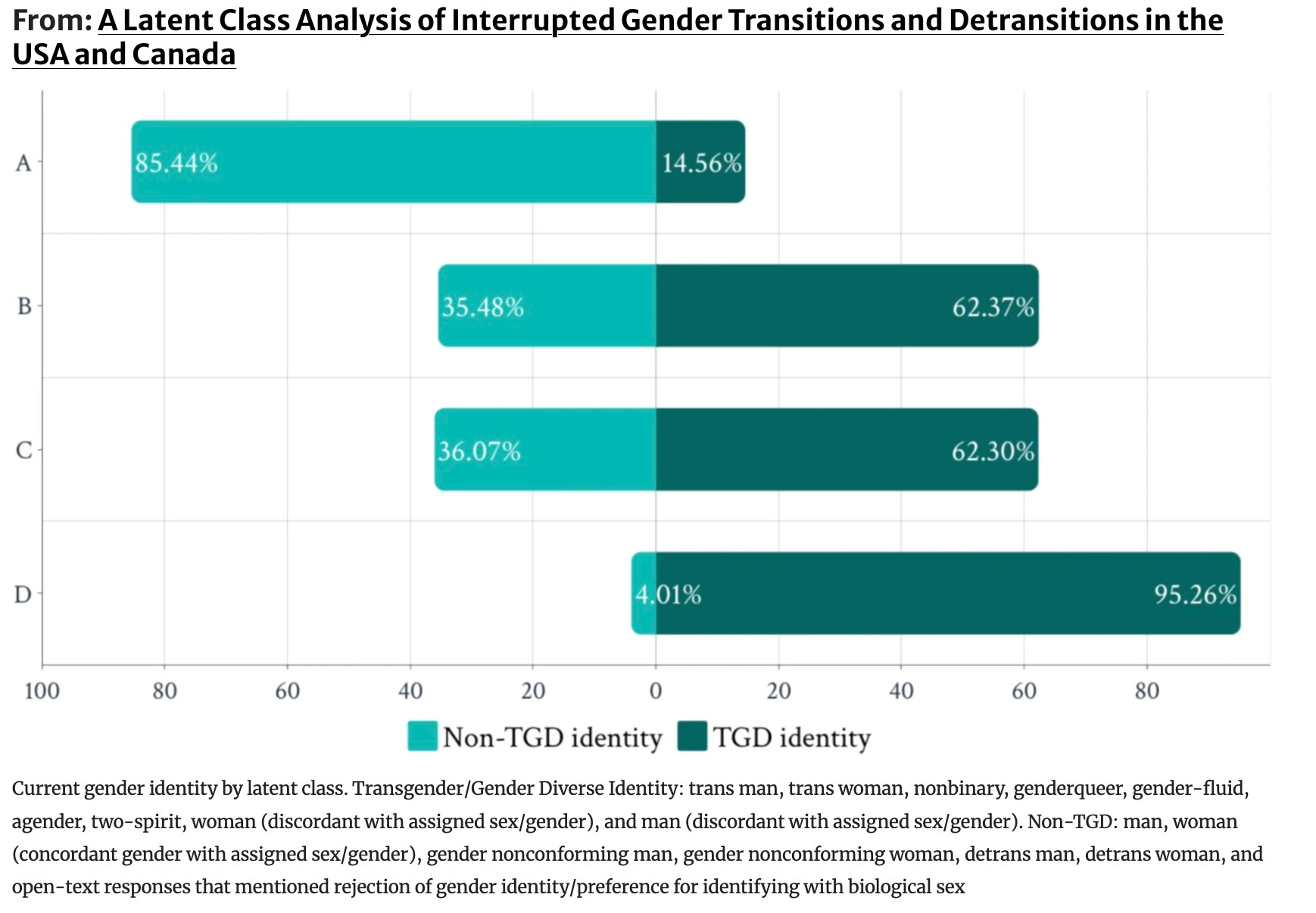
The next Figure shows the prevalence of trans/nonbinary identities versus non-trans ones. Class A were the least likely to report a current TGD identity. Almost everyone in Class D reported a current TGD identity, where again, we see most of the trans women in the study and others reporting a temporary detransition.
There were also group differences in the time elapsed between realizing a TGD identity, transitioning, and making subsequent changes.
These data, together with Twenge’s and Kaufmann’s, indeed point toward a sociological shift happening with regards to gender-diverse identities.
All things considered, here are a few working hypotheses:
The trans-hostile climate in the United States and elsewhere has many TGD people jumping ship, including would-be-future trans/nonbinary people. Even hypothetical “eggs” are seeing the Trumpian politics and NOPE-ing out. In the future, prevalence of TGD identities among young people could increase and stabilize.
There’s some alphabet hopping happening, mediated by socio-political, medical, and community dynamics. LGBTQ+ young people—particularly AFABs—are more fluid than previous generations and they’re shifting around LGBTQ+ labels (cis and trans). Though, the boundaries between butch lesbian, transmasc, and trans man have long been especially porous. Some portion of youth/young adults explored transness for a period of time before landing on something else.
Competing online niches have created new identity possibilities, new ways of thinking and acting. Our social, technological, and political environments make possible the kinds of people we become, and these environments are not static. Some are trading trans for neurodiversity or detrans (Why? See points 1 and 2). As my team already observed and wrote about in 2023, ambivalent trans people can be influenced by detrans content, ultimately moving away from a trans identity. Likewise, the latent population of people who saw themselves reflected in trans narratives 5-10 years ago, may today gravitate towards something different, even if the underlying phenomenology and traits are roughly the same. As Gregory Bateson wrote in Steps to an Ecology of Mind: “The map is not the territory, and the name is not the thing named.”
Research participants I’ve interviewed have put it like this:
“Thirty years ago, I would have just been, pardon the language, a nelly fag… a super femme gay men… But in today’s political context, I feel like that caused a bit of a shift and destabilised my identity with the very binary ways that people talked and thought about trans people 15 years ago [circa 2007]… It was very much a binary narrative and I got swallowed up in that. I put [hormones] on pause and started to detransition from trans woman and arrived at nonbinary.”
and
“I found this YouTuber called [name], who is sort of a well-known detransitioner who is not right wing. She just talked about her experiences and how she also had experienced childhood sexual trauma, which I have. I just felt seen for the first time. And then I started watching a lot of videos of detransitioned people who told their stories. And I was just like, “holy shit, that might be me.”
Detrans niches began forming around 2017-2018, with a small group of people connecting, speaking publicly about their experiences, and giving conference presentations. The first subreddit focused on detransitioning, r/detrans, was established in 2017. There are now two main detrans subreddits today, and other private online groups.
Applying the term neuroecosociality, sociologist Nikolas Rose and colleagues argued that human identities develop within actively constructed “ecological niches”—environments that are not just physical but also social, digital, and affective. Rose et al. applied this concept to think about ways that people who are mentally distressed make a life for themselves, creating livable niches that shape embodied and cerebral existence. These niches also transmit new ideas.
In a recent Substack post, philosopher Victor Kumar raised some interesting questions about socially transmitted/acquired gender identities versus being “born this way.” He essentially argued that socially transmitted gender identities are no less authentic or worthy of respect.
I agree.
To dig even deeper into all of this stuff, Pablo and I are planning to post a key chapter from our forthcoming book, Understanding Detransition. Please subscribe to see the next instalment!
Thank you for reading The One Percent!
If you enjoyed this post, please share it with your friends, family, or colleagues:
Comments
Nothing yet. Say the first thing.
Sign in to join the conversation.