
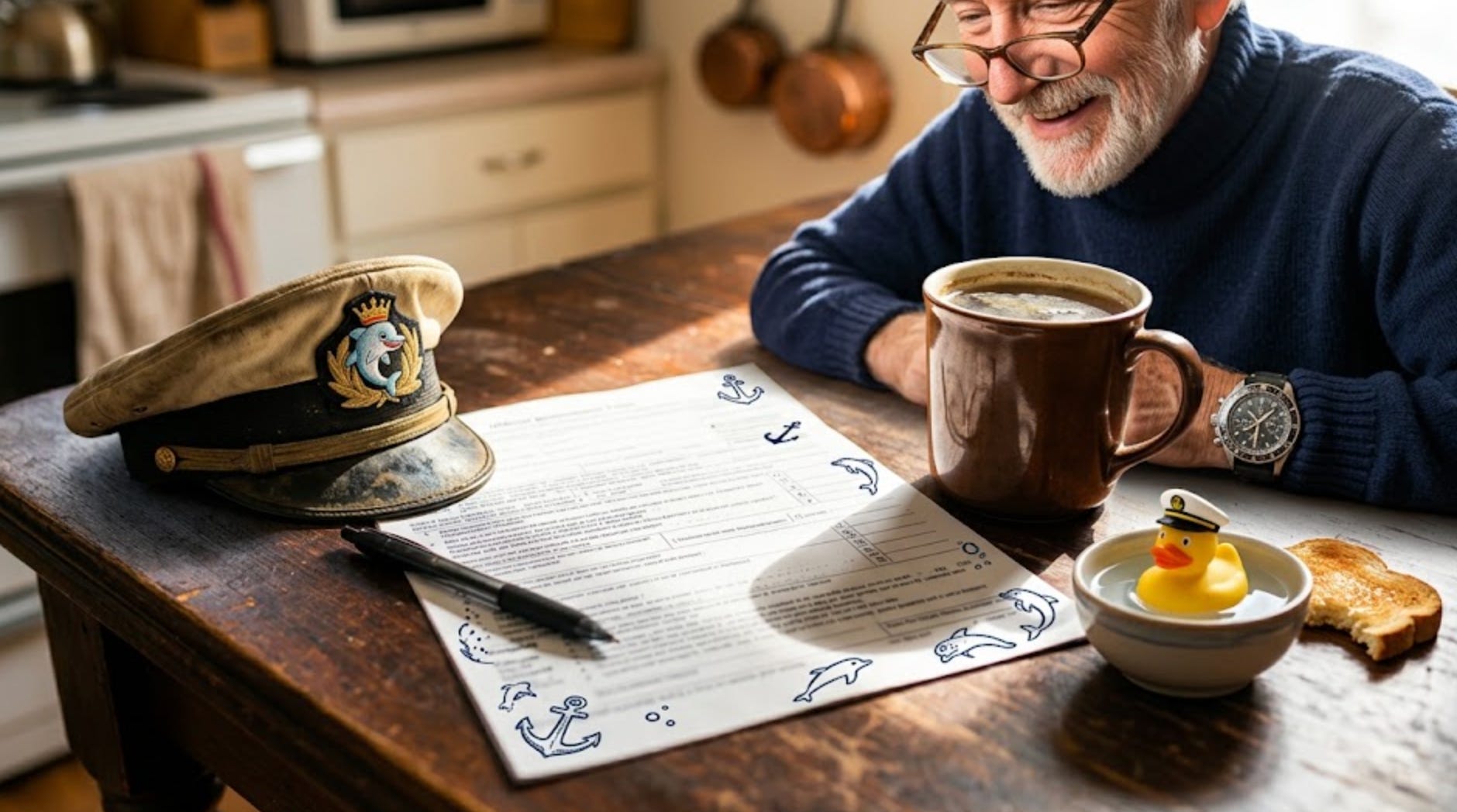
A pension provider I have never met in person, never spoken to on the telephone, and correspond with exclusively through letters written in a font clearly chosen to discourage reading, sent me a form this month whose entire purpose was to establish that I am, in fact, still alive.
Not a birthday card.
Not a "thinking of you."
A "life certificate," they called it, as though I'd applied for the position of being alive and they were still processing the paperwork.
I want to be reasonable about this, because I try to be reasonable about most things, and because the alternative to reasonable is the sort of man who shouts at insurance companies down the phone, which I have become, briefly, twice this month already.
The pension provider's logic, once you dig it out from underneath the officialese, is not actually mad: some small number of pensions genuinely do get claimed by people who are, technically, no longer entitled to claim them, on account of being dead. Fraud happens.
Fine. I accept the premise.
What I do not accept is the method, which requires me to take an actual paper form to an actual other human being — a doctor, a solicitor, a police officer, or, and I am not making this up, a bank manager, which suggests they haven't checked how many bank branches still exist in the North East of England — and have that person write, in their own hand, that they have personally seen me, in the flesh, breathing, on a specified date.
Not photographed.
Not verified digitally.
Witnessed, the way you'd witness a crime, or a wedding, except considerably less fun and with worse biscuits.
I live in a coastal town where the nearest branch of my own bank closed eighteen months ago and has since become, with a kind of grim comic inevitability, a shop that sells vapes and phone cases.
My GP surgery operates a booking system that treats an actual appointment the way most people treat lottery numbers — theoretically obtainable, practically a matter of luck and persistence.
And I am meant to locate a suitably official human being, get them to lay actual eyes on me, and have them sign a form, all so that a computer somewhere can confirm what my heart rate, my council tax payments, and the fact that I am currently typing this sentence, all already prove conclusively.
Here is the part that actually made me laugh, in the specific way that has nothing to do with finding something funny:
the same organisation that requires a witnessed, hand-signed paper form to confirm I exist will happily let me manage the rest of my pension entirely online, through an app, using a password I set myself and a security question about my mother's maiden name that anyone with an afternoon and an internet connection could probably work out.
They trust the app with the money.
They don't trust the app with the fact of me.
I am, apparently, more convincingly real when a sum of money is involved than when the question is simply whether I've stopped breathing.
I rang them.
I want that on the record, because ringing them is itself a small act of heroism these days, involving a hold-music selection that appears to have been curated specifically to make death seem like the more restful option.
I asked, politely at first and less politely by the end, why a photograph of me holding that day's newspaper — a method that would take four minutes and satisfy anyone with functioning eyesight — wasn't acceptable, when a form signed by a bank manager in a branch that no longer exists apparently was.
The young man on the phone, to his credit, sounded genuinely sorry, in the way of someone reading from a script he privately suspects is nonsense.
"It's just the process," he said, and I believed him, which was somehow worse than if he'd tried to defend it.
I found my witness eventually — a solicitor two towns over, a forty-minute round trip, a fee for the privilege of being told I was alive by someone who does this three times a week for people exactly like me, all of us driving forty minutes each way to pay someone to state the obvious.
I sat in her waiting room next to a woman doing precisely the same errand for precisely the same reason, and we had, without either of us particularly wanting to, a full and slightly furious conversation about it, the way you do with a stranger who has arrived at exactly your level of quiet outrage.
If any part of this sounds like your own particular flavour of bureaucratic nonsense, I've written something for exactly this mood — not a solution, because there isn't one, but a genuinely useful way of not letting it eat your whole afternoon: Retiring From Nonsense — A Practical Guide to Stoicism for the Over 60s. It won't get your form processed any faster. It might stop you shouting at a twenty-three-year-old who didn't design the system either.
What I haven't told you yet is what happened when I finally posted the form back — first class, tracked, because I've learned not to trust this particular organisation with anything less — and the letter that arrived three weeks later informing me, with what I can only describe as breathtaking nerve, that the form had not been received.
Keep reading below for what actually happened to that form, the phone call that followed, and the one sentence the second person I spoke to said that finally made the whole thing worth the aggravation.
⬇️ Keep reading for the deeper story — this is the part you shouldn’t miss.
Not everything needs a subscription. If this one stayed with you, you can support it here: Buy me a Yorkshire Tea
Comments
Nothing yet. Say the first thing.
Sign in to join the conversation.