
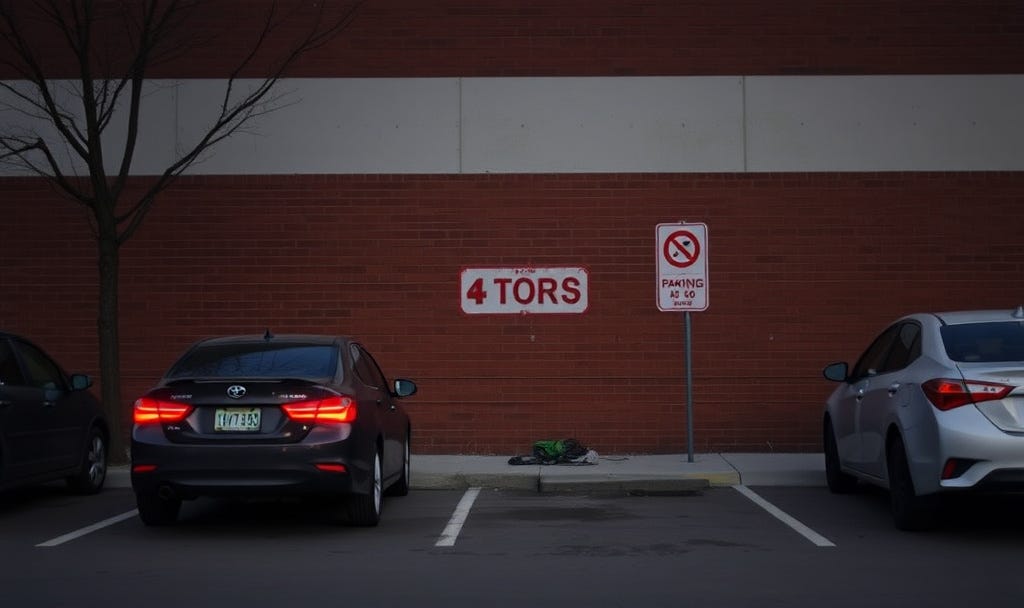
Half past nine on a Tuesday morning, and the car park outside the supermarket is two-thirds empty.
There's a space directly by the door — no queue for it, no scramble, nobody idling behind me with an indicator on, willing me to hurry up and reverse.
It's just there, the way something is there when nobody else wants it.
It took me the better part of a year to stop finding that suspicious.
For forty-odd years I did the food shop the way everyone I worked with did it — Saturday morning, ideally before eleven, in convoy with what felt like every other household within three miles, all chasing the same short list of good bread, decent tomatoes, and whatever had been reduced near the freezers. It wasn't shopping so much as light infantry work. You went in with a plan and a level of politeness that was doing quite a lot of heavy lifting, and you came out having competed, however civilly, for a trolley's worth of the exact things four hundred strangers also wanted that morning.
Nobody tells you it stops. Not abruptly — nobody hands you a certificate. It just quietly becomes optional, and then one Tuesday you notice the car park is two-thirds empty with a space directly outside the door, and something in you that spent four decades circling for parking simply doesn't know what to do with that information.
The bread aisle on a Tuesday is the whole argument, condensed. On a Saturday there are eleven of you reaching for the same shelf, all doing the small silent choreography of not quite making eye contact while quietly resenting one another's proximity to the good loaf.
On a Tuesday there's me, and the loaf, and nobody timing how long I take deciding between them. I have started, I'll admit, deciding rather slowly, purely because I can.
I've caught myself, more than once, treating four unhurried minutes over a loaf of bread as something that needs explaining — to myself, if nobody else is asking.
A man who used to run a bridge watch, standing in an aisle weighing up two loaves purely because he can, looks on paper like a change of some magnitude. I've stopped trying to account for it. Some things don't need accounting for. They just need noticing.
What actually happened, I think, is smaller and stranger than a symptom.
Forty years of institutional time — shift patterns, watch rotations, other people's deadlines dressed up as your own — trains you to treat every errand as something to be won against a clock and against other people simultaneously. You stop noticing you're doing it. The queue becomes a mild adversarial event. The car park becomes a contest. Nobody declared war; you just absorbed the terms.
Retirement didn't announce that this was over either. It just removed the opponent, quietly, while I was looking somewhere else, and left me standing in an aisle on a Tuesday wondering why nobody had warned me that owning your own errands outright would feel this specifically good. It's not a big freedom. It's a very small one, repeated daily, which is possibly the best kind there is.
The tea-spitting bit, if I'm honest, came when I told a former colleague, still working, about the four minutes and the empty aisle.
I expected sympathy, or at least polite interest, and instead watched him go somewhere very far away behind his eyes — the specific stare of a man doing complicated maths about his own pension forecast in real time.
I don't think I've ever felt so accidentally cruel while discussing bread.
If this is the kind of thing nobody warned you about either, I put together the fuller list — The Invisible List: Seven Things Nobody Tells You About Life After Work: Bread not included.
What I haven't told you yet is what happened three weeks later, when I worked out exactly how much of the last forty years I'd spent competing for things nobody was actually rationing — and why the answer sent me back to look at every other queue I've quietly lost since.
Comments
Nothing yet. Say the first thing.
Sign in to join the conversation.