
14,000+ readers. Retirement, the version nobody warned you about.
This is a preview. Paid subscribers get the full story.
You’ll also get:
30 new stories every month
The full archive (500+ retirement & ageing stories)
Your personal retired ship’s captain. Comment, ask questions, DM me anytime
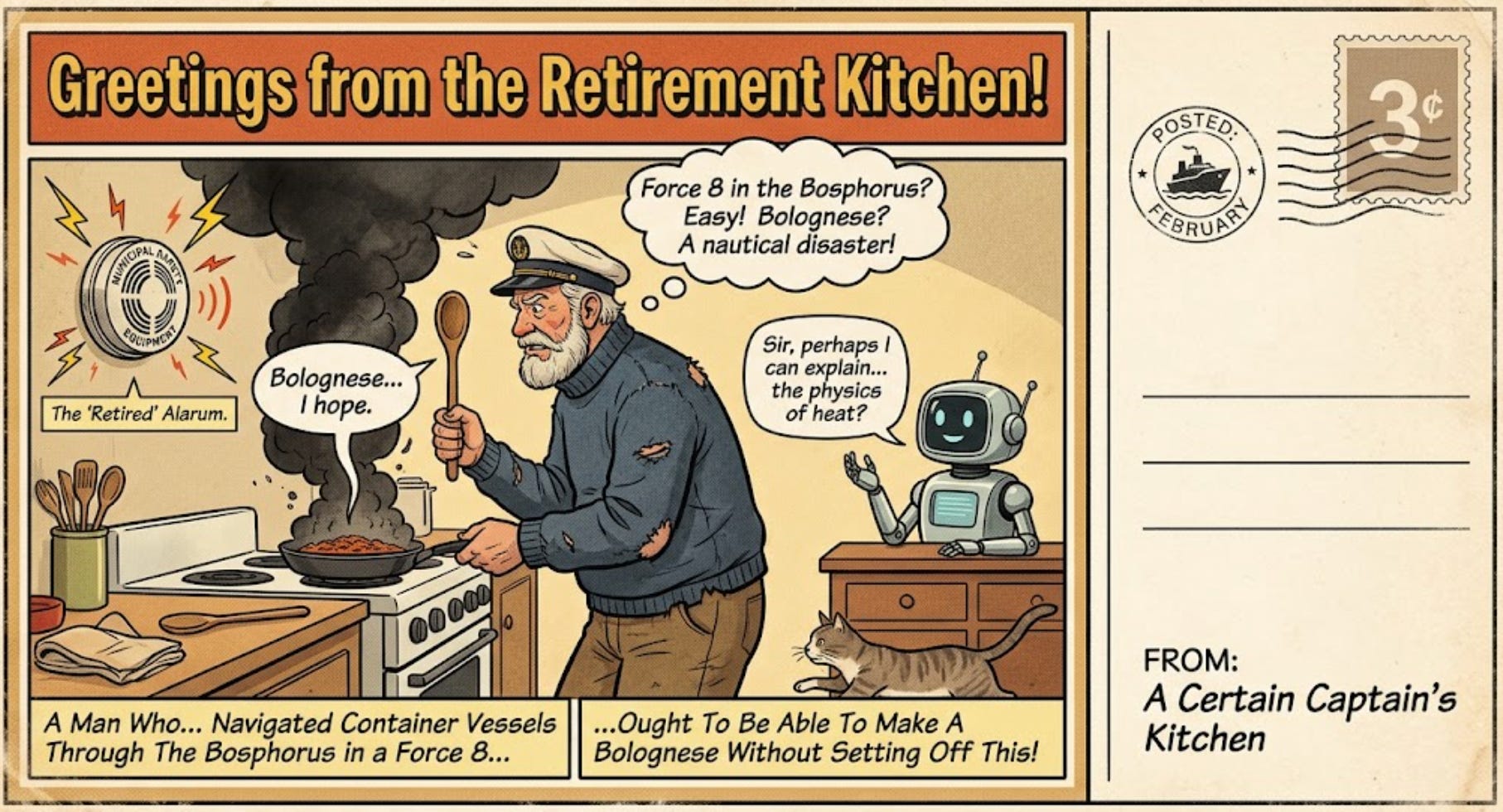
There is a particular kind of silence that follows a smoke alarm going off over a pan of onions, and I have become something of a connoisseur of it. It's not silence exactly — it's the low, patient hum of the extractor fan doing its best, plus the sound of a grown man who commanded ships for the better part of four decades standing in his own kitchen holding a wooden spoon like it might go off.
That was February. I'd decided, somewhere around the third month of retirement, that a man who has navigated container vessels through the Bosphorus in a Force 8 ought to be able to make a bolognese without setting off municipal safety equipment.
I was wrong about that, as it turned out, in the specific and humiliating way you're wrong when you discover a skill everyone else seems to have acquired by osmosis while you were elsewhere. Which, to be fair, I was. I was at sea.
For thirty-eight years, more or less, other people fed me. A galley crew, a canteen, whatever the nearest port could produce at short notice, or — God forgive me — a microwave curry eaten standing up over the sink at two in the morning because the watch had run long and standing felt like the only defensible use of my remaining energy.
So cooking, real cooking, the kind where you understand why you're doing a thing rather than just following an incantation, passed me by entirely. And I want to be clear that this isn't a complaint about the sea — I loved the sea, mostly, and it gave me things a kitchen never could — but it does mean I arrived at retirement as a sixty-seven-year-old man who could plot a great circle route across the Atlantic and could not, with any confidence, tell you why you're supposed to let a steak sit for ten minutes before you cut into it.
I tried the normal routes first. Cookbooks, which assume a baseline of knowledge so enormous that reading one felt like being handed a manual in a language I'd once vaguely heard spoken in another room. Television chefs, who are lovely people I'm sure, but who explain a technique once, at speed, while also talking about their nan, and then move on forever.
And well-meaning people — a neighbour, a woman at church, my daughter — all of whom know how to cook the way you know how to walk, which is to say they've completely forgotten there was ever a stage where they didn't, and so their advice arrives as "well, you just fold it in," delivered with the same baffled kindness you'd get asking someone to explain how they blink.
Nobody had ever explained why.
Why you rest meat.
Why you salt the water before the pasta goes in and not after.
What "fold" actually means as an action, as opposed to a word people say while making a vague gesture with a spatula and expecting you to intuit forty years of accumulated kitchen instinct from it.
I didn't want a recipe.
I wanted the physics.
Ships make sense to me because someone, at some point, explained the physics.
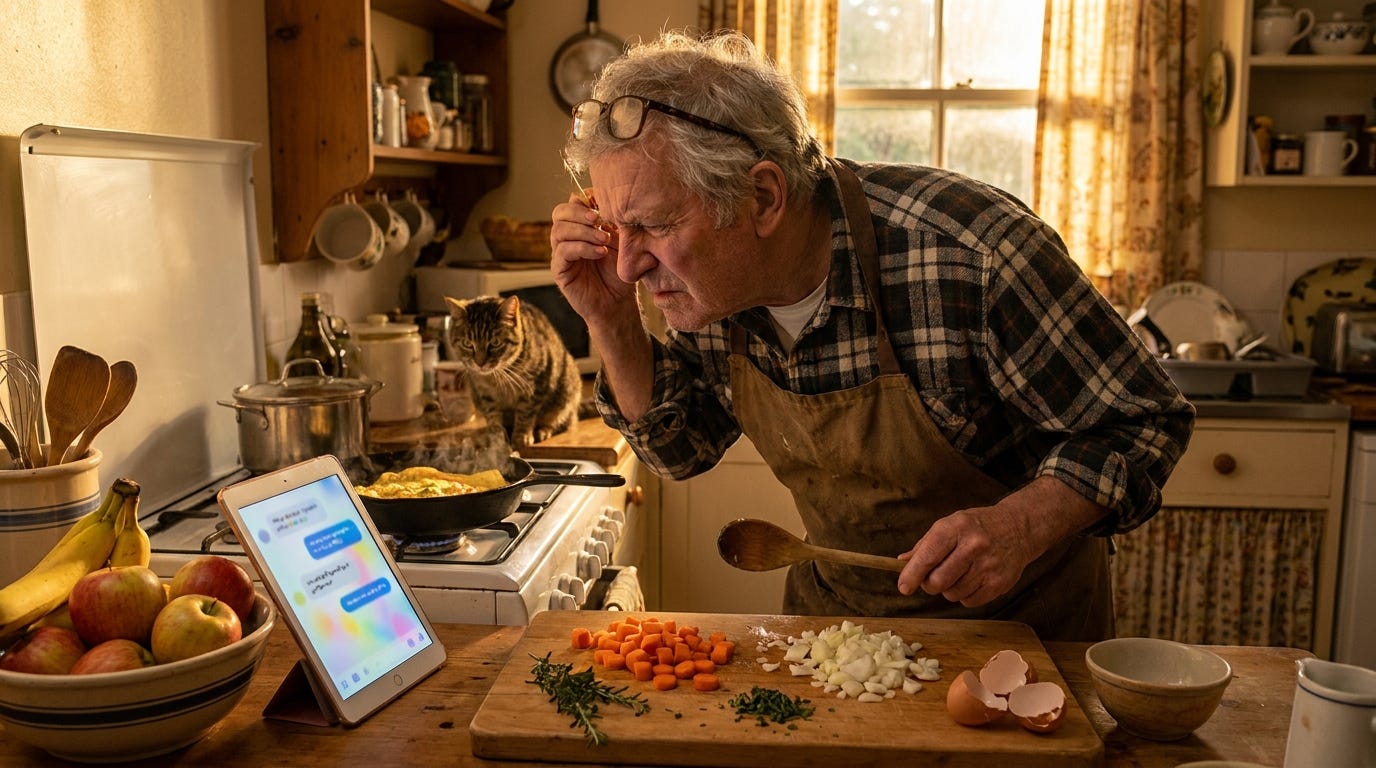
So one night in March, slightly ashamed of myself, I opened one of these AI chatbots everyone keeps talking about and typed, essentially, "why do you have to let meat rest, I am not a child, I would just like to understand it," and it told me.
No sigh. No "well, you just."
An actual explanation, patient as you like, about resting allowing the muscle fibres to relax and reabsorb the juices that heat has driven towards the surface, so that when you finally cut in, the moisture stays in the meat instead of flooding straight out onto the board. Cut too soon and you're essentially watching your dinner leave in a hurry.
I sat there for a moment feeling something I hadn't expected, which was faintly foolish and enormously grateful at the same time, in roughly equal measure, which I gather is a very common way to feel about learning something at sixty-seven that you feel you ought to have known at twenty-two.
That was the first lesson. What came after — weeks of asking the same question four different ways, a granddaughter who caught me out over a béchamel, and the strangest sentence I’ve said in years, “I actually knew” — is where it gets interesting.
Paying subscribers get the rest: the deglazing lesson that finally explained six weeks of ruined meringues, why failing at a leek all Tuesday afternoon turned out to be one of the real gifts of retirement, and the moment nine-year-old Addie looked at me with something other than tolerant disappointment. Subscribe here if you want the whole of it.
Everything above is free. Everything below is for paying subscribers — and if you'd rather not, some readers just buy me a Pot of Yorkshire Tea. I’m English and run my days on tea. It’s one of the ways I keep this work independent.
Comments
Nothing yet. Say the first thing.
Sign in to join the conversation.