
10,000+ readers. Retirement, the version nobody warned you about.
This is a preview. Paid subscribers get the full story.
You'll also get:
30 new stories every month
The full archive (500+ retirement & ageing stories)
Your personal retired ship's captain. Comment, ask questions, DM me anytime
It was the second Wednesday in April this year, twenty-five minutes past seven in the evening, and I know the time precisely only because I'd checked my watch every ninety seconds since quarter to, the way you check a barometer before you trust the weather.
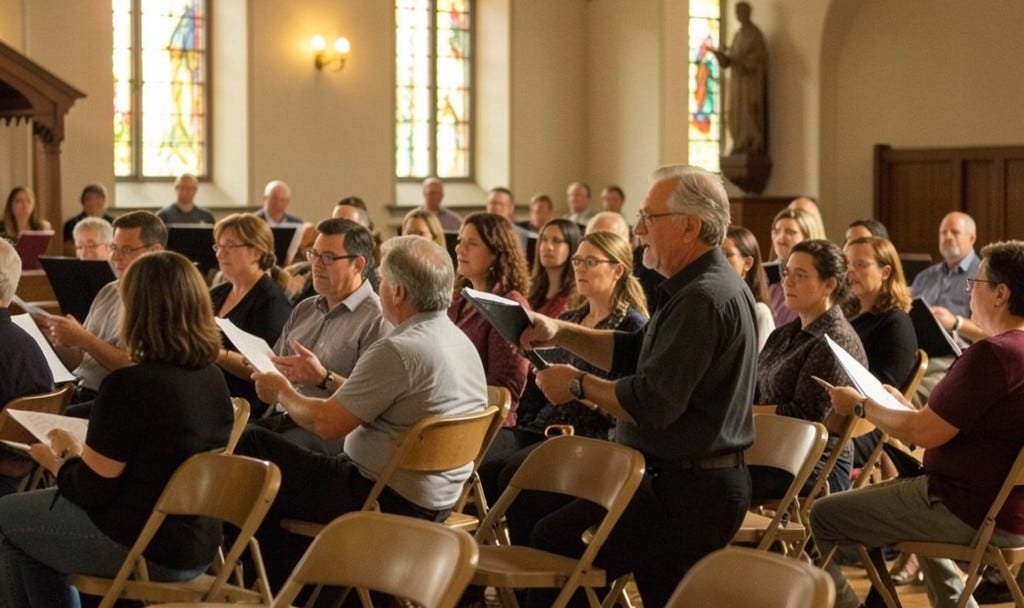
St Aidan's church hall smells of instant coffee, damp coats, and a floor polish applied by someone with a genuine grudge against dust, and underneath all of that, faintly, of eighty people's hairspray and aftershave converging on one room with a low ceiling and acoustics built, apparently, for maximum unforgiving clarity.
There is a particular kind of silence that happens when eighty people stop singing at once and you are the only one still going.
It isn't really silence, of course — someone always titters, a chair creaks, Eileen's biro clicks against her clipboard like a full stop — but it feels like silence, and it lasted, by my reckoning, about four years, though the church clock at the back insists it was closer to four seconds.
I'd come in a full bar early. Not half a beat early, which any reasonable choir would forgive, but a full measure, arriving at "and the tide will turn for—" while the rest of the tenors were still politely waiting their cue, like a man walking into a minute's silence with a party popper. Eighty faces turned. Eileen didn't turn, particularly, she just raised one eyebrow about four millimetres, which in choir terms is the equivalent of a foghorn.
I can still feel it in my chest when I think about it, which tells you something about how much of ageing is not forgetting the mortifying things but simply acquiring more of them to keep the old ones company.
I should explain that I have been told, consistently, by every teacher, shipmate, and every unfortunately honest crewmate I have ever sailed with, that I cannot sing.
Not "needs practice."
Not "an acquired taste."
Cannot sing, full stop, the way a kettle cannot recite poetry.
My voice has been compared, over the decades, to a foghorn with a head cold, to a seagull that has just discovered betrayal, and once, memorably, by a bosun in Rotterdam, to "a man being slowly informed of bad news through a tuba."
I took these as data points.
I filed them under Things I Am Not, alongside ballroom dancing and understanding cricket, and I got on with a career where the only singing required was the occasional off-key rendition of Happy Birthday in a mess room, which nobody could hear over the engines anyway, mercifully.
I'd sat in the car park for eleven minutes before going in, which is not a habit I'm proud of at sixty-eight but is, I'll admit, one I've kept since my very first command, when I did much the same thing outside the harbourmaster's office.
Eleven minutes is long enough to talk yourself out of most things and just short enough that you still, technically, go in anyway. I watched three people go through that door ahead of me — a woman wrestling a tartan flask the size of a fire extinguisher, a man in a flat cap carrying what I can only describe as a suspiciously large trumpet, and somebody's dog, entirely unaccompanied, trotting in with the easy confidence of a regular.
If the dog could manage it, I decided, so could a man with fifty years of command experience currently sitting in a Jaguar losing an argument with himself.
Then I retired in June last year, and somewhere around the third month of having nowhere to be and nobody requiring me to make decisions about anything more consequential than what to have for lunch, I saw a poster in the library. COMMUNITY CHOIR, WEDNESDAYS, ALL WELCOME, NO EXPERIENCE NECESSARY.
I stood in front of that poster for a worryingly long time. Long enough that the librarian asked if I was alright. I said I was just reading, in the tone of a man who has been caught doing something faintly disgraceful, which, in a library, reading generally isn't, so that tells you where my head was at.
What the poster didn't mention, and what nobody ever tells you about that particular stage of retirement, is how loud a decision that small can feel. COMMUNITY CHOIR, WEDNESDAYS, ALL WELCOME, NO EXPERIENCE NECESSARY sounds, on paper, like the least threatening sentence in the English language. Standing in front of it, though, I found myself running the same risk assessment I used to run before taking a ship out in poor visibility — what could go wrong, how badly, and could I live with it if it did. The honest answers were: quite a lot, not very, and yes, probably, eventually, once the ringing in my ears stopped.
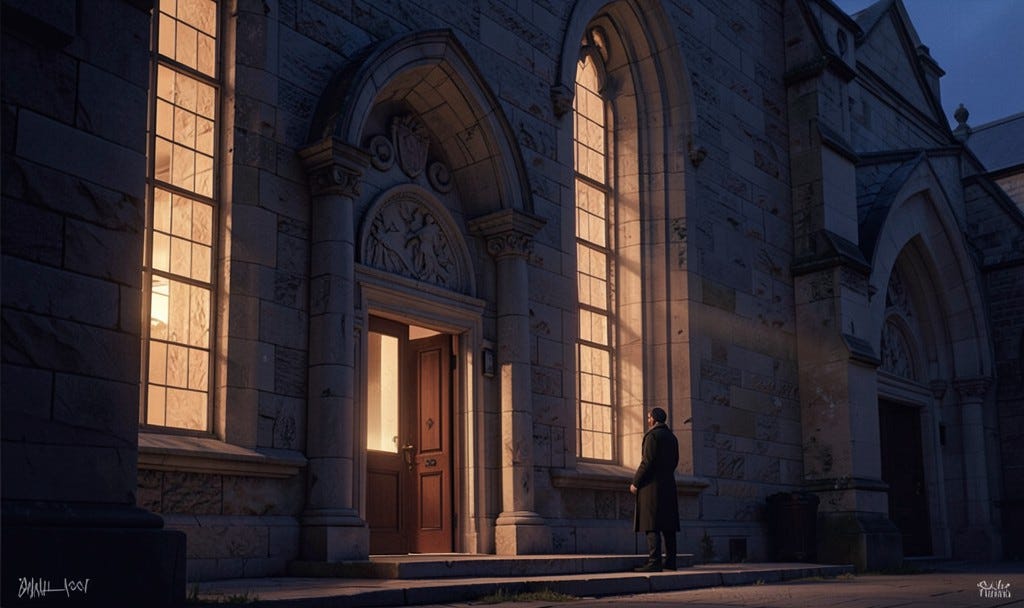
I joined anyway. This is the part where I'm supposed to tell you I did it out of some blaze of post-retirement courage, a man determined to seize the day, but honestly it was closer to a dare I made with myself on a slow Tuesday, the kind of dare that seemed sensible at 4pm and considerably less sensible at 6.55pm on the Wednesday, standing outside the church hall listening to eighty strangers warming up like a flock of geese being audited.
What happened once I actually walked through that door is the whole reason I'm telling you any of this — because four bars into my very first solo entry, I proved every one of those shipmates and harbour pilots entirely correct, in front of eighty witnesses.
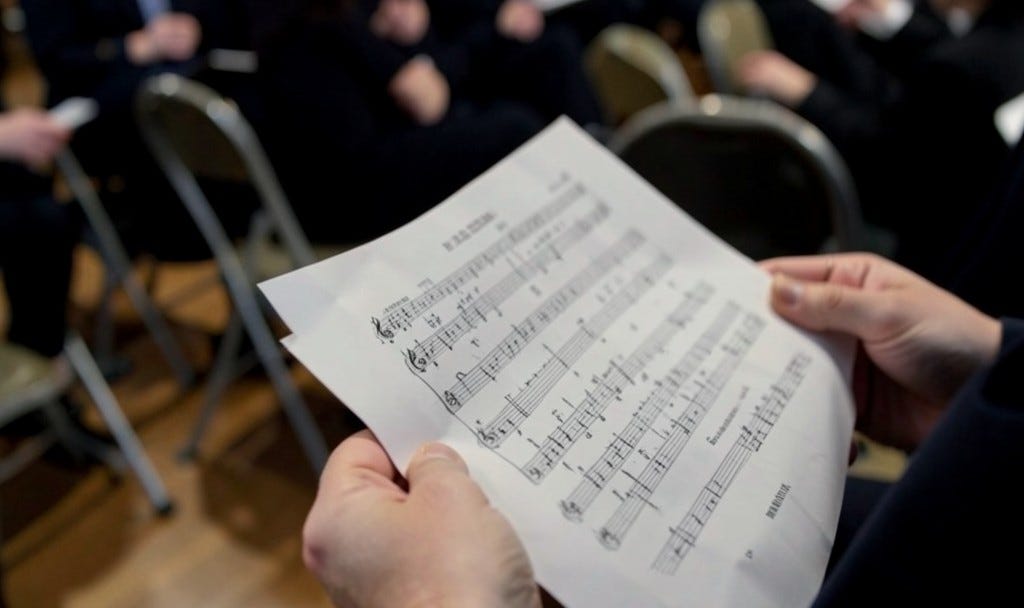
Inside, it was worse and better than I'd expected in roughly equal measure. Eighty-odd chairs in loose rows, a photocopied sheet of music warping slightly in someone's damp hand, and at the front, a woman I would later learn was called Eileen, conducting nothing yet but somehow already commanding the room the way a good bosun commands a deck — not by volume, but by the simple fact that everyone had decided, independently, to do what she said.
The tenor next to me, a retired postman with a magnificent moustache and no discernible nerves, leaned over before we'd sung a note and said, 'First time? You'll be grand.
Nobody remembers anybody's first rehearsal except the poor sod having it.'
He was, it turned out, entirely wrong about that particular prediction, at least in my case.
What I didn't tell the tenor, and what I've never really told anyone, is exactly why being bad at something in public, in front of eighty strangers, should matter so much to a man who spent four decades being professionally, unforgivingly good at things where the stakes were rather higher than a wrong note — and why one particular watch, on one particular night, thirty-odd years ago, is the real reason I stayed in that hall instead of walking straight back out to the Micra.
Comments
Nothing yet. Say the first thing.
Sign in to join the conversation.