
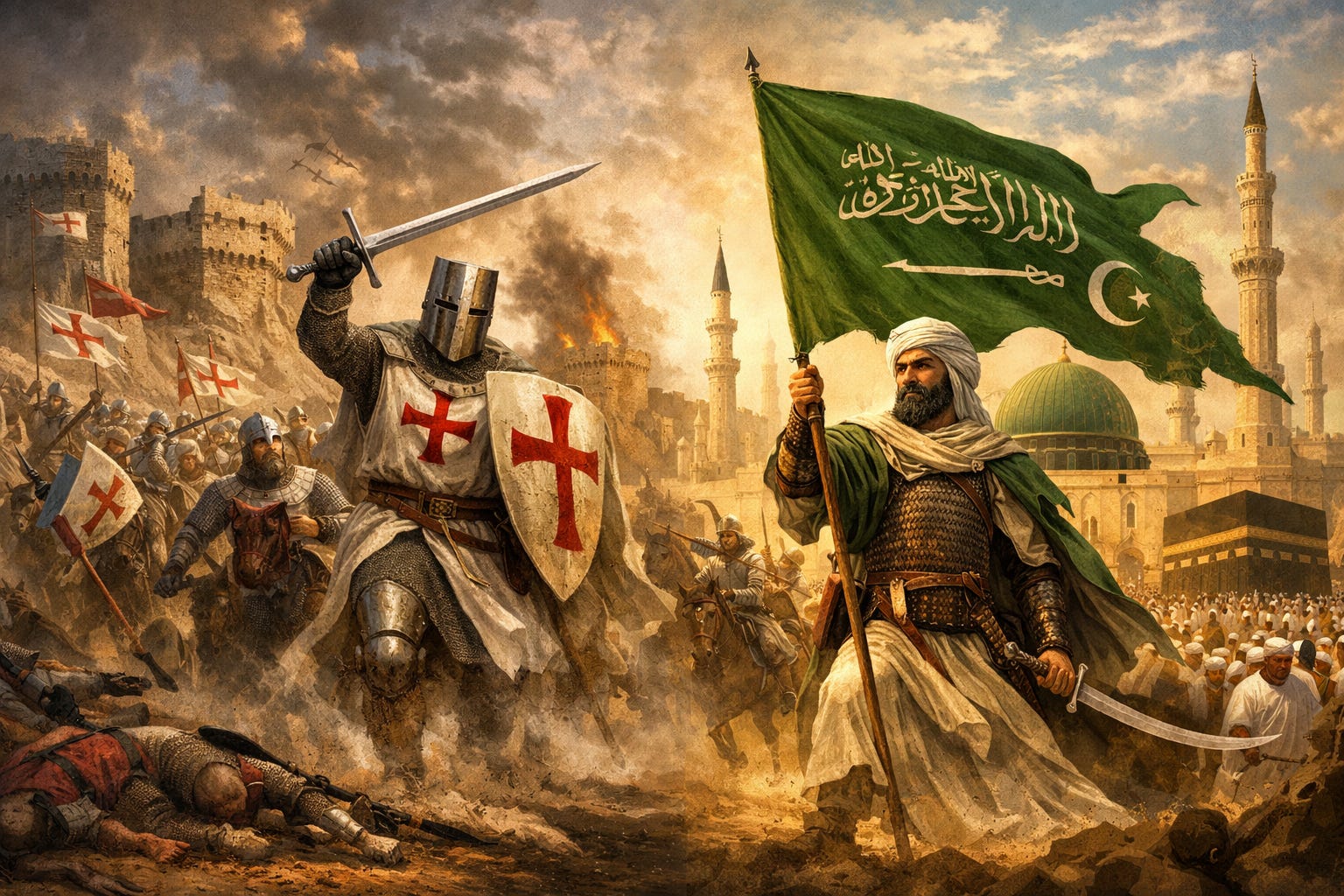
A recent video, bringing perspective on the historical Christian Crusades in response to the expansion of Islam has gone viral on social media. This article assesses and transcribes concepts from this video:
The First Crusade, launched in 1095, did not emerge out of nowhere. It followed roughly four centuries of relentless pressure on Christian lands. From the 630s onward, Muslim armies had systematically conquered vast swathes of what had once been Christian territory—North Africa, the Levant, Palestine, Egypt, Syria, Sicily, and parts of Spain. By the late 11th century, Muslim forces had taken control of about two-thirds of the Christian world, leaving the Byzantine Empire and Western Europe as the last major holdouts.
This expansion came with documented violence: church burnings, mass murders, enslavement of Christians, and forced conversions. Pilgrims traveling to Jerusalem faced increasing danger, and the Byzantine Emperor Alexios I Comnenus appealed directly to the West for aid against the Seljuk Turks closing in on Constantinople. Pope Urban II answered by calling for a holy expedition—not to start a fight, but to reclaim lost ground and protect the faithful.
The claim that “Islam is not a religion of peace” rests partly on its texts. The Quran contains 109 verses that instruct Muslims to fight non-believers in pursuit of Islamic rule. Some are stark: Surah 8:12, for example, commands striking “their necks” and “fingertips”—a graphic order from the Battle of Badr, aimed at enemies in active combat. Elsewhere, Surah At-Tawbah (9:68, 73) warns that Muslims who refuse to join the fight—labeled “hypocrites”—will be sent to Hell by Allah if they shirk the slaughter.
This pattern isn’t confined to history. Islam remains the world’s fastest-growing major religion. From 2010 to 2020, the global Muslim population surged by 347 million—from 1.7 billion to 2.0 billion—a 21% increase, twice the global average. By 2020, Muslims made up 25.6% of the world’s people, up from 23.9%. Growth came fastest in North America (up 52%) and sub-Saharan Africa (up 34%), driven by high birth rates and migration.
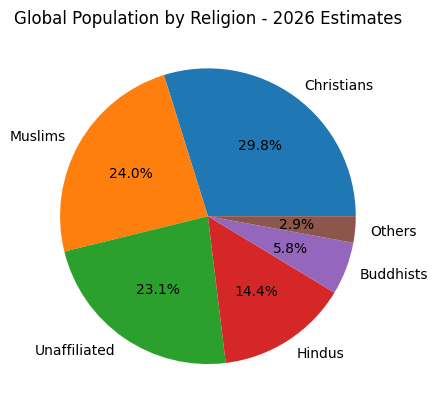
As of February 17, 2026, the global Muslim population stands at approximately two billion—around 2.06 billion by real-time estimates. That makes Islam the second-largest religion worldwide, behind Christianity. The world population today sits at about eight point three billion (roughly 8.3 billion), so Muslims represent over a quarter of humanity—and still growing fastest. Projections say they’ll nearly catch Christians by mid-century.
Here’s an original pie chart breaking down the stats (2026 estimates):
[Imagine a clean pie chart: Christians 31% (blue), Muslims 25% (orange), Unaffiliated 24% (green), Hindus 15% (red), Buddhists 6% (purple), Others 3% (brown). Title: Global Population by Religion - 2026 Estimates]
In Europe, the Muslim share climbed to 6% by 2020—up 0.7 points in a decade—thanks to immigration. Projections suggest it could hit 7-14% by 2050 depending on migration levels. In the US, estimates put Muslims at around 4 million (about 1.2%) as of 2025, with steady increases from both births and arrivals.
Though it can be argued that not all Muslims are violent or radical, the fact remains, 100% of Islam, according to its principles, is incompatible with the United States constitution and our Judeo-Christian foundational values.
The original speaker argued history is repeating: millions of Muslim men of fighting age now cross into Western nations—seen not as migration, but invasion. They frame it as a holy war Islam began, one it never truly ended, and one it will ultimately lose. The cross, they say, will never break—though the drive to break it remains.
Whether viewed as defense or conquest, the First Crusade arrived after centuries of loss. The numbers and dates align: two-thirds of Christian lands gone by 1095, violence on record, and a scripture that still calls for war—now backed by a population exploding toward billions.
Oklahoma voters approved State Question 755 on November 2, 2010, by over 70 % of the vote.
The measure was written to amend the state constitution to ban the use of Sharia law and international law in Oklahoma courts, even though there had been no known cases where such law was used here; it was pitched by proponents as a “pre‑emptive” action.
Shortly after the vote, Muneer Awad, then executive director of the Council on American‑Islamic Relations (CAIR) Oklahoma, filed a lawsuit (Awad v. Ziriax) challenging SQ 755, arguing it violated religious freedom and the U.S. Constitution’s Establishment Clause by targeting Islam.
A federal judge issued a preliminary injunction in November 2010 that blocked the state from certifying the amendment’s results and prevented it from going into effect while litigation continued.
The U.S. Court of Appeals for the Tenth Circuit unanimously upheld the lower court’s decision blocking the anti‑Sharia amendment, agreeing it likely violated the Constitution and noting the state couldn’t point to any actual problem it was solving.
After SQ 755 was blocked, some state legislators, including Republican Rep. Sally Kern, introduced bills (e.g., House Bill 1552) aimed at banning “religious and foreign law” in courts.
These efforts passed the Oklahoma House of Representatives but failed to become law in the Senate.
Certain legislators, including John R. Bennett, were involved in creating anti‑“foreign law” legislative caucuses and circulated claims linking Islamic organizations to broader security threats — moves criticized by civil liberties and Muslim advocacy groups as discriminatory.
CAIR Oklahoma continued efforts to monitor and oppose anti‑Sharia measures at the state capitol, arguing such measures stigmatize Muslims and undermine constitutional protections.
A proposed mosque project by the Islamic Society of Tulsa was denied rezoning approval by the Broken Arrow City Council after public debate that included anti‑Muslim rhetoric from some speakers and statements of concern about Islam’s compatibility with U.S. norms.
Critics said anti‑Muslim sentiment influenced the outcome; the mosque leaders are considering legal action, including under federal anti‑discrimination law.
State Rep. Gabe Woolley filed House Joint Resolution 1040, aiming to revive a constitutional amendment banning Sharia law in Oklahoma courts — essentially a renewed attempt at what SQ 755 sought in 2010.
Woolley framed it as a defense of constitutional liberties, though opponents see it as targeting a religious minority.
Oklahoma State Senator, David Bullard is expected to soon file SJR3636 (2026), a measure aimed at banning foreign law from being recognised in Oklahoma.
Other efforts to combat foreign influence in Oklahoma consist of Senator Julie McItosh’s SB1784, Senator Bergstrom’s SB 1486, and Senator Warren Hamilton’s SB1679, SB1672, & SB1963.



This is an editorial article based on a combination of opinions, research, and personal experiences.
Like & Follow The Oklahoma Lion Media On Facebook and Twitter / X
Comments
Nothing yet. Say the first thing.
Sign in to join the conversation.